By Sam Piha
For the past decade we have been promoting the use of mindfulness activities in afterschool to address the needs of youth participants and the self-care of youth workers. Integrating mindfulness activities into youth programs to benefit young people and educators has been a very popular educational concept. It appears in the literature on emotional regulation, trauma-informed practice, social emotional learning, grief-responsive teaching, and other leading topics.
Youth who engaged in mindfulness activities report a greater sense of optimism and well-being, and a reduction in depression, anxiety, stress, and anger. They also benefit academically. Mindfulness activities are also a valuable “self-care” strategy for teachers and afterschool staff, and these activities can be tailored to be used in staff meetings.
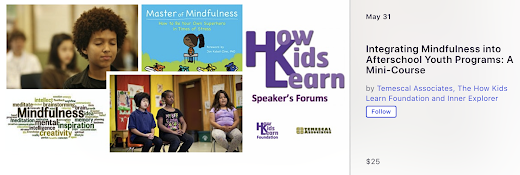
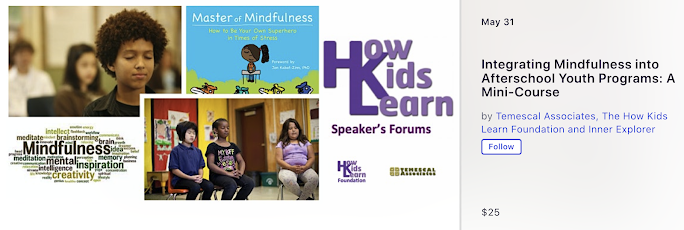
On May 31st we are hosting a zoom/ mini-course on integrating mindfulness activities into afterschool youth programs. To learn more and register, click here.
We also recommend Mindfulness in Afterschool, a curriculum written by Temescal Associates. Temescal offers customized training on mindfulness for afterschool leaders. For more information on these resources, write to info@temescalassociates.com.
Below we share some comments from a mindfulness leader, Laurie Grossman (Inner Explorer) and educators, Allison Haynes (Riverside County Office of Education), Ken Dyar (Delano Union School District) and Dr. Katarina Roy Schanz (Riverside Unified School District). Each of them has promoted mindfulness techniques at the school and district level and their responses below are from previous LIAS interviews.
Q: CAN YOU BRIEFLY DESCRIBE WHAT MINDFULNESS IS?
 |
| Laurie Grossman |
Laurie Grossman (LG): Mindfulness is awareness of the present moment without judgment. Many of us miss a lot of our lives because we live in the past or the future; we spend most of the time in our heads reliving what has already happened or worrying about what is going to happen. By practicing mindfulness, one learns to live more often in the present moment; benefitting from what is actually occurring right now. One of the most common ways to practice mindfulness is to focus on the breath as an anchor to the present.
Dr. Jon Kabat-Zinn founded Mindfulness Based Stress Reduction (MBSR) in 1979 at the University of Massachusetts Medical Center. Those benefits as described by the MBSR website include:
- Lasting decreases in physical and psychological symptoms
- An increased ability to relax
- Reductions in pain levels and an enhanced ability to cope with pain that may not go away
- Greater energy and enthusiasm for life
- Improved self-esteem
- An ability to cope more effectively with both short and long-term stressful situations.
Q: WHY IS MINDFULNESS EFFECTIVE WITH YOUNG PEOPLE?
LG: Mindfulness lessons are interactive, short and impactful. When teaching mindfulness, we are teaching children about themselves; the curriculum is relevant to them and therefore engaging. Students tell us they can concentrate more easily on their schoolwork, they can calm themselves down, and they feel less stress. The benefits of mindfulness occur rather quickly, students feel better as a result and they enjoy the practice.
The very first lesson we offered in an Oakland public school resulted in this comment from a third grader, “I think if we do this every day we won’t fight anymore.” I was stunned because the school was one where violence in the community was common.
 |
| Ken Dyar |
Ken Dyar (KD): Children living in poverty or in unhealthy environments are under constant, unending stress. Is it any wonder that they struggle to self-regulate, or attend to a school lesson? In an afterschool program, we are extending their learning day until 6 pm, five days a week. Mindfulness is the perfect way to do this, in my opinion. Additionally, it is a practice that the kids can extend to their lives outside of school. It is a life skill.
Q: WHAT BENEFITS DO YOU BELIEVE MINDFULNESS BRINGS TO YOUNG PEOPLE?
KD: Stress management, regulating behavior, lowering blood pressure, increasing positiveness, increasing hopefulness, empowering youth to feel that they are in control of themselves. It develops a growth mindset in kids. It gives them a tool to move them forward emotionally and therefore academically.
Q: DO YOU BELIEVE THAT MINDFULNESS IS APPROPRIATE FOR ALL AGE YOUTH?
 |
| Allison Haynes |
Allison Haynes (AH): YES. Why not? Why would we arbitrarily choose a number and determine that until one reaches that age, they are restricted from engaging in a practice that includes benefits such as relaxation, self-regulation of emotions, self-awareness, and compassion for others?
KD: I do believe that mindfulness is appropriate. I have introduced it to my eighth graders this year. Students in middle school are truly "stuck in the middle." Anyone who has worked with middle school students will tell you that these kids are both babies and adults. They need a tool like mindfulness to manage the swings in mood and emotion. I also believe that educators who use mindfulness with their students will enhance the relationships they have with their kids. Sharing mindfulness with my students has certainly proven to them how much I care about them.
Q: WHAT BENEFITS DO YOU BELIEVE MINDFULNESS BRINGS TO ADULT STAFF?
AH: Mindfulness provides immediate feedback to adult staff. Taking a breath while letting the thought pass is indeed helpful when your inner voice is shouting doom and gloom. Interrupting the critical voices in one’s head allows a pathway for creative thinking (which is always necessary for afterschool program adult staff). But engaging in a practice before arriving to engage youth is most valuable because it is during that time that intentions can be set, loving kindness administered, and a stronger connection to compassion forged.
Q: WOULD YOU RECOMMEND MINDFULNESS TO OTHER AFTERSCHOOL LEADERS?
AH: YES. I’d recommend mindfulness to other afterschool leaders because a practice is good self-care. Additionally, I know afterschool leaders are role models who can’t give what they don’t have. I say, give them what they need and watch it spread.
KD: When I share mindfulness with my kids, one comment I always hear at the beginning is that it is "weird." It's weird because no other teacher they've had has ever shared this with them. Taking a moment to do a body scan, be grateful, be in the moment, etc., is completely foreign to them. It is my wish that mindfulness becomes such a regular part of education that it is never considered "weird" anymore. I wish every teacher on my site spent time using mindfulness with their students. I would certainly recommend the practice to any leaders involved in educating our youth.
Q: WHY ARE YOU TEACHING MINDFULNESS TO SCHOOL DISTRICT STAFF?
 |
| Dr. Katarina Roy Schanz |
Dr. Katarina Roy Schanz (KRS): The primary target group for this mindfulness training are our Student Assistance Program (SAP) Counselors and SAP Behavior Support Teams. Additionally, adding mindfulness to their self-care practice will help the team both personally and professionally. We’re hoping that by implementing a mindfulness practice, we will see decreases in anxiety and improvements in self-awareness and social-emotional skills, among other positive changes.
Laurie Grossman is the Director of Social Justice & Educational Equity for Inner Explorer. She cofounded Mindful Schools in 2007. With Angelina Alvarez Manriquez and 4th & 5th grade students at Reach Academy in East Oakland, California, she wrote Master of Mindfulness: How To Be Your Own Superhero in Times of Stress & Breath Friends Forever.
Allison Haynes is the Administrator of Pupil and Administrative Services at the Riverside County Office of Education. She has worked in the field of education for 25 years, with the last five focused on Expanded Learning Programs. Her experience ranges from working with elementary, middle school, and high school students as a school counselor and/or a site administrator.
Ken Dyar was named a California Teacher of the Year in 2006. He is currently a Physical Educator at the Delano Union School District. Prior to this assignment, he was Director of Physical Education and After School Programs, including DUESD's afterschool programs. Ken has taught for over 18 years, teaching 3rd, 4th, 6th, 7th and 8th grades.
Dr. Katarina Roy Schanz is the Coordinator of the Student Assistance Program with Riverside Unified School District. Dr. Roy Schanz has been an educator for 21 years. She has served as a school counselor, assistant principal, and principal.