Showing posts with label staff self-care. Show all posts

Monday, February 9, 2026

Ensuring That Program Staff Are Ready to Address Youth Mental Health Issues

Source: www.pexels.com

By Sam Piha

AFTERSCHOOL PROGRAMS CAN HELP

Youth afterschool programs are uniquely positioned to help because they reach young people in informal, trusting environments that often feel safer than school or home. “Research shows that high-quality afterschool programs contribute significantly to positive mental health outcomes, including improved interpersonal skills, self-control, and reduced externalizing behaviors. They offer a vital ‘spectrum of care’ that complements formal education and family support systems.” [i] 

According to the Afterschool Alliance, “Afterschool and summer programs play an essential role in supporting the healthy development of young people by serving as a safe space that fosters belonging, develops supportive relationships with peers and adult mentors, encourages healthy behaviors, and helps young people build and cultivate the skills necessary to navigate through the struggles and challenges they may come up against in life.” [ii] 

“After-school programs are also another place where kids have the opportunity to have ‘healthy interactions’ with each other and with adults. For example, some programs have brought in mental health professionals to work with students’ emotional needs.” [iii]  

Chat GPT writes, “Here’s a clear, research-based overview of how youth programs can help address the mental health crisis:

1. Create Supportive, Trust-Based Environments

  • Build belonging and connection — consistent relationships with caring adults buffer against anxiety and depression.
  • Train staff in trauma-informed practices so they recognize stress reactions and respond with empathy, not punishment.
  • Normalize mental health talk by incorporating check-ins, ‘feelings boards,’ or ‘wellness circles’ into regular activities.

2. Promote Emotional Literacy

  • Integrate social-emotional learning (SEL) — teach youth to identify emotions, manage stress, and resolve conflict.
  • Use games, art, journaling, or storytelling to help youth process emotions safely.
  • Provide short workshops on coping skills (e.g., breathing, mindfulness, self-talk).

3. Early Identification and Support

  • Train staff to notice signs of distress (withdrawal, irritability, sleep or appetite changes).
  • Establish clear referral pathways to local mental health providers or school counselors.
  • Partner with mobile crisis teams or mental health nonprofits for on-site consultation days.

4. Strengthen Family and Community Connections

  • Host family nights to share mental health resources and communication tools.
  • Partner with schools, clinics, and local organizations to create a continuum of care.
  • Encourage mentorship: consistent one-on-one relationships reduce loneliness and self-harm risk.

5. Foster Purpose, Mastery, and Joy

  • Provide creative outlets (music, art, dance, theater, sports) — shown to reduce depressive symptoms and improve mood.
  • Offer youth a chance to lead projects or volunteer; helping others boosts self-esteem and hope.
  • Integrate movement and outdoor time — both improve mood regulation and stress resilience.

Source: Temescal Associates

6. Train and Support Staff (see more below)

  • Youth workers often experience ‘secondary trauma.’ Build in staff wellness practices and peer support.
  • Provide professional development on: De-escalation and crisis response, Culturally responsive care, Suicide prevention (e.g., QPR or safeTALK training)

7. Advocate and Educate

  • Join local coalitions for youth mental health.
  • Advocate for funding and policies that increase access to counseling and youth development opportunities.
  • Include youth voice in shaping program priorities — feeling heard is itself protective.” [iv] 

“Afterschool programs support youth mental health by providing a safe and structured environment, offering access to caring adult mentors, and fostering vital social-emotional skills.”[v] 

Best practices for afterschool programs addressing the youth mental health crisis also include,

QUALIFICATIONS FOR AFTERSCHOOL PROGRAM STAFF WORKING WITH YOUTH WHO MAY HAVE MENTAL HEALTH ISSUES? 

It is important that program leaders consider the qualifications that their staff need. According to Chat GPT, “Afterschool program staff who work with youth mental health typically have diverse qualifications, ranging from formal degrees to specialized training and certifications. The specific requirements depend on the staff member's role and the services offered. At a minimum, staff should possess strong social-emotional skills like compassion and patience. 

Foundational Qualifications and Skills
According to Google AI, some foundational qualifications needed by afterschool staff working with youth who may have mental health issues are,

  • Educational Background: While not all positions require a degree in a specific field, a background in child psychology, social work, human services, or education (often at the bachelor's level for entry-level positions and master's for supervisory or clinical roles) is highly valued.
  • Experience: Prior experience working with adolescents or children in an urban or diverse environment is often preferred.
  • Core Competencies: Essential soft skills include:
    • Patience and Compassion: Working with youth facing challenges requires a calm and understanding demeanor.
    • Strong Interpersonal and Communication Skills: The ability to build rapport and communicate effectively with youth, families, and a multidisciplinary team is crucial.
    • Active Listening: The capacity to genuinely listen and pick up on verbal and non-verbal cues is essential.
    • Cultural Competence: The ability to work effectively and respectfully with people from diverse backgrounds is a key requirement.
    • Creativity and Problem-Solving: Using creative approaches to engage youth and find solutions to challenges.” [vi]  

SPECIALIZED STAFF TRAINING FOR MENTAL HEALTH SUPPORT

Even though afterschool staff may have personal attributes that will help them address youth mental health issues, it is important that they also receive specialized training. Below are trainings for afterschool staff on the topic of recognizing and responding to youth mental health issues taken from Google AI:

  • Youth Mental Health First Aid (YMHFA): This is a research-based training that teaches staff to recognize the signs and symptoms of mental distress or crisis, initiate help, and connect youth to professional care through a five-step action plan.
  • Trauma-Informed Care: Training on understanding, recognizing, and responding to the effects of trauma to create a physically, emotionally, and culturally safe environment.
  • Social-Emotional Learning (SEL) Curricula: Familiarity with evidence-based programs that help youth develop emotional awareness, self-regulation, problem-solving, and communication skills.
  • Crisis Intervention and Prevention: Training on suicide prevention, bullying prevention, and de-escalation techniques.
  • Referral Methods: Clear understanding of how to link children and families to experts in youth mental health services when a situation is beyond the scope of the afterschool program.” [vii]

Other specialized trainings recommended for afterschool staff are:

  • Question, Persuade, Refer (QPR): Some programs use this training to provide staff with practical skills for suicide prevention.
  • 'Notice. Talk. Act.® at School': Developed by the American Psychiatric Association, this training teaches staff how to recognize mental health issues, talk with students about their concerns, and refer them to appropriate resources. 

CARE FOR STAFF 

This blog is focused on the youth mental health crisis. However, we also need to be mindful of the accumulated stress on the part of staff. We know that stress leads to burn out and staff turnover and can also be detrimental to the young people we are responsible for. How do we go about caring for staff? It is its own topic and too large to fully explore here. 

Below is a brief outline regarding strategies to mitigate stress for staff. We’ve divided up the lists regarding organizational strategies and individual vs team-based strategies. According to Google AI, “Addressing staff stress in youth programs requires a two-pronged approach equipping employees with individual coping skills and implementing organizational changes to foster a supportive and sustainable work environment. 

Organizational Strategies: 

  • Manage Workload and Expectations 
  • Provide Strong Supervisory Support 
  • Offer Competitive Compensation and Benefits 
  • Foster a Supportive Work Culture • Prioritize Work-Life Balance and Flexibility
  • Invest in Professional Development: are valued and helps combat disengagement.
  • Offer Access to Professional Help

Individual and Team-Based Strategies: 

  • Provide Stress Management Training 
  • Encourage Self-Care 
  • Implement Debrief Sessions 
  • Set Clear Boundaries” [viii] 

To learn more about staff self-care, check out our briefing paper, Self-Care for Youth Workers

Source: Chat GPT

To learn more about this topic, we developed a briefing paper entitled, How Afterschool Programs Can Address the Youth Mental Health Crisis


END NOTES:
[iv]: Chat GPT, How can youth programs help address the mental health crisis?
[v]: Google AI, How do afterschool programs support youth mental health?
[vi]: Google AI, What are the qualifications needed by afterschool staff working with youth with mental health issues?
[vii]: IBID.
[viii]: Google AI, What strategies are recommended to address staff stress in youth programs?

Monday, September 9, 2024

Voices from the Afterschool Field on Self-Care (Part 2)


Source: www.pexels.com
 
By Sam Piha

We interviewed several afterschool leaders on the importance and benefits of youth worker self-care. Below are their responses. This blog is an excerpt from our recently released briefing paper entitled, "Self-Care for Youth Workers."


Q: What experiences in youth work result in a need for self-care?
(LR): I think youth workers are pushed to their limit with capacity to reduce cost for programs; and especially now, the workforce is strained, so without enough staff, folks are pulling double duty. Beyond this, I think staff experience – at the very least – secondary trauma from the trauma their youth experience. Youth workers care so much about the work they do and the young people in their care, and this can be a heavy weight to carry, considering the challenges many of the youth they serve are grappling with. And, many staff are grappling with their own trauma as well. 

(LP): The issues that youth bring to our staff can be overwhelming and daunting; especially for our younger staff who are closer to the age of some of our older youth. The pandemic created situations in which our younger staff felt they could not provide the support needed, because they felt hopeless in solving complex issues. The older staff would assist and tell the younger staff to take a break, take care of yourself – “we understand this can be overwhelming.” Even our older staff needed time away, because they would give and give to the point, of exhaustion.
 
Q: In your experience, what works? 
(SS): Education, group discussion, assessment, and training. Also, building a nurturing organizational culture that encourages personal self-care and genuinely values and honors one another is essential. An intentionally, caring, educational community naturally promotes personal self-care as a healthy shared practice.
 
(LR): All in all, I think the issues are systemic – so, while I think helping individuals figure out how to navigate these challenges and care for themselves is good, I think helping individuals do self-care without addressing why wellness and mental health is such a major issue in our field is a major miss. We need to be looking at how we’re changing roles and positions and pay that results in sustainable jobs and livable wages if we truly want to see wellness in the field.

(LP): It begins with the depth of relationship with your staff. Have you created a safe, nurturing welcoming environment to help them seek self-care. We focus on an Indigenous worldview of self-care, that we are connected to everything and everything is connected to us. The culture of caring, kindness, and compassion in the Youth Institute is shared with all the staff in the afterschool program to ensure they are connected and in balance. Education and reflection (discussion) is our main strategy for
self-care from an Indigenous worldview.
 
Q: What do you do in your organization to address this topic? 
(SS): EduCare Foundation teaches “Eight Skills for Heartset ® Education” tools for self-care through self-awareness, mindfulness, self-forgiveness, and empathetic listening. When these become our personal baseline, then we can create a kind and compassionate climate at school and at home that impacts, sustains, and elevates ourselves and children. As we develop a deeper positive regard (honoring and caring) for ourselves, then we can have a mindset and a heartset that really sees the best in our children and their aspirations. We can be ones who see the possibilities of their bright future, at times when they don’t even see it for themselves. From our growth heartset, we are compassionate sparks that support and lift both our young people and ourselves.
 
Organizationally, we do our best at EduCare to practice these tools for self-care with and for our staff. There is attention to structuring meetings to start with check-ins and centering activities (e.g.- mindfulness & gratitude), offering communication and self-care workshops, providing ample time off to
allow for nurturing ourselves and our families, and scheduling staff celebrations and acknowledgment activities for supporting one another.
 
(LR): We’ve had a lot of conversations in our organization about self-care over the years. It’s not easy in a small nonprofit, but we are committed to the people in our organization so continue to strive to grow and improve. I think organizationally wellness starts with workload. There is no self-care that will change a sole-crushing, impossible workload. This is probably one of the hardest shifts to make though, because the world outside us, i.e. funders, still expect us to do our work for pennies on the dollar, and staff often pay the price. We are doing our best to get to true cost in our budgets and grant requests, and hold the line with and educate our funders.
 
A couple additional practices:
  • We have an annual health and wellness benefit that is essentially a bonus for staff to use to support their wellness. 
  • We do a compensation and benefits review every three years to ensure we are paying competitive wages and a living wage to all staff.
  • We give the week around Christmas off to the full team, which is beyond vacation and personal time.
  • We have been experimenting the past two years with what we’re calling the “July Slowdown”, which means no external communication, no external meetings, just time for the team to slowdown, look inward, get projects done that they haven’t been able to get to (i.e. cleaning up files, clean desk, update curriculum) and work shorter days.
  • We hold “flex” rules pretty firmly for salaried staff – if you have to work extra hours, you pay yourself back with time off.
  • We spend time and resources accounting for our team relationships and staff culture, as we think this is critical for wellness, and wellness is critical for org success.
  • Staff are co-designing these solutions, which I also think is important so that we can ensure needs are being met.
And of course, we have a bunch of mental health and wellness curriculum which incorporates wellness for youth but also for adults:  https://www.calsac.org/virtual-training#mh&w

(LP): We stressed with our staff that you need to be in a healthy mind and spirit before you help others, because the youth are counting on you to help them. Encouraging them to practice weekly self-care; by going outside, taking a walk, going to the gym, meditating, learn a new skill (non-work related).

Monday, September 2, 2024

Voices from the Afterschool Field on Self-Care (Part 1)

Source: All photos from www.pexels.com

By Sam Piha

We interviewed several afterschool leaders on the importance and benefits of youth worker self-care. Below are their responses. This blog is an excerpt from our recently released briefing paper entitled, "Self-Care for Youth Workers."


Q: Why should youth workers engage in self-care?
(AB): Positive relationships are key to health, school-engagement, and community. As youth workers and educators, we take care of the needs of students and families every day, but we often overlook our own self-care in the process. Additionally, there are many stressors in life that can be experienced on a daily basis, and it is well-known that stress can also be seen as contagious, if I’m having a bad day, my mood can contribute to you also having a bad day. Therefore, engaging in self-care in order to combat the effects of stress by releasing the stress in order to reset the body by engaging in self-care, it’s a way in order to refill your own cup! 


(SS): In order to give to others in healthy ways, youth workers need to remember to give first to ourselves. Only then can we give from the overflow. We take care of ourselves so we can take care of each other.

As we take good care of ourselves and fill our own cup, giving becomes an expression or act of compassionate service. We can give of the natural overflow. Acts of service to others, it has been said, are the highest form of loving. It is the nature of the unconditionally loving heart, a growth heartset,
to give. The joy of giving is a wonderful gift youth workers give ourselves. It starts however with a genuine necessity to taking care of ourselves. Self-care, rather than being a self-centered or indulgent practice, is truly the essential ingredient that supports our mental health and resilience allowing us to be more fully available for our young people.
 
As healthy, authentic role models, youth workers then can deeply assist our students as they navigate and strengthen their positive emotional and mental health. Our attention to our self-care is at the core.
 
(LR): Everyone needs self-care. We live in a society that expects us to push so hard with a disregard for ourselves, and this has so many negative results – i.e. mental health challenges, physical health issues, etc. Stress (unmanaged) is a major killer.

(LP): The pandemic elevated internal and external stresses that have increased mental health issues among our youth and peers. During this crisis, youth workers where on the front lines providing comprehensive services to meet the diverse needs of the communities and youth they serve. This created undo stress on youth workers, causing many to seek help for themselves. In our afterschool program, we mobilized our resources to ensure that staff had opportunities to step away and take care of themselves. We established extended lunches by eating outside to share and reflect on what issues and concerns that they needed assistance with. Staff become their support group through the pandemic.
 
Q: What have you seen are the benefits of self-care?
(AB): Self-care is the practice of taking action to preserve or improve one's own health. Since a lot of us may have experienced some form of trauma, there are great benefits to identifying trauma and dealing with it through self-care techniques. For example, simply taking the time to participate in an artistic pursuit can be seen as self-care and make the heart rejoice! Self-care can help to combat anxiety, hopelessness or lack of motivation. There is indeed an interconnectedness of stress, self-care, and well-being. 
 
(SS): Educators and youth workers, as did many, went through a tremendously tough time during and post pandemic. The trauma, that they personally experienced along with the secondary trauma from working with their students who in turn were traumatized, caused great stress. It impacted their lives and their ability to truly give to their students in ways that the most wanted to. Self-care was a key ingredient for healing themselves and restoring their resiliency, fortitude, and commitment.
 
(LR): In our society, self-care is often branded as getting a mani-pedi or something like that. And while this is nice and all, I think self-care with depth are things like therapy, boundaries, self-reflection, etc...things that can help us navigate our lives and the world around us better – this is where I’ve personally experienced a true release and recovery. And with that in mind, these types of practices – and even things like exercise and healthy eating, are ways that we take time to invest in ourselves with the intention of a more restorative and balanced life. When we are making shifts like this – major shifts in habits/perspective, the results are transformative. We are able to engage in the world differently, feel differently in our day to day, and are able to support others better.

(LP): Staff are centered, rested, and focused to engage with youth. In many Indigenous communities, self-care is part of being “connected” – to self, to nature and to your community. We follow that same philosophy with our staff about being connected and understanding that we are related to everything, like a web. If one strand of the web breaks if effects everything else – it becomes unbalanced, you lose your way (focus). Self-care is a part of that balance of being connected.


Monday, August 26, 2024

Self-Care 4: Self-Care Assessment & Reflection

Source: www.pexels.com
By Sam Piha

Those in the helping professions, including youth workers, are vulnerable to stress, burnout, and professional impairment. 
 
This blog, the fourth in a five-part series, focuses on a self-assessment tool that can be used by individual youth workers or as a group exercise. Download this Self-Care Assessment/ Reflection tool for assessing self-care practices. This blog is also an excerpt from our recently released briefing paper entitled, "Self-Care for Youth Workers."

This tool is not exhaustive, merely suggestive. Feel free to add areas of self-care that are relevant for you and rate yourself on how often and how well you are taking care of yourself these days. When you are finished, look for patterns in your responses. Are you more active in some areas of self-care but ignore others? Are there items on the list that make you think, "I would never do that"? Listen to your inner responses, your internal dialogue about self-care and making yourself a priority. Take particular note of anything you would like to include more in your life. 

Source: www.pexels.com
After completing this assessment, staff members can pair up and exchange their assessment with their partner. They can discuss with the entire group and share their thoughts after reviewing their partner’s assessment. 

Monday, August 19, 2024

Self-Care 3: How to Prevent Burnout in Youth Workers

Source: www.pexels.com

By Sam Piha
 
Those in the helping professions, including youth workers, are vulnerable to stress, burnout, and professional impairment. 
 
This series of blog posts examines the role of self-care in the promotion of well-being among mental health practitioners and specific domains of self-care practice, including awareness, work/life balance, flexibility, physical health, social support, and spirituality. It underscores the importance of taking a proactive approach to self-care. In this post we explore how we can prevent youth worker burnout. This blog is an excerpt from our recently released briefing paper entitled, "Self-Care for Youth Workers."

“According to several studies, 21—67% of practitioners who provide psycho-emotional support in their fields have experienced high levels of burnout. This is because the nature of the work is one where ‘there’s a lot of use of self, which means that our emotional state comes into play in our connection and relationship with our client.’” [i] - Amos Ng, Outreach & Intervention Services at Trybe. 

According to Project GROW, “Youth workers told us that the need they see is so great, and often so urgent, that they ignore their own needs in order to meet those of others. Equally, the needs of vulnerable girls can seem so significant that it is easy to dismiss the needs and trials of fellow youth workers, whether staff or volunteers, as they seem insignificant in comparison. As youth workers, we can silence our own needs, and each other. This stoicism can lead to burnout, which does not serve our communities long term. Good youth workers will always be hard to find, and we need to ensure that the mental and physical health of these essential workers. Burnout makes a sustained approach to youth projects much more difficult. Yet even more significantly, it gives the girls we work with the idea that as women, our needs are not important. This creates a detrimental effect, as rather than learning the value of their worth though youth project, girls may internalize the idea that burnout is normal and struggle to advocate for their needs and rights in their families, communities and workplaces. As youth workers, we need to lead by example. 

Burnout can happen to all of us — and the more we care, the more we can set ourselves up to be unable to care anymore. This is especially so if we are working with young women and girls who are living in distressing conditions, or who tell us about traumas they have suffered. From hearing about others’ experiences, or witnessing bad things happening to others, we can become traumatized ourselves. Vicarious and secondary trauma are real, and don’t simply happen to us because we are ‘weak’ or ‘oversensitive’ Additionally, listening to many stories over time can lead to ‘empathy fatigue’. We can become de-sensitized. 

Source: www.pexels.com

Here are some of the symptoms of burnout for you to watch out for:
  • Physical stress e.g. feeling tense, palpitations, stomach problems, headaches
  • Emotional stress e.g. nightmares, flashbacks or anxiety, anger, racing thoughts, feeling jumpy or easily startled
  • Exhaustion, feeling overwhelmed, under pressure or powerless
  • Needing sick days, feeling unable to rest or recharge
  • Needing more time alone, away from others
  • Feel disconnected from friends and family
  • Losing a sense of self
  • Loss of pleasure in daily activities
  • Losing sense of purpose  
Here are some things that you can do to make sure you don’t burnout and lose the joy of your youth work: 
  • Take regular breaks between work sessions, including to eat full meals and gain eight hours of sleep
  • Set a regular schedule for yourself, and block out times when you will be available for calls, emails or meetings, and when you will not be available. Share these times with others you work with, so they are less likely to disturb you when you’re not working
  • Be mindful of your own history of trauma, if you have one, and how this may impact you when listening to traumatic stories from youth you support
  • Cultivate your own interests, hobbies and activities outside of youth work, even if it’s as simple as meeting a friend, taking a walk, or learning to cook a new meal
  • Seek counseling if you feel you need it.” [ii] 
“Regularly disengaging from work to rest and focus on oneself has been shown to increase productivity, boost creativity and improve mental well-being, enabling practitioners to continue providing meaningful care and support for their clients.” [iii] 

END NOTES:
[ii]: Wonder Foundation, How to Prevent Burnout in Youth Workers

Monday, August 12, 2024

Self-Care 2: Creating a Self-Care Plan

Source: www.pexels.com

By Sam Piha

Those in the helping professions, including youth workers, are vulnerable to stress, burnout, and professional impairment.  

This series of blog posts examines the role of self-care in the promotion of well-being among mental health practitioners and specific domains of self-care practice, including awareness, work/life balance, flexibility, physical health, social support, and spirituality. It underscores the importance of taking a proactive approach to self-care. This blog is an excerpt from our recently released briefing paper entitled, "Self-Care for Youth Workers."

“Self-Care 2: Creating a Self-Care Plan” focuses on the steps needed to develop an individual self-care plan.

“A self-care plan is a guide that helps you promote your health and well-being by prioritizing yourself. It can include activities that help you stay fit and healthy, relax, and relieve stress. Self-care can be preventative or reactionary, and can benefit your physical, emotional, mental, social, and spiritual health.” [i]

“I didn’t realize how much I needed a break from my daily routine to learn and to recharge.” [ii] - Youth Worker

Kirsten Posluns and Terry Lynn Gall write, “Think of your self-care plan as a roadmap -- with planned vehicle maintenance, travel activities and rest stops along the way. Steps to guide you...Don't be overwhelmed by the steps in this process! They are simple and straightforward and will help to guide you on your path.” [iii]  

“There’s no one-size-fits-all self-care plan. Each of us has to develop our own plan because each of us has our own unique life history.” [iv] - Lisa Butler, PhD

To develop your self-care plan, you will identify what you value and need as part of your day-to-day life (maintenance self-care) and the strategies you can employ when or if you face a crisis along the way (emergency self-care). 

 “1. How do you cope now?

Identify what you do now to manage the stress in your life. The Lifestyle Behaviors and the Transcript of Lifestyle Behaviors, (“Is your life causing you stress?”) assessment can help you to identify the coping strategies you currently use and whether they are likely to be good (or not so good) for your well-being.

Decreasing or eliminating at least one “negative” coping strategy can be one of the goals of your maintenance self-care; employing more "positive" strategies can be another.

2. What do you do for self-care now?

Source: www.pexels.com
The Self-Care Assessment will help you highlight the good things you are already doing for yourself and whether there is an imbalance in the areas in which you practice self-care. The items in this assessment can also give you some ideas for additional things you may want to do in the future to help prevent stress and burnout and to maintain and enhance your well-being. Make a note of the items that you would like to add (or add more of) to your self-care practice. In considering this, try to be sure that each domain of self-care is well represented. If you think of things that are not included in this list, just add them at the end.

3. Maintenance self-care: Adding self-care practices and eliminating obstacles

“Do more of what makes you happy. That would seem to be a good place to start.” [v] - Lisa Butler, PhD

"Maintenance self-care" refers to the activities that you have identified as important to your well-being and that you have committed to engage in on a regular basis to take care of yourself. My Maintenance Self-Care Worksheet and the Transcript of My Maintenance Self-Care Worksheet provide an opportunity for you to identify the activities you would like to add to your self-care practice in each self-care domain (“new practice”). 

“The most important practices are to develop healthy habits, create clear boundaries, ask for and accept help, find ways to center yourself for peace, and manage perfectionist tendencies—to be aware of what you are humanly capable of. But each person will have to explore the path and practices that best suit their needs. de Saussure maintains calm through meditation, for example, but acknowledges that this practice may not be everyone’s preference. Other coping strategies might be activities such as writing in a journal, talking to a friend, or going for a run.” [vi] -  Jade de Saussure, MSW, OMC, continuing education program coordinator and program director of the Fordham CASAC (credentialed alcoholism and substance abuse counselor).

It is also useful to identify possible barriers or obstacles that could get in the way of implementing and/or maintaining these new activities. Think about what you anticipate these barriers/obstacles to be (try to list at least 3 or 4 in the spaces provided), how you can address them, and how you can remind yourself to follow your plan. Write these solutions on the last page of the My Maintenance Self-Care Worksheet. If you have chosen to limit or eliminate a negative coping strategy that you currently use, note this as well. You can revisit this topic and revise your list as the demands of your personal and professional life change. 

4. Emergency Self-Care: Be Prepared

So far we have focused on maintenance self-care: the kinds of things one does regularly to reduce stress and maintain and enhance well-being. But planning out what you would do under extremely trying circumstances, even though they are rare, is also important. To do this, develop a framework using your Emergency Self-Care worksheet before you are faced with a crisis or feel overwhelmed. Think of developing your emergency self-care plan in the way you would think about preparing for other possible emergency situations: it is important to figure out your plan in advance when you have the time, wherewithal, and concentration to do so effectively!

Source: www.pexels.com

5. Make a commitment to yourself

Remember: Just like the flight attendant says, you need to put on your own oxygen mask first before you can be of help to others. So, take a moment, think it over, and then make your personal commitment to your own self-care. You deserve it! If you find making a commitment to be a challenge, then take some time to explore your reservations. Do you have a tendency to put the needs of others first? The truth is that your self-care is not only essential to your well-being, but it is also a necessary element for you to be effective and successful in honoring your professional and personal commitments. Preparing a plan is important; it identifies your goals and the strategies to achieve them. However, your success in implementing your plan is ultimately based on the level of commitment you make to your self-care.

6. Share your plan

Once you have developed your plan and made your commitment, remember that friends, family, peers, and/or colleagues may be good additional resources for exchanging new self-care ideas/strategies and to provide support and encouragement. Consider taking your commitment a step further by joining or starting a support or discussion group (see Tips for Starting a Support or Discussion Group).

7. Follow your plan

“Start slow. Take baby steps and don’t feel flooded or overwhelmed by a long to-do list for self-care. Pick one thing and work on that to start.” [vii] - Lisa Wessan, LICSW 

“Now that you have completed the assessments and worksheets described above, you have identified the core elements of your personal Self-Care Plan. The final step is to implement your plan and keep track of how you are doing. Keeping track of your progress will help you recognize your successes and identify and address any difficulties you may not have anticipated. Don’t forget that you can revise your plan as needed. Remember, also, to employ your emergency plan should emotionally difficult circumstances arise.” [viii] Don’t Wait - Start Planning NOW! 

END NOTES

Monday, August 5, 2024

Self-Care 1: What is Self-Care?

Source: www.pexels.com

By Sam Piha

Those in the helping professions, including youth workers, are vulnerable to stress, burnout, and professional impairment. 

This series of blog posts examines the role of self-care in the promotion of well-being among mental health practitioners and specific domains of self-care practice, including awareness, work/life balance, flexibility, physical health, social support, and spirituality. It underscores the importance of taking a proactive approach to self-care. 

“Self-Care 1: What is Self-Care” focuses on learning more about what is self-care and reviews the benefits and obstacles to self-care.  

“Youth work is a profession of the heart. Most people come into the field because they are dedicated to and passionate about making the lives of young people better. Those same motivations make self-care an important topic.” [i]

WHAT IS SELF-CARE? 

“The term self-care refers to activities and practices that we can engage in on a regular basis to reduce stress and maintain and enhance our short- and longer-term health and well-being.”—  University at Buffalo School of Social Work: Introduction to Self-Care

Most professionals in this line of work easily recognize the importance of taking care of young people in our communities, but unfortunately do not recognize the importance of taking care of ourselves until we are simply overwhelmed. This is why self-care should not be seen as a one-time or reactionary event, but rather part of our everyday maintenance and well-being.

Source: Pinterest
“Just like you do on a plane, you need to put on your first before trying to help others. ” [ii] - Dean Nancy Smyth

“Self-care as an ongoing practice is a method for not only preventing negative outcomes among mental health practitioners and their clients, but also appears to promote flourishing. This review of the literature suggests that fostering areas of self-care, including awareness, balance, flexibility, physical health, social support, and spirituality can help prevent the downward spiral of stress, burnout, and professional impairment, and promote an upward spiral of well-being for mental health professionals.” [iii] 


BENEFITS OF SELF-CARE

According to University at Buffalo School of Social Work, “Practicing self-care will help you:

  • Identify and manage the general challenges that all hard-working professionals face, such as the potential for stress and burnout or interpersonal difficulties.
  • Be aware of your own personal vulnerabilities, such as the potential for re-traumatization (if you have a trauma history), vicarious or secondary traumatization (if you work with individuals who report their own traumatic experiences), and compassion fatigue (which you can develop from a combination of burnout and vicarious traumatization). 
  • Achieve more balance in your life, by maintaining and enhancing the attention you pay to the different domains of your life in a way that makes sense to you.

Self-care is about enhancing your overall well-being. There are common aims to almost all self-care efforts:

  • Taking care of physical and psychological health
  • Managing and reducing stress
  • Honoring emotional and spiritual needs
  • Fostering and sustaining relationships
  • Achieving an equilibrium across one’s personal, school, and work lives

“Each of us may differ in the domains we emphasize and the balance we seek among them. Each life is unique and has its own unique demands. Consequently, we each must determine what self-care means for us and how to apply it in our life.” [iv] 


Source: www.pexels.com
OBSTACLES TO SELF-CARE
Myths About Self-Care 

There are many myths about self-care and work-related stress that show up as obstacles to addressing these issues. Below are some common myths about self-care.


“Youth workers ‘fail to practice self-care because they become wrapped up in a state of mind that suggests that they need to work nonstop. They view self-care as an activity that they don’t have time for.’” [v] - Kathy Cox and Sue Steiner  

Among the obstacles experts identify as standing in the way of self-care are a lack of energy, too many responsibilities, and the fear of appearing weak or vulnerable.

“Begin to implement changes, even very small ones, to take care of yourself.” [vi] - Lisa Butler, Associate Professor, University at Buffalo School of Social Work

Among the obstacles experts identify as standing in the way of self-care are a lack of energy, too many responsibilities, and the fear of appearing weak or vulnerable.

END NOTES:

[i] Act for Youth, Self-Care for Youth Development Professionals
[ii] University at Buffalo School of Social Work, Introduction to Self-Care
[iii] Kirsten Posluns & Terry Lynn Gall, Dear Mental Health Practitioners, Take Care of Yourselves: A Literature Review on Self-Care
[iv] IBID.
[v] IBID.
[vi] Kate Jackson, Social Worker Self-Care —  The Overlooked Core Competency

Monday, April 3, 2023

Mental Health in Afterschool: Don't Forget to Actively Promote the Mental Health of Afterschool Workers

Source: www.pexels.com

By Sam Piha
 
In Part 1 & 2 of Youth Mental Health: What Can We Do in Afterschool, we explored which afterschool superpowers can be applied to address the youth mental health crisis. Below we offer thoughts on how afterschool programs can promote the mental health of adult staff. We also offer additional resources on mental health. (Note: learning loss indicated by lower reading and math scores should not be the focus of afterschool.)
 
Don’t Forget to Actively Promote the Mental Health of Afterschool Workers
Serving as a youth worker can be very stressful, even before the pandemic. It can be challenging, especially if staff are struggling with their own stress. It is important for afterschool organizations, leaders and individual youth workers to take actions to support the mental health of staff.
 
“Self-care is giving the world the best of you instead of what’s left of you.” - Katie Reed, Writer, speaker, and mental health advocate 
 
Tips for Afterschool Provider Organizations: 
  • Ensure access to free mental health services for staff
  • Allow program staff to take mental health days, with pay.
  • Lead activities that express appreciation for program staff as important “first responders.”
  • Even though many programs suffer from staff shortages, try to avoid over scheduling your staff.
  • Compensate staff when they work overtime. 
 
Tips for Afterschool Program Leaders:
  • Make statements that normalize the stress that comes with youth work and acknowledge the contributions of staff.
  • Conduct frequent team building exercises.
  • Promote messaging to staff to set aside time for self-care and seek mental health support when needed.
  • Institute check-in circles at staff meetings, which allow people to share their experiences.
  • Offer workshops on self-care practices. Incorporate self-care practices into meetings and encouraging staff to practice mindfulness, yoga and stretching can help build coping skills. 
  • Remind staff, “We can’t solve the youth mental health crisis alone. It takes the entire village.”
 
Self-Care Tips for Individual Afterschool Workers 
“Self-care is the action and effort of taking care of one’s physical, mental and emotional well-being. It is not about being selfish, but rather about self-preservation. It also isn’t about investing in products; it’s about investing in one’s self.”National Afterschool Association, 104 Self-Care Strategies for Afterschool Professionals
  • Set aside time for self-care and seek support when needed.
  • Take a mental health day as a paid sick day when needed. 
  • Practice mindfulness, yoga and stretching.
Source: www.pexels.com

“Self-care is a personal practice that should be exercised daily and for the long term. Beginning a self-care journey may feel daunting and overwhelming with all the information available on the topic. The following 104 strategies are tips to help get you started and/or refine your self-care practices. While there plenty of tips included in this guide, identify those which you most resonate with and will help you on your self-care journey.” - National Afterschool Association, 104 Self-Care Strategies for Afterschool Professionals
 
MORE INFORMATION ON AFTERSCHOOL AND YOUTH MENTAL HEALTH
There is an abundance of information on COVID and youth mental health. In addition to the links cited in our previous blogs on mental health, below are some recommended resources on the topics discussed. 
 
 
Speaker’s Forums/ Webinars
Temescal Associates and The How Kids Learn Foundation have sponsored 4 recent webinars on the topic of kindness and mental health. We invite you to view these presentations by clicking on the image below.


Monday, May 23, 2022

Integrating Mindfulness into Afterschool Youth Programs


By Sam Piha

For the past decade we have been promoting the use of mindfulness activities in afterschool to address the needs of youth participants and the self-care of youth workers. Integrating mindfulness activities into youth programs to benefit young people and educators has been a very popular educational concept. It appears in the literature on emotional regulation, trauma-informed practice, social emotional learning, grief-responsive teaching, and other leading topics. 

Youth who engaged in mindfulness activities report a greater sense of optimism and well-being, and a reduction in depression, anxiety, stress, and anger. They also benefit academically. Mindfulness activities are also a valuable “self-care” strategy for teachers and afterschool staff, and these activities can be tailored to be used in staff meetings.

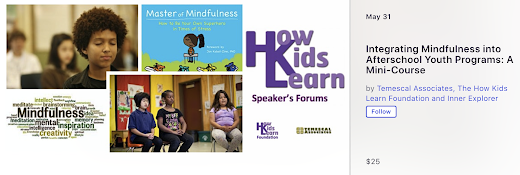
On May 31st we are hosting a zoommini-course on integrating mindfulness activities into afterschool youth programs. To learn more and register, click here.


We also recommend Mindfulness in Afterschool, a curriculum written by Temescal Associates. Temescal offers customized training on mindfulness for afterschool leaders. For more information on these resources, write to info@temescalassociates.com

Below we share some comments from a mindfulness leader, Laurie Grossman (Inner Explorer) and educators, Allison Haynes (Riverside County Office of Education), Ken Dyar (Delano Union School District) and Dr. Katarina Roy Schanz (Riverside Unified School District). Each of them has promoted mindfulness techniques at the school and district level and their responses below are from previous LIAS interviews

Q: CAN YOU BRIEFLY DESCRIBE WHAT MINDFULNESS IS?
Laurie Grossman
Laurie Grossman (LG):
Mindfulness is awareness of the present moment without judgment. Many of us miss a lot of our lives because we live in the past or the future; we spend most of the time in our heads reliving what has already happened or worrying about what is going to happen. By practicing mindfulness, one learns to live more often in the present moment; benefitting from what is actually occurring right now. One of the most common ways to practice mindfulness is to focus on the breath as an anchor to the present.  

Dr. Jon Kabat-Zinn founded Mindfulness Based Stress Reduction (MBSR) in 1979 at the University of Massachusetts Medical Center. Those benefits as described by the MBSR website include: 

  • Lasting decreases in physical and psychological symptoms
  • An increased ability to relax
  • Reductions in pain levels and an enhanced ability to cope with pain that may not go away
  • Greater energy and enthusiasm for life
  • Improved self-esteem
  • An ability to cope more effectively with both short and long-term stressful situations.

Q: WHY IS MINDFULNESS EFFECTIVE WITH YOUNG PEOPLE? 
LG: Mindfulness lessons are interactive, short and impactful. When teaching mindfulness, we are teaching children about themselves; the curriculum is relevant to them and therefore engaging. Students tell us they can concentrate more easily on their schoolwork, they can calm themselves down, and they feel less stress. The benefits of mindfulness occur rather quickly, students feel better as a result and they enjoy the practice. 

The very first lesson we offered in an Oakland public school resulted in this comment from a third grader, “I think if we do this every day we won’t fight anymore.” I was stunned because the school was one where violence in the community was common. 

Ken Dyar
Ken Dyar (KD):
Children living in poverty or in unhealthy environments are under constant, unending stress. Is it any wonder that they struggle to self-regulate, or attend to a school lesson? In an afterschool program, we are extending their learning day until 6 pm, five days a week. Mindfulness is the perfect way to do this, in my opinion. Additionally, it is a practice that the kids can extend to their lives outside of school. It is a life skill.

Q: WHAT BENEFITS DO YOU BELIEVE MINDFULNESS BRINGS TO YOUNG PEOPLE?
KD:
Stress management, regulating behavior, lowering blood pressure, increasing positiveness, increasing hopefulness, empowering youth to feel that they are in control of themselves. It develops a growth mindset in kids. It gives them a tool to move them forward emotionally and therefore academically.

Q: DO YOU BELIEVE THAT MINDFULNESS IS APPROPRIATE FOR ALL AGE YOUTH? 
Allison Haynes
Allison Haynes (AH):
YES. Why not? Why would we arbitrarily choose a number and determine that until one reaches that age, they are restricted from engaging in a practice that includes benefits such as relaxation, self-regulation of emotions, self-awareness, and compassion for others? 

KD: I do believe that mindfulness is appropriate. I have introduced it to my eighth graders this year. Students in middle school are truly "stuck in the middle." Anyone who has worked with middle school students will tell you that these kids are both babies and adults. They need a tool like mindfulness to manage the swings in mood and emotion. I also believe that educators who use mindfulness with their students will enhance the relationships they have with their kids. Sharing mindfulness with my students has certainly proven to them how much I care about them.

Q: WHAT BENEFITS DO YOU BELIEVE MINDFULNESS BRINGS TO ADULT STAFF? 
AH:
Mindfulness provides immediate feedback to adult staff. Taking a breath while letting the thought pass is indeed helpful when your inner voice is shouting doom and gloom. Interrupting the critical voices in one’s head allows a pathway for creative thinking (which is always necessary for afterschool program adult staff). But engaging in a practice before arriving to engage youth is most valuable because it is during that time that intentions can be set, loving kindness administered, and a stronger connection to compassion forged. 

Q: WOULD YOU RECOMMEND MINDFULNESS TO OTHER AFTERSCHOOL LEADERS?
AH: YES. I’d recommend mindfulness to other afterschool leaders because a practice is good self-care. Additionally, I know afterschool leaders are role models who can’t give what they don’t have. I say, give them what they need and watch it spread.

KD: When I share mindfulness with my kids, one comment I always hear at the beginning is that it is "weird." It's weird because no other teacher they've had has ever shared this with them. Taking a moment to do a body scan, be grateful, be in the moment, etc., is completely foreign to them. It is my wish that mindfulness becomes such a regular part of education that it is never considered "weird" anymore. I wish every teacher on my site spent time using mindfulness with their students. I would certainly recommend the practice to any leaders involved in educating our youth.

Q: WHY ARE YOU TEACHING MINDFULNESS TO SCHOOL DISTRICT STAFF?
Dr. Katarina Roy Schanz
Dr. Katarina Roy Schanz (KRS):
The primary target group for this mindfulness training are our Student Assistance Program (SAP) Counselors and SAP Behavior Support Teams. Additionally, adding mindfulness to their self-care practice will help the team both personally and professionally. We’re hoping that by implementing a mindfulness practice, we will see decreases in anxiety and improvements in self-awareness and social-emotional skills, among other positive changes.


Laurie Grossman is the Director of Social Justice & Educational Equity for Inner Explorer. She cofounded Mindful Schools in 2007. With Angelina Alvarez Manriquez and 4th & 5th grade students at Reach Academy in East Oakland, California, she wrote Master of Mindfulness: How To Be Your Own Superhero in Times of Stress & Breath Friends Forever.

Allison Haynes is the Administrator of Pupil and Administrative Services at the Riverside County Office of Education. She has worked in the field of education for 25 years, with the last five focused on Expanded Learning Programs. Her experience ranges from working with elementary, middle school, and high school students as a school counselor and/or a site administrator. 

Ken Dyar was named a California Teacher of the Year in 2006.  He is currently a Physical Educator at the Delano Union School District. Prior to this assignment, he was Director of Physical Education and After School Programs, including DUESD's afterschool programs. Ken has taught for over 18 years, teaching 3rd, 4th, 6th, 7th and 8th grades. 

Dr. Katarina Roy Schanz is the Coordinator of the Student Assistance Program with Riverside Unified School District. Dr. Roy Schanz has been an educator for 21 years. She has served as a school counselor, assistant principal, and principal.

Understanding Attention-Deficit Hyperactivity Disorder

Source: www.pexels.com By Sam Piha PURPOSE The purpose of this blog is to advance understanding of Attention- Deficit Hyperactivity Disorder...