Showing posts with label stu semigran. Show all posts

Monday, September 9, 2024

Voices from the Afterschool Field on Self-Care (Part 2)


Source: www.pexels.com
 
By Sam Piha

We interviewed several afterschool leaders on the importance and benefits of youth worker self-care. Below are their responses. This blog is an excerpt from our recently released briefing paper entitled, "Self-Care for Youth Workers."


Q: What experiences in youth work result in a need for self-care?
(LR): I think youth workers are pushed to their limit with capacity to reduce cost for programs; and especially now, the workforce is strained, so without enough staff, folks are pulling double duty. Beyond this, I think staff experience – at the very least – secondary trauma from the trauma their youth experience. Youth workers care so much about the work they do and the young people in their care, and this can be a heavy weight to carry, considering the challenges many of the youth they serve are grappling with. And, many staff are grappling with their own trauma as well. 

(LP): The issues that youth bring to our staff can be overwhelming and daunting; especially for our younger staff who are closer to the age of some of our older youth. The pandemic created situations in which our younger staff felt they could not provide the support needed, because they felt hopeless in solving complex issues. The older staff would assist and tell the younger staff to take a break, take care of yourself – “we understand this can be overwhelming.” Even our older staff needed time away, because they would give and give to the point, of exhaustion.
 
Q: In your experience, what works? 
(SS): Education, group discussion, assessment, and training. Also, building a nurturing organizational culture that encourages personal self-care and genuinely values and honors one another is essential. An intentionally, caring, educational community naturally promotes personal self-care as a healthy shared practice.
 
(LR): All in all, I think the issues are systemic – so, while I think helping individuals figure out how to navigate these challenges and care for themselves is good, I think helping individuals do self-care without addressing why wellness and mental health is such a major issue in our field is a major miss. We need to be looking at how we’re changing roles and positions and pay that results in sustainable jobs and livable wages if we truly want to see wellness in the field.

(LP): It begins with the depth of relationship with your staff. Have you created a safe, nurturing welcoming environment to help them seek self-care. We focus on an Indigenous worldview of self-care, that we are connected to everything and everything is connected to us. The culture of caring, kindness, and compassion in the Youth Institute is shared with all the staff in the afterschool program to ensure they are connected and in balance. Education and reflection (discussion) is our main strategy for
self-care from an Indigenous worldview.
 
Q: What do you do in your organization to address this topic? 
(SS): EduCare Foundation teaches “Eight Skills for Heartset ® Education” tools for self-care through self-awareness, mindfulness, self-forgiveness, and empathetic listening. When these become our personal baseline, then we can create a kind and compassionate climate at school and at home that impacts, sustains, and elevates ourselves and children. As we develop a deeper positive regard (honoring and caring) for ourselves, then we can have a mindset and a heartset that really sees the best in our children and their aspirations. We can be ones who see the possibilities of their bright future, at times when they don’t even see it for themselves. From our growth heartset, we are compassionate sparks that support and lift both our young people and ourselves.
 
Organizationally, we do our best at EduCare to practice these tools for self-care with and for our staff. There is attention to structuring meetings to start with check-ins and centering activities (e.g.- mindfulness & gratitude), offering communication and self-care workshops, providing ample time off to
allow for nurturing ourselves and our families, and scheduling staff celebrations and acknowledgment activities for supporting one another.
 
(LR): We’ve had a lot of conversations in our organization about self-care over the years. It’s not easy in a small nonprofit, but we are committed to the people in our organization so continue to strive to grow and improve. I think organizationally wellness starts with workload. There is no self-care that will change a sole-crushing, impossible workload. This is probably one of the hardest shifts to make though, because the world outside us, i.e. funders, still expect us to do our work for pennies on the dollar, and staff often pay the price. We are doing our best to get to true cost in our budgets and grant requests, and hold the line with and educate our funders.
 
A couple additional practices:
  • We have an annual health and wellness benefit that is essentially a bonus for staff to use to support their wellness. 
  • We do a compensation and benefits review every three years to ensure we are paying competitive wages and a living wage to all staff.
  • We give the week around Christmas off to the full team, which is beyond vacation and personal time.
  • We have been experimenting the past two years with what we’re calling the “July Slowdown”, which means no external communication, no external meetings, just time for the team to slowdown, look inward, get projects done that they haven’t been able to get to (i.e. cleaning up files, clean desk, update curriculum) and work shorter days.
  • We hold “flex” rules pretty firmly for salaried staff – if you have to work extra hours, you pay yourself back with time off.
  • We spend time and resources accounting for our team relationships and staff culture, as we think this is critical for wellness, and wellness is critical for org success.
  • Staff are co-designing these solutions, which I also think is important so that we can ensure needs are being met.
And of course, we have a bunch of mental health and wellness curriculum which incorporates wellness for youth but also for adults:  https://www.calsac.org/virtual-training#mh&w

(LP): We stressed with our staff that you need to be in a healthy mind and spirit before you help others, because the youth are counting on you to help them. Encouraging them to practice weekly self-care; by going outside, taking a walk, going to the gym, meditating, learn a new skill (non-work related).

Monday, September 2, 2024

Voices from the Afterschool Field on Self-Care (Part 1)

Source: All photos from www.pexels.com

By Sam Piha

We interviewed several afterschool leaders on the importance and benefits of youth worker self-care. Below are their responses. This blog is an excerpt from our recently released briefing paper entitled, "Self-Care for Youth Workers."


Q: Why should youth workers engage in self-care?
(AB): Positive relationships are key to health, school-engagement, and community. As youth workers and educators, we take care of the needs of students and families every day, but we often overlook our own self-care in the process. Additionally, there are many stressors in life that can be experienced on a daily basis, and it is well-known that stress can also be seen as contagious, if I’m having a bad day, my mood can contribute to you also having a bad day. Therefore, engaging in self-care in order to combat the effects of stress by releasing the stress in order to reset the body by engaging in self-care, it’s a way in order to refill your own cup! 


(SS): In order to give to others in healthy ways, youth workers need to remember to give first to ourselves. Only then can we give from the overflow. We take care of ourselves so we can take care of each other.

As we take good care of ourselves and fill our own cup, giving becomes an expression or act of compassionate service. We can give of the natural overflow. Acts of service to others, it has been said, are the highest form of loving. It is the nature of the unconditionally loving heart, a growth heartset,
to give. The joy of giving is a wonderful gift youth workers give ourselves. It starts however with a genuine necessity to taking care of ourselves. Self-care, rather than being a self-centered or indulgent practice, is truly the essential ingredient that supports our mental health and resilience allowing us to be more fully available for our young people.
 
As healthy, authentic role models, youth workers then can deeply assist our students as they navigate and strengthen their positive emotional and mental health. Our attention to our self-care is at the core.
 
(LR): Everyone needs self-care. We live in a society that expects us to push so hard with a disregard for ourselves, and this has so many negative results – i.e. mental health challenges, physical health issues, etc. Stress (unmanaged) is a major killer.

(LP): The pandemic elevated internal and external stresses that have increased mental health issues among our youth and peers. During this crisis, youth workers where on the front lines providing comprehensive services to meet the diverse needs of the communities and youth they serve. This created undo stress on youth workers, causing many to seek help for themselves. In our afterschool program, we mobilized our resources to ensure that staff had opportunities to step away and take care of themselves. We established extended lunches by eating outside to share and reflect on what issues and concerns that they needed assistance with. Staff become their support group through the pandemic.
 
Q: What have you seen are the benefits of self-care?
(AB): Self-care is the practice of taking action to preserve or improve one's own health. Since a lot of us may have experienced some form of trauma, there are great benefits to identifying trauma and dealing with it through self-care techniques. For example, simply taking the time to participate in an artistic pursuit can be seen as self-care and make the heart rejoice! Self-care can help to combat anxiety, hopelessness or lack of motivation. There is indeed an interconnectedness of stress, self-care, and well-being. 
 
(SS): Educators and youth workers, as did many, went through a tremendously tough time during and post pandemic. The trauma, that they personally experienced along with the secondary trauma from working with their students who in turn were traumatized, caused great stress. It impacted their lives and their ability to truly give to their students in ways that the most wanted to. Self-care was a key ingredient for healing themselves and restoring their resiliency, fortitude, and commitment.
 
(LR): In our society, self-care is often branded as getting a mani-pedi or something like that. And while this is nice and all, I think self-care with depth are things like therapy, boundaries, self-reflection, etc...things that can help us navigate our lives and the world around us better – this is where I’ve personally experienced a true release and recovery. And with that in mind, these types of practices – and even things like exercise and healthy eating, are ways that we take time to invest in ourselves with the intention of a more restorative and balanced life. When we are making shifts like this – major shifts in habits/perspective, the results are transformative. We are able to engage in the world differently, feel differently in our day to day, and are able to support others better.

(LP): Staff are centered, rested, and focused to engage with youth. In many Indigenous communities, self-care is part of being “connected” – to self, to nature and to your community. We follow that same philosophy with our staff about being connected and understanding that we are related to everything, like a web. If one strand of the web breaks if effects everything else – it becomes unbalanced, you lose your way (focus). Self-care is a part of that balance of being connected.


Wednesday, February 8, 2023

The Radical Power of Kindness and Joy in Afterschool Programs


By Sam Piha

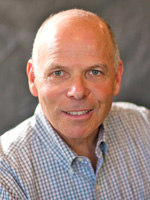
It seems we live in a time in which meanness is in vogue, whether it's social media, political discourse, cyber bullying, violent actions, or hate crimes. To learn more we interviewed Stu Semigran, Co-Founder and President of the EduCare Foundation. His responses are below.

Q: Do you agree that meanness is in vogue? And why do you think this is so?

A: It certainly appears as if discord, againstness, and striking back is increasingly evident in our world.  Many people are feeling threatened and fearful with a great need for power, to gain control, and stake out positions of being “right” and claiming others as “wrong”. Righteous judgment is on the loose. On one level, people are dealing with more stress and are looking to feel more secure. One misdirected approach for establishing a sense of personal security may be to stake out a position, hold on tight and defend it, and then combat anything that might shake that position- threaten that false sense of inner security.


Source: www.pexels.com

It takes a strong sense of self (apart from our righteous beliefs) and a solid foundation to withstand and be receptive to other points of view. Building that deeper core of self-awareness and self-acceptance leads to a freedom to step into a world where opposing opinions, beliefs, and points of view are not threatening. 

Building greater self-acceptance and self-compassion opens the way to more readily respond to others with more acceptance and kindness. The path out from meanness- to tolerance, to understanding, and to compassion- is each person’s responsibility. Educating towards that is the aim of Heartset® education.

Q: How would you define “Kindness”?

A: Kindness is a generosity of heart. It is expression of loving in action. It has infinite expressions. It may be a mere thought, a wish, or prayer for another. It is a willingness to risk sharing love and compassion and perhaps being rejected or misunderstood. Kindness can be expressed quietly or very demonstratively. It may be seen or go unnoticed. Nonetheless, it is setting a tone, a pervasive foundation of caring and unconditional love. 

Kindness provides the encouragement and the fortitude to keep going when life is tough by knowing that you are valued, supported, and cared for. 


“Do your little bit of good where you are; it’s those little bits of good put together that overwhelm the world.”- Desmond Tutu


Q: What can we do in afterschool to prevent meanness? What can we do in afterschool to promote kindness?

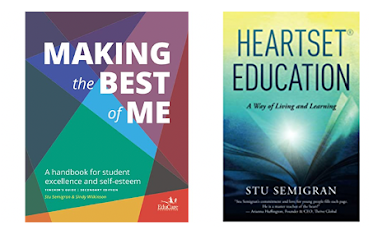
A: As adults we can promote kindness by taking care of ourselves, expressing kindness with others, encouraging our students to treat themselves kindly, and by teaching kindness activities on a regular basis so it becomes a way of relating. There are many excellent resources for teaching compassion, empathy, and kindness. One, developed through EduCare, is Making the Best of Me: A handbook for student excellence and self-esteem, that includes over 200 easy-to-use, engaging activities for afterschool and school day classes.

Community service projects are terrific opportunities for students to build the lifestyle habit of expressing kindness. Practicing acts of kindness individually and as a group or class are impactful, joyful ways to begin to redirect a pattern of meanness to one of acceptance and compassion. Acts of kindness and community building become important parts of the kindness formula. The mindset and heartset of giving and receiving kindness set a personal habit and lay a solid foundation for students to continue to develop throughout their lives.)

Source: EduCare, Lynwood, Ca.

Q: Can you give an example of kindness between youth and their peers or community?

A: One example is the Take Action Campaign (TAC), a far-reaching initiative launched in 2008 by Los Angeles Unified School District’s (LAUSD’s) Beyond the Bell and facilitated by EduCare and several community partners. TAC gives thousands of high school students leadership opportunities by celebrating the arts, serving their schools & their local communities, and empowering them to mentor their peers. Projects have included volunteering at homeless shelters & food banks, environmental cleanups, tree planting, food and clothing drives, unity building events, and student led advocacy campaigns around issues important to them. In school year 2022-23, students from 37 LAUSD high schools are participating in TAC.

Q: You recently wrote a book Heartset Education: A Way of Living and Learning. Can you say a little about the book and whether it would be useful for afterschool leaders?

A: Students need to have their minds ready to learn. However, to become active learners, a lot of our young people need more than that. They don’t just need a new mindset; they need a new heartset. When the heart is set in a good place, the mind is open and receptive. When heart is troubled, the mind is cluttered. So heart and mind have to go hand in hand. 

Q: Can you describe what the Educare Foundation does? 

A: EduCare Foundation’s mission is “to inspire and support young people in empowering themselves to become responsible citizens, courageous and compassionate leaders, and live their dreams.” In 1987, EduCare piloted the ACE (Achievement and Commitment to Excellence) Program in one Los Angeles Unified School District (LAUSD) middle school. ACE focuses on the social-emotional learning (SEL) elements of character development, personal management, emotional intelligence, and interpersonal skills. EduCare’s flagship ACE Program became the forerunner to the educational movements that today bear many names: Character Education, Social-Emotional Learning (SEL), and Trauma-Informed Teaching. To learn more about EduCare’s efforts, check out their website here.

Q: Why did you start this organization? 

A: Why EduCare? It was a chance, an opportunity, a pressing need that I saw to do something that I thought was missing in education- to address an obvious need of my students who were coming into my classroom when I was a middle school teacher in LA. I could see that they were lost in many ways. For many, their wholistic needs, not just physical needs, but their emotional, mental and social needs as well, we're not being addressed and attended to.

I wanted them to be healthier and happier and be in a place to succeed academically. I felt they needed to develop greater self-awareness and personal development tools so they could believe in themselves, ignite their desire, and gain the skills for creating a successful and fulfilling life. I wanted the chance to touch their hearts, open their minds, and hopefully assist them in empowering themselves to transform the trajectory of their lives. 

Michael Funk
“As I drove up to the school, the blighted neighborhood was giving off all the signals of distress. But when I walked into the school, it was like when the Wizard of Oz turned from black and white to color! You could feel the positive energy, the love. I have been around high quality after school and youth development work for over 25 years. What I witnessed while visiting the ACE Program was some of the most transformational and powerful moments I have ever seen.”- Michael Funk, Director of Expanded Learning Division, California Department of Education 

[You can view a Zoom webinar featuring Stu on this topic, by clicking here.]

MORE ABOUT…

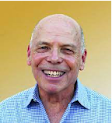
Stu Semigran is the Co-Founder and President of the EduCare Foundation. With over 35 years of experience as an educator, he has facilitated thousands of youth, professionals, educators and parents in Heartset® education, SEL, leadership development, and afterschool management. His new book, Heartset® Education: A Way of Living and Learning, has been rated a #1 Amazon New Release Bestseller. His previous book, Making the Best of Me: A Handbook for Student Excellence and Self-Esteem, is used in schools worldwide. He was recognized in 2012 as a David Chow Humanitarian Award Foundation recipient for his service to youth. 


UPCOMING WEBINARS:

Play comes natural to kids and to out-of-school time educators! Research across youth development and education fields have identified principles that define playful learning and the positive youth outcomes that can come from intentional play. In this webinar, we will explore this topic and learn about free resources you can use to incorporate high-quality playful learning opportunities into your programs and how to advocate for more play in the lives of children. To learn more and register, click here.


Do your children or students trigger you? Do you match anger with more anger? Or do you want to hide from conflict? When we face certain situations, our bodies react with fight/flight reactions. You CAN interrupt these reactions and replace them with productive responses. You can hold calm power, both inside and out.

This webinar will dive into the habits, tools, and techniques that help both you and your kiddos stay regulated. We’ll cover:
  • Your reactivity profile,
  • Closing the stress cycle,
  • Regulation techniques for kids and grown-ups,
  • Mindfulness for the fidgety,
  • Personal wellness plans,
  • What to do when the sh*t hits the fan
To learn more and register, click here.

Tuesday, November 15, 2022

3 New Books to Check Out

By Sam Piha

A number of colleagues have recently released books that we think are very valuable to the afterschool field. We discuss them below.

Raising Kids: Your Essential Guide to Everyday Parenting

While this book is targeting parents, we believe that it is also valuable for afterschool leaders. We have been working with co-author Sheri Glucoft Wong, LCSW for many years. She has provided in-person workshops on managing behavior for afterschool staff, has led online webinars and has contributed to several LIAS Blogs.

Publisher's Synopsis: “In Raising Kids, family therapist and parent educator Sheri Glucoft Wong and Silicon Valley private school head Olaf Jorgenson team up to deliver a down-to-earth guide to parenting that is as encouraging as it is illuminating. With its easy-to-grasp language and tools, Raising Kids is there for you, from managing family routines, screen time, and homework, to supporting friendships, self-esteem, and resilience. You'll find out how being "on your spot" leads to fewer conflicts and replaces threats, nagging, and punishment with clear, effective messages that make sense to your kids.”  

To learn more and order Raising Kids: Your Essential Guide to Everyday Parenting, click here.

“The authors successfully blend their experience with anecdotes and practical lessons on how to raise resilient children while maintaining one’s perspective—or sanity, in some cases—leaving the reader hopeful rather than powerless in striking balance and setting limits. As an educator, I plan to disseminate the lessons learned from the book. As a parent, I will rethink and re-shape some of the misconceptions and fears that I brought to parenting my two children. Raising Kids is an essential read for parents who want to parent with purpose, integrity, and equanimity.” — Percy L. Abram, PhD, head of school at The Bush School (WA) 

Heartset Education: A Way of Living and Learning

Stu Semigran
Author Stu Semigran is an important partner of Temescal Associates and The How Kids Learn Foundation. Stu, founder of EduCare Foundation, has led several online webinars and contributed to many LIAS Blogs.

Amazon’s Synopsis: “For our children to be active learners, they not only need a new growth mindset… they also need a growth heartset. Stu Semigran provides a new way to educate our children in Heartset® Education: A Way of Living and Learning. In this book, you will:

  • Discover How to Listen from Your Heart
  • Get Tools to Turn Challenges into Learning Opportunities
  • Learn How to Resolve Conflict from a Different Perspective
  • Gain Knowledge to Build a Sense of Connection with Your Children
  • Realize the Magnitude of the Power of Choice as a Personal Responsibility”

To learn more and order Heartset Education: A Way of Living and Learning, click here.

“Heartset Education brings to light the need for educating every child with greater love and understanding. It should be at the core for all our schools!” — Michael Funk, Director, Expanded Learning Division for the California Department of Education 

“Heartset Education is a MUST for bringing the best out of both educators and parents!”— Gloria Halley, Region 2 Lead for Learning Support, Expanded Learning Service, Office of Education, Butte County (CA)

The Heartbeat of the Youth Development Field

Georgia Hall, NIOST
We have been working with co-author Georgia Hall for many years and her latest release, The Heartbeat of the Youth Development Field, provides a window into the lives of youth workers and experiences that led to their work with young people. It beautifully illustrates the importance of building positive relationships with youth, and details the practices and strategies successfully employed by youth workers. While this book will be immeasurably valuable to researchers, funders, and policymakers, it is also an important resource for program leaders to promote reflection and discussion among youth worker staff as part of staff development.

Publisher’s Synopsis: “Youth work is a sacred opportunity to make a significant difference in the lives of children and youth. Through research and personal essay narrative, The Heartbeat of the Youth Development Field: Professional Journeys of Growth, Connection, and Transformation shines a light on the intricate connections between research and practice, touching upon both the vulnerability and triumph of youth development work. The passionate voices of youth workers in this volume lead to the inescapable conclusion that programs and policies for youth must be informed by these same voices and the values they express.”

To learn more and order The Heartbeat of the Youth Development Field, click here.

Monday, May 9, 2022

Social Emotional Learning and Teens: The Importance of Adult Staff and Focused Program Practices


By Sam Piha

For successful delivery of SEL content has to do with the need to model it to the students to effectively teach it. SEL is necessarily responsive and works moment-to-moment over time; because it’s all about behaving and interacting, a “do as I say, not as I do” approach doesn’t work. Students learn and emulate self-awareness from someone who is demonstrating it. For this reason, educators must continue to develop their own social emotional skills so they can set the example — working on their personal development, becoming more self- and socially aware, learning how to manage their own stress, and walking the talk.  - Heather Daly, Courageous Hearts and Normandie Nigh,  A World Fit for Kids 

Dr. Dale Blyth
Dr. Dale Blyth, University of Minnesota, emphasizes that social emotional skills are “taught” through direct instruction and “caught” through adult modeling and the program values and culture. We know that the success of any program to promote social emotional and character skills is partially dependent on the social emotional and character skills of the adult leaders. 

Whoever our students may be, whatever subject we teach, ultimately we teach who we are. - Parker Palmer, Educator


Below is a reflection from Stu Semigran, Founder of EduCare Foundation, on the importance of adult staff and their social emotional skills. 

Stu Semigran
“We can only truly teach or impact our students in the value and competencies of SEL to the degree that SEL is becoming part of our own repertoire… our own way of being.  As we commit to our personal SEL self-development, this naturally influences our instructional practices, programs, and decisions. SEL becomes more than a collection of lesson plans, activities, or programs. It becomes a way of teaching… a way of being… a way of living. Then we as role models can deeply assist our students as they evolve in their own mastership of SEL. This has implications for how we hire and provide professional development.

There are a variety of valuable SEL skills that can be addressed through staff professional development. EduCare Foundation teaches “Eight Skills for Heartset® Education”.  Some of these include tools for self-awareness, mindfulness, self-forgiveness, and empathetic listening.  When these and other SEL skills are personalized and become our baseline, then we are more equipped to create an SEL styled climate with SEL curriculum and activities that can really “stick with” and impact our students.”


FOCUSED PROGRAM PRACTICES

Social emotional learning (SEL) is very important for teens and afterschool programs are well equipped to promote SEL skills. Below are some social emotional learning practices and activities for older youth that can be seamlessly incorporated into afterschool programs:

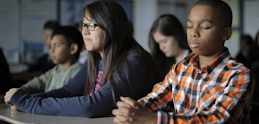
MindfulnessThe term ‘mindfulness’ is often associated with calm or total peace. But that’s not what it’s about. Mindfulness is a practice — meaning, something to be returned to again and again — that involves focusing on the present moment and accepting whatever is showing up. Doing this each day can help foster a feeling of centeredness, which in turn can result in reduced stress and more regulated emotions.  

You can register for Integrating Mindfulness into Afterschool Youth Programs: A Mini-Course to learn more here.


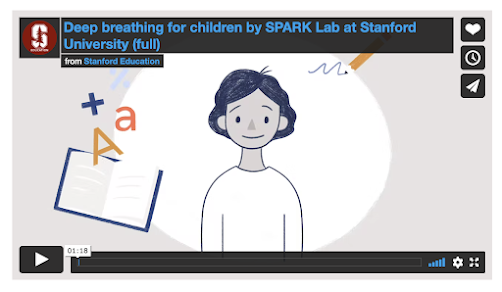
This animated video shows young children how to slowly inhale by pretending to smell a flower and to exhale by pretending to blow out a candle. The video was developed for a study by the Stanford Project on Adaptation and Resilience in Kids (SPARK Lab) at Stanford University.


Engaging Youth in Civic Action - In her article, How to Teach Older Students Social-Emotional Skills? Try Civics,  Arianna Prothero makes the case that “Understanding other points of view, solving problems collaboratively, and building relationship skills all come to mind [in teaching civics]. For many educators, those skills will sound familiar, because they’re many of the same taught through social-emotional learning…Civic engagement can be a meaningful way to teach and reinforce social and emotional skills. That’s especially true for middle and high schoolers who are searching for their place in their communities and the world and might not otherwise connect with traditional social-emotional lessons.” 


Source: Ever Forward Club
Circle Meetings - We know that bringing together young people and offering them the opportunity to have their individual voices heard in the larger community is an important practice. We are referring to ‘talking or sharing circles’ - bringing youth together in a circle and asking each individual to speak while the rest of the group practices active listening. In youth programs, these circle meetings are often called ‘sharing circles’ or ‘community circles.’ Click here to read more about sharing circles.


Source: Ever Forward Club
"Who I Am" Masks - The Ever Forward Club developed an exercise where young people write down words that describe who they are on the outside (the outside mask) and words that describe who they are on the inside (the inside mask)- the things that no one sees. (On their website, Ever Forward Club offers a curriculum on how to utilize this exercise). 

According to Darius Simpson, a former Ever Forward staff member, “A mask is a metaphor representing what we allow the world to see about ourselves. We all wear masks for different reasons, at Ever Forward we don't believe the mask is an inherently bad thing. Sometimes a mask is necessary to survive, get from one place to the next. What we've found is that when people, young men specifically, don't have a space to take off their masks and deal with what’s really happening for them, the mask becomes a part of them. That's where the conversation about what is living in what we call ‘the back of the mask’ comes into our workshops and circles.

* * *


Tuesday, February 16, 2021

2021: Expectations from Afterschool Leaders

By Sam Piha

Source: jackuldrich.com
In a recent blog we shared responses from afterschool workers on their lessons and take-aways from a turbulent 2020. Below we asked two respected leaders in the afterschool field, Dale Blyth (University of Minnesota) and Stu Semigran (EduCare Foundation), to look forward and share their thoughts regarding 2021. 

Can you name one challenge that we will face in 2021? 

Stu Semigran

"One major challenge will be the essential need for students and staff to reconnect and reestablish their relationships with one another and with their school community as a whole.  We will be faced with how to effectively process all that has taken place... for us individually, within our families, our communities, and our nation.  There will be attention needed on addressing trauma and concerns about learning loss.  There will be a need for deep listening and increased sensitivity to how individuals are doing, along with a boost of vitality, enthusiasm, and a strong sense of purpose as reassuring adults and positive role models." – Stu Semigran

Dr. Dale Blyth
"Uniting the many different parts of the youth sector and community youth programs so that we are able to be both more visible to the community as necessary not just nice and more powerful in creating learning and development opportunities that matter in these challenging times and complement and expand beyond those schools can offer." – Dale Blyth

Can you name one opportunity that you see in 2021? 

"These same challenges can be turned into uplifting and exciting opportunities that are in front of us in afterschool in 2021.  Within EduCare, we are actively developing our "return to school" (3Rs- Reconnect- Reinspire- Reignite learning) model for high school students returning back onto school sites hopefully in early 2021. The intent is to provide essential mental health support and social-emotional skills development while reestablishing a positive school culture that assists students restore themselves, renew their relationships, and step forward into learning." – Stu Semigran   

"I believe learning and development, both how important they are and how hard they are to do intentionally, has dramatically increased as a result of 2020. The opportunity for afterschool in 2021 is to position itself as a viable, valuable and versatile place where such learning and development can and is being done." – Dale Blyth

Source: eenews.net

What do you think we should be thinking about as we look forward to a new presidential administration?

"With the possibility of broader government support for social causes such as afterschool and expanded learning, we need to keep building our collective voices and advocacy for the essential increased funding for expanded learning programs." – Stu Semigran

"I think now is the time to push for a significant children and youth cabinet with a lead "czar" that focuses on what is best for the learning and development of children and youth in America. the type of people and places where real, forward thinking policy and practices might be promoted and resourced. Such a cabinet and czar needs to explicitly recognize and engage families but also child care and youth development programs in the community. A focus on all adults, all settings, and all approaches to learning and development in a strength- based approach." – Dale Blyth


As schools prepare to re-open, afterschool program staff need to consider the experiences of youth who have been away from school and their friends due to the COVID-19 pandemic. We know these vary greatly depending on family income and racial/ ethnic background. What are young people's needs? What should we, as afterschool staff, do to help youth thrive when they return to afterschool programs post COVID? How might we build back school and program culture and a sense of "family" spirit and connection in our afterschool programs? Join Stu Semigran and a panel of afterschool program experts to learn how best to help youth thrive as they return to school and afterschool. To get more information and to register for our next Speaker's Forum, click here.

Stu Semigran is the co-founder and president of EduCare Foundation and the executive director of EduCare’s ACE (Achievement and Commitment to Excellence) Student Success Program. Currently serving more than 45 high schools and middle schools in Southern California, EduCare also is the grant manager for the ASSETs after school programs at 17 LAUSD Beyond the Bell high schools and 1 middle school. Over 30,000 students are served each year through EduCare afterschool and youth development programs.

Dr. Dale Blyth is a senior research consultant and advisor who recently retired as Extension Professor in the College of Education & Human Development at the University of Minnesota where he served as the Howland Endowed Chair in Youth Development Leadership and Senior Research Fellow with the Center for Applied Research and Educational Improvement. For 15 years he served as Associate Dean directing the Center for Youth Development. The Center was home for the Minnesota 4-H Program, the Youth Work Institute, Youth Community Connections (then the statewide Mott network), and conducting applied research and evaluation. Recently he led an initiative to advance social & emotional learning outcomes. He serves on several community, state and national groups related to out of school time, data systems, and youth development.


Tuesday, March 10, 2020

A Look Ahead to Afterschool in the Next Decade

As we head into a new decade, we thought it would be appropriate to hear from afterschool leaders regarding how they viewed the opportunities and the challenges to afterschool moving forward.

COREY NEWHOUSE, PUBLIC PROFIT
EMERGING TRENDS/ OPPORTUNITIES: There are more and more options for expanded learning programs to specialize in certain kinds of practices, whether STEM, arts, CTE, culturally sustaining practice, and so on. How they navigate among these choices is an open question for me, and possibly an opportunity for additional support and guidance.

CHALLENGES: Challenges include a strong economy that creates more competition for talent, minimum wage laws in many cities and states, plus AB 5 in California. The cost pressures on programs continue to increase, and philanthropies are lessening their support for expanded learning rather than increasing it. Also, the distinction between social and emotional learning and positive youth development practices can use more clarification, especially from a practice perspective.

JEFF DAVIS, CALIFORNIA AFTERSCHOOL NETWORK 
EMERGING TRENDS/ OPPORTUNITIES: The vision described here is THE FUTURE. In 2020 and beyond, the Expanded Learning field will leverage the Science of Learning and Development to strengthen the case and strengthen our practice that we create the conditions necessary for youth to thrive. Expanded Learning programs are also serving communities that have a lot of needs. In 2020 and beyond Expanded Learning programs will partner better with health, mental health, and social service sectors to offer relevant interventions when kids and families are in need of support beyond what we can provide in our programs.

CHALLENGES: The rates that support Expanded Learning programs are still woefully insufficient and decision-makers such as legislators are becoming fatigued with the message that Expanded Learning programs need more investment to meet baseline operational costs, let alone live up to their true potential. 2020 will be another critical year to rally our staff, families, and communities to communicate clearly and with large numbers that Expanded Learning programs are worthy of investment.

STU SEMIGRANEDUCARE FOUNDATION
EMERGING TRENDS/ OPPORTUNITIES: I see the emerging trends include the issues of mental health and well-being (both for our students and our staff), school safety (anti-bullying / positive school climate), equity & inclusion, and student voice.  Some of the focus areas that address these emerging issues and trends include:  SEL, Trauma-informed practices Restorative Justice, Mindfulness, and Growth Heartset.

CHALLENGES: Adequate funding and developing and retaining quality staff.


DEBORAH MORONEY, AMERICAN INSTITUTES FOR RESEARCH

EMERGING TRENDS/ OPPORTUNITIES: I see and hope for a rising priority in the shape and value of programs for older youth, and youth action and voice in society.

CHALLENGES: We need to rise to the challenge to systemically support the adults in the field with meaningful career pathways and preparation to support their critical role in youth learning and development.

BILL FENNESSY, THINK TOGETHER 
EMERGING TRENDS/ OPPORTUNITIES: The emerging trend in Expanded Learning that continues to grow, and I believe is on the verge of doing so exponentially, is "Workforce Readiness", or the "Career" part of the new "College and Career" focus.  There is now a proliferation of Industry Pathways and Academies in high schools, which to produce great outcomes really requires important foundational work at both the middle and elementary school level.  The opportunities to create, develop, and innovate effective programming models in Expanded Learning Programs to support this Workforce Readiness movement are currently boundless.  This is truly an incredible opportunity for Expanded Learning Programs to provide more than multiple modalities of learning that directly support the Instructional Day.

CHALLENGES: The biggest challenge I see facing the field is the ability to find and retain program level staff.  With the dramatic increases in minimum wage, it is almost impossible for programs to financially compete for quality program level staff.  There is work now beginning which hopes to make work experience/internships in Expanded Learning Programs as a part of a course of study for post-secondary students on a Teaching Pathway.  Teachers that have Youth Development experience have better student engagement skills that directly result in excellent classroom management.

REBECCA FABIANO, FAB YOUTH PHILLY 
I’m thinking about:
  • The Census and its impact on Youth Programs/OST; also thinking about voter registration (of staff and participants/families). 
  • Equity and professional development (PD)- who gets to go to conferences for example, where do we invest our PD dollars in our organizations and in the field? 
  • The role of extended learning programs in addressing poverty (e.g, living wages, skills for 21st century employment, entrepreneurship).

Wednesday, March 28, 2018

HEARTSET: Transforming Teaching & Learning

By Guest Blogger, Stu Semigran, President and Co-Founder of EduCare Foundation


Stu Semigran
Have you ever thought that the challenges that educators face today are different from any in modern time?  With political and social unrest creating a stressful environment, how can we best uplift ourselves and assist our young people deal with life and learning? 

Here’s an idea for you to consider: If we deeply intend to give the best to our students and teach them so they are prepared for going out into the world, what if the first ones to give to and teach is ourselves?  What if, in order to take care of others, we must first take care of ourselves? And in taking care of ourselves, we automatically promote and influence positive change around us.

This is not necessarily a new idea. I’m sure you’ve heard, "Let there be peace on earth and let it begin with me." How many people do you know whose email signature includes, “Be the change that you wish to see in the world.”?

But how do we take care of ourselves such that we and our young people benefit? I suggest that we develop a positive, Growth HEARTSET in ourselves so that we can support those we teach in developing theirs.


EduCare's Growth Heartset Professional Development

What is a HEARTSET? 
Most people are familiar with the idea of a mindset- a frame of mind that has a significant correlation to one’s motivation, effort, and approach to life’s challenges.

HEARTSET is a frame of heart. 

Have you ever walked into a room or a group, where listening to different points of view is the norm? Where mistakes are tolerated and understood as part of a learning process? Where support and encouragement is common among people? Where there's joy, acceptance, consideration, and kindness? Where love is felt and shared—it's in the air? It is these foundational elements of a Growth HEARTSET—that lay the nurturing soil from which the seeds of vibrant curriculum and impassioned teaching and learning sprout. 

A Growth HEARTSET is a kindness of heart. It establishes an energy field of self-awareness, non-judgment (acceptance), peace, caring, positivity, giving, forgiving, and compassion that allows us to more freely and proactively be a force of good. A Growth HEARTSET creates an emotional environment in which we and the young people we teach can flourish in spite of the uncertainties and challenges that are so prevalent today.


EduCare's ACE Program

Recently, after one of EduCare’s ACE (Achievement and Commitment to Excellence) students success programs that promote Growth HEARTSET, a high school principal shared, "Well, you've opened my students’ hearts and now we can capture their minds." He recognized that when the heart is “set” in a healthy and compassionate place, the mind is more open and prepared to learn.  


How do we create a Growth HEARTSET? 

We can set or reset the "heart" through self-awareness, a clear intention, and practicing habits of a Growth HEARTSET. There are many effective teaching approaches and ways to assist you in moving along that trajectory that will be the subject of subsequent blogs and articles. 

By creating a Growth HEARTSET—first in yourselves so it infuses your relationships and teaching—a greater “field” or culture of caring and loving can be known, felt, and shared. This Growth HEARTSET then serves as the foundation for effective teaching and social-emotional learning (SEL) that not only enriches your teaching experience but also captures and expands the hearts, minds, and imagination of your students. 

View EduCare's Program Impact infographic here.

Stu will be leading a Speaker's Forum on Growth Heartsets in Fresno, CA (April 18, 2018) and Modesto, CA (April 19, 2018).

-------------- 
Stu Semigran is the co-founder and president of EduCare Foundation and the executive director of EduCare’s ACE (Achievement and Commitment to Excellence) Student Success Program. Currently serving more than 45 high schools and middle schools in Southern California, EduCare also is the grant manager for the ASSETs after school programs at 17 LAUSD Beyond the Bell high schools and 1 middle school. Over 30,000 students are served each year through EduCare afterschool and youth development programs.


Stu’s book, Making the Best of Me: A Handbook for Student Excellence and Self-Esteem is used in schools worldwide. He currently serves on the CA Department of Education Expanded Learning Division’s SEL Planning Team and LAUSD’s Beyond the Bell’s “Take Action Campaign” Steering Committee. In 2012, Stu was recognized as a David Chow Humanitarian Award Foundation recipient for his service to youth. 

Wednesday, August 9, 2017

Speaker's Forums: Learning Opportunities for Afterschool Professionals

By Sam Piha


We know that due to budget restrictions, afterschool workers have less access to professional development. 

The How Kids Learn Speaker’s Forums are designed to offer expanded learning professionals easy and affordable access to training opportunities led by innovative practitioners. 

Below are some exciting Speaker’s Forums scheduled for this fall. We hope to see you and your staff there. 

"Growth Heartsets": Establishing a Culture of Caring with Stu Semigran

Come and learn skills for developing a new "growth heartset" in our teaching and learning. This interactive session focuses on shaping successful learning environments that thrive upon a foundation infused with caring, connectivity, and proven SEL practices.

Stu Semigran is the co-founder and president of EduCare Foundation and the executive director of EduCare's ACE (Achievement and Commitment to Excellence) Student Success Program, which currently serves more than 35 high schools and middle schools in Southern California.

When: Tuesday, September 19, 2017, 9:00am - 12:30pm - OAKLAND
Thursday, October 5, 2017, 9:00am - 12:00pm - LOS ANGELES
Cost: $11.54 (includes continental breakfast and ticketing fees)


Wrapping Our Heads Around “Fake News” with Elyse Eidman-Aadahl

How do we, as adults, make sense of this rapidly developing media and communications ecology? What does it imply for our work with youth? How can we help young people become more savvy and responsible consumers and producers of media now and into the future? These are the questions we will consider in this forum.

Elyse Eidman-Aadahl is Executive Director of the National Writing Project (NWP), where she draws upon 15 years of experience designing and leading national programs, partnerships, and action-learning efforts for the NWP and other educational organizations.

For more information and to register, click here.

When: Tuesday, October 3, 2017, 9:00am - 12:30pm - OAKLAND
Cost: $11.54 (includes continental breakfast and ticketing fees)


"Taking Off the Mask": Working with School-Age Boys with Ashanti Branch

Through presentation, hands on activities, and film, this workshop will introduce participants to the world of gender-specific support groups, with a focus on school-age boys and our societal notions of "masculinity". 

Ashanti Branch is Founder and Executive Director of The Ever Forward Club. Ashanti was raised in Oakland by a single mother on welfare. In 2004, during Ashanti's first year teaching high school math, he started The Ever Forward Club to provide support for African American and Latino males who were not achieving to their potential. In April 2017, Ashanti was awarded a fellowship from the national organization, CBMA - Campaign for Black Male Achievement. 

For more information and to register, click here.

When: Tuesday, October 17, 2017, 9:00am - 12:30pm - OAKLAND
Cost: $11.54 (includes continental breakfast and ticketing fees)

How Hadley Gray is Mobilizing Youth-Led Blood Drives

Source: Giving Tuesday Guest Blog by Giving Tuesday. This article originally was published on Giving Tuesday .  When Hadley Gray first helpe...