Showing posts with label Laurie Grossman. Show all posts

Monday, May 23, 2022

Integrating Mindfulness into Afterschool Youth Programs


By Sam Piha

For the past decade we have been promoting the use of mindfulness activities in afterschool to address the needs of youth participants and the self-care of youth workers. Integrating mindfulness activities into youth programs to benefit young people and educators has been a very popular educational concept. It appears in the literature on emotional regulation, trauma-informed practice, social emotional learning, grief-responsive teaching, and other leading topics. 

Youth who engaged in mindfulness activities report a greater sense of optimism and well-being, and a reduction in depression, anxiety, stress, and anger. They also benefit academically. Mindfulness activities are also a valuable “self-care” strategy for teachers and afterschool staff, and these activities can be tailored to be used in staff meetings.

On May 31st we are hosting a zoommini-course on integrating mindfulness activities into afterschool youth programs. To learn more and register, click here.
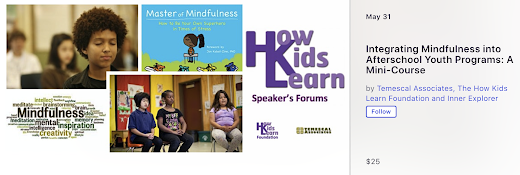


We also recommend Mindfulness in Afterschool, a curriculum written by Temescal Associates. Temescal offers customized training on mindfulness for afterschool leaders. For more information on these resources, write to info@temescalassociates.com

Below we share some comments from a mindfulness leader, Laurie Grossman (Inner Explorer) and educators, Allison Haynes (Riverside County Office of Education), Ken Dyar (Delano Union School District) and Dr. Katarina Roy Schanz (Riverside Unified School District). Each of them has promoted mindfulness techniques at the school and district level and their responses below are from previous LIAS interviews

Q: CAN YOU BRIEFLY DESCRIBE WHAT MINDFULNESS IS?
Laurie Grossman
Laurie Grossman (LG):
Mindfulness is awareness of the present moment without judgment. Many of us miss a lot of our lives because we live in the past or the future; we spend most of the time in our heads reliving what has already happened or worrying about what is going to happen. By practicing mindfulness, one learns to live more often in the present moment; benefitting from what is actually occurring right now. One of the most common ways to practice mindfulness is to focus on the breath as an anchor to the present.  

Dr. Jon Kabat-Zinn founded Mindfulness Based Stress Reduction (MBSR) in 1979 at the University of Massachusetts Medical Center. Those benefits as described by the MBSR website include: 

  • Lasting decreases in physical and psychological symptoms
  • An increased ability to relax
  • Reductions in pain levels and an enhanced ability to cope with pain that may not go away
  • Greater energy and enthusiasm for life
  • Improved self-esteem
  • An ability to cope more effectively with both short and long-term stressful situations.

Q: WHY IS MINDFULNESS EFFECTIVE WITH YOUNG PEOPLE? 
LG: Mindfulness lessons are interactive, short and impactful. When teaching mindfulness, we are teaching children about themselves; the curriculum is relevant to them and therefore engaging. Students tell us they can concentrate more easily on their schoolwork, they can calm themselves down, and they feel less stress. The benefits of mindfulness occur rather quickly, students feel better as a result and they enjoy the practice. 

The very first lesson we offered in an Oakland public school resulted in this comment from a third grader, “I think if we do this every day we won’t fight anymore.” I was stunned because the school was one where violence in the community was common. 

Ken Dyar
Ken Dyar (KD):
Children living in poverty or in unhealthy environments are under constant, unending stress. Is it any wonder that they struggle to self-regulate, or attend to a school lesson? In an afterschool program, we are extending their learning day until 6 pm, five days a week. Mindfulness is the perfect way to do this, in my opinion. Additionally, it is a practice that the kids can extend to their lives outside of school. It is a life skill.

Q: WHAT BENEFITS DO YOU BELIEVE MINDFULNESS BRINGS TO YOUNG PEOPLE?
KD:
Stress management, regulating behavior, lowering blood pressure, increasing positiveness, increasing hopefulness, empowering youth to feel that they are in control of themselves. It develops a growth mindset in kids. It gives them a tool to move them forward emotionally and therefore academically.

Q: DO YOU BELIEVE THAT MINDFULNESS IS APPROPRIATE FOR ALL AGE YOUTH? 
Allison Haynes
Allison Haynes (AH):
YES. Why not? Why would we arbitrarily choose a number and determine that until one reaches that age, they are restricted from engaging in a practice that includes benefits such as relaxation, self-regulation of emotions, self-awareness, and compassion for others? 

KD: I do believe that mindfulness is appropriate. I have introduced it to my eighth graders this year. Students in middle school are truly "stuck in the middle." Anyone who has worked with middle school students will tell you that these kids are both babies and adults. They need a tool like mindfulness to manage the swings in mood and emotion. I also believe that educators who use mindfulness with their students will enhance the relationships they have with their kids. Sharing mindfulness with my students has certainly proven to them how much I care about them.

Q: WHAT BENEFITS DO YOU BELIEVE MINDFULNESS BRINGS TO ADULT STAFF? 
AH:
Mindfulness provides immediate feedback to adult staff. Taking a breath while letting the thought pass is indeed helpful when your inner voice is shouting doom and gloom. Interrupting the critical voices in one’s head allows a pathway for creative thinking (which is always necessary for afterschool program adult staff). But engaging in a practice before arriving to engage youth is most valuable because it is during that time that intentions can be set, loving kindness administered, and a stronger connection to compassion forged. 

Q: WOULD YOU RECOMMEND MINDFULNESS TO OTHER AFTERSCHOOL LEADERS?
AH: YES. I’d recommend mindfulness to other afterschool leaders because a practice is good self-care. Additionally, I know afterschool leaders are role models who can’t give what they don’t have. I say, give them what they need and watch it spread.

KD: When I share mindfulness with my kids, one comment I always hear at the beginning is that it is "weird." It's weird because no other teacher they've had has ever shared this with them. Taking a moment to do a body scan, be grateful, be in the moment, etc., is completely foreign to them. It is my wish that mindfulness becomes such a regular part of education that it is never considered "weird" anymore. I wish every teacher on my site spent time using mindfulness with their students. I would certainly recommend the practice to any leaders involved in educating our youth.

Q: WHY ARE YOU TEACHING MINDFULNESS TO SCHOOL DISTRICT STAFF?
Dr. Katarina Roy Schanz
Dr. Katarina Roy Schanz (KRS):
The primary target group for this mindfulness training are our Student Assistance Program (SAP) Counselors and SAP Behavior Support Teams. Additionally, adding mindfulness to their self-care practice will help the team both personally and professionally. We’re hoping that by implementing a mindfulness practice, we will see decreases in anxiety and improvements in self-awareness and social-emotional skills, among other positive changes.


Laurie Grossman is the Director of Social Justice & Educational Equity for Inner Explorer. She cofounded Mindful Schools in 2007. With Angelina Alvarez Manriquez and 4th & 5th grade students at Reach Academy in East Oakland, California, she wrote Master of Mindfulness: How To Be Your Own Superhero in Times of Stress & Breath Friends Forever.

Allison Haynes is the Administrator of Pupil and Administrative Services at the Riverside County Office of Education. She has worked in the field of education for 25 years, with the last five focused on Expanded Learning Programs. Her experience ranges from working with elementary, middle school, and high school students as a school counselor and/or a site administrator. 

Ken Dyar was named a California Teacher of the Year in 2006.  He is currently a Physical Educator at the Delano Union School District. Prior to this assignment, he was Director of Physical Education and After School Programs, including DUESD's afterschool programs. Ken has taught for over 18 years, teaching 3rd, 4th, 6th, 7th and 8th grades. 

Dr. Katarina Roy Schanz is the Coordinator of the Student Assistance Program with Riverside Unified School District. Dr. Roy Schanz has been an educator for 21 years. She has served as a school counselor, assistant principal, and principal.

Wednesday, April 29, 2020

Pause: Cultivate Grace for Yourself and Your Community

By Sam Piha

For many years we have been promoting the effectiveness of mindfulness activities in afterschool- both for adult staff and youth participants. We have posted blogs, offered trainings to schools and created a 16- week mindfulness curriculum for afterschool leaders.

In this COVID-19 world, activities that help adults and young people release stress, be aware of one’s emotions, and stay in the moment have never been more important.
Mindfulness provides immediate feedback to adult staff. Taking a breath while letting the thought pass is indeed helpful when your inner voice is shouting doom and gloom. Interrupting the critical voices in one’s head allows a pathway for creative thinking (which is always necessary for afterschool programs adult staff).”- Allison Haynes, Riverside County Office of Education 

On Thursday, May 7th, 2020 (10:00am-11:00am PST) we invite you to participate in an upcoming webinar entitled, Pause: Cultivate Grace for Yourself and Your Community. Grace is most easily found in the present moment. Journey with Laurie Grossman and Stacey Daraio to learn mindfulness practices that you can share with your community to live in the present. You will leave calmer than when you arrived and with resources to use and share.

Laurie Grossman
Laurie Grossman is the Director of Social Justice & Educational Equity for Inner Explorer. She cofounded Mindful Schools in 2007. With Angelina Alvarez Manriquez and 4th & 5th grade students at Reach Academy in East Oakland, California, she wrote Master of Mindfulness How to Be Your Own Superhero in Times of Stress and Breath Friends Forever.

Stacey Daraio
Stacey Daraio is Co-Director of Temescal Associates and The How Kids Learn Foundation. Along with Laurie Grossman, she co-authored the Mindfulness in Afterschool, a 16-week curriculum, and has supported its implementation in schools and afterschool programs throughout California.


To learn more and to register, click here.


Wednesday, January 9, 2019

A Mindfulness Story For Kids By Kids


“From the creators of the hugely successful Master of Mindfulness, this charming children’s book for readers ages 4 to 7 tells the story of Nessa and Leo’s friendship, and how mindfulness helps them deal with strong emotions such as fear, shyness, and anger.”
-Greater Good Science Center, UC Berkeley


By Sam Piha

We have been promoting the use of mindfulness techniques in afterschool, for both young people and adult staff self-care, for many years. We are happy to announce that a second book created by young people on this topic was recently released. Below is an interview with Laurie Grossman who organized this effort.  

Laurie Grossman
Q: Can you say a word about what this book is about?
A: Breath Friends Forever is a book about two best friends who share the same birthday. One is often calm and the other often frustrated. As a birthday present, Leo teaches mindfulness, the power of using her breath when she gets upset, angry, nervous or sad. Leo teaches readers a few mindfulness techniques that are easy to use, one of which, the Sharkfin was originally created by Temescal Associate’s own Stacey Daraio.

Our world has become, it seems to me, more difficult to navigate for all of us, little ones included. Teaching kids mindfulness to deal with the challenges they face even at very early ages, can help them develop emotional regulation, deal with difficulties with more calm and make their lives happier and healthier. 

Q: Can you share some of the back story about how it was developed? 
A: In 2014, I was doing lots of volunteer work bringing mindfulness to Reach Academy in Oakland, CA. One day, Mr. Musumeci, a fifth grade teacher, mentioned to me that in selecting superheroes, one of his students thought they should have a mindfulness superhero. 

Several weeks later, while practicing mindfulness, it occurred to me that we should write a book. I asked the teacher what he thought and he thought it would be a great learning experience for the kids. I came into the class and asked them if they liked mindfulness. 100% did. I asked them if they thought other kids should know about it. 100% did. Finally I asked them how we could tell other kids about it and eventually someone said we could write a book. Voila, the beginning of the first book, Master of Mindfulness: How To Be Your Own Superhero in Times of Stress


That book did well so the publisher, New Harbinger, asked us to do one for older kids. Angelina Manriquez, the book designer, thought it would be more important to begin with the little ones, thus Breath Friends Forever was born. 

Chasmin Moses, a fourth grade teacher at Reach was a huge advocate of mindfulness. When I inquired about her interest in participating, she jumped at the chance. This book seemed much harder because we wanted to make it a story book for Pre-K through 1st or 2nd graders. We had no idea what the story would be or if the characters would be animals, zombies or people. It took about three months but we finally got the ball rolling and things started coming into place. 

Q: Can you say something about how this book can be used in afterschool programs?
A: All kids love birthdays and all kids need mindfulness. It's a great read a loud. Kids could practice what is taught in the book and kids can also listen to the practices the authors dictated to learn mindfulness. 

Older kids could read it to little ones. Kids could act out the story and they could also write their own books about mindfulness. Knowing that kids like them wrote and published a book could inspire them to do the same. 

Q: Is this book only for children who have experienced mindfulness practice?
A: No, because Leo teaches Nessa how to practice mindfulness so readers can learn too! Also, the authors' audio practices lead students through a variety of mindfulness practices.

Q: Are there any resources that afterschool leaders could use?
A: There are many resources providing research evidence, case studies of how schools have used mindfulness techniques, and guidance to program practitioners. Many of these can be founds by doing an online search of mindfulness techniques for youth. I have listed a few below: 

  • Temescal Associates’ Mindfulness in Afterschool: A 16-Session Curriculum of Mindfulness Activities for Young People in Afterschool Programs 
  • Inner Explorer is a non-profit organization whose mission is to provide mindfulness in schools for PreK-12 classrooms, helping children develop self-awareness, self-control, resilience and compassion. Each series contains 90 audio-guided practices that can be used every day by simply logging in and pressing play. Students and their teachers participate together in the brief (5-10 minute) daily practices. No prep, planning or curriculum changes required.
  • Past LIAS Blog Posts on Mindfulness in Afterschool 

-------------------
Laurie Grossman, one of the founders of the mindfulness in education movement, has been an activist since 1975. She believes that mindfulness in schools is the tool most likely to help achieve social justice. Over the last two decades, she started two innovative programs: one that created partnerships between private and public schools, and one that brought mindfulness into schools. In 2007, as part of Park Day School's Community Outreach Program, she and two colleagues launched a pilot program of mindfulness in an Oakland, CA, elementary school that was covered in The New York Times and on NBC. Grossman is cofounder of Mindful Schools, now one of the largest mindfulness-in-education programs in the world. She currently works with Inner Explorer, an organization focused on bringing daily mindfulness practices into schools to improve educational outcomes and the well-being of children and teachers. She is passionate about Inner Explorer because the organization has made mindfulness scalable, providing easy and immediate access to every K-12 classroom, anywhere, anytime.

Thursday, April 28, 2016

Mindfulness in Afterschool: No Cost Resources Until May 31

By Sam Piha


Sam Piha
We know that teaching mindfulness in afterschool has great benefits for the young people as well as the staff who lead these activities. That is why we are expanding our efforts to help afterschool and summer programs incorporate mindfulness into their activities. Temescal Associates and the LIAS project are partnering with Inner Explorer to move this forward. 

Inner Explorer has answered the call for no/low cost resources through the end of May, 2016 that can sustain your efforts at bringing mindfulness to your afterschool program. These resources come in the form of daily audio sessions that are designed for different age groups and require only 20 minutes of staff training because staff learn with their students! These resources are no/low cost only if you sign up before May 31st, 2016 because Inner Explorer is in an expansion mode, Beta testing their new internet platform and hoping that once folks love the program, they will want to start an easy to use campaign to help pay it forward. Learn more here.


In addition, Laurie Grossman, a team member of Inner Explorer and Temescal Associates, and cofounder of Mindful Schools has published a children’s book entitled Master of Mindfulness: How To Be Your Own Superhero in Times of Stress. This book is authored and illustrated by 5th graders from Reach Academy in East Oakland, CA with Laurie and Angelina Alvarez. The majority of royalties from the sales of this book will be donated to a fund to support the post high-school educational or vocational endeavors of the twenty five authors who co-wrote the book. 


The book’s description begins by asking a question:

“Do you ever feel angry, disappointed, or stressed out about family problems, school, bullies, or trouble with friends? If so, mindfulness can help. Master of Mindfulness is a unique and empowering book written for kids by kids, with cool illustrations and tips that show you how to be confident, get focused, stay calm, and tap into your own inner strength so that you can be your own superhero—no matter what life throws your way!”

This book can be purchased at your local bookstore or through Amazon. You can also contact Temescal Associates for information on training to bring mindfulness to your staff (self-care strategies) and to your youth program.  

Temescal Associates is delighted about our partnership with Inner Explorer and we look forward to watching the fruits of this collaboration.


••• 
More About Inner Explorer 
The mission and vision of Inner Explorer are: To unlock the academic potential and foster well-being for millions of children through mindfulness and to break the cycle of poverty and violence.

Inner Explorer was created in 2011 by Laura Bakosh and Janice Houlihan, who together have 30 years of experience practicing mindfulness. The K – 12 programs, based on Jon Kabat-Zinn’s Mindfulness Based Stress Reduction Program, were developed to help teachers and students develop a daily mindfulness practice.  

The effective, sustainable and scalable programs are streamed through the internet. It’s a simple push and play; staff and teachers learn with their students and there is no daily preparation. Research has shown the use of Inner Explorer results in a 50% reduction in discipline issues, a 43% reduction in teacher stress and a 10 – 30% increase in grades and test scores. For questions about how to sign onto Inner Explorer, please go to www.innerexplorer.org or contact Laurie Grossman.

•••
You can read other blogs by the LIAS project by going to: 
  • Expanded Learning 360°/365 Project website 
  • LIAS Blog Written for the California Afterschool Network

What We Get Wrong About Teaching Kids to Apologize and Forgive

Source: www.pexels.com By Guest Blogger Suzanne Freedman. This article, What We Get Wrong About Teaching Kids to Apologize and Forgive , was...