Showing posts with label survey. Show all posts

Tuesday, July 26, 2022

The Effects of the COVID Pandemic According to a Survey of School Counselors

Source: Photo by Manny Becerra via Unsplash

By Sam Piha

During the last year we have posted many LIAS blogs on the impact of the COVID pandemic on afterschool programs but we have not written about how young people’s behaviors have revealed the impacts of the pandemic.

We want to call your attention to a survey published by the New York Times in April that polled 362 school counselors nationwide who described many students as “frozen, socially and emotionally, at the age they were when the pandemic started.” 

“American schoolchildren’s learning loss in the pandemic isn’t just in reading and math. It’s also in social and emotional skills — those needed to make and keep friends; participate in group projects; and cope with frustration and other emotions. Nearly all the counselors, 94 percent, said their students were showing more signs of anxiety and depression than before the pandemic. Eighty-eight percent said students were having more trouble regulating their emotions. And almost three-quarters said they were having more difficulty solving conflicts with friends.” – authors, Claire Cain Miller and Bianca Pallaro, New York Times

Below we share quotes from the survey. We invite you to share your comments on what you are seeing in the afterschool setting. Send your comments to info@temescalassociates.com.

        
        “The number of students with chronic attendance issues is much higher than pre-pandemic.” - Jess Firestone, Buckman Elementary School, Portland, Or. 

        “Cyberbullying behaviors are through the roof! We deal with this almost on a daily basis.” - Amy Riley, Mercer County Intermediate School, Harrodsburg, Ky.

        “So much self-harm and suicide ideation.” - Briana Smith, Everett High School, Everett, Wash. 

Source: Photo by Callum Skelton via Unsplash

        “Kids are struggling to make friends, and when there is a conflict, they aren’t sure how to work through it.” - Jennifer Schlatter, Southeast Elementary, Brighton, Colo. 

        “Teamwork skills are almost nonexistent.” - Emily Fain-Lynch, Green Magnet Academy, Knoxville, Tenn. 

        “Students are less bought in to school, less excited about life after high school.” - Ria Ferich, Texas School for the Blind and Visually Impaired, Austin, Texas 

        “Kids are more impulsive, less controlled, and struggle with emotional regulation.” - Joy Sparrey, Gilbert Intermediate School, Gilbert, Iowa

Tuesday, May 31, 2022

SURVEY OF THE FIELD: The Future of Professional Development in Afterschool Programs


By Sam Piha

Afterschool programs were greatly affected by the COVID-19 pandemic. This included program closures, a youth worker shortage and a drop in attendance. We wanted to learn more about the impacts on professional development and future needs looking forward. To this end, we conducted a survey of 43 afterschool program leaders inquiring about the future of professional development. Below we offer a report on what we learned. (This report is also available as a PDF here).

ROLES OF RESPONDENTS: 

  • Afterschool Program Director (Single Site): 31%
  • Multiple Afterschool Sites Coordinator (This could be a school district or a regional coordinator): 29%
  • Afterschool Consultant (This could be a school district or private consultant focused on program quality, student support, coach and staff development, etc): 19%
  • Afterschool Program Staff:  10%
  • Non-profit Program Provider Executive Director: 7%
  • Other: 5%

WHAT STATES DO RESPONDENTS WORK IN: 

  • California: 72%
  • Florida: 12%
  • Ohio: 7%
  • Texas: 3%
  • Missouri: 3%
  • Washington: 3%
  • New York: 3%

DO PROGRAM LEADERS PREFER FACE-TO-FACE, VIRTUAL OR A HYBRID MODEL FOR TRAININGS? 


DUE TO THE MANY POSITIONS THAT NEED TO BE FILLED BY THE FALL, IS THERE A STRONG NEED FOR AFTERSCHOOL "BASICS" TRAINING (INTRO TO YOUTH DEVELOPMENT, BEHAVIOR MANAGEMENT AND MENTAL HEALTH, PROGRAM QUALITY, ETC.), AS THEY ONBOARD A NUMBER OF NEW STAFF? 

  • Yes: 100%

IS YOUR BUDGET FOR PROFESSIONAL DEVELOPMENT LARGER OR SMALLER THIS YEAR THAN BEFORE THE PANDEMIC? 


ARE YOU ABLE TO PAY YOUR STAFF FOR PROFESSIONAL DEVELOPMENT TIME? 


HOW MANY NEW HIRES WILL YOU TRY TO RECRUIT FOR THE NEXT SCHOOL YEAR? 


ARE THERE FUTURE TRAINING TOPICS THAT PROGRAMS ARE PARTICULARLY INTERESTED IN?

  • Managing Behavior: (9)
  • SEL: (9)
  • Trauma Informed Practices: (7)
  • Student Mental Health: (5)
  • How To Re-Engage Students: (5)
  • Classroom Management: (4)
  • Engaging Activity Planning: (3)
  • Child/Youth Development: (2)
  • De-Escalation: (2)
  • The Pandemic Shutdown and Effects on Mental Health
  • Self-Care
  • Mental Health for Staff
  • Youth Engagement in The Post Pandemic Era
  • Children Growing Up Without a Parent
For a complete list of training topics cited by respondents, click here.


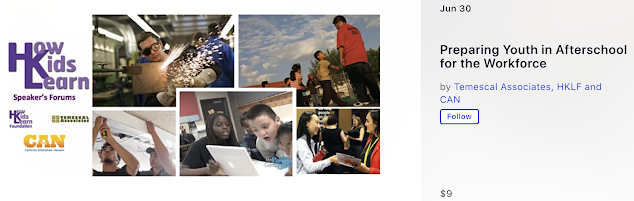
We know that when asked, older youth say they are most interested in acquiring the skills needed to get a job. Also, we know that as youth program leaders, it is our job to help prepare young people for success in adulthood, which includes creating opportunities to explore careers and gather work-based skills. Afterschool, sometimes referred to as Expanded Learning (ExL), is well positioned to help older youth to acquire these skills.

In this Speaker’s Forum webinar, Bill Fennessy (CAN) and panelists will provide information on and examples of a series of workshops on employment skills for youth. They will also discuss how high school expanded learning programs can employ their older youth in elementary expanded learning programs, thereby creating a pipeline for program staff to address the worker shortage.

To learn more and register, click here.


What We Can Do to Support Children with ADHD Features

Source: www.pexels.com By Sam Piha ADHD can be diagnosed by a mental health professional if a child presents with a number of features liste...