Showing posts with label Emotional Intelligence. Show all posts

Monday, September 15, 2025

How to Help Kids Understand and Manage Their Emotions

Source: Temescal Associates

By Sam Piha

According to Ariana Hoet, Ph.D, from Kids Mental Health Foundation, “The best way to teach kids to express emotions is by making the time to talk about them and normalizing all feelings.” Below Ariana suggests some activities that may be useful:

  • Check-in. Create a habit of conversation with your child. Find a time to talk every day, even if it’s just for a few minutes. This will let them know you care, you are listening, and you are there to support them. Conversations can help us understand how children are feeling and experiencing their environment. (See past Learning in Afterschool & Summer Blogs on Sharing Circles here.) 
  • Praise. When a child uses emotion words or an appropriate way to express themselves, take the time to notice and compliment them. For example, saying things like “Thank you for sharing you’re feeling angry instead of slamming the door.”
  • Validate. All emotions are normal and OK, even if you don’t think you would feel the same way. Say things like “I understand you’re nervous, we all feel that way sometimes” instead of dismissing how they feel (“there’s nothing here to be afraid about. It’s no big deal”). You can also share moments where you felt that emotion and how you coped with it.
  • Encourage Pause. Many parents share that their child will go ‘from 0 to 100’ so quick. What is likely happening is that the child is ignoring the cues from their body that they are starting to get upset. As adults, we can encourage children to be more mindful of their thoughts and feelings and to take a pause to check-in with themselves. Kids can ask themselves things like, “How does my body feel right now? What thoughts are going through my mind?” This will help them identify their emotion and express it in a helpful way, instead of letting the emotion take control of them.
  • Children learn by watching you. Express your emotions out loud so that they know it’s okay for them to do the same thing. Also, remember that children are learning to regulate, so they may still act out sometimes. When they express anger, sadness or another difficult emotion by misbehaving, responding with more negative emotion does not help. Respond with sympathy and try to coach them toward a better way to express themselves.” [i]

ACTIVITIES TO PRACTICE EXPRESSING EMOTIONS

Below are some activities suggested by Ariana Hoet. She writes,

  • “Have your children draw, write, or tell a story about a character who feels a strong emotion. How do they express themselves?
  • For younger children, puppets are a great way to create characters who can express different emotions and act them out in a playful way. Adults can help practice difficult events and how to identify the emotions and express them appropriately. 

We want to validate and normalize all emotions so that children feel comfortable talking about what they’re experiencing on the inside. Find those moments to check-in and always praise when you catch them using emotion words. Learn how you can teach children how to cope with those strong emotions.[ii] 


INTRODUCE FEELINGS USING MY PAL, LUKE

Temescal Associates and The How Kids Learn Foundation developed a number of “talking therapy dog” videos to help kids build a feeling vocabulary and that focuses on the question of ‘How are you feeling?’ and explains how to use a feelings chart. These videos can help introduce the subject of feelings. To view the My Pal, Luke videos, click here.


MORE ABOUT...

Ariana Hoet Ph.D
Ariana Hoet, Ph.D, executive clinical director of The Kids Mental Health Foundation, is the driving force behind our mission of providing educational resources that make sure mental health is a vital part of every child’s upbringing. 

Dr. Hoet believes all children and families should have a fair opportunity to be as healthy as possible. That enthusiasm extends into her desire for making sure that people of all backgrounds are accepted and celebrated – a passion born from her own experience as an immigrant to the U.S. from Venezuela.

Dr. Hoet works in Pediatric Primary Care where she serves primarily immigrant children. She is also a clinical assistant professor of Pediatrics in the Department of Pediatric Psychology and Neuropsychology at Nationwide Children’s Hospital and The Ohio State University, with a role in training the next generation of behavioral health professionals who will tackle the emerging mental health crisis in children.


RESOURCES:


END NOTES:
[i] Ariana Hoet, Helping Kids Express Emotions Appropriately
[ii] IBID

Monday, September 8, 2025

Identifying and Understanding Feelings

Source: www.pixarpost.com
By Sam Piha

There are so many aspects to young people’s mental health. One thing we know is that kids need to be able identify their feelings. Helping kids identify their feelings is a crucial part of social and emotional development and is core to dealing with trauma and being able to self- regulate. This involves helping them recognize different emotions, understand their causes, and learn healthy ways to express them. 

“All emotions are a normal part of life and it's good to express them. Children need to learn how to communicate their emotions, even those often seen as negative, like anger or sadness. Regular conversations help kids feel supported and understood, it also will encourage them to express their feelings. Encourage children to pause and reflect on their feelings.” [i]

HERE'S WHY IT'S IMPORTANT

It is critical that we help young people develop a language related to feelings and use this language to help identify their own feelings and those of others. This is core to developing empathy for others. Why is this important? Google AI states:

  • Emotional Regulation: Learning to identify feelings is the first step in emotional regulation, which is the ability to manage and control one's emotions. 
  • Improved Mental Health: Understanding emotions can help reduce anxiety, depression, and other mental health challenges. 
  • Stronger Relationships: When children can identify and understand their own emotions, they can also better understand and empathize with the emotions of others, leading to stronger relationships. 
  • Enhanced Self-Esteem: Being able to understand and express feelings helps children feel more in control of their emotions and reactions, leading to increased self-esteem and confidence. 
  • Increased Resilience: Children who can identify and manage their emotions are better equipped to cope with difficult situations and bounce back from setbacks. 
  • Better Social Skills: Understanding emotions helps children navigate social situations more effectively, leading to improved social skills and interactions. 
  • Academic Success: Emotional regulation skills are linked to school success and academic achievement.” [ii]  

TEACHING KIDS HOW TO COPE WITH THEIR EMOTIONS

Teaching kids how to cope with their emotions ids how to cope with their emotions is one of the best life skills you can give them. This is what we call emotion regulation, and you can start the moment they’re born! Our experts recommend reading in this order:

“Once children learn emotion words and start noticing as they feel them in the moment, it’s important they learn how to communicate what they are feeling. This can be hard because children sometimes mistakenly learn we should avoid certain emotions, like anger, sadness or loneliness.” [iii] 

EMOTION VOCABULARY

If we want young people to be able to identify their feelings, they need to first develop an emotion vocabulary. To do this, Google AI suggests:

  • Name the feelings: Help children learn to label their emotions using words like happy, sad, angry, scared, surprised, frustrated, etc. 
  • Use visual aids: Employing picture cards or charts with faces showing different emotions can be helpful.  

Source: My Pal, Luke

“A feelings chart is a visual tool that can help you identify and verbalize your feelings. Feelings charts can be helpful for both kids and adults and can take on a variety of forms. And while they’re helpful in healthcare settings, you can also use a feelings chart on your own or with your family at home.” [iv] - Ariana Hoet (To download a free Feelings Chart, click here.) 

  • Talk about feelings regularly: Create a safe space for open conversations about feelings in everyday situations. 
  • Use books and stories: Discuss the emotions of characters in books and how they might be feeling in different situations. 
  • Model emotional expression: Parents and caregivers can model healthy ways of expressing their own emotions. 
  • Use play: Role-playing, puppets, and dolls can be great tools for exploring emotions. 
  • Connect feelings to events: Help children understand what might cause them to feel a certain way. For example, ‘You seem sad because you didn't get to play outside today’. 
  • Notice body language: Pay attention to how emotions show up in their bodies (e.g., butterflies in the stomach for nervousness, a tight chest for anger).” [v] 


END NOTES:
[i] Ariana Hoet, Helping Kids Express Emotions Appropriately
[ii] Google AI, Why is it Important for Young People to Develop Language for Their Feelings
[iii] Ariana Hoet, Helping Kids Express Emotions Appropriately
[iv] Liz Talago MEd, How to Use an Emotions Chart to Track Your Feelings
[v] Google AI, Best Ways to Identify Feelings and Develop Emotional Vocabulary with Young People

Monday, May 2, 2022

A Brief History of the Social Emotional Learning Movement and the Challenges for Teens


By Sam Piha

The ideas around social emotional learning (SEL) are not new. The importance of social emotional learning is built into many early and more recent youth development program frameworks. However, few know the history of the SEL movement. 

According to Edutopia, “The roots of SEL are as old as ancient Greece. When Plato wrote about education in The Republic, he proposed a holistic curriculum that requires a balance of training in physical education, the arts, math, science, character, and moral judgment. ‘By maintaining a sound system of education and upbringing, you produce citizens of good character,’ he explained.

Preparing children to be responsible, productive, caring, and engaged citizens is a timeless pursuit that continues to be the goal of education today. How best to do this in our modern school system, however, is a relatively recent and still evolving area of study and practice, and it's the main question the SEL movement seeks to answer.

The concept of SEL was propelled into the popular culture in 1995 with a book by New York Times science reporter, Daniel Goleman. With support from Fetzer, Goleman published Emotional Intelligence: Why It Can Matter More Than IQ, in which he argued that character matters and, more significantly, the skills that build character can be taught.”

The history of the social and emotional learning (SEL) movement is the story of a simple, but powerful idea: What if education fully supported the social, emotional, and academic development of all children? Beginning in 1994, to address this question, CASEL was formed, growing from a small conference in New Haven to partnerships across the country and an audience around the globe. Since then, CASEL has served as a leader of the global movement and a trusted voice in the rapidly growing SEL field to make SEL an integral part of education.- The Collaborative for Academic, Social, and Emotional Learning (CASEL)


THE CHALLENGE OF SEL FOR TEENS


“Social and emotional learning approaches used with young children are unlikely to be effective with teens. As part of their natural urge to become independent, teenagers often will disengage from programs that directly teach skills. Using SEL programs that make teens feel valued. How can an SEL solution instill these feelings among a discerning teenage audience.” Professor David YeagerUniversity of Texas,  Austin


In Why High School SEL Programs Feel ‘Lame'—and How to Fix Them, author Stephen Sawchuk writes “The big problem, researchers and practitioners say, is that too much of what constitutes SEL learning feels patronizing to teenagers and fails to address their core psychological needs and motivations.

Programs that explicitly teach SEL skills generally have a good track record for younger children. But for older students, the paradigm looks different. It’s less explicit and requires creating leadership opportunities—formal and informal—where students will have to exercise their relationship and self-regulation muscles.
” 

Source: A World Fit For Kids

According to Professor David Yeager, a developmental psychology researcher at the University of Texas in Austin, “as part of their natural urge to become independent, teenagers often will disengage from programs that directly teach skills.” He suggests using SEL programs that make teens feel competent, autonomous, and valued. 


Integrating mindfulness activities into youth programs to benefit young people and educators has been a very popular educational concept. It appears in the literature on emotional regulation, trauma-informed practice, social emotional learning, grief-responsive teaching, and other leading topics. Youth who engaged in mindfulness activities report a greater sense of optimism and well-being, and a reduction in depression, anxiety, stress, and anger. They also benefit academically. Mindfulness activities are also a valuable “self-care” strategy for teachers and afterschool staff, and these activities can be tailored to be used in staff meetings.

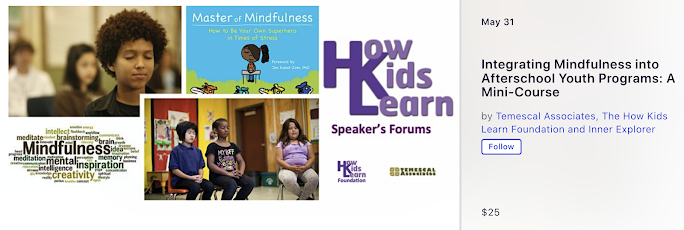
Integrating Mindfulness into Afterschool Youth Programs: A Mini-Course (2 hours) will teach the basics of mindfulness and provide multiple opportunities to experience its benefits through practice. It will provide attendees with hands-on training to support the integration of mindfulness activities in afterschool, curriculum, teaching tips and other tools. This mini-course will also include implementation examples as well as the challenges and benefits of integrating mindfulness into afterschool programs.

To learn more and register, click here.


Voices from the Field: The Importance of Teamwork and Collaboration Skills

Source: www.unsplash.com We are told by business leaders that soft skills, like team work and collaboration, are very important. We believe ...