Showing posts with label Karen Pittman. Show all posts

Monday, October 4, 2021

The Language of Inclusion and Equity

Source: www.researchgate.net

As we increase the dialogue around inclusion and equity, it is important that we examine the language and terms that we are using. Below are some terms that we often use as synonyms followed by their definitions and differences, courtesy of Karen Pittman and the Forum for Youth Investment (FYI). She later offers some of her thoughts on this. To read her full article, click here.

Equality | Equity. Equality is a good goal given where we are, but it is not at all a sufficient one. Equity is achieved when all kids have a shot at getting the essentials they need to succeed because 1) the differences in their starting points have been taken into account, and 2) the systemic or institutional barriers to their success have been addressed. People often use a baseball analogy to get at equality vs. equity. Equity is achieved when the playing field is leveled and the fences are taken down, providing young people with real opportunities to get into the game. 

Access | Quality. Access is necessary, but far from sufficient and sometimes harmful. Providing young people with opportunities to get into the game is only useful if these opportunities are appropriately structured to support youth success. Opportunities that are mismatched to youth’s capacities and motivations significantly reduce the chance that young people feel that they matter and want to put in the effort to master the game. 

Source: www.sfcenter.org
Completion | Readiness. Grades and diplomas have become necessary tickets for youth success, but they are not sufficient. 40 percent of employers report that high school graduates lack the competencies they need to succeed at entry-level jobs – such as responsibility, initiative, problem- solving, teamwork and a strong work ethic. When learning opportunities lead too heavily with content and don’t create safe and engaging contexts, youth may gain rote knowledge but miss the opportunity to name, practice and master the skillsets and mindsets that economists now confirm are more important for adult success than academic grades. 

Readiness, according to the Merriam-Webster Dictionary, is defined as 1) being willing to do something, and 2) being prepared to do something. This dual definition is important. To embrace the opportunities and survive the challenges that come their way, young people need to be willing and prepared to tackle things they cannot anticipate. This means that every opportunity to learn new content (e.g., how to bake a pie, hit a double, build an engine) is also an opportunity to use the skills and knowledge they have. Young people who “hit the wall” when trying to learn something new have not only internalized the idea that they can’t learn, they have missed the opportunity to use and improve the skills employers are looking for.
 
Source: https://i.imgur.com/aJNHjPq.png
Young people who have repeatedly hit the wall and found that no one notices, no one is surprised, or no one helps, tune out, act out or drop out. Ultimately, they lose out on opportunities they could easily have been prepared for. The cost to them, and to the country, is absurdly large. This is not just because these young people are more likely to earn less or stray into trouble more. It is because these young people are the ones best suited to change the odds in their communities. They are willing, if asked. They can be ready, if supported. History shows that they are able. 

To tackle the country’s readiness problem, we also have to address equity issues. And when the path to readiness goes through quality, young people not only build skills and competencies, they develop a sense of agency and a sense of urgency to take action to change the odds for themselves and their communities.  


Karen J. Pittman
served as the President & CEO of the Forum for Youth Investment (FYI) until February 2021 then transitioned to a senior fellow role to dedicate more of her time and energy to thought leadership. FYI is a national nonprofit, nonpartisan “action tank” that combines thought leadership on youth development, youth policy, cross-system/cross-sector partnerships and developmental youth practice with on-the-ground training, technical assistance and support. Karen is a respected sociologist and leader in youth development. Prior to co-founding the Forum in 1998, she launched adolescent pregnancy prevention initiatives at the Children’s Defense Fund, started the Center for Youth Development and Policy Research, and served as senior vice president at the International Youth Foundation. She was involved in the founding of America’s Promise and directed the President’s Crime Prevention Council during the Clinton administration.


We are hosting a webinar/ Speaker's Forum on Wednesday, October 6, 2021 from 10:00am- 12:00pm (PST) entitled, Youth Civic Engagement and Activism in Afterschool. The purpose of this webinar is to inform and encourage expanded learning programs to offer youth opportunities to be civically engaged. It is our intention to capture and share valuable and intriguing ideas and information. To learn more and register, click the banner below.


We are hosting another webinar/ Speaker’s Forum on Wednesday, October 20, 2021 from 10:00am- 12:00pm (PST) entitled, Engaging Youth as Workers in Afterschool. The purpose of this webinar is to inform and encourage afterschool programs to offer youth opportunities to serve as workers within these programs. It is our intention to capture and share valuable and intriguing ideas and information to help programs enlist youth as workers. To learn more and register, click the banner below.


Tuesday, July 6, 2021

SEL and Character Building Program Practices

By Sam Piha

There is great agreement that social emotional learning skills are very beneficial in preparing youth for success. While we hear a lot about the “why” of SEL and character building, little is heard about the application (the “what” and “how”) within expanded learning (afterschool) programs. Expanded learning practices need to be uplifted so that the field can begin to see what good character/SEL practices look like.
Source: CASEL

We were interested in how programs promote these skills, so we put out an announcement asking afterschool programs to submit a program practice. We compiled these practices into a paper entitled, “Promising Activities, Practices and Resources: Promoting SEL and Character Skills in Expanded Learning Programs”. Each submission included a description of the submitting organization, a contact person within the organization, and a description of the practice or activity (i.e. purpose, time needed/frequency, target audience, and supporting resources).
The concept of social emotional learning has come to a frenzy in the past couple of years. Where does afterschool fit in to all of this? You would hope that we’d be right at the forefront. We’ve been doing this for years we know how to do it. – Karen Pittman, Forum for Youth Investment
Below are some practices that programs submitted:

Source: Temescal Associates
EDUCARE- Guided Visualizations. Visualizations are guided around a particular theme. There are a variety of mindfulness and centering practices they enjoy using and have found valuable. An example theme: Gratefulness. Youth close their eyes and review on an imaginary movie screen, images of who and what they are grateful for or appreciate - friends, family members, their health, people who support or inspire them, opportunities they have at school or elsewhere, etc.

Source: Ever Forward Club
EVER FORWARD CLUB- Mask Making. Youth are given a handout and asked to follow 3 steps anonymously. They are also asked to keep their eyes on their own paper. 1. Draw a mask on the left side. 2. Write 3 words on the front of the mask that represent qualities they let people see. 3. Write 3 words on the back of the mask that represent the things they don’t usually let people see. Adult leaders collect the masks and then have a few volunteers read a few of the responses anonymously. Youth are then invited to share how it felt hearing about the front and back of the masks of their peers. This would be a good time to discuss their commonalities and differences. Deeper processes can be created depending on the level of safety that has been generated in the room.

Source: LA's BEST
LA’S BEST- Sanford Harmony Cards. These cards provide engaging questions and activities to explore with a "buddy". The students then get to know each other and connect, which prepares them to handle future challenges and conflicts and opportunities to collaborate in a meaningful and constructive way. Sanford Harmony also provides recommendations of how and why to pair students together. The "Meet Up" strategy provides a way to strengthen a program's daily routine by incorporating practices that allow the entire group of students to explore how they treat each other and how they communicate with one another.

CALSAC- Regular Check Ins. This is an intentional space created for staff and youth to share how they are showing up in that space. Participants typically sit or stand in a circle during the check in. Next, a volunteer is asked to start and then chooses a direction for participants to follow. The information shared allows everyone in the room to understand what may be going on for them and honor that each individual may be coming into the space with varying life experiences. This allows everyone to see each other more wholly and create safety for people to be authentic in the space. It is recommended to create an opportunity for everyone to lead the check-in. (From Temescal Associates: It is recommended that each speaker holds a talking piece, such as a feather or item chosen by the group. The talking piece is held by the person speaking and then passed around the circle. Those not holding the talking piece are engaged in active listening.)

Source: Greater Good Science Center
GREATER GOOD SCIENCE CENTER- Gratitude Letter. In this activity, youth are guided to complete the Gratitude Letter practice, where they write a letter of thanks and then try to deliver it in person. To introduce the activity, the following script may be helpful: 'Most everyone enjoys thanks for a job well done or for a favor done for a friend, and most of us remember to say “thank you” to others. But sometimes our “thank you” is said so casually or quickly that it is nearly meaningless.' In this activity, you will have the opportunity to express your gratitude in a very thoughtful manner. Think of the people—parents, friends, coaches, teammates, and so on—who have been especially kind to you but whom you have never properly thanked. Choose one person you could meet individually for a face-to-face meeting in the next week. Your task is to write a gratitude letter (a letter of thanks) to this individual and deliver it in person. The letter should be specific about what he or she did that affected your life. It is important that you meet him or her in person. Don’t tell this person, however, about the purpose of this meeting. This activity is much more fun when it is a surprise to the person you are thanking.
-----------------


Tuesday, April 27, 2021

Leveraging Summer Programs: A Downpayment on Long- Term Change

Source: www.afterschoolalliance.org

Some young people are now returning to school, in a face- to- face or hybrid model. This after a full year of isolation. This fall youth are likely returning to school full time. Summer programs will be an important gateway to returning to school and healing from a year of isolation. 

Below we offer excerpts from an article authored by Karen Pittman with the Forum for Youth Investment on the importance of summer programs in 2021. Please note: this is just an excerpt from her article posted from Medium.com. You can read the entire article here.

Almost a full year into the COVID-19 pandemic, we once again find ourselves at a critical juncture. As we head into the spring, schedules are still uncertain. But there is growing confidence schools will reopen in the fall. 

With this anticipation of reopening, there is broad commitment to build back better. There is increased recognition of the role that community partners and families can play and that the impact of the last year on teens and young adults will have lasting ramifications. COVID and the racial reckonings have exposed inefficiencies and inequities. This means we are now face to face with a tangible opportunity to challenge and support school districts and community partners in creating equitable learning and development ecosystems that unleash the potential of all learners, recognize the power of all committed adults, and optimize all learning settings and approaches. 

If we are truly intent on not going back to normal, we must recognize the interdependence of systems and center on young people and their families. To do so, school and community leaders must work collaboratively to reflect and take stock to identify innovations and understand roadblocks, look at the ways school, family, and community leaders worked or did not work together, and hear the lessons learned from students, families, and front-line staff. 

Source: www.medium.com
While we saw pockets of exceptional supports for young people and innovation, for the most part young people went without opportunities to connect in meaningful relationships, without opportunities for engaging learning experiences, and without summer jobs to earn money critical to their future goals. 

Summer 2021 shouldn’t look like 2020. The young people across the nation deserve more. It also shouldn’t look like summers of years past. Summer has traditionally been a time when schools stepped back, families stepped in and community organizations stepped up. This division of labor made sense because the stakes are not only lower in summer (no requirements, no grades, no tests) and the success metrics are different (keep academic skills sharp while having fun, mastering new skills, taking on family responsibilities, having different experiences). If we are intent to Build Forward Together our roles in and focus on summer will have to shift. 

This summer can begin to preview “the new normal” and to make a down payment toward the equitable learning ecosystems we hope to create. Where instead of some stepping back and others stepping in, we see communities working collaboratively. We are confident there are many communities that see value in finding some way to use Summer 2021 to document, design, test, or even scale up some ways to BUILD FORWARD TOGETHER to make a down payment on the idea that by the summer of 2022, every student should have equitable opportunities for learning and development because every young person and their family has the support needed to create learning pathways across the ecosystem that are attractive, accessible, affordable, appropriate, affirming, and assessable. 

The Readiness Projects are challenging local school, government and community leaders to: 
  1. Use summer as a low-stakes testing ground to document, test, and scale different ways to leverage school, family, and community assets in support of accelerated learning and development that can help us build forward together post-COVID. 
  2. Prioritize children and youth most challenged by the pandemic who are also the least likely to have resources for summer programs. 
  3. Place focused attention on teens, especially those whose success trajectories are threatened. 
  4. Ask how you will know how many young people had great summers and why, so you can bring that data into the school year and have a baseline for improvement in 2022. 
After a full year of learning isolation, young people are just now returning to school, in a face- to- face or hybrid model. This Fall youth are likely returning to school full time. 

Summer youth programs will be an important gateway to returning to school and healing from a year of isolation. But how should we be thinking about our gateway summer youth programs? What do youth need from their summer program experiences? How will this year's summer programming differ from past years?

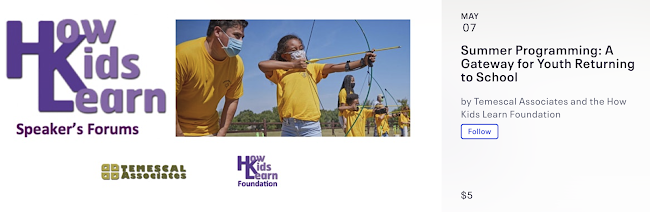
On Friday, May 7, 2021, we are sponsoring a Speaker's Forum/ webinar discussion on this topic. It will be facilitated by Ayala Goldstein (Director of Programs, California School- Age Consortium). She will be joined by Aaron Dworkin (CEO of National Summer Learning Association), Autrilla Gillis (Director of Expanded Learning, ISANA Academies) and other summer program experts and practitioners who will be sharing their thoughts and responding to your questions. To register and learn more, click here.


Karen J. Pittman
served as the President & CEO of the Forum for Youth Investment (FYI) until February 2021 then transitioned to a senior fellow role to dedicate more of her time and energy to thought leadership. FYI is a national nonprofit, nonpartisan “action tank” that combines thought leadership on youth development, youth policy, cross-system/cross-sector partnerships and developmental youth practice with on-the-ground training, technical assistance and support. Karen is a respected sociologist and leader in youth development. Prior to co-founding the Forum in 1998, she launched adolescent pregnancy prevention initiatives at the Children’s Defense Fund, started the Center for Youth Development and Policy Research, and served as senior vice president at the International Youth Foundation. She was involved in the founding of America’s Promise and directed the President’s Crime Prevention Council during the Clinton administration. 

Tuesday, July 14, 2020

Re-Opening Programs and More

By Sam Piha

There is a lot of discussion and debate about how and when to re-open schools and youth programs. For youth programs that are located within schools, it is important that afterschool leaders stay abreast of the current thinking on this topic and ensure that any re-opening encompasses youth development values. Because the pandemic situation is very fluid, ideas about re-opening schools are very dynamic.


“As you prepare to welcome students and adults back to school, you face the layered impact of schools closures, the pandemic, racial inequities amplified by nationwide mobilization, and more.”
-CASEL Newsletter, 7/9/20 


The Collaborative for Academic, Social and Emotional Learning (CASEL) has released a roadmap for re-opening schools. CASEL collaborated with over 40 leading organizations in developing 4 critical practices:

  1. Take time to cultivate and deepen relationships, build partnerships, and plan for SEL.
  2. Design opportunities where adults can connect, heal, and build their capacity to support students.
  3. Create safe, supportive, and equitable learning environments that promote all students’ social and emotional development.
  4. Use data as an opportunity to share power, deepen relationships, and continuously improve support for students, families, and staff.


"As we sit down and really try to figure out what is going to be a long haul of reopening slowly...we're going to need such a different approach to the traditional 'show up and sit in your seat.' We need all partners at the table together."

-Karen Pittman
President & CEO, Forum for Youth Investment

Below we have offered a link to this entire report as well as some other resources. (Because the plans for re-opening is developed locally, it is important that afterschool leaders track their local plans.)


IN CASE YOU MISSED IT...

  • Two medical students, Samantha Harris and Devon Scott, recently wrote a children’s book about coronavirus, Why We Stay Home, to help parents communicate with their children about why so many families across the nation have been staying home. For a free download of the book, click here. To access video read aloud, click here. To view an interview with the authors on PBS News Hour, click here.


Tuesday, January 29, 2019

From a Nation at Risk to a Nation at Hope

By Sam Piha


On Jan. 15, Aspen's National Commission on Social, Emotional, and Academic Development released a report, From a Nation at Risk to a Nation at Hope: Recommendations from the National Commission on Social, Emotional, & Academic Development


This report calls on all of us to ensure that all youth have access to quality social and emotional learning (SEL). We advise anyone who works with youth, whether in the classroom or in the community, to read this report. View the full report and its complementary research, practice, and policy briefs at NationatHope.org


Karen Pittman
When we interviewed Karen Pittman (Forum for Youth Investment and Aspen Report Commissioner) for the History of Afterschool documentary, we asked her about the rise of SEL and where afterschool fits in. She responded, “The concept of social, emotional and academic development has really sort of come to a frenzy in the past couple of years. It's certainly come to the attention of schools over the past decade.

Where does after school fit into all this? You would hope that we'd be right at the  forefront, saying, ‘We've been doing this for years. We know how to do it.’

Unfortunately, because we've been calling this youth development, when the K-12 field started to say, ‘We need to do social and emotional learning’, they were developing specific curricula around social and emotional learning, and we have a little bit of a language difference with K-12.

We think on the after school side that we know that these are the skills that young people are building, and we have had a focus on making sure that we're meeting those standards for developmental settings, and what we talked about is building quality programming. We’ve had a little bit of a hiccup in making sure that K-12 educators understand that when we talk about quality programming, we're talking about creating settings where these skills can happen.” 

Ms. Pittman also issued a letter to youth development leaders and funders regarding how best to leverage this report by the commission. You can read it here. You can also read commentaries by New York Times columnist David Brooks, by Rick Hess and Tim Shriver, and by Chester Finn

Wednesday, January 16, 2019

The History of Afterschool in America

By Stacey Daraio

Stacey Daraio
Afterschool programs are now a part of the community landscape. But, few are aware that afterschool has been around for over a hundred years, making important contributions to families and the larger society. 

To ensure that afterschool stakeholders appreciate the long history of afterschool youth programs in America, Temescal Associates and the How Kids Learn Foundation have created a video to document this history. In this documentary, we attempt to tell the full story of the history of afterschool, it’s important role as a unique institution serving low-income youth. It also looks at the contemporary afterschool field, and look to the future of afterschool programs.


Below we interview Sam Piha, Co-Director of Temescal Associates and producer of the documentary, The History of Afterschool in America.

Q: What inspired you to produce this documentary?
A: I was initially inspired by Robert Halpern’s book, Making Play Work. In this book, he offered a detailed history of out-of-school programs serving the needs of low-income youth. After reading this book, I created a series of Power Point slides on the history of afterschool, which I included in all of my presentations to afterschool stakeholders. Youth workers always responded with great interest and excitement in learning that they belong to something that was an important part of American history. From those experiences, I decided it was important to create a video documentary on the subject. 

Q: How was The History of Afterschool in America made?
A: This project took several years to complete. We identified nearly 20 afterschool leaders across the country and attained their agreement to participate in video interviews. We then contacted local youth media programs across the country that would lead these video recorded interviews for us. After researching this subject, we prepared a list of interview questions. We also simultaneously raised funds through private donations and small grants to begin this process. Change Agent Productions, a social enterprise dedicated to providing high quality media services while providing workforce opportunities for teens, agreed to assist us with producing a brief trailer and the final 60-minute documentary. 

Q: Who were the afterschool leaders that you interviewed? 
Karen Pittman
A: We were interested in enlisting leaders at the national, state, and local levels. National leaders included Karen Pittman (Forum for Youth Investment), Ellen Gannett (NIOST), Robert Granger (formerly WT Grant Foundation), Terry Peterson (Afterschool Alliance), Jodi Grant (Afterschool Alliance), and Pedro Noguera (UCLA), who served as our narrator. State leaders included Bonnie Reiss (USC), Brian Lee (Fight Crime - Invest in Kids), Jennifer Peck (Partnership for Children and Youth), and Sylvia Yee (formerly Haas, Jr. Fund). We also included interviews with youth, program and technical assistance leaders. 

Q: How is The History of Afterschool in America structured? 
A: The 60-minute documentary is broken into 12 brief chapters. This allows the flexibility to select those chapters that are most relevant to the audience. Chapters 1 through 3 examine the social upheaval beginning in the late 1800s, which served as the pre-conditions for the early afterschool movement. Chapters 4 and 5 introduce the growing need for child supervision, leading to the playground movement and the rise of afterschool youth programs. Chapters 6 through 12 look at the milestones and events that gave rise to the modern and greatly expanded afterschool movement we see today, and important program concepts and trends. 

Q: How can this documentary be used and who is the intended audience?
A: The intended audience includes afterschool staff and their stakeholders, older youth, and adults in higher education studying for a career working with young people (education, social work, leisure studies, child and adolescent development, etc.). This documentary is an excellent resource to orient and train new and existing youth program staff. 


Q: How can afterschool stakeholders use and/or promote The History of Afterschool in America documentary?  
A: 
  • Sponsor a viewing: Show this documentary to interested audiences. Because this documentary is lengthy, users may want to share it in its entirety, but in more than one sitting. 
  • Trailer: Build awareness of this documentary by showing the 2.5 minute trailer at conferences and other gatherings of afterschool stakeholders. 
  • Staff development: This documentary is an excellent resource to orient and train new and existing program staff.
  • Newsletters and social media: Organizations and individuals can promote awareness of this resource through their newsletters and social networks. 
  • Higher education: Instructors can show this documentary to students who are studying to enter a career working with youth. 

Q: Are there tools to assist those who want to use or promote this documentary? 
A: We are in the process of developing a media kit and learning guide for this purpose. The learning guide includes activities and discussion questions. This guide also includes a list of keywords and their definitions, and a historical timeline. The media kit will include information on the documentary such as a Q&A and sample text for use in newsletters, social media posts, etc. 

Q: How can people view and access the trailer and full documentary?
A: These can be downloaded for free. The documentary can also be purchased on DVD by contacting Temescal Associates

--------------


Sam Piha is the founder and principal of Temescal Associates, a consulting group that was formed in 2001. It is dedicated to building the capacity of leaders and organizations in education and youth development. Sam began his career in 1974 as an afterschool worker, an experience that led to 10 years of classroom teaching, and later work as a child and family counselor and school social worker. Between 1989 and 2001, Sam developed and managed school-based youth programs at the regional and national levels.


Wednesday, February 3, 2016

Looking Back: Some of Our Favorite Interviews

By Sam Piha


Sam Piha
The Learning in Afterschool & Summer project posted our first blog post on October 6, 2010. Since then, we had attracted 142,000 views. The purpose of the blog is to interview thought leaders in the field of afterschool and summer, alert readers to important developments, and provide commentary and an exchange between readers. 

Some of our colleagues have expressed a concern that because so many afterschool workers are young, underpaid, and have a short tenure, they “can’t handle” so much information. We are mindful of this concern, but are convinced that many of the youth worker professionals have made this work a vocation and deserve to have access to leading thinkers and researchers. 

Below (in no particular order) are some of our favorite interviews that we have published on our blog. We urge readers to click on these to go back and view these interviews. (There are many other great blog posts that are not included in this list.)


Wednesday, September 19, 2012

Expanded Learning Requires Expanded Thinking: An Interview with Karen Pittman, Part 2

By Sam Piha 

We have been following the national discussion of "expanded learning". We believe that expanded learning opportunities should be developed by both educators and out-of-school time leaders. Further, we believe that any discussion of expanded learning time has to include clear learning principles that explain how children best learn so we can shape these experiences accordingly. The Learning in Afterschool & Summer project is focused on defining these learning principles.

Karen Pittman
Below is an interview on this topic with Karen Pittman, President and CEO of the Forum for Youth Investment. This interview with the FrameWorks Institute is an excerpt of one that the Forum posted on their website, which can be found here in its entirety. We offer this interview in 2 parts. 


Q: What does a classroom that promotes intrinsic motivation look like? 

A: In an engaging classroom you will see desks pushed together, more team time, students working on group projects where the project on one table may be completely different from the project on the next table. Essentially, this is about effective project-based learning. Young people need opportunities to make meaningful decisions about topics they want to learn about, and then [they need] the supports to do something with that topic.  

Once you show students that they can really learn whatever they want to learn and they experience that sense of mastery, they will learn because they enjoy feeling that sense of mastery. In that kind of environment, young people will trust an adult who says, “You need to learn this because …”  


Q: There seems to be a notion in the education system that fairness is about having clearly defined standards and everyone learning the same thing. Do you see that as a problem?  

A: Standards are good. We use standards in our work for all kinds of things. There is value, however, in broadening what gets included in standards, and providing genuine opportunities for students to get there through different paths. So we need youth to have basic reading and math skills, but we also need them to develop teamwork, communication and problem-solving skills, financial literacy, a solid work ethic. These are competencies that have multiple uses once you develop them and that employers say their incoming workforce often lacks.  

There are examples of schools paying close attention to both content and competence. In the New Tech Network’s high schools, half of a student’s course grade is based on mastery of the content, and the other half is for improvement in different skills like teamwork, communication and initiative. Teachers’ lesson plans address both content and the development of those core competencies.   

Q: What do you think about the separation between the learning that goes on inside vs. outside of school?  

A: When kids are in preschool, we stay true to an expanded definition of learning. Learning in the early years includes all of those things that allow kids to be curious and navigate their environment, and teachers and parents are considered equal partners in learning. When kids become school-aged, the definition gets restrictive. The word “learning” gets captured by school – and then suddenly everything else isn’t thought of as learning. 

When an uncle teaches his nephew how to tune an engine, does that get counted as learning? Maybe. Does it get the same respect as the learning that occurs when a teacher teaches you how to do long division? No. And yet when we do a simple exercise and ask people to reflect on the most powerful learning experiences they had as a young person, their answers are rarely about something they learned in school.  

Q: What kinds of changes do you think need to happen in order to improve the quality of our education system?   

A: Public education is absolutely critical to the American ideal, but there is room for reinvention. Look at other large public systems, like public health. The CDC [Centers for Disease Control] has reinvented itself many times, both in terms of how public health is defined and how the system is designed to address it. We haven’t done the same level of redefinition and reinvention in public education. The system is defined more by buildings and schedules than by student learning needs and desires. 

I would want to step back and think about what really works for kids and families. Research on everything from how kids learn to adolescent sleep patterns demonstrates that the system as currently conceived isn’t working for many kids. But we have difficulty getting outside of the box. I’d like to get to a public education system that has standards, expectations and resources, but a little more flexibility in terms of how and where learning happens. We have the expertise and the technology to make public education a very different system while keeping its core intact.  


___________________________________
Karen Pittman is a co-founder, President and CEO of the Forum for Youth Investment. She started her career at the Urban Institute, conducting numerous studies on social services for children and families. Karen later moved to the Children’s Defense Fund, launching its adolescent pregnancy prevention initiatives and helping to create its adolescent policy agenda. In 1990 she became a vice president at the Academy for Educational Development, where she founded and directed the Center for Youth Development and Policy Research and its spin-off, the National Training Institute for Community Youth Work.
In 1995 Karen joined the Clinton administration as director of the President's Crime Prevention Council, where she worked with 13 cabinet secretaries to create a coordinated prevention agenda. From there she moved to the executive team of the International Youth Foundation (IYF), charged with helping the organization strengthen its program content and develop an evaluation strategy. In 1998 she and Rick Little, head of the foundation, took a leave of absence to work with ret. Gen. Colin Powell to create America’s Promise. Upon her return, she and Irby launched the Forum, which later became an entity separate from IYF.

Wednesday, September 12, 2012

Expanded Learning Requires Expanded Thinking: An Interview with Karen Pittman, Part 1

By Sam Piha 

We have been following the national discussion of "expanded learning". We believe that expanded learning opportunities should be developed by both educators and out-of-school time leaders. Further, we believe that any discussion of expanded learning time has to include clear learning principles that explain how children best learn so we can shape these experiences accordingly. The Learning in Afterschool & Summer project is focused on defining these learning principles.

Karen Pittman
Below is an interview on this topic with Karen Pittman, President and CEO of the Forum for Youth Investment.  This interview with the FrameWorks Institute is an excerpt of one that the Forum posted on their website, which can be found here in its entirety. We offer this interview in 2 parts. 

Q: In education circles there is a lot of talk about what kids learn and how learning happens. Is the expanded learning agenda getting the where and when questions on the table?  

A: We haven’t asked the how and why questions about learning enough. So the when and where questions either don’t come up or they don’t stick. The conversation about extended learning is still very school-centric and bound within a fairly restrictive definition of how learning happens and why.  

Learning is an intrinsic thing that humans do. If kids are awake – whether they are two or 12 – they’re learning and developing. Learning is intrinsically satisfying. But that can get lost when it is defined only in terms of academic content. When learning becomes too defined by content, the conversation about expanding when and where kids learn becomes a conversation about where to stick the content, and the intrinsic side can get lost.  

School only fills a small piece of that developmental space, but we spend very little time trying to understand, assess, improve and coordinate the learning that’s going on in the rest of that space. As long as our definition of learning is driven by formal education and things like the common core and standardized tests, we’re unlikely to capitalize on the opportunity presented by the rest of that time and space.  
  
Q: What are the first steps to de-compartmentalizing learning?  

A: One way is to put the learning that happens through high-quality programs and opportunities outside of school on par with K-12 learning. Another way is to bring [into schools] more of what these other practitioners have figured out about effective learning opportunities.  


Reed Larson’s research on intrinsic motivation is relevant here. In one study, middle school kids were given beepers so the research team could track what they were doing and how they were feeling. Each time he [Larson] beeped them, they responded to a couple of quick questions about what they were doing and their levels of concentration and motivation. When kids were in class, they weren’t motivated and they weren’t concentrating. When they were with friends, they were motivated but not concentrating. When they were playing sports, they reported relatively high levels of both motivation and concentration. The highest levels of concentration and motivation were reported when youth were in structured informal learning environments where they had made choices about what they were doing and how to do it.  


This doesn’t mean we shut down schools and send everyone to youth programs, but it should make us think about how to bring higher levels of intrinsic motivation and engagement into schools. Schools are not monolithic. Some students certainly experience more engaging, motivating experiences than others. If you beeped kids who were in a magnet science program, they would probably be engaged. They would likely be in a different type of learning environment than kids in, say, a remedial English course. The most gifted and talented kids get more opportunities for this kind of engagement. Far too many others experience the other end of the spectrum.  

I would flip the conversation about learning. The underlying assumption is that the stuff we want kids to learn is like medicine. If left to their own devices, they wouldn’t learn it.  We need to spend more time understanding how we can support intrinsic motivation.   


___________________________________
Karen Pittman is a co-founder, President and CEO of the Forum for Youth Investment. She started her career at the Urban Institute, conducting numerous studies on social services for children and families. Karen later moved to the Children’s Defense Fund, launching its adolescent pregnancy prevention initiatives and helping to create its adolescent policy agenda. In 1990 she became a vice president at the Academy for Educational Development, where she founded and directed the Center for Youth Development and Policy Research and its spin-off, the National Training Institute for Community Youth Work.
In 1995 Karen joined the Clinton administration as director of the President's Crime Prevention Council, where she worked with 13 cabinet secretaries to create a coordinated prevention agenda. From there she moved to the executive team of the International Youth Foundation (IYF), charged with helping the organization strengthen its program content and develop an evaluation strategy. In 1998 she and Rick Little, head of the foundation, took a leave of absence to work with ret. Gen. Colin Powell to create America’s Promise. Upon her return, she and Irby launched the Forum, which later became an entity separate from IYF.

Understanding Attention-Deficit Hyperactivity Disorder

Source: www.pexels.com By Sam Piha PURPOSE The purpose of this blog is to advance understanding of Attention- Deficit Hyperactivity Disorder...