Showing posts with label Paul Tough. Show all posts

Wednesday, February 3, 2016

Looking Back: Some of Our Favorite Interviews

By Sam Piha


Sam Piha
The Learning in Afterschool & Summer project posted our first blog post on October 6, 2010. Since then, we had attracted 142,000 views. The purpose of the blog is to interview thought leaders in the field of afterschool and summer, alert readers to important developments, and provide commentary and an exchange between readers. 

Some of our colleagues have expressed a concern that because so many afterschool workers are young, underpaid, and have a short tenure, they “can’t handle” so much information. We are mindful of this concern, but are convinced that many of the youth worker professionals have made this work a vocation and deserve to have access to leading thinkers and researchers. 

Below (in no particular order) are some of our favorite interviews that we have published on our blog. We urge readers to click on these to go back and view these interviews. (There are many other great blog posts that are not included in this list.)


Wednesday, February 6, 2013

Paul Tough, How Children Succeed and Non-cognitive Skills

By Sam Piha

Reporter, Paul Tough, recently authored a book entitled How Children Succeed.  It has stimulated conversation among educators and afterschool and summer providers. This book can be ordered by clicking here, and Paul can be heard on a recent This American Life radio broadcast by clicking here
Paul Tough, Author, How Children Succeed

Mr. Tough was unable to attend our recent How Kids Learn II conference but offered the responses below, many of which are drawn from his own website

Q: What made you want to write How Children Succeed?

A: In 2008, I published my first book, Whatever It Takes, about Geoffrey Canada and the Harlem Children’s Zone. I spent five years reporting that book, but when I finished it, I realized I still had a lot of questions about what really happens in childhood. How Children Succeed is an attempt to answer those questions, which for many of us are big and mysterious and central in our lives: Why do certain children succeed while other children fail? 

Q: Where did you go to find the answers?

A: My reporting for this book took me all over the country, from a pediatric clinic in a low-income San Francisco neighborhood to a chess tournament in central Ohio to a wealthy private school in New York City. And what I found as I reported was that there is a new and groundbreaking conversation going on, out of the public eye, about childhood and success and failure. It is very different than the traditional education debate. There are economists working on this, neuroscientists, psychologists, medical doctors. They are often working independently from one another. They don’t always coordinate their efforts. But they’re beginning to find some common ground, and together they’re reaching some interesting and important conclusions.

Q: What’s new?

A: Until recently, most economists and psychologists believed that the most important factor in a child’s success was his or her IQ. This notion is behind our national obsession with test scores. From preschool-admission tests to the SAT and the ACT – even when we tell ourselves as individuals that these tests don’t matter, as a culture we put great faith in them. All because we believe, on some level, that they measure what matters.

But the scientists whose work I followed for How Children Succeed have identified a very different set of skills that they believe are crucial to success. They include qualities like persistence, curiosity, conscientiousness, optimism, and self-control. Economists call these non-cognitive skills. Psychologists call them personality traits. Neuroscientists sometimes use the term executive functions. The rest of us often sum them up with the word character.

Q: Who are the big thinkers behind these ideas?
Economist, James Heckman

A: The central scholar in this movement is James Heckman, a Nobel prize–winning economist at the University of Chicago. He’s the one who did some of the first work identifying and quantifying these non-cognitive skills. And in recent years he has been working to pull together thinkers from lots of different disciplines — psychologists and economists and neuroscientists and geneticists — to get them to share ideas and find connections between their theories.

The book includes plenty of others doing important research, from Angela Duckworth, a psychologist at the University of Pennsylvania who studies self-control and grit; to Michael Meaney, a neuroscientist in Montreal who found a remarkable connection between a mother rat’s licking-and-grooming habits and the future success of her offspring; to Suniya Luthar, a psychology professor at Columbia University who has written about the unique stresses faced by kids who grow up in affluence.

Q: How do these ideas play out in the lives of actual kids?

A: There’s a lot of science in How Children Succeed, but much of the book is taken up with stories of young people trying to improve their lives, and the teachers and counselors and doctors trying to help them, often using unorthodox methods.

Sometimes these kids are achieving great things: Take James Black Jr., a student who just graduated from Intermediate School 318 in Brooklyn. He grew up in a low-income neighborhood, he has siblings who’ve spent time in prison, and he doesn’t do great on traditional tests of cognitive ability. But he might be the best thirteen-year-old chess player in the country. I followed him for a year, trying to figure out why he’s so successful.
James Black, Jr. was featured in a recent documentary
entitled Brooklyn Castle

When I started my reporting, I thought what everyone thinks: that chess is the ultimate intellectual activity, a skill inextricable from IQ. But to my surprise, I found that many chess scholars now believe that chess success has more to do with non-cognitive skills than with pure IQ. James’s chess teacher at IS 318 is a woman named Elizabeth Spiegel. She’s a great teacher, and I think what makes her so good is that she’s able to help her students develop their non-cognitive skills to high levels — in James’s case, to very high levels.

__________________________________
A contributing writer to the New York Times Magazine, Paul Tough is also the author of Whatever It Takes: Geoffrey Canada's Quest to Change Harlem and America, which focuses on the steps necessary to improve the lives and education of underserved children. Through the case study of the Harlem Children's Zone, Tough describes the inspiring struggle to establish a way to combat poverty that could be replicated nationwide. Tough has also contributed to This American Life and The New Yorker, where he has honed his focus upon education, poverty, parenting, and politics.

Wednesday, January 16, 2013

All About Character


Long ago, I had the pleasure of co-teaching with Tom Little for 2 years. Most recently, Tom and Park Day School co-hosted a screening of Brooklyn Castle, a feature film that details the grit of a national championship chess team from a public middle school in Brooklyn. This chess team was also featured in a new book by Paul Tough, which Tom comments on below. We will interview Paul Tough in an upcoming post. - Sam Piha

By Guest Blogger, Tom Little, Head of School at Park Day School

Tom Little
Much is being made these days about character. Especially those virtues of character related to grit, perseverance and all manner of a person’s capacity to persist and endure. Educators across the country are making waves in schools and school districts on the heels of the release of How Children Succeed: Grit, Curiosity, and the Hidden Power of Character by Paul Tough. Tough is a writer for the N.Y. Times who wrote an article last year presaging the publication of his book. Pulling together findings from various fields, Tough makes the case that there are traits beyond cognitive ability, namely perseverance, resiliency and optimism, necessary for academic success. 

Even before his book was released, I could see the tides rising. Last year I wrote an article for Park Central asking to what extent the development of character was the province of a school, using as examples Tough’s description of schools in New York which have embarked on efforts to make character development essential to their mission.

Angela Duckworth, a professor at the University of Pennsylvania is featured prominently in Tough’s book (see her 2009 TEDtalk on the subject of Grit here). Duckworth’s research focuses on hundreds of subjects who had achieved measurable success, and revealed that the most successful individuals have in common character traits such as perseverance, grit, and diligence. More than intelligence or talent, in study after study these attributes demonstrated that the “grittier” a person is, the more he or she is likely to succeed. Both Tough and Duckworth make the distinction between two categories of character: moral character and performance character. Moral character embodies ethical values like fairness, generosity, compassion and integrity, while performance character refers to values such as effort, diligence, and grit.
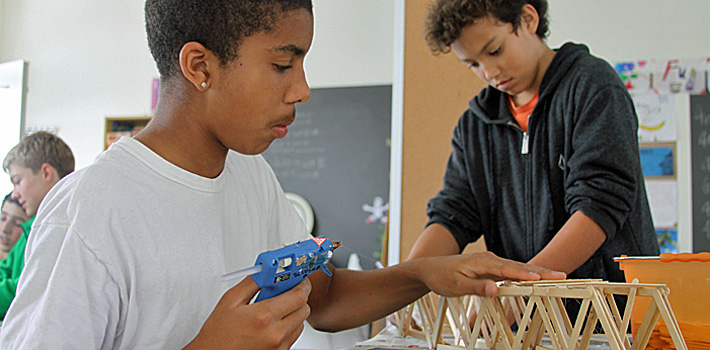
So, what is grit? In her tool measuring this attribute in children and adults, Duckworth looks at a person’s reaction to very difficult or challenging tasks; how does one respond to failure? Does one have the capacity to stick with projects that require perseverance and hard work? Grit is a measurement of how one endures and pushes through obstacles in pursuit of a goal or passion.

It’s no surprise if you are asking (as I have been), “so, how can we teach grit?” Are there teacher parenting or educational strategies that seem to foster these virtues in our children?

In his book, Tough illustrates that the most important factors in a child’s early life are close, loving, nurturing, and attached relationships with a parent (or guardian). Ironically, the need to pull back becomes vital as the children grow. Resisting the temptation to intervene, we need to allow children to stumble and fall, experience failure, have lots of frustrations and disappointments, then to dust off and carry on, learning something about themselves in the process.

Progressive educators have resonated strongly with Tough’s premise and the recent research in the measurement of student success. We understand the need to partner with parents in the challenging task of child rearing. Weighing on us is the tension between wanting to pave the way for children and allowing them to experience disappointment and failure. As parents, we can feel it viscerally – the pain of failure – we want to fix it or make it better. This tendency is quintessential to parenting. Teachers also face this struggle.

In part, the teaching of character arises situation by situation. I spoke recently with a parent whose daughter had “hit a wall” while trying to learn a new skill.  Though she wanted to quit, he pushed her to stick with it and she finally succeeded in learning the process. It was difficult for him to watch her angst and resistance. Similarly, I recently observed a teacher who insisted that two students who were involved in a conflict sit as long as necessary for them to resolve their issue. I saw the students’ transition from a fevered pitch of anger and venom to a reasonable place of calm and measured discussion and problem solving. In these situations, had it not been for the parent and the teacher, the players would have walked away from an important learning opportunity.

I recommend that folks read Paul Tough’s book. It has spawned countless blogs and commentary such as this. The book validates our mission of holding children’s social and emotional development, and brings into relief the importance of encouraging the development of their character. These virtues are important to their success as students, but equally to their success at life.
_____________________________
Tom Little was a founding teacher at Park Day School in 1976, and taught for ten years before becoming the Director in 1986. He earned his Masters Degree in Educational Leadership at Teachers College, Columbia, at the Klingenstein Leadership Academy. In 2001, Tom was awarded a Klingenstein Visiting Heads Fellowship. From 1997-2003, he served as the Private School Representative on the Mayor's Oakland Education Cabinet. He currently serves on the Board of Directors for the Oakland Academic Stars, an organization providing college scholarships for public school students in Oakland. Tom is also on the Board of Wingspan, a national organization sponsoring public and private school partnerships. He serves on the Board of the Progressive Education Network, a national organization of educators working to advance progressive educational practices throughout the United States. Tom has consulted on educational matters with public and private schools in the Bay Area and in Ireland. He and his wife, Elizabeth, have two grown children, both of whom are Park Day School graduates, Courtney ('93) and Matthew ('00). 

Wednesday, November 7, 2012

Skills That Matter and the Role of Afterschool and Summer Programs

By Sam Piha


Sam Piha
There is a growing body of research that suggest that young people's development of non-academic skills are critical to their academic achievement and success. In fact, there is good evidence that the acquisition of these skills are better predictors of academic achievement and life success than standardized test scores. These skills are referred to as social-emotional competencies and non-cognitive skills. We believe that afterschool and summer programs are well-positioned to develop these skills and educate stakeholders as to their importance. It is important to note that having an impact on youth outcomes requires strong program design and consistent implementation. 


Jenny Nagaoka
Pedro Noguera
The Learning in Afterschool & Summer project will use the upcoming How Kids Learn II conference and several future blogs to highlight these important skills. At the conference, we will hear from Dr. Daniel Goleman (via video), Founder of Collaborative for Academic, Social, and Emotional Learning (CASEL) and the author of Emotional Intelligence. The conference will also feature a presentation by Jenny Nagaoka, University of Chicago, on the role of non-cognitive skills in adolescence. We expect that we will also hear about the importance of these skills from presenter, Dr. Pedro Noguera from NYU. 


Joseph Durlak
A future blog will focus on the Responsive Classroom approach - a way of teaching that emphasizes social, emotional, and academic growth in a strong and safe school community. In addition, future blogs will feature interviews with Joseph Durlak and Paul Tough. Dr. Durlak is known for his meta-analysis studies of the impact of in-school and afterschool programs that worked to promote social-emotional learning and key features of implementation that are required for impacting youth outcomes. Paul Tough is a writer whose articles and books examine the importance of non-cognitive skills. His latest book, How Children Succeed, is having a major impact in the fields of education and youth development.  

Practitioners can find more articles on social-emotional learning and activities that promote these competencies on the Edutopia website. 


Voices from the Field: Youth Activist, Hadley Gray

Source: Hadley's Hope By Sam Piha We first learned about Hadley Gray from an article by Giving Tuesday, which we posted last week. She ...