Showing posts with label afterschool programs. Show all posts

Monday, October 11, 2021

Policy Recommendations to Promote Youth Employment in Afterschool Programs

By Sam Piha

Involving older youth as workers within afterschool programs makes a great deal of sense. Engaging youth in this way addresses their developmental tasks and personal interests, helps develop their workforce skills, offers opportunities for leadership and service to others, and brings youth input, making the program more relevant. 

This is even more important post COVID. A recent study entitled, The State of Youth Employment-Navigating the World of Work During COVID-19 found:

  1. Young people in America are struggling—they are financially strained, emotionally drained, and facing significant barriers to employment. 
  2. COVID-19 and the related economic recession have disrupted young people’s work lives in myriad ways and prompted extraordinary levels of concern about the future. 
  3. The professional connections and supportive relationships that can help young people advance their work-related goals are out of reach for most youth. 
  4. Young people’s hope about their future work lives is in jeopardy. 
Afterschool programs can be part of the solution. Based on our conversations with program providers, we offer the following recommendations to policy makers:

  1. State departments of education develop and distribute clear policies and guidelines on the use of 21st CCLC funds to engage youth as workers within the afterschool program. They should issue guidelines for the use of government funding to support high school workers within elementary and middle school programs. These guidelines should be designed to encourage, not restrict, programs from using the funds for this purpose. 
  2. Document promising practices being successfully used at afterschool programs and share them with those who are seeking to expand their programs’ capacity to engage youth as workers. This can be done by those who support the implementation of high school afterschool programs, including state afterschool networks, and those who receive technical assistance funds from private sources. 
  3. Identify supplemental funding to support career pathways to engage older youth working within afterschool settings. If needed, policy changes should be enacted to encourage access or eliminate any barriers impeding access to these funds by afterschool programs. Identifying funds is a form of technical assistance and can be done by those named in recommendation #2, above. Efforts needed to change policy can be led by afterschool advocacy organizations within your state. 
  4. Assist afterschool leaders in identifying and obtaining workforce and other supplemental dollars to support efforts that engage youth as workers in the afterschool setting. If needed, policy changes should be enacted to encourage access or eliminate any barriers impeding access to these funds by afterschool programs. 
  5. Incorporate into existing studies or identify dedicated funding to evaluate the efficacy in providing youth with work opportunities within afterschool settings. This can be achieved by local afterschool grantees who are charged with evaluating their programs, as well as larger evaluations that are funded by state departments or private sources. 

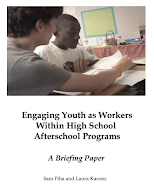
We wrote a detailed briefing paper on this topic to guide afterschool programs. The paper entitled, Engaging Youth as Workers Within High School Afterschool Programs, which includes discussion of policies and guidelines regarding youth employment, use of stipends and other forms of compensation. It also includes examples from actual programs and quotes from youth employed in their afterschool program. You can download this briefing paper here.
We also developed a less detailed paper on this topic, which can be downloaded here.


We are hosting a webinar/ Speaker’s Forum on Wednesday, October 20, 2021 from 10:00am- 12:00pm (PST) entitled, Engaging Youth as Workers in Afterschool. The purpose of this webinar is to inform and encourage afterschool programs to offer youth opportunities to serve as workers within these programs. It is our intention to capture and share valuable and intriguing ideas and information to help programs enlist youth as workers. To learn more and register, click the banner below.

Tuesday, July 6, 2021

SEL and Character Building Program Practices

By Sam Piha

There is great agreement that social emotional learning skills are very beneficial in preparing youth for success. While we hear a lot about the “why” of SEL and character building, little is heard about the application (the “what” and “how”) within expanded learning (afterschool) programs. Expanded learning practices need to be uplifted so that the field can begin to see what good character/SEL practices look like.
Source: CASEL

We were interested in how programs promote these skills, so we put out an announcement asking afterschool programs to submit a program practice. We compiled these practices into a paper entitled, “Promising Activities, Practices and Resources: Promoting SEL and Character Skills in Expanded Learning Programs”. Each submission included a description of the submitting organization, a contact person within the organization, and a description of the practice or activity (i.e. purpose, time needed/frequency, target audience, and supporting resources).
The concept of social emotional learning has come to a frenzy in the past couple of years. Where does afterschool fit in to all of this? You would hope that we’d be right at the forefront. We’ve been doing this for years we know how to do it. – Karen Pittman, Forum for Youth Investment
Below are some practices that programs submitted:

Source: Temescal Associates
EDUCARE- Guided Visualizations. Visualizations are guided around a particular theme. There are a variety of mindfulness and centering practices they enjoy using and have found valuable. An example theme: Gratefulness. Youth close their eyes and review on an imaginary movie screen, images of who and what they are grateful for or appreciate - friends, family members, their health, people who support or inspire them, opportunities they have at school or elsewhere, etc.

Source: Ever Forward Club
EVER FORWARD CLUB- Mask Making. Youth are given a handout and asked to follow 3 steps anonymously. They are also asked to keep their eyes on their own paper. 1. Draw a mask on the left side. 2. Write 3 words on the front of the mask that represent qualities they let people see. 3. Write 3 words on the back of the mask that represent the things they don’t usually let people see. Adult leaders collect the masks and then have a few volunteers read a few of the responses anonymously. Youth are then invited to share how it felt hearing about the front and back of the masks of their peers. This would be a good time to discuss their commonalities and differences. Deeper processes can be created depending on the level of safety that has been generated in the room.

Source: LA's BEST
LA’S BEST- Sanford Harmony Cards. These cards provide engaging questions and activities to explore with a "buddy". The students then get to know each other and connect, which prepares them to handle future challenges and conflicts and opportunities to collaborate in a meaningful and constructive way. Sanford Harmony also provides recommendations of how and why to pair students together. The "Meet Up" strategy provides a way to strengthen a program's daily routine by incorporating practices that allow the entire group of students to explore how they treat each other and how they communicate with one another.

CALSAC- Regular Check Ins. This is an intentional space created for staff and youth to share how they are showing up in that space. Participants typically sit or stand in a circle during the check in. Next, a volunteer is asked to start and then chooses a direction for participants to follow. The information shared allows everyone in the room to understand what may be going on for them and honor that each individual may be coming into the space with varying life experiences. This allows everyone to see each other more wholly and create safety for people to be authentic in the space. It is recommended to create an opportunity for everyone to lead the check-in. (From Temescal Associates: It is recommended that each speaker holds a talking piece, such as a feather or item chosen by the group. The talking piece is held by the person speaking and then passed around the circle. Those not holding the talking piece are engaged in active listening.)

Source: Greater Good Science Center
GREATER GOOD SCIENCE CENTER- Gratitude Letter. In this activity, youth are guided to complete the Gratitude Letter practice, where they write a letter of thanks and then try to deliver it in person. To introduce the activity, the following script may be helpful: 'Most everyone enjoys thanks for a job well done or for a favor done for a friend, and most of us remember to say “thank you” to others. But sometimes our “thank you” is said so casually or quickly that it is nearly meaningless.' In this activity, you will have the opportunity to express your gratitude in a very thoughtful manner. Think of the people—parents, friends, coaches, teammates, and so on—who have been especially kind to you but whom you have never properly thanked. Choose one person you could meet individually for a face-to-face meeting in the next week. Your task is to write a gratitude letter (a letter of thanks) to this individual and deliver it in person. The letter should be specific about what he or she did that affected your life. It is important that you meet him or her in person. Don’t tell this person, however, about the purpose of this meeting. This activity is much more fun when it is a surprise to the person you are thanking.
-----------------


Tuesday, June 6, 2017

Call or write Congress to support afterschool and summer learning programs

By Sam Piha

Sam Piha
During the Bill Clinton presidential administration, Congress approved the first appropriation for 21st Century Community Learning Centers (21st CCLC). It was one of the fastest growing social programs in our country’s history. 

President Trump’s budget calls for eliminating funding for the 21st CCLC. It’s now up to Congress. Nearly two million children and families would be left without reliable afterschool choices.

You can make a difference: call on Congress to protect funding for afterschool and summer learning programs. The Afterschool Alliance is urging afterschool advocates to phone their representatives on Wednesday, June 7th but you can call or write anytime. We wrote to Rep. Barbara Lee, and she quickly replied. 


Below are some resources that may be helpful. 

  • You can go here to find talking points and suggestions from the Afterschool Alliance to assist you with your call or letter. 


Photo Credit: The Afterschool Alliance
*Please note that calling your representative in Congress to urge them to save 21st CCLC funds is considered lobbying and should not be done during staff hours paid for by 21st CCLC funds. If you have any questions on what you can do to participate, please feel free to reach out to the Afterschool Alliance. 


Thursday, May 11, 2017

Afterschool Program Quality and Effectiveness: 25 Years of Results!!

By Sam Piha


Sam Piha
It is important that afterschool supporters have access to studies that have shown that afterschool is an effective strategy to support young people’s success in school, work, and life. This is especially important because the Trump Administration has proposed the elimination of the 21st CCLC because they “lack strong evidence of meeting its objectives, such as improving student achievement.”

Are afterschool programs effective? We asked our colleagues at Policy Studies Associates (PSA), a leading organization that has studied this question. Below are remarks from Christina Russell, Managing Director at PSA. 


Christina Russell,
Managing Director at PSA
“Through our partnerships over the last 25 years with afterschool programs throughout the U.S., our evaluation team at PSA has seen that afterschool programs can benefit youth, families, schools, and communities in many ways. We have seen evidence that high-quality afterschool programs:

  • Keep students safe
  • Engage students in learning
  • Improve students’ academic performance
  • Develop students’ core competencies for success in life and careers 
  • Support working families 
  • Are in demand

As the afterschool field has matured, we have evaluated the implementation and impact of various program models, technical assistance interventions, and system-building efforts designed to improve the capacity and quality of programs. The research shows—and programs know—that quality matters. Afterschool providers have engaged in continuous improvement initiatives to become more intentional in program planning and to increase program participation, through internal assessment and tracking systems as well as through external evaluation.

We also know that afterschool programs play important, varying, and evolving roles in education. Effective afterschool programs are not cookie-cutter:  they strategically partner with schools and communities to identify gaps and the priority needs of students, and to design services to meet those needs.  As a result, some programs may focus on strengthening the academic outcomes of students, some on the development of essential life skills, and others on closing the opportunity gap through enriching, experiential experiences that expand the school day.   


Our brief entitled, Afterschool Program Quality and Effectiveness, curates the key, policy-relevant findings on the implementation and effectiveness of afterschool programs. In addition, the brief links to some of our most important reports on afterschool initiatives implemented throughout the U.S. 

We hope that the brief makes our research findings accessible. For any of the topics touched on in the brief, there is a wealth of existing data as well as new questions to be explored, and we encourage you to reach out to discuss how PSA’s evaluation expertise can support your efforts as you continue to advocate for and strengthen afterschool.”

———
Christina Russell is Managing Director at Policy Studies Associates (PSA) and leads studies focused on expanded learning opportunities and their role in promoting positive social and educational outcomes for youth in grades K-12. Ms. Russell also directs evaluation projects designed to inform efforts to improve program quality and capacity. Ms. Russell has extensive experience designing and managing studies that employ both quantitative and qualitative research methods to assess the implementation and impact of education and youth development initiatives.

Monday, April 27, 2015

Youth Voice: A Perspective on Hiring Young People in Afterschool Programs

By Sam Piha

Sam Piha

One important way of affecting afterschool quality and its attractiveness to young people is to engage older youth and program alumni in the operation of the program. There are multiple benefits - both to the program and the young adults who are engaged as leaders or hired as staff. 

Who would know better about the benefits of hiring youth and program alumni than the young people who were granted this employment opportunity? Below are some of their statements regarding their experiences. 


Lorena Retano, Program Alumni, Youth Institute

Lorena Retano, Age 18
Youth Institute Program Alumni
Being a Youth Institute alumnus is probably one of the best things I’ve experienced. I’ve had the opportunity to work on multiple jobs teaching kids, younger than me, how to use movie and photograph editing software. The best example I have for what I experienced when being hired to work in an afterschool program was when I went to Richmond two summers ago to go teach iMovie, Adobe Photoshop, Adobe Illustrator, and Adobe InDesign. A team of three other people and myself spent about six hours a day teaching kids in middle school and high school how to use the different software. It was really exciting to share my knowledge with other people.

To work in an afterschool program you need to have confidence in what you are doing with your students so that you are not only successful but so that your students respect you. Supporting youth and program alumni in practicing different skills is definitely a great way to develop that confidence.


David Montoya, Age 20
arc Program Alumni

David Montoya, Program Alumni, arc 
I was a student of the after school program for 4 years. After I graduated, the program offered me a job. It was a great opportunity since I was pretty familiar with the program - I knew what was going on and what needed to happen. At the beginning, it was a bit weird since I went from being a student to a staff. The staff was very supportive, the students saw me as their friend. It took me a while to set myself aside from them and to build a line and to show them that I am a staff now.

Being hired allowed me to go to school, have a job, and do something that I love. I brought everything that I knew about the after school program. As a student participant, I gained leadership skills, which I used in my community, and most importantly at my school.

I think when people think of young adults they think of people who have no experience, who don’t know what they’re doing. But I think we are capable of taking on bigger responsibilities. We just need someone that would trust us and give us a chance.


Skhy Felder, Age 17
Youth Institute Program Alumni
Skhy Felder, Program Alumni, Youth Institute
Employing program alumni gives them the opportunity to grow and gives them the feeling of being an adult. They understand the younger youth better because they, in a way, know the struggle they go through.

From this experience, I have an advantage for future jobs. I can’t wait to be a full staff member, give back to the youth and give them my knowledge. I want to be that staff that a youth would say, "I remember when so and so helped me through this".


Jon Cabral, Age 18
Youth Institute Program Alumni
Jon Cabral, Program Alumni, Youth Institute 
The addition of older youth and program alumni into the team of afterschool professionals greatly affects the dynamic of the experience for both youth and staff alike. Working this past summer as technical instructor after finishing my third year as a high school program alumni student, it shifted from being the student inspired by mentors to the mentor inspiring students. Having been with the YMCA and its branches since sixth grade and having grown up with the program, I’ve definitely benefitted from having a young, relatable staff person, which I saw as my older sibling. Largely of who I am today is a result of the many young mentors I have had through the YMCA.

My responsibilities range from afterschool tutor assisting in homework questions and project help, to a mentor lending advice - a hand for help, a shoulder to cry on, or whatever else an adolescent teenager navigating through middle and high school would need. 

Coming back and being able to give back to the program that helped me grow gives me the gift of now being the person I needed when I was young. This job equipped me with technical, child development, and professional skill sets and provided me with advantages leading to my being a well-rounded person and professional.

Adriana Zuniga, Age 17
Youth Institute Program Alumni
Adriana Zuniga, Program Alumni, Youth Institute
While working as an intern for the program, I experienced many benefits. I was able to get hands-on training from the staff and also teach younger kids the basics of computer literacy and camera functions. It gave me a chance to learn technological skills and help develop my social skills. Having been involved with the program for four years, I already know how the program runs, what is expected and how to do certain things that incoming interns are not familiar with yet. Because I already have experience, I can lead my own group of people on projects or inform them on how to use a Canon camera or edit a photograph on Photoshop.


David Molina, Program Alumni, A World Fit For Kids! 
David Molina, Age 27
WFIT Program Alumni
I am an alumnus from A World Fit For Kids! Mentors In Motion (MIM) program at Belmont High School. I was a part of the program for 3 years. The Assistant Coach position was my first job that I held and I began to do it when I was 15 years old. The position was the dip of my toe in the water that is the real world. This position provided me my first professional experience that I ever had; it was a great learning platform.

When I graduated high school, I was fortunate enough to be asked to coach soccer at Lawrence Middle School, while I attended California State University Northridge. I was able to bring my 3 years of experience into the fields right off the bat. I knew the high standard of performance I had to deliver to the kids that I coached.

The wealth of knowledge that I gained was immense from the time I was a MIM. I always felt that the MIM program is a great resource to groom future coaches because the lessons taught are specific to the afterschool program and their expectations. These types of positions are usually entry level positions and they are usually a stepping stone to students’ eventual careers.


Jacob Reyes, Age 21
arc Program Alumni
Jacob Reyes, Program Alumni, arc
The impact we have made is amazing. Hiring older youth helps communicate more with the students because we know how it is to be a student, we understand their feelings, and we can help them in the best possible way that we can.

I think that hiring program alumni is an important practice because the communications between alumni and students are close and more responsive. Students can go up to us and talk. They don't have to fear oppression of what a teacher or an adult might give them. They feel a sense of trust in us, which is good for a student.

Tuesday, October 14, 2014

Lights On Afterschool

By Sam Piha

Sam Piha
Every year there is one day dedicated to raising awareness and celebrating the contributions of afterschool programs. As everyone knows, this national day is called Lights On Afterschool and it will be celebrated on October 23, 2014. 

You can participate in this celebration at the California State Capitol. You can find more information by clicking here. You can also join others in showcasing afterschool programs. Plan your event by using the planning guide, found here.
Register your event here.

Hats off to afterschool programs!


Showing Gratitude

We know that the holidays are a time to remind us to be thankful for what we have. From all of us at Temescal Associates and the How Kids Le...