Showing posts with label afterschool alliance. Show all posts

Monday, May 4, 2026

New Survey Reveals Uncertainty Among Afterschool Program Providers

Source: www.pexels.com

Temescal Associates recently surveyed afterschool leaders on their concerns regarding 2026. The Afterschool Alliance did a similar but much larger survey of afterschool leaders entitled, Uncertain Times for Afterschool Programs. The findings were very similar. Below is a guest blog by Nikki Yamashiro, Vice President, Research at the Afterschool Alliance on the survey’s findings.

Since 2020, the Afterschool Alliance has surveyed afterschool and summer program providers to capture the current state of the afterschool field in order to better understand providers’ offerings and operations, as well as identify the issues that are most pressing.  

What stands out in the most recent survey, conducted October 27 through December 22, 2025, is that concerns about program sustainability and students’ well-being are on the rise, largely reaching the levels of concern we haven’t seen since the early days of the pandemic. A few key points from the brief, “Uncertain times for afterschool programs: Concerns over sustainability, students’ well-being, and federal actions top of mind,” include: 

  • Afterschool program providers’ worries about program sustainability are trending upward. Providers concerned about losing funding, permanently closing their program, or laying off or furloughing staff increased by double-digit percentage points from fall 2024, with worries rising for the second consecutive year. For example, 56% of providers were concerned about the loss of funding to their program in the fall of 2023, increasing to 63% in fall 2024, and reaching 77% in the fall of 2025. The intensity of providers’ level of concern has also grown—providers extremely or very concerned about the loss of funding grew from 32% in 2023 to 40% in 2024, and now, more than half of providers (55%) are extremely or very concerned about losing funding.

“When asked which resources would be most helpful to their program right now, the top answer selected by program providers reflects their growing concerns about funding.” – Afterschool Alliance

Source: A World Fit for Kids

  • Providers, regardless of where they are located, are concerned about their funding and future.  Nearly 9 in 10 providers (88%) are concerned about their long-term funding and program’s future, including 67% who are extremely or very concerned. At least 5 in 6 providers across community-types and regions are concerned: this includes programs located in rural (89%), suburban (86%), and urban communities (90%), and in the Northeast (87%), Midwest (89%), South (90%), and West (85%).


“Our funding has been getting cut every year. Each year we are making more and more sacrifices to our quality of programming.” – Afterschool Program Leader, SF 

  • Concerns for students—in particular about food insecurity, learning loss, and screen time—are high. While students’ mental and emotional health remains the most prominent concern among program providers, worries about students experiencing food insecurity, learning loss, and unproductive screen time harming their well-being saw significant gains from the previous fall 2024 provider survey. 93% of providers are concerned about their students’ mental and emotional health, with 75% extremely or very concerned, similar to fall 2024 (93%), but providers reporting that they are extremely or very concerned about their students experiencing food insecurity grew from 51% to 64%, concerns over learning loss grew from 56% to 62%, and providers extremely or very concerned about unproductive screen time harming their students’ well-being increased from 63% to 71%.
 
  • The disruptions and uncertainty at the federal level are having an effect on programs. More than 6 in 10 providers (62%) said that the children and families they served were impacted at least somewhat by the six-week federal government shutdown that lasted from October 1 through November 12, 2025. And most providers (86%) said that if proposed federal education budget cuts are implemented, they are concerned about the impact to their program. Additionally, nearly half of program providers (46%)  reported being impacted by the withholding of federal funds that took place during the summer of 2025.

“On April 3, the Trump Administration released the proposed federal budget for fiscal year 2027. While the budget proposal is a ‘skinny budget’ that does not include all funding details, it does suggest consolidation of federal education funds and elimination of the 21st Century Community Learning Centers (21st CCLC) program, the only federal funding that exclusively supports local, school and community afterschool and summer learning programs.” – Erik Peterson, Afterschool Alliance

Source: Champions

  • Programs impacted by federal government actions are more likely to be concerned about sustainability and their students’ well-being. Afterschool program providers who report that the children and families they served were significantly impacted by the government shutdown and those who said that they were affected by the withholding of education funds last summer are more likely than programs overall to express extreme levels of concern about their program sustainability by double-digit percentage point differences. Providers who were significantly affected by the government shutdown are also more likely to be concerned about their students’ well-being, in particular about food insecurity. For example, 83% of programs who were affected a lot by the government shutdown are extremely or very concerned about their students experiencing food insecurity, 19 percentage points higher than programs overall (64%).

“Sustainability of our 21st CCLC programs is a major concern.” – Afterschool Program Leader, Reno, Nevada


In spite of these concerns and challenges afterschool programs face, they continue to provide young people with opportunities for academic enrichment, time to be active and outdoors, and access to healthy snacks and meals, all while helping to build foundational skills such as the ability to work in teams, think critically, and be leaders. Additionally, providers remain optimistic overall about their future; 69% of providers say that they feel optimistic about the future of their afterschool program, an increase from 62% in fall 2024.


MORE ABOUT...

Nikki Yamashiro
Nikki Yamashiro is Vice President, Research at Afterschool Alliance. She joined the Afterschool Alliance in June 2012. In her current role, Nikki coordinates, manages, and advances the Afterschool Alliance’s research efforts, including developing the organization's research goals and agenda and effectively communicating findings on afterschool and summer programs to policy makers, afterschool providers, advocates, and the public. Current major research initiatives that are a part of Nikki's portfolio include America After 3PM, a longitudinal study of how children in America spend their hours after school, and Afterschool in the Time of COVID-19, a multi-wave tracking survey documenting the pandemic's impact on the afterschool field. Prior to joining the Afterschool Alliance, Nikki served in a variety of research capacities, including as Policy Advisor at Third Way, where she handled domestic policy issues such as juvenile justice, and as legislative assistant to former Rep. Hilda L. Solis, where she handled education and youth issues.

The Afterschool Alliance was established in 2000 by a small group of corporate and foundation philanthropies—including the Charles Stewart Mott Foundation, the U.S. Department of Education, JCPenney Company, Inc., the Open Society Institute/The After-School Corporation, the Entertainment Industry Foundation and the Creative Artists Agency Foundation—to expand afterschool and summer learning opportunities nationwide. Since our inception, public investment in afterschool programs has doubled. 

Today, the Alliance works with a broad range of organizations and supporters, including policymakers, government agencies, youth, parent and education groups, business and philanthropic leaders, afterschool coalitions and providers at the national, state, and local levels, and leaders representing health and wellness, college and career readiness, social and emotional learning, science, technology, engineering, and math (STEM) learning, and more—each with a stake in afterschool. 


Wednesday, April 15, 2026

SAVE 21ST CENTURY CCLC

Every year the United States congress needs to approve the federal budget. This means that we need to keep updated and advocate for renewed afterschool funding. Below is a guest blog and update from Erik Peterson, Senior Vice President, Policy at Afterschool Alliance.

On April 3, the Trump Administration released the proposed federal budget for fiscal year 2027. While the budget proposal is a “skinny budget” that does not include all funding details, it does suggest consolidation of federal education funds and elimination of the 21st Century Community Learning Centers (21st CCLC) program, the only federal funding that exclusively supports local, school and community afterschool and summer learning programs.

The budget proposal is similar to the one introduced by the Administration last year, however Congress passed a bipartisan spending bill that rejected last year’s proposal and instead maintained and protected federal 21st CCLC afterschool and summer program funding for summer 2026 and the 2026-2027 school year.


Source: www.pexels.com
Federal support for local afterschool and summer programs helps 1.4 million children and youth nationwide have opportunities for math and reading enrichment, healthy activity and nutritious snacks, and hands-on, engaging activities that help children learn and grow. Instead of cutting funding for these programs, which help students succeed, keep young people safe, and support working parents—a funding increase is needed to help programs cover rising costs and to start to meet the nationwide demand for programs.


Please take two minutes to send a message to Congress in support of afterschool and summer learning programs by clicking here.


MORE ABOUT...

Erik Peterson
Erik Peterson is the Senior Vice President, Policy at Afterschool Alliance.  He joined the Afterschool Alliance in July 2009 and coordinates and advances the Afterschool Alliance’s policy efforts at the federal level by helping develop policy goals and implementing strategies that advance access to quality afterschool and summer learning programs for all. Erik works to build and strengthen relationships with policy makers and allied organizations to increase public support and funding for out of school time programs. Prior to coming to the Afterschool Alliance, Erik worked for the School Nutrition Association (SNA) in the Washington DC area, and as both an AmeriCorps VISTA and staff for the Sustainable Food Center in Austin, Texas. 

The Afterschool Alliance was established in 2000 by a small group of corporate and foundation philanthropies—including the Charles Stewart Mott Foundation, the U.S. Department of Education, JCPenney Company, Inc., the Open Society Institute/The After-School Corporation, the Entertainment Industry Foundation and the Creative Artists Agency Foundation—to expand afterschool and summer learning opportunities nationwide. Since our inception, public investment in afterschool programs has doubled. 

Today, the Alliance works with a broad range of organizations and supporters, including policymakers, government agencies, youth, parent and education groups, business and philanthropic leaders, afterschool coalitions and providers at the national, state, and local levels, and leaders representing health and wellness, college and career readiness, social and emotional learning, science, technology, engineering, and math (STEM) learning, and more—each with a stake in afterschool. 

Monday, May 12, 2025

President Calls for Elimination of Afterschool and Summer Funding

Source: www.pexels.com

According to Google AI, “Here's a breakdown of President Trump's afterschool policies, particularly his budget proposals, have had a significant impact on afterschool programs, primarily through proposed cuts and changes to federal funding streams. Here's a breakdown of the key impacts:

  • Proposed Elimination of 21st Century Community Learning Centers (21st CCLC) Funding: The 21st CCLC program is the largest federal funding source specifically for afterschool and summer learning programs. President Trump's administration repeatedly proposed eliminating 21st CCLC funding, arguing the program lacked evidence of effectiveness. These proposals, if enacted, would have led to the loss of afterschool and summer programs serving millions of children and families, particularly in high-poverty areas. 

  • Proposed Cuts to Other Education Programs Supporting Afterschool: Trump's budget proposals also included cuts to other federal programs that indirectly support afterschool, such as Title II (Supporting Effective Instruction State Grants) and Title IV Part A (Student Support and Academic Enrichment Grants). These cuts would have further reduced resources available to states and localities for afterschool and related enrichment activities. 
  • Consolidation and Block Granting Proposals: Some proposals aimed to consolidate various K-12 programs, including afterschool and summer learning funding, into a single block grant. This approach raised concerns about the potential for reduced funding for afterschool specifically and a loss of focus on the unique needs of these programs. 
  • Impact of Overall Education Budget Cuts: President Trump's budget proposals generally sought to reduce the overall budget for the Department of Education. This could have resulted in reduced capacity for federal oversight, technical assistance, and innovation in afterschool programming.  
  • Bipartisan Opposition and Congressional Action: While the Trump administration proposed these cuts, afterschool programs generally enjoyed strong bipartisan support in Congress. Congress often rejected the proposed cuts and maintained or even increased funding for programs like 21st CCLC.  

In Summary: President Trump's policies towards afterschool programs were largely characterized by proposed funding cuts and shifts in federal education policy. While some proposals were not enacted due to Congressional opposition, they created uncertainty and challenges for afterschool programs relying on federal support.” [i]

Source: Boost Cafe

According to Afterschool Alliance, “The President’s proposed ‘skinny’ budget for 2026 puts funding for afterschool and summer programs via 21st Century Community Learning Centers (21st CCLC) at risk. The proposal appears to eliminate entirely or collapse 21st CCLC into a consolidated grant program, lumping 18 programs together without enough funding for them all. Please urge your representatives in Congress to sustain this funding! [See Erik Peterson, Senior Vice President of Policy, Afterschool Alliance Afterschool Snack Blog here.]


21st CCLC supports nearly 1.4 million youth in programs in every state. Remind them of the importance of local afterschool and summer learning programs.

It supports 10,000 local programs serving nearly 1.4 million across the nation. The President’s proposal appears to eliminate entirely or collapse 21st CCLC into a consolidated grant program, lumping 18 programs into a fund to be sent to states without enough money to pay for them. With $12 billion in cuts to education programs overall, the consolidation effectively eliminates 21st CCLC afterschool and summer program grants. 

The need for afterschool has never been greater: for every child in a program, 4 are waiting to get in. Help make sure those doors stay open. Ask our leaders to act.
 

Please take a minute to make a phone call to your elected officials. A phone call helps show how much this issue matters to you! Don’t stop there:

- To help get the word out, use the tools at 3to6.co/Challenge. 
 

- See how the proposed cut could affect your state at AfterschoolWorksforAmerica.org

Federal support is essential to help the nearly 25 million children and youth who would be in an afterschool program if one were available. Increased program costs are making it harder for afterschool providers to serve families and children. In communities nationwide the need cannot be greater for math and reading enrichment, healthy activity and nutritious snacks, and hands-on, engaging activities that help children learn and grow.


Please take two minutes to send a message to Congress in support of afterschool and summer learning programs." [ii]


END NOTE:

[i] Google AI, How Have Trump’s Policies Impact Afterschool Programs?

[ii] Afterschool Alliance, Don't Eliminate Afterschool and Summer Funding in FY 2026

Monday, June 3, 2024

Survey Results Point to a Summer of Learning and Engagement Ahead for Young People

Source: Afterschool Alliance

By Guest Blogger Nikki Yamashiro. This was originally posted by Afterschool Alliance on the Afterschool Snack Blog.

As the temperature starts to rise, and in D.C., we start to feel the familiar humidity creep into the air, one’s thoughts can’t help but turn to summer—and for those of us at the Afterschool Alliance, that includes thinking about what the state of summer programming will look like. If this upcoming summer is anything like the last, we anticipate summer programs to be open and ready to provide fun, academically enriching, and hands-on learning opportunities for their students.

Based on a survey of 989 summer program providers conducted late last year—October 31 through December 5, 2023—more than 9 in 10 (96 percent) reported that they offered programming during the 2023 summer, similar to the number of providers reporting that they offered programming during the 2022 summer (96 percent), and up from the summers of 2021 (88 percent) and 2020 (79 percent). Additionally, nearly 1 in 3 programs (32 percent) said that they expanded their summer program to serve more children and 1 in 10 (11 percent) were able to offer summer programs at more sites than in the past. When asked about the type of activities offered, nearly 3 in 10 summer program providers said that they placed a greater focus on ensuring a balance of academic and enrichment activities for their young people (28 percent) and were more intentionally focusing on students’ holistic needs and supporting their overall well-being (27 percent).  

However, providing summer programming wasn’t without its challenges. Forty-four percent of summer program providers said that there was a waitlist for their program, although down slightly from the 48 percent of summer providers who reported a waitlist for their 2022 summer program. Additionally, 62 percent of summer providers said that they were concerned about their ability to meet the demand from families.

Summer providers’ level of concern about staffing their program may help shed some light on the issue of waitlists, with three-quarters of providers (75 percent) concerned about being able to hire enough staff for their summer programming, including half (50 percent) who said that they were extremely or very concerned. Summer program providers’ concerns over staffing mirrors concerns afterschool program providers reported about their fall programming, where 81 percent reported concerns about finding staff, retaining staff, or both. 

Looking ahead, nearly three-quarters of summer program providers (74 percent) said that they felt optimistic about the future of their program, which also bodes well for this upcoming summer. To see the full survey findings, visit our Afterschool Program Provider Survey page. If you are a provider looking for ideas, tools, or resources for your summer program, National Summer Learning Association’s Summer Planning Bootcamp webinar series is available now to watch recordings of the two day event. The Wallace Foundation’s Summer Learning Toolkit is another valuable resource, where you can find a planning calendar, sample job descriptions and staff handbooks, facilitation guides, sustainability tools, and more to help you bring your best summer program forward for your students and families.

MORE ABOUT...

Nikki Yamashiro 
joined the Afterschool Alliance in June 2012. In her current role, Nikki coordinates, manages, and advances the Afterschool Alliance’s research efforts, including developing the organization's research goals and agenda and effectively communicating findings on afterschool and summer programs to policy makers, afterschool providers, advocates, and the public.


The Afterschool Alliance
is a national organization that works to ensure that all youth have access to affordable, quality afterschool programs by engaging public will to increase public and private investment in afterschool program initiatives at the national, state, and local levels.

Tuesday, September 20, 2022

New Survey Shows that Afterschool Programs are Still in High Demand

Source: NHP Foundation

By Guest Blogger, Nikki Yamashiro (Previously published by The Afterschool Alliance)

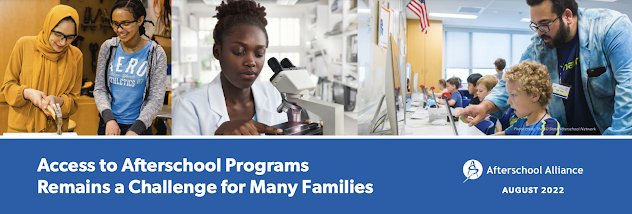
Back-to-school season is in full swing and intermixed with the uplifting news stories on students’ return to the classroom are stories of the challenges taking place after the school day ends, from families waitlisted for afterschool programs to program providers struggling to find staff to fill open positions. A new brief, based on responses from nearly 1,500 parents or guardians of school-age children, conducted May 12-June 28, 2022, provides insights into both the issues families face when looking for afterschool programming, as well as the motivations behind wanting to enroll their child in a program. Four key takeaways from “Access to Afterschool Programs Remains a Challenge for Many Families,” include:

  1. Unmet demand for afterschool programs remains high during the pandemic. There are 24.7 million children who are not in an afterschool program, but would be enrolled if a program were available to them. Now, for every child in an afterschool program, there are four more who are waiting for an available program.
  2. Cost is the top barrier to afterschool program participation. More than half of parents without a child in an afterschool program (57 percent) report that programs being too expensive was an important factor in their decision not to enroll their child.  Other barriers include lack of a safe way for their child to get to and from programs (52 percent), inconvenient program locations (51 percent), and programs’ hours of operation not meeting parent needs (49 percent).
  3. For kids who are able to access afterschool programs during the pandemic, programs are keeping kids safe, connected, and engaged in learning. Fully 95 percent of parents are satisfied with their child’s afterschool program and 90 percent rate the quality of their afterschool program as excellent or very good. Most parents report that their program is helping their child with everything from building social skills (91 percent) to providing homework help (79 percent) and from providing time for physical activity (87 percent) to connecting their child with caring adults (79 percent).
  4. Parents agree that afterschool programs are providing critical supports to children and families during the pandemic. Strong majorities of parents agree on the positive role of afterschool programs, including keeping kids safe and out of trouble (82 percent), helping young people build positive relationships with caring adults and mentors (78 percent), providing working parents peace of mind that their children are safe and supervised (85 percent), and helping working parents keep their jobs (83 percent). Eighty-three percent of parents agree that all young people deserve access to quality afterschool and summer programs.


As a recent EdWeek Research Center report finds that nearly half (49 percent) of program providers surveyed in May and June 2022 said that they currently had a waitlist of students, similar to Afterschool Alliance’s Afterschool in the Time of COVID-19 spring 2022 survey, it’s clear that additional public and private investments at the local, state, and federal levels are needed to ensure that all young people have access to quality, affordable afterschool programming. Thanks to COVID relief funding, there are programs who have benefited from the additional support and have been able to meet the needs of their children and families, with one spring 2022 program provider respondent writing, “We would not have been able to stay in business or provide the same quality of care and programming without financial assistance. Or, we would have had to greatly increase the cost of our programming at a time our families were least able to afford it.” However, with only 1 in 5 program providers reporting receiving COVID relief funds, there is still more to be done. Read the full brief to learn more about the current afterschool program landscape. 


MORE ABOUT...
Nikki Yamashiro
Nikki Yamashiro
joined the Afterschool Alliance in June 2012. In her current role, Nikki coordinates, manages, and advances the Afterschool Alliance’s research efforts, including developing the organization's research goals and agenda and effectively communicating findings on afterschool and summer programs to policy makers, afterschool providers, advocates, and the public. Current major research initiatives that are a part of Nikki's portfolio include America After 3PM, a longitudinal study of how children in America spend their hours after school, and Afterschool in the Time of COVID-19, a multi-wave tracking survey documenting the pandemic's impact on the afterschool field.

Wednesday, August 17, 2022

Maintaining Bipartisan Support for Afterschool


By Sam Piha

We wanted to get a better understanding of the bipartisan support for afterschool, of the past and present. We interviewed Dr. Terry Peterson who was the Chief Counselor for former US Secretary of Education and Governor, Dick Riley. Terry was involved in the launching of the 21st Century Community Learning Center Initiative. 

Q: Can you say something about the bipartisan roots of the afterschool movement?
A: I find it very useful to trace overtime the bipartisan roots and continuing support for expanding, funding and improving summer enrichment and comprehensive afterschool and expanded learning opportunities and partnerships.


The “roots” of the 21st Century Community Learning Centers in the 1990’s clearly involved Republican and Democratic members of Congress and a Democratic Administration.  

The roots in California involved bipartisan support in some key cities in the late 1980’s, like Los Angeles, San Francisco, San Diego and Sacramento and then spread greatly with the strong leadership of a Republican Governor, Schwarzenegger, and then much later, now, a huge expansion by a democratic Governor Newsom. This type of local, state and national expansion of an initiative overtime is very unusual and very important.  

Q: What kind of politics are needed to support afterschool, summer and expanded learning programs?
A: It is critical to keep this bipartisan support for afterschool, summer and expanded learning. Unfortunately, in these highly politicized times, certain concepts and especially acronyms and initials are magnifying the polarization. Because of the benefits seen for many years of bipartisan support for more and better afterschool and summer opportunities and partnerships, I think we have a special obligation for our children, youth and families served by afterschool, summers, and expanded learning to try to stay above these battles when representing the afterschool, summer, expanded learning and community school movements.  

One way to stay above the fray is to go back to our simple roots and concepts, like expanding opportunities and developing more community connections for children, youth and families that want and need afterschool and summer programs to better succeed in school and life. By the way, this is not just good education and youth development but good “politics”. Most voters and parents of most political persuasions appreciate terms like “expanding opportunities” and building more "community connections” and "local partnerships." 

Another way is to approach voters and parents differently using everyday common-sense ways. For example, we know that in some localities, states and nationwide, certain terms like SEL and related terms are “offending” some Republicans and even Independents. While operating in the afterschool, summer, community schools and expanded learning arenas, why not use concepts that are similar, but that parents of many political persuasions approve of?

Q: There is a myth that Republican parents do not support funds for afterschool programs. Do we have research that suggests something different?
A: We have found that Republican parents support funding afterschool and summer programs as well as Democratic and Independent parents. Interestingly and importantly, they all support very similar content in the programs. And this content is similar to the research evidence too.

Unpublished analyses by the Afterschool Alliance done very recently, found:

Support for afterschool and summer learning programs is strong among Republican parents. More than 8 in 10 parents who identify as Republican agree that all young people deserve access to quality afterschool and summer programs (82%).

From providing children opportunities to build life skills to helping working parents keep their jobs, Republican parents overwhelmingly agree on the positive role afterschool programs play for children and families.

Strong majorities of parents who identify as Republican agree that afterschool programs:
  • help young people engage with their peers and reduce unproductive screen time (85%);  
  • learn life skills, like the ability to communicate and work in teams (81%); 
  • have opportunities to build confidence (80%); 
  • provide opportunities to build positive relationships with caring adults and mentors (76%); 
  • and become more excited about learning and interested in school (74%). 

Republican parents also agree that afterschool programs provide working parents peace of mind knowing that their children are safe and supervised (83%), help working parents keep their job (81%), and keep kids safe and out of trouble (74%).

Focusing on activities and supports, Republican parents are as likely as parents overall to report that opportunities for their child to build life skills were important in their selection of afterschool and summer programs. Similar to parents overall, most Republican parents report that opportunities for their child:
  • to build life skills, such as interacting with their peers, developing social skills, and responsible decision making, were important in their selection in their child's afterschool program (88% vs. 87%) 
  • and what their child did during the summer (94% vs. 94%).

Republican parents want public investment in afterschool and summer programs. 85% of parents who identify as Republican report that they support public funding of afterschool programs and 86% support public funding of summer learning programs.


MORE ABOUT… 
Terry Peterson
was the Chief Counselor for former US Secretary of Education and Governor, Dick Riley. During his decades-long tenure in public service, Terry held senior state- and federal-level positions in which he developed numerous education policies and funding streams, including at the U.S. Department of Education where he helped create the 21st CCLC initiative. Terry currently serves on the board of the Afterschool Alliance and is also the executive editor of, Expanding Minds and Opportunities: Leveraging the Power of Afterschool and Summer Learning. He is also featured in the History of Afterschool in America documentary.


Over the past 30 years the afterschool movement has enjoyed public support and the support of elected leaders from both sides of the aisle, at the local, state and federal levels. However, this is being threatened by a political climate that is plagued by polarization, misinformation and the rise of education culture wars. The core values of many afterschool programs are being scrutinized including issues concerning equity, mindfulness, identity (racial and LGBTQ+), growth mindsets and social emotional learning (SEL).

In this upcoming Speaker''s Forum, our panelists will review afterschool’s bipartisan history, the rise of today’s education culture wars, and ways that afterschool programs can avoid entanglement in these controversies and promote bipartisan support. Join us on September 13, 2022 from 10:00am-12:00pm PST. To learn more and register, click here.

Monday, January 24, 2022

Afterschool Worker Shortage: The Impacts of the COVID-19 Pandemic

Source: healthmatters.nyp.org

By Sam Piha

The issues of staff shortages, including the recruiting and retention of staff, are not new to veteran afterschool program leaders. However, these issues have been exacerbated by the COVID-19 pandemic. These and more recent COVID-related influences are summarized below. (We are currently involved in the outbreak of the Omicron variant. This blog was written as the spread of this variant increases daily.)

This is another installment in a series of LIAS Blogs to address the afterschool worker shortage. This blog is an excerpt from a larger, briefing paper entitled, Understanding the Shortage of Workers in Afterschool Programs developed by Temescal Associates. The full paper can be downloaded and read here.

Low Wages
According to Cheryn Hong, ”COVID-19 has exacerbated the long-standing issue of low wages of afterschool staff, advocates said. Most afterschool care programs have a starting salary of $9-$12 an hour. Coupled with rising concerns about the virus and now the Delta variant, many of these new challenges are changing the fundamental nature of afterschool programs.

As Alana Semuels wrote in Time, ‘…what’s really happening is more accurately described as a living-wage shortage, a hazard pay shortage, a childcare shortage, a paid sick leave shortage, and a health care shortage. Naomi Ishisaka, Seattle Times

Lack Of Mobility
People have to look into other industries not only due to money but also due to the lack of social mobility within the sector. It’s very hard for people to grow and move on into other positions,” said Lissette Castillo, the Director of Community Schools in Cambridge, Massachusetts. “For example, educators can move from paraprofessional to educators to administrators, there is a lack of support for afterschool staff to have access to programming like that.” - Cheryn Hong

Lower Demand
For several reasons, young people previously enrolled in afterschool programs, have not returned. These lower attendance numbers have caused problems for schools and afterschool programs. 

 In Palm Beach County, Florida, school district officials anticipate that only one-third of the 20,000 students typically enrolled in afterschool programs will attend this year.- Jodi Wagner

Family Obligations
Workers also left their employment due to family obligations: taking care of sick relatives and family illness or having to look after siblings due to lack of childcare for working parents. 


Job Insecurity
Nearly 9 in 10 programs have long-term funding concerns because of school closures caused by COVID-19—and 6 in 10 are concerned that they may have to permanently shut their doors, a survey commissioned by the Afterschool Alliance.” - Corey Mitchell 

During the height of the pandemic, many schools moved to distance learning and afterschool programs closed, amended their mission, or lost many of their program participants. 

As the pandemic has continued, afterschool programs across the country are facing staffing shortages, forcing them to reduce the number of children they serve or close down completely. - Cheryn Hong

Health Concerns
 Before working during the pandemic, these jobs barely paid a living wage, let alone access to sick leave. Once COVID-19 hit, workers became fearful about showing up for work. - Jodi Grant, ED, Afterschool Alliance


Many workers have left employment due to concerns about contracting COVID from their young people or unvaccinated colleagues, and hesitancy to comply with vaccine mandates.

“’Some Omaha afterschool centers are operating with non-vaccinated staff but are still short staffed as workers, fearful of getting sick, leave their job,’ said Chief Operating Officer of Kids Can Community Center, Josh Gillman.” - Cheryn Hong

The Changing Nature of Afterschool Programs
Many afterschool programs changed their work in response to community needs during the heights of the pandemic. “They are no longer simply “after” school, out-of-school time programs have pivoted to take on a number of new roles, including: hybrid and distance learning facilitators, child care providers, social workers, and community distributors of essentials like meals and diapers.” - Education Writers Association

Source: Ed Week
Federally and state-funded programs, and those that rely on philanthropic funding, are more likely to have pivoted to offer virtual services, such as academic support or online meetups, or are doing what they can to deliver meals and other aid to families struggling with food insecurity and unemployment. - Corey Mitchell

Burn Out, Especially Programs That Rely on Teachers
Due to pressures related to the COVID-19 pandemic, teachers and afterschool staff are reporting high levels of burn out. According to Nikki Yamashiro, Vice President of Research at the Afterschool Alliance, “There’s the challenge for programs that rely on teachers, with teachers feeling burnout during the pandemic, as well as programs that have increased hours or needed staff to work overtime to cover shifts- which then leads to burnout of current staff.

Loss of College-Enrolled Afterschool Staff 
College-enrolled afterschool staff may have left the area since most college courses pivoted to distance learning, while contact with others may have been lost during shelter-in-place and remote work transitions.


Temescal Associates and The How Kids Learn Foundation will be conducting a webinar focusing on the nature of the current worker shortage, the challenges to afterschool programs and how best to respond to this as a field on Thursday, January 27, 2022 from 10:00am - 12:00pm (PST). To learn more and register, click here.


Tuesday, January 18, 2022

Afterschool Worker Shortages: An Overview

Source: (Clockwise, Top to Bottom): Jill on Money, WINGS For Kids,
The How Kids Learn Foundation and Coaching Corps


By Sam Piha

Recruiting, hiring, and retaining afterschool workers have been long standing issues in afterschool programs. This is due to low wages, mostly part-time hours, the lack of opportunities for advancement, and the lack of job security due to the reliance on temporary grants and funding. (Many say that low wages are also the result of childcare being a “women’s profession,” as well as our society’s undervaluing of the education and care of children and youth).   
 
Then the COVID-19 pandemic hit—and these issues were greatly exacerbated. They had resulted in programs closing, drastically reducing capacity, and adding stress to afterschool workers. Many of these challenges are not unique to the afterschool field- they are being experienced by those in education and a wide range of fields. 

This is the first in a series of LIAS Blogs to address this issue. This blog is an excerpt from a larger, briefing paper entitled, Understanding the Shortage of Workers in Afterschool Programs developed by Temescal Associates. The full paper can be downloaded and read here.


“The most pressing problem facing afterschool is the nationwide shortage of workers.”Michael Funk, Director of CDE Expanded Learning Division


VOICES FROM THE FIELD


In Afterschool Alliance’s Wave 5 survey of the field, conducted June 2-28, 2021, they found:
  • 80% of program providers surveyed reported that they were concerned about finding staff to hire/staffing shortages (57% extremely or very concerned).
  • 41% of program providers reported that advice on staff burnout and keeping teams engaged would be most helpful to their program.
  • 57% of programs that reported that they planned to be open in the fall of 2021 said that being able to hire enough staff was of most concern to them.

Survey Conducted by East Bay Asian Youth Center of 13 Lead Agencies Providing Afterschool Programs to 76 Schools 

What Factors Contribute to Average Daily Attendance Requirements Not Being Met? 
  • 85% Staff Shortage
  • 70% Health & Safety Concerns
  • 54% COVID-19
  • 46% School Day Enrollment Decline
  • 31% Seasonal Program Enrollment Withdrawal by Students
  • 23% Other
Factors Contributing to Staff Shortages:
  • 85% Health & Safety Concerns
  • 77% Preference for Full Time Employment
  • 80% Unqualified Candidates
  • 39% Compensation
  • 39% Family Obligations
  • 39% Preference for Employment in Other Industry
  • 23% Other


“There’s great uncertainty about economics. Programs are losing resources and funding and really struggling to survive. We’re really concerned with what is happening in the field. Afterschool programs have been a lifeline for our kids, for our families and our communities during these desperate times.”
 
 – Jodi Grant, Executive Director, Afterschool Alliance


IMPORTANT TERMS AND DEFINITIONS
Afterschool - There are many terms that refer to school-based and community-based youth programs outside of the classroom. They include “afterschool,” “out-of-school time (OST),” “expanded learning programs (EXL),” and “youth programs.” For the purposes of this blog series, we will primarily use the term “afterschool” to refer to all these programs.

Afterschool Workforce - The expanded learning workforce is largely made up of people of color, in part-time employment with limited to no benefits. A 2012 study found that 69% of the afterschool workforce in California are people of color, 65% are female, and 69% are part-time workers.

Worker Shortage - This is when there are an insufficient number of qualified individuals in a particular occupation to meet the demand for workers. This is worsened when afterschool programs have problems retaining staff.

Equity - Equity is just and fair inclusion. An equitable society is one in which all can participate and prosper. The goals of equity must be to create conditions that allow all to reach their full potential. In short, equity creates a path from hope to change.

“The route to achieving equity will not be accomplished through treating everyone equally. It will be achieved by treating everyone justly according to their circumstances.” Paula Dressel, Race Matters Institute 

Actions at the Program Level vs. Policy/ Systems Level - “Programs are short-term interventions that create temporary improvements in the wake of challenges. Policies, on the other hand, are covenants we collectively choose to live by, as articulated in legislation and regulation.” For example, “programs can't eliminate the systemic injustices that any group faces. They can help people manage the effects of these injustices, but they don't overcome or cure them. Policies, conversely, actually shift the way communities and their members react and relate to one another, empowering people to improve their own well-being in a systematic way.

Temescal Associates and The How Kids Learn Foundation will be conducting a webinar focusing on the nature of the current worker shortage, the challenges to afterschool programs and how best to respond to this as a field on Thursday, January 27, 2022 from 10:00am - 12:00pm (PST). To learn more and register, click here.


Tuesday, December 22, 2020

What Changes in Washington D.C. Could Mean for Afterschool

Source: www.theconversation.com

By Sam Piha

The Afterschool Alliance is working to ensure that all children, regardless of income or geographic area, have access to quality afterschool programs. Their efforts are aimed at securing resources to expand programming and help programs be the best they can be. They focus foremost on underserved and disadvantaged children and communities. Every year the Afterschool Alliance releases an afterschool report entitled, America After 3pm. You can read the full report here and the executive summary here.  

We asked Erik Peterson, Senior Vice President of Policy of Afterschool Alliance, what changes in Washington in the new year could mean for the afterschool field. Jodi Grant, Executive Director, added her thoughts on the final question. Below are their answers.

Erik Peterson, Sr. Vice 
President of Policy
Q: We have a new presidential administration coming in 2021. What can we expect in terms of support for afterschool at the federal level?

A: While it is always hard to predict the future, the Biden campaign platform included a number of education priorities that would directly affect and support access to and quality of afterschool programs if they come to fruition, including:

  • Tripling support for Title I programs under ESEA: The Biden campaign notes a $23 billion funding gap between white and non-white districts as well as gaps between high-income and low-income communities across the United States. Title I programs are provided to schools based on their population of low-income students to help school improvement and student achievement. Afterschool programs are an allowable use and have an evidence base on moving the needle on indicators of student success. A number of districts and schools use some of these funds to support afterschool and summer programs, addressing needs such as transportation, staffing, and more. The platform mentions that Title I funds should allow communities to direct funding resources to meet the specific local needs of their area.
  • Increased support for Community Schools: This section begins, “When parents are working hard to make ends meet, it can be difficult, if not impossible, for them to navigate various family needs like after-school care.” It goes on to envision increased access to community schools serving as community hubs created with broad stakeholder input and wraparound services for 300,000 additional students.
President-elect Biden also has a “caregiving” platform focusing on the needs of parents trying to balance their jobs and their families, especially in light of the COVID crisis, but extending before the pandemic as well. This plan includes:
  • Improved access to afterschool, weekend, and summer care for school-aged children: Importantly, this section mentions “expanding the 21st Century Community Learning Centers that provide critical enrichment to school age children.” In addition, this section of the caregiving platform loops back to other listed priorities and initiatives and includes a combination of increased investments in the child care and development block grant (CCDBG), the child care tax credit mentioned below for youth, birth to age 13, and investments in community schools.
  • Increased Child Care Tax Credits: The plan outlines a refundable credit of up to $8,000 for one child and $16,000 for multiple children which would pay for as much as half (depending on income levels) of a family’s child care expenditures for low-income and middle class families making $400,000 and under.
  • Other areas: Early childhood, universal pre-kindergarten, military family care and family care for college students, child care staff compensation, benefits, professional development, and infrastructure.

Source: www.eenews.net

Vice President Harris also comes to her historic position with a history of supporting certain education goals in her role as a U.S. Senator. Last year Harris introduced the Family Friendly Schools Act. The Act had a number of education-related components but most importantly proposed to “authorize an additional $1.3 billion for 21st Century Community Learning Centers to allow up to 1.8 million more children to access summer programming.

It is encouraging to see both Biden and Harris explicitly recognizing the importance of increased funding for 21st Century Community Learning Centers.

Q: Should we be thinking about how we all can be involved in advocacy in 2021? 

A: Absolutely, advocacy was critical to keeping federal support for afterschool from being eliminated under the Trump Administration and it will continue to be critical moving forward. There will be much work to do and many priorities for the new Administration and the new 117th Congress, therefore it will be vital to tell the story of out of school time, and the important role programs play in communities nationwide – both during and after the pandemic. In particular we need to share the innovations we have seen this year around community learning hubs and centers made possible by robust community-local government- school partnerships which present an opportunity even after the pandemic to provide new learning opportunities to young people. 

Q: If we have a republican controlled Senate in 2021, what can we expect and should we be thinking about expanding our advocacy efforts?

A: Based on what we have seen in the past several years, a Republican controlled Senate will likely focus on reigning in spending on domestic programs and priorities like education and afterschool. That combined with a closer margin in the House means we must double our efforts at outreach to elected officials and their staff – inviting them to virtual (or eventually in-person) site visits; reaching out as parents, students, and programs providers; and communicating why investments in quality afterschool and summer learning programs are so important for children, young people, families, and communities.

Q: If we have a democratic- led Senate in 2021, what can we expect and should we be thinking about expanding our advocacy efforts?

A: While a Democratic led Senate could be more willing to make investments in education, advocacy will still be important. A narrow margin of control, constraints around the federal deficit, and a wide range of priorities coming out of the pandemic will combine to make telling the out of school time story just as important in this scenario as well.

Jodi Grant, ED, 
Afterschool Alliance
"Our strategy shouldn’t change regardless of who wins the Senate – the strength of afterschool programs remains in the fact that they make a difference in all communities, for all kids whether they be red, blue, or purple. Our goal will be to keep shining a light on the extraordinary difference these programs are making so that we can continue to build support – especially during the pandemic and recovery when afterschool allies are needed more than ever to support our children and families." - Jodi Grant, Executive Director


Erik Peterson joined the Afterschool Alliance in July 2009 and coordinates and advances the Afterschool Alliance’s policy efforts at the federal level by helping develop policy goals and implementing strategies that advance access to quality afterschool programs for all. Erik works to build and strengthen relationships with policy makers and allied organizations to increase public support and funding for quality before-school, afterschool and summer learning programs. 

Jodi Grant has been Executive Director of the Afterschool Alliance since 2005. She oversees all aspects of the Afterschool Alliance’s work – setting its goals and strategies for reauthorization of the Elementary and Secondary Education Act, working with the field to help programs tap into federal funding streams, and supervising research to help national, state and local afterschool advocates and providers support, create and expand quality afterschool programs.

How Hadley Gray is Mobilizing Youth-Led Blood Drives

Source: Giving Tuesday Guest Blog by Giving Tuesday. This article originally was published on Giving Tuesday .  When Hadley Gray first helpe...