Showing posts with label ebayc. Show all posts

Wednesday, February 9, 2022

Afterschool Worker Shortage: Voices from the Field


by Sam Piha

We thought it is important to understand the issue of worker shortages from afterschool practitioners. To accomplish this, we issued a “snap” field survey in which we received 44 responses from practitioners across the country in 12 hours. Below we share some of the responses from our “snap” survey as well as from a survey from the East Bay Asian Youth Center (representing a collective of 13 lead agencies providing afterschool programs to a total of 76 OUSD schools.


SURVEY OF AFTERSCHOOL PRACTITIONERS CONDUCTED BY TEMESCAL ASSOCIATES ON 12/6/21: 


What are the reasons for the worker shortage? 

I believe many of the people that worked for us before the 2020-21 school year went on to find other work. I also believe that some have enrolled in college and some no longer are able to live in the area due to being priced out of the housing market.” – School District Coordinator, California

1. Competitive hiring market with higher pay than pre-pandemic. 2. Not all youth are vaccinated and fear of contracting or passing Covid. 3. High cost of Bay Area living and relocation of workers. 4. Work from home job options more prevalent. 5. Stimulus checks led to savings for some and not needing to immediately return to the workforce. 6. Secured alternate work with higher wages instead of returning to the afterschool field.” – Afterschool Program Staff, California

After school programs generally do not pay well, and we're dealing with a major inflation. Also, I think fear of exposure to COVID plays a large part, too. Working with a large number of mostly unvaccinated people, even if they're kids, is scary sometimes.” – Afterschool Program Staff, California

Low wages, part-time work (only), no benefits; perception of lack of career path (rather, just a part time, temp job on the way to something more permanent. People staying home to take care of own kids.” – Afterschool Provider CEO, Pennsylvania

There are a variety of stressors that bring about this shortage: loss of work hours, loss of loved ones and family members, mental exhaustion, and lack of adequate health care and better wages.”- Afterschool Provider CEO, Florida

We had trouble finding qualified staff who were also fully vaccinated.” – Afterschool Program Staff, Ohio


How has your program been impacted by the worker shortage?

Programs have had to limit youth attendees in some programs, sometimes programs have had to cancel a day or so due to lack of substitute staff, and less activities are offered in some sites due to lack of instructors.” – Afterschool Evaluator and Consultant, California

We are serving less students than we have spaces for. The staff is overwhelmed, and the program quality has decreased.”- Afterschool Program Director, California

Depending on the site location, we are at 50%-75% of capacity to serve youth after school. Fewer students are being served which jeopardizes our local/state/federal grant awards.” – Afterschool Program Staff, California

The current staff shortage has prevented our 13 programs from fully enrolling our ASES funded sites. We are at about 50% capacity at this time. It is very distressing to not be able to serve the maximum number of families.” – School District Coordinator, California

We’ve had substantial turnover at our site coordinator level, and front-line staff is more of a revolving door than before.” – Afterschool Program Director, Michigan

Our enrollment is low because we only have 2-3 staff per site (as opposed to 5-6).” – Afterschool Program Director, Utah


What are some things that the field can do to address the impacts of a worker shortage? 

I believe we were better positioned than many organizations to hire because we budgeted for a higher wage than many other youth programs. I think increasing wages and explaining the necessity of that to funders so that they can support the organizations they fund in that increase. Afterschool and youth development work also need to be seen as a viable career path with professional training and education.” – Afterschool Program Director, Ohio

Hire high school students who are 18+ to work at elementary sites, provide university credit for field service hours, increase pay rates.” – Afterschool Program Director, Michigan

Formal pipelines for after school to educators. Schools facing the same concerns. Increasing wages is tough - in our area, California’s Afterschool Education and Safety (ASES) program will not cover the full cost of the program nor will parents be able to afford the true cost of program.” – Afterschool Provider, California

Beyond livable wages? Benefits that compensate for the low pay such as full-time employment, fully paid medical and dental, free childcare, reimbursed college tuition, access to robust mental health coverage.” – Afterschool Program Director, California

We need more money. We are criminally underpaid and overworked.” – Afterschool Program Coordinator, California


Any suggestions on how we can improve the worker shortage at the policy/systems level? 

Could give credit for high school students that work in afterschool programs under an elective or community service requirement.” – Afterschool Evaluator and Consultant, California

Funders and contracting organizations like Starting Point and Say Yes could set a $15 minimum wage for afterschool program work and fund programs accordingly. Local colleges could offer Youth Development degrees/certifications and place students in afterschool programs for field experience.” – Afterschool Program Director, Ohio

Encourage funders to raise grant amounts to get to living wages. Create full time jobs. Consider hybrid work schedules if appropriate. Paid training and prep-time.” - Afterschool Provider CEO, Pennsylvania

The California Department of Education has to truly make it a pathway to education careers and the Unions should let LEAs and CBOs hire combined positions, so both the school and the afterschool program are fully staffed, because offering more hours attracts more staff. Higher compensation.”- Afterschool Program Director, California

Bring back funding to invest in and manage workforce development by building a formal pipeline between high school to community colleges and state universities, including the UC system and tap into the resources of private universities.” – Afterschool Program Staff, California

Loan forgiveness or tuition credits as many part time afterschool workers are in school. Regional or statewide benefits packages as the cost to smaller orgs is tremendous but better benefits could entice workers to stay in or take these jobs. Ensure the jobs are pipelines to full time opportunities and careers.” – Afterschool Program Staff, California


SURVEY OF 13 AFTERSCHOOL PROGRAM LEAD AGENCIES CONDUCTED BY THE EAST BAY ASIAN YOUTH CENTER: 


What program strategies are being implemented to hire staff?:

  • 92% Use of “Indeed”
  • 85% Recruitment through Colleges & Universities
  • 85% Recruitment through Personal Network
  • 77% Recruitment through Professional Network
  • 77% Increase Hourly Wage
  • 62% Recruitment through social media (Facebook, Etc.)
  • 54% Referral Bonus
  • 31% Idealist
  • 23% Paid Recruiter
  • 15% Sign-on Bonus
  • 23% Other 

Temescal Associates and The How Kids Learn Foundation will be conducting a webinar featuring a presentation by Stu Semigran and his team from the EduCare Foundation on Heartset® for Self-Care and Resiliency on Wednesday, February 23, 2022 from 10:00am - 11:30am (PST). To learn more and register, click HERE.


Tuesday, January 18, 2022

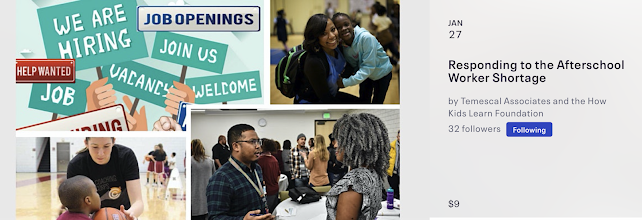
Afterschool Worker Shortages: An Overview

Source: (Clockwise, Top to Bottom): Jill on Money, WINGS For Kids,
The How Kids Learn Foundation and Coaching Corps


By Sam Piha

Recruiting, hiring, and retaining afterschool workers have been long standing issues in afterschool programs. This is due to low wages, mostly part-time hours, the lack of opportunities for advancement, and the lack of job security due to the reliance on temporary grants and funding. (Many say that low wages are also the result of childcare being a “women’s profession,” as well as our society’s undervaluing of the education and care of children and youth).   
 
Then the COVID-19 pandemic hit—and these issues were greatly exacerbated. They had resulted in programs closing, drastically reducing capacity, and adding stress to afterschool workers. Many of these challenges are not unique to the afterschool field- they are being experienced by those in education and a wide range of fields. 

This is the first in a series of LIAS Blogs to address this issue. This blog is an excerpt from a larger, briefing paper entitled, Understanding the Shortage of Workers in Afterschool Programs developed by Temescal Associates. The full paper can be downloaded and read here.


“The most pressing problem facing afterschool is the nationwide shortage of workers.”Michael Funk, Director of CDE Expanded Learning Division


VOICES FROM THE FIELD


In Afterschool Alliance’s Wave 5 survey of the field, conducted June 2-28, 2021, they found:
  • 80% of program providers surveyed reported that they were concerned about finding staff to hire/staffing shortages (57% extremely or very concerned).
  • 41% of program providers reported that advice on staff burnout and keeping teams engaged would be most helpful to their program.
  • 57% of programs that reported that they planned to be open in the fall of 2021 said that being able to hire enough staff was of most concern to them.

Survey Conducted by East Bay Asian Youth Center of 13 Lead Agencies Providing Afterschool Programs to 76 Schools 

What Factors Contribute to Average Daily Attendance Requirements Not Being Met? 
  • 85% Staff Shortage
  • 70% Health & Safety Concerns
  • 54% COVID-19
  • 46% School Day Enrollment Decline
  • 31% Seasonal Program Enrollment Withdrawal by Students
  • 23% Other
Factors Contributing to Staff Shortages:
  • 85% Health & Safety Concerns
  • 77% Preference for Full Time Employment
  • 80% Unqualified Candidates
  • 39% Compensation
  • 39% Family Obligations
  • 39% Preference for Employment in Other Industry
  • 23% Other


“There’s great uncertainty about economics. Programs are losing resources and funding and really struggling to survive. We’re really concerned with what is happening in the field. Afterschool programs have been a lifeline for our kids, for our families and our communities during these desperate times.”
 
 – Jodi Grant, Executive Director, Afterschool Alliance


IMPORTANT TERMS AND DEFINITIONS
Afterschool - There are many terms that refer to school-based and community-based youth programs outside of the classroom. They include “afterschool,” “out-of-school time (OST),” “expanded learning programs (EXL),” and “youth programs.” For the purposes of this blog series, we will primarily use the term “afterschool” to refer to all these programs.

Afterschool Workforce - The expanded learning workforce is largely made up of people of color, in part-time employment with limited to no benefits. A 2012 study found that 69% of the afterschool workforce in California are people of color, 65% are female, and 69% are part-time workers.

Worker Shortage - This is when there are an insufficient number of qualified individuals in a particular occupation to meet the demand for workers. This is worsened when afterschool programs have problems retaining staff.

Equity - Equity is just and fair inclusion. An equitable society is one in which all can participate and prosper. The goals of equity must be to create conditions that allow all to reach their full potential. In short, equity creates a path from hope to change.

“The route to achieving equity will not be accomplished through treating everyone equally. It will be achieved by treating everyone justly according to their circumstances.” Paula Dressel, Race Matters Institute 

Actions at the Program Level vs. Policy/ Systems Level - “Programs are short-term interventions that create temporary improvements in the wake of challenges. Policies, on the other hand, are covenants we collectively choose to live by, as articulated in legislation and regulation.” For example, “programs can't eliminate the systemic injustices that any group faces. They can help people manage the effects of these injustices, but they don't overcome or cure them. Policies, conversely, actually shift the way communities and their members react and relate to one another, empowering people to improve their own well-being in a systematic way.

Temescal Associates and The How Kids Learn Foundation will be conducting a webinar focusing on the nature of the current worker shortage, the challenges to afterschool programs and how best to respond to this as a field on Thursday, January 27, 2022 from 10:00am - 12:00pm (PST). To learn more and register, click here.


Thursday, November 21, 2013

What Our Youth Need is Much More than School Day Reform


By Guest Bloggers, David Kakishiba and Jennifer Peck (Originally posted on Inside Bay Area Opinion)

Every fall, households around the East Bay are busy with the shuffle of back-to-school activities and the shift
Jennifer Peck
 in routine that the season brings. A lot of preparation goes into getting students ready for the new school year, and working parents begin sorting through weekly schedules, including after-school arrangements.


Just as critical as being ready for the school day is being ready for the times outside of school -- having a plan to keep students safe, learning and healthy. What do children need for social, emotional and learning development all day long?

The hours after school and during the summer -- increasingly known as "expanded learning time" -- are critical to building the skills and character students need to be successful, not only in school but in life.

High-quality after-school programs are expanding students' horizons and learning capabilities through activities that are active, collaborative, meaningful and fun. These are the strategies we know best support children's learning.


David Kakishiba
Research shows that these expanded learning programs are removing barriers to success for students, with participating students showing improved achievement in math, increased school attendance and more positive attitudes toward learning.

Many factors outside the school day play a significant role in whether a student will succeed or fail academically.

The East Bay Asian Youth Center (EBAYC), a community-based organization that runs expanded learning programs and partners with Oakland Unified School District (OUSD) on community-school efforts, is working with the Partnership for Children and Youth (PCY) to identify all the needs children and youth have, putting into place the right solutions to meet those needs.

We've found that the hours after school and in the summer hold enormous potential to create environments that offer young people the supports and the opportunities they need most. A wide range of learning activities that are project-based, interactive and collaborative provides students the chance to directly apply what they've learned during the school day.

At EBAYC, this means young people have a safe place to be outside of school, the power to design and choose programming and access to specialized learning supports often needed by English learners.

We know that the skills of a teacher matter in the quality of education and learning opportunities a child receives, and in the same way, the skills of all staff working with children and youth matter -- including after-school and summer program staff.

Every adult supporting youth directly needs strong professional development to make sure kids are learning and benefiting to the fullest. EBAYC and PCY partner to provide staff with coaching, tools and ongoing support to make sure students are getting the most from their experiences.


East Bay Asian Youth Center 

Our commitment to ever improving our services offered to students and their families is a hallmark of EBAYC's impact on the broader community. The investment provides young people high-quality learning opportunities to increase their productivity, build healthy connections with others and safely and effectively navigate their changing environment.

The hours after school and during the summer occupy a powerful space that sets our children and youth on a course for the future.

We know through decades of research that impacting what happens during these hours is essential to every student's success. It is through collaboration, leadership and a commitment to continuous improvement that communities will be able to provide the support our children need.

Ultimately, we know that these efforts move us closer to a world where every young person has the opportunity to thrive.
___________________________
David Kakishiba is executive director for the East Bay Asian Youth Center, a community-based organization partnering with Oakland Unified School District, and Jennifer Peck is executive director for Partnership for Children and Youth.

Understanding Attention-Deficit Hyperactivity Disorder

Source: www.pexels.com By Sam Piha PURPOSE The purpose of this blog is to advance understanding of Attention- Deficit Hyperactivity Disorder...