Showing posts sorted by date for query save afterschool. Sort by relevance Show all posts

Wednesday, April 15, 2026

SAVE 21ST CENTURY CCLC

Every year the United States congress needs to approve the federal budget. This means that we need to keep updated and advocate for renewed afterschool funding. Below is a guest blog and update from Erik Peterson, Senior Vice President, Policy at Afterschool Alliance.

On April 3, the Trump Administration released the proposed federal budget for fiscal year 2027. While the budget proposal is a “skinny budget” that does not include all funding details, it does suggest consolidation of federal education funds and elimination of the 21st Century Community Learning Centers (21st CCLC) program, the only federal funding that exclusively supports local, school and community afterschool and summer learning programs.

The budget proposal is similar to the one introduced by the Administration last year, however Congress passed a bipartisan spending bill that rejected last year’s proposal and instead maintained and protected federal 21st CCLC afterschool and summer program funding for summer 2026 and the 2026-2027 school year.


Source: www.pexels.com
Federal support for local afterschool and summer programs helps 1.4 million children and youth nationwide have opportunities for math and reading enrichment, healthy activity and nutritious snacks, and hands-on, engaging activities that help children learn and grow. Instead of cutting funding for these programs, which help students succeed, keep young people safe, and support working parents—a funding increase is needed to help programs cover rising costs and to start to meet the nationwide demand for programs.


Please take two minutes to send a message to Congress in support of afterschool and summer learning programs by clicking here.


MORE ABOUT...

Erik Peterson
Erik Peterson is the Senior Vice President, Policy at Afterschool Alliance.  He joined the Afterschool Alliance in July 2009 and coordinates and advances the Afterschool Alliance’s policy efforts at the federal level by helping develop policy goals and implementing strategies that advance access to quality afterschool and summer learning programs for all. Erik works to build and strengthen relationships with policy makers and allied organizations to increase public support and funding for out of school time programs. Prior to coming to the Afterschool Alliance, Erik worked for the School Nutrition Association (SNA) in the Washington DC area, and as both an AmeriCorps VISTA and staff for the Sustainable Food Center in Austin, Texas. 

The Afterschool Alliance was established in 2000 by a small group of corporate and foundation philanthropies—including the Charles Stewart Mott Foundation, the U.S. Department of Education, JCPenney Company, Inc., the Open Society Institute/The After-School Corporation, the Entertainment Industry Foundation and the Creative Artists Agency Foundation—to expand afterschool and summer learning opportunities nationwide. Since our inception, public investment in afterschool programs has doubled. 

Today, the Alliance works with a broad range of organizations and supporters, including policymakers, government agencies, youth, parent and education groups, business and philanthropic leaders, afterschool coalitions and providers at the national, state, and local levels, and leaders representing health and wellness, college and career readiness, social and emotional learning, science, technology, engineering, and math (STEM) learning, and more—each with a stake in afterschool. 

Monday, June 9, 2025

Save 21st CCLC Afterschool Programs- An Update from the Afterschool Alliance

Source: Afterschool Alliance

Erik Peterson
Erik Peterson, Senior Vice President of Policy at Afterschool Alliance, issued an alert that the 21st CCLC may be at risk of defunding. He wrote:

“President Trump's full education budget proposal came out last Friday evening, clearly eliminating dedicated funding for afterschool and summer programs via 21st Century Community Learning Centers (21st CCLC). The plan levies enormous cuts on the Department of Education that would impact afterschool and summer programs and the youth and families they serve. Now Congress will decide whether to adopt the proposed budget.

Source: New York State Network for Youth Success

21st CCLC supports roughly 10,000 local programs serving 1.4 million across the nation. If Congress adopts the President's budget proposal, 21st CCLC would be lumped with 17 other programs under one grant program of $2 billion—reflecting an almost 70% funding cut compared to the current allocation for these programs. States would be left with far fewer resources to divvy up among many priorities. With $12 billion in cuts to education programs overall, the consolidation effectively eliminates 21st CCLC afterschool and summer program grants.

The budget only outlines the Administration's guidance on funding. It is now the job of Congress to craft spending legislation.

Use the tools at AfterschoolWorksforAmerica.org to help get the word out and engage the public in saving afterschool and summer program funding. 21st CCLC funding supports programs in every state and territory—view this map to see how the proposed cut could impact your state. Read the Afterschool Alliance's blog and statement for more on the budget proposal.


WHAT YOU CAN DO

1. Get the Word Out: Post on social media, local parent and community boards, newsletters – any place where community members might see it. Tag your Congressional representatives so they see it. Here are some samples:

  • 'The President’s budget calls for eliminating dedicated federal funding for local afterschool and summer programs. 1 in 5 children may lose their programs nationwide. If you want to keep afterschool and summer programs, send a message to Congress'
  • 'Do you count on afterschool programs to keep kids safe and engaged? Local programs serving 1.4 million youth nationwide may close if Congress does not act - the President’s budget cuts federal funding for local afterschool and summer programs. Programs run by schools, community organizations, parks and rec centers, and more will suffer. Tell Congress to save afterschool and keep kids protected.' 

To keep up to date on the latest developments, join the Policy Pulse! Every second Friday at noon ET, Erik Peterson, will recap the latest policy developments, what we know (or don’t know!) about how they may impact afterschool and summer programs, and what may be coming up next. To register, click here.

2. Engage Families: Educate families about what’s at risk and encourage them to take action.

  • Ask families to email Congress. Include a note in your emails or on social media posts asking families to contact Congress: 'Kids and families across our state may lose their afterschool and summer programs if Congress agrees to the federal proposal to cut all funding for local programs. As many as 1 in 5 youth may be affected, including kids and programs in our state. Please take a moment to use this Action Center to have an email sent to our Congressional representatives reminding them how important our programs are.' 


3. Collect postcards or letters: Distribute postcards or letter templates families can fill out with a personal note and their information. Deliver the messages to the local offices of your Congressional representatives. Mail the letters or hand deliver them – along with an invite to visit your program! Get Afterschool Alliance's postcard design and petition here.

  • TIP: Make it fun! Consider running a contest or setting a goal and prize around the number of letters collected/sent.

4. Host a Site Visit: There’s no better way to showcase the power and value of afterschool than showing people first hand. Invite your representatives in Congress and their staff to come visit your program. You do not need to get the Member of Congress there – having one of their staff join can be incredibly powerful. Our site visit toolkit helps you each step of the way, from preparing and planning, to drafting invitations, to following up after a great visit! 

5. Generate Media Interest: Let media know that afterschool and summer programs are at risk. Send a letter to the editor (we will post a template soon). If your program receives federal funds, like a 21st Century Community Learning Center grant, alert local education reporters, bloggers, and community boards about the prospect of your program closing. More media tips on the Afterschool Alliance website can be found here.

Source: Afterschool Alliance

RESEARCH SHOWS AFTERSCHOOL WORKS

Monday, September 4, 2023

The Power of Work and Afterschool (Part 2)

Source: A World Fit for Kids

By Sam Piha

In his book, The Means to Grow Up: Reinventing Apprenticeship as a Developmental Support in Adolescence, author Robert Halpern describes the developmental tasks of older youth. Halpern’s descriptions of these tasks include:

  • Asserting control over their lives and the forces that affect them and their communities, 
  • Beginning to think about the adult world, how it works, make sense of it, and discern their role 
  • Ability to carry out more complex tasks: to plan, apportion time, sustain attention and effort, gather and organize information, and monitor one’s work.
  • Forging a sense of identity and voice as someone who has power, can positively impact others, and can demonstrate real accomplishment and achievement that has meaning. 

We believe that afterschool programs can play an essential role in workforce development and providing opportunities for older youth to work. We think that youth employment can help address the developmental tasks of older youth as described above. To learn more about this we interview Bill Fennessy, who is an expert on workforce development in afterschool, educational researcher, Regie Stites and Normandie Nigh, Chief Executive Officer and Founder of A World Fit For Kids!.

Q: Do you think young people's engagement in work provides special benefits? 

Bill Fennessy
A: There is no question that young people’s engagement in work provides benefits, and that engagement could be pivotal to their success in life. Most of our students will need a to know how to get job after high school to support themselves or contribute financially to the household. They will also need a job to financially be positioned to be able to attend college and other post-secondary educational opportunities.

Engagement in work is especially important for our students of color. Gallup results show that 65% of students of color will follow the educational and career advice from someone in the workplace, over the advice from their parents, teachers, and counselors combined.

Normandie Nigh

A: (Normandie Nigh) Absolutely! When young people join the workforce they benefit in so many ways, including earning a pay check and experiencing the pride that comes with having a job and learning a variety of skills such as writing a resume, interviewing, expectations, responsibility, punctuality and workplace professionalism. For many of our students they’re also grateful to be able to contribute to their families or save towards their education. At A World Fit For Kids! we believe that it is also important to assist students in learning financial management, time management, safety protocols & procedures, and laws pertaining to teen employment.

Q: How did you discover the power of work for older youth? 

A: (Bill Fennessy) The discovery started with the belief that our programs must be student-driven both in content and delivery, and with we adults serving as facilitators. From there I took the opportunity to require the student leadership to participate in employment skills and position specific trainings to be able to attain those leadership positions. The level of student interest, despite the required training, was incredibly high. So, students that wanted these opportunities, also learned how to get a job.

I also strongly believe that students should be encouraged and supported in looking at what career or careers they are interested in. With that information, students, parents, and counselors can make decisions on the student’s education based, both secondary and post-secondary, on the relevancy to that career. The value of workforce opportunities such as Work Exploration, Work Experience, Internships, Apprenticeships, and Employment is immeasurably positive and will support life changing success.

A: (Normandie Nigh) When I starting working with inner-city teens in Los Angeles in 1994 I saw first hand the power of providing training, requiring community service and then allowing students to apply and get a job in our afterschool programs where they coached and mentored elementary kids. It truly changed both lives in the process!

Q: Do you think that the out-of-school setting is a good place to prepare youth for success in work and career?

Regie Stites
A: (Regie Stites) The simple answer is yes, the out-of-school setting is essential for preparing youth for work and career success. This is so because out-of-school programs can play a key role in supporting the types of integrated learning activities that connect school learning to real-world applications of knowledge and skills. For many young people, especially young people from low-income neighborhoods, one of the most important keys to educational engagement, persistence, and success is relevance. 

Simple common sense (and research) supports the notion that young people who can clearly see the relevance of what they are learning to their own lives and futures are more likely to persist and be successful in education and, as a result, are more likely to be ready for career success. The best methods for connecting school learning to real-world applications of knowledge and skills are well known. These methods include project-based learning, experiential learning, service learning, and a range of work-based learning activities. Some of these integrated learning activities, such as project-based learning and some forms of work-based learning may not require an out-of-school setting, but they are stronger when they do.

A: (Bill Fennessy) Absolutely! The Expanded Learning setting (afterschool) is where young people can feel comfortable to learn and practice the skills they want to experience, in this case “Employability Skills Workshops”. Work is something many of them are curious about or are already very interested in, so it is a very relevant activity for them. For those high school students that will serve at the elementary school Expanded Learning programs, the relationships they have with their own Expanded Learning program staff gives them the great opportunity to watch someone they trust model what would be expected when they work with elementary students. They also are implicitly introduced to the thought of an actual Expanded Learning job after high school, and they will likely need a job if they plan to attend college.

MORE ABOUT…

Regie Stites, Ph.D., is an author, social science researcher, and family historian. He served for twenty years at SRI International as a senior researcher and program manager. He conducted research on policies and practices designed to improve educational quality and outcomes for all students, but particularly for linguistic and racial minority students and for students living in poverty. 


Bill Fennessy currently serves with the California AfterSchool Network (CAN) as a Program Specialist on Equity, Quality and Workforce Development. In 2004 at Blair IB School in Pasadena, CA, Bill launched California’s first ASSETs pilot programs. Bill is recognized as a pioneer, innovator, exemplary practitioner, and thought leader in High School Expanded Learning nationwide. During the pandemic, Bill served as the Director of High School Programs for “A World Fit for Kids!”. 

Normandie Nigh is the Chief Executive Officer and Founder of A World Fit For Kids! (WFIT), a leading youth development organization that has been providing healthy behaviors and self-empowerment programs and training for inner-city youth and their families since 1994. She is an active advocate on behalf of healthy kids, families and communities and is an authority in the program development and training. She currently serves on many distinctive boards and steering committees that influence public policy in regards to physical education, physical activity, nutrition education, workforce development and additional aspects of developing the emotional, mental and physical well-being of kids.

Below are two briefing papers and three webinar recordings you should check out on the topic of youth workforce development in afterschool. 


[New Briefing Paper]

Restorative Justice Practices in Afterschool Programs
Restorative justice is a values-based practice. It creates a safe environment and builds trusting relationships, which are critical features of quality afterschool programs. These are the foundation on which afterschool programs can integrate restorative justice practices.
​
This paper is designed to raise understanding and awareness of restorative justice practices and identify ways afterschool leaders can integrate them. We recommend that program leaders share this paper with organizational leaders and program staff and consider the best ways to respond to personal harm and conflicts among youth participants.

To view and download this paper, click here.

Monday, March 6, 2023

A Youth Leader Speaks Out on Peer-to-Peer Counseling and Suicide Prevention

Source: Sofia Mendoza

By Sam Piha

Since the return of young people to school and afterschool programs after the COVID shutdowns, there have been major concerns raised by educators and youth workers regarding youth mental health, the increase of challenging behavior and a decrease in acts of kindness shown to peers. Youth are not blind to these issues and want to be part of the solution.
 
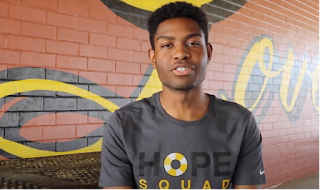
In this vein, meet Sofia Mendoza, a freshman at Purdue University. When she was a senior at Hilliard Davidson High School, she served as a peer-to-peer counselor in the HOPE Squad program. HOPE Squad is a school-based peer support team that partners with local mental health agencies. They seek to reduce self-destructive behavior and youth suicide by training, building and creating change in schools and communities. 
 
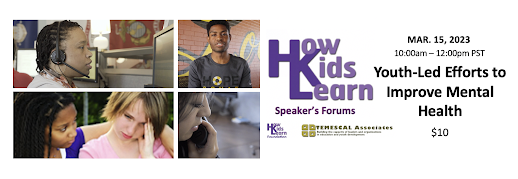
Below is an interview with Sofia Mendoza about her experiences as a HOPE Squad peer counselor. She is also a featured speaker in an upcoming webinar entitled, Youth-Led Efforts to Improve Mental Health on March 15, 2023 from 10am-12pm PST.
Q: Why did you join the HOPE Squad?
A: During my freshman year of high school, I was selected to be a HOPE Squad member as the selection process was based on peer-to-peer nominations. I accepted my role because I did not know what HOPE Squad would look like at my school, but I knew that breaking the stigma around mental health was something I wanted to be a part of.

Source: HOPE Squad
Q: How were you prepared for this role?
A: As a HOPE Squad member, we all received instruction on how to Question, Persuade, and Refer our peers, better known as QPR training. We learned about the warning signs of suicide, practiced mock conversations with students, and learned about all the resources students can utilize to find professional help regardless of whether or not the student is in crisis.

Q: Many people say that youth are not able to handle the responsibility of a peer counselor. Please comment on this.
A: The situations that youth must deal with nowadays can be very challenging to navigate and especially mentally draining. Even if a student isn’t a peer counselor, they are already helping their peers through these difficult times. 
 
HOPE Squad equips students with a toolbox to navigate these tough conversations. I would also say that as a peer counselor, we focus our efforts on referring students to the correct resources. We are not expected to solve a student’s issues, what we are responsible for is recognizing when students are showing signs of suicide and providing them the support to find the resources best for them. Especially with programming such as HOPE Squad, students work hand in hand with their guidance counselors. This relationship is critical because the student does not have the sole responsibility of ensuring their peer gets help, these counselors are here to support as well.

Q: Why do you think this peer approach is important?
A: Unfortunately, there are many students who do not have strong support systems to lean on when going through difficult times. Often when students do have these support systems, they would rather lean on their peers anyways because they do not want to burden their parents and mentors, or they simply may feel uncomfortable talking about their mental struggles. This is where their peers come in because the trust and confidence built between friendships is like no other. Because of these relationships, peers can notice these mental struggles earlier and have the ability to intervene. We must equip youth with the tools to listen and adequately respond when they believe their friends are in crisis. This is why this approach works because speaking about personal struggles comes much easier than discussing these issues with adults.
 
Q: What impact did serving as a peer counselor have on you?
A: I have gained a new awareness when interacting with people and I feel this experience has increased my emotional intelligence. I do my best to spread positivity each and every day by recognizing that the interactions I have with people can have a huge impact on their lives.
 
Q: Can you define "kindness"?
A: To me, kindness means being emotionally aware of others and offering continuous support to those around you. Kindness can be shown from little things such as saying thank you, holding the door for others, or even complimenting someone. It can also be exemplified through larger things such as assisting someone through difficult times.
 
Q: In your experience, what was the impact of the COVID pandemic on young people?
A: The little good that did come from COVID was that the pandemic highlighted the importance of self-care practices. Many students went from rigorous schoolwork and busy lifestyles to immediate isolation. This shift illustrated that it is okay to take breaks and not force students to stretch themselves thin. 
 
Additionally, many young people’s lives changed by the pandemic whether their financial, family, or physical situations had changed. These unforeseen circumstances shifted many people’s views on what they truly value in life.
 
Q: Did you find that self-care was important in your role? Can you say more about this?
A: You cannot fully help people when you are not meeting your own needs. Even before joining HOPE Squad I had struggled with this because I enjoyed giving and helping people even when I could not give anymore. Once I was in this role, I found that our curriculum had equally emphasized the importance of self-care, and I even learned about new activities I could try to decompress. I have found that self-care is one of the most important things you could do in order to recharge your social, emotional, and physical batteries.
 
Q: If schools and youth programs want to learn more about youth led peer counseling, who could they contact or what resources would you recommend?
A: I would recommend schools and youth programs to look into starting a HOPE Squad. This organization has done a good job developing a curriculum for students to follow in order to begin breaking the stigma around mental health. If this opportunity is not an option, an alternative could be hosting educational events centered around mental health by consulting mental health experts in the area. Anything that involves talking about mental struggles and acknowledging that everyone deals with these issues whether big or small, is one step closer to normalizing discussing mental health.
 
Additionally, I would also recommend having all faculty to be QPR certified, sponsored by a Youth Suicide Prevention organization, as this is one of the most important educational tools I have been taught. As a society, I think it is important to be able to recognize the warning signs of suicide because this information alone can save lives if we correctly respond to these signs.

Click the image below to hear an interview with Sofia when she was named "A Rising Star." 


Click on the image below to view a video of statements by other HOPE Squad youth volunteers.
 

MORE ABOUT...

Sofia Mendoza is a freshman in First-Year Engineering at Purdue University. She serves as the project manager for the Women in Engineering section of the Engineering Projects in Community Service initiative at Purdue, as well as a multi-faceted dancer for XSeries and the Purdue Contemporary Dance Company. Along with her passion for STEM and dance, she has an extensive history with advocating for mental health as a past member of HOPE Squad, a peer-to-peer suicide prevention program.

Tuesday, May 11, 2021

The Missing Hours: COVID Shutdown and Afterschool

By Sam Piha

This fall, after nearly a year of isolation, youth are likely returning to school full time. What did young people experience during this time? A recent article in the NY Times, The Missing Hours: 7 Students on Losing a Year of After-School Activities, by Juliana Kim, quoted young people about their experience during the last year of shut down. 

Julianna writes, “From 3 p.m. to 6 p.m. That block of time, between the end of classes and the beginning of dinner, were for millions of teenagers everywhere the golden hours of the day. They provided a release from the pressures of school or an escape from a stressful home. It was a time for friendship and fun.”  

Below we provide some excerpts from this article. To read the full article, click here. 

Source: NY Times,
Lila Barth

“I’ve done the Y.M.C.A. from sixth grade onward. It started because my mom was working, my dad was working, my sister was working, so my mom needed to find somewhere I could spend my time instead of staying home alone. I haven’t gone to the Flushing Y in a year; it’s tough. I really miss going. We still have our meetings but they’re online — very rarely do I get to go outside and see my friends or counselors, so it’s a big adjustment. Sometimes I feel like I’m just far away from the world.”— Samir, 16 


Source: NY Times,
Lila Barth
“The 96th street library on the East Side was my second happy place, after home. I would go there after school, get my work done, then go home. The security guard knows me, some staff know me. It was like a family to me over there… Libraries were the place you could rely on and have peace. I’ve been through shelters since I was 8 years old. My dad kicked out my mom, and she took me and my little sister with her. It was a lot of back and forth. Some kids out there might go to a cafe, but they have to buy something if they want to study. So it’s hard. The library is really the only option. When they were opening up schools, I was like, OK, are they going to open up the library? But they mentioned nothing about the library. What’s the whole point of opening up schools if you can’t go to the library?” — Sam, 18


Source: NY Times,
Lila Barth
 . This year, remote learning has been very isolating for me. My mom works at a hospital and my dad is a taxi driver so it can feel very lonely at home. And I haven’t danced after school since March. There’s no space to dance but also, I’ve become more self-conscious. I realize how important it is to have company when you do activities that might spark insecurities, like dancing. I feel like there’s been an insensitivity about youth mental health. There’s a huge emphasis on taking care of and making time for yourself, but the best way to take care of myself was through my extracurriculars. I feel like a part of myself has been erased.” — Meril, 17


Source: NY Times,
Lila Barth

“These activities and organizations are so important. They might just save somebody’s life, you know?” — Rafael, 15


Tuesday, March 31, 2020

We Need to Save Afterschool and Our Non-profits

By Sam Piha

We can't stop educating the public and policy makers on the value of afterschool and our non-profit providers.

SAVE OUR NON-PROFITS: Congress has ignored the non-profit sector as they consider the COVID-19 Stimulus Package. Read more.
Source: Council of Non-profits

FEDERAL FUNDING FOR AFTERSCHOOL: Once again, the current Presidential administration is proposing a federal budget calling for the elimination of funds for afterschool and summer learning programs for 1.7 million young people. Policymakers in the House and Senate have the power to decide whether local afterschool and summer learning programs will receive the funds they need to remain open.


Tell your members of Congress to protect the programs America's children and families rely on, and invite a policy maker to visit an afterschool program. Also, participate in the next Lights On Afterschool event.
Source: www.afterschoolnetwork.org


Below are some resources to learn more:
Below are some resources for California programs:

Tuesday, September 10, 2019

Thinking About Equity: Nature and Afterschool

By Sam Piha


When I managed afterschool programs in the SF Bay area, we learned that many of the kids we served had never been on the bay, seen the ocean, planted a seed and experienced it grow into a real plant, walked in a forest or camped outside overnight. Many had never been beyond their neighborhood, owned a swimsuit or knew how to swim. Was this an equity issue? Yes. 

In response, we conducted nature outings, camping trips, and swimming lessons. We even purchased swimsuits for those that didn’t have them. Because one of our lead agencies was the YMCA, we had resources for this. But every afterschool program can contribute by incorporating nature into their program. 
Recent studies focus not so much on what is lost when nature experience fades, but on what is gained through more exposure to natural settings, including nearby nature in urban places. - Richard Louv


Richard Louv
In two previous blog posts, we reviewed the power of nature in afterschool programs. Richard Louv, author and Co-Founder of the Children & Nature Network, has written a lot about the intersection between access to nature and development. He was recently interviewed by the Greater Good Science Center. We share an excerpt and link to the full interview below. 

Q: How will this trend impact pro-environmental attitudes and behaviors in kids?

RL: If nature experiences continue to fade from the current generation of young people, and the next, and the ones to follow, where will future stewards of the earth come from?

Past research has shown that adults who identify themselves as environmentalists or conservationists almost always had some transcendent experiences in the natural world. What happens if that personal experience virtually disappears?

Q: Are there particular kinds of experiences in nature that seem to have the most impact on kids?

RL: The quality of the nature experience depends on how direct the experience with nature is. Are kids getting their hands wet and their feet muddy? These types of activities can help kids learn to have confidence in themselves and power to make independent decisions. 

One reason for this is the risk-taking inherent in outdoor play, which plays an important role in child development. Without independent play, the critical cognitive skill called executive function is at risk. Executive function is a complex process, but at its core is the ability to exert self-control, to control and direct emotion and behavior. Children develop executive function in large part through make-believe play. The function is aptly named: When you make up your own world, you’re the executive. A child’s executive function, as it turns out, is a better predictor of success in school than IQ.

See full interview here. 

Richard also gave us permission to share some of his interview with youth development guru, Karen Pittman. 

RL: Did you have experiences in nature that helped form who you are today? As a child or an adult?


Karen Pittman
KP: I grew up in a working class, urban neighborhood in a family that emphasized the value of sending children outdoors to play. We did not, however, do any organized outdoor activities beyond family picnics. So it wasn’t until I was in high school that I realized that you could walk the length of Washington D.C. through Rock Creek Park, or stand on the waterfront of the Potomac River. Learning this was liberating. To this day, I seek nature to calm, inspire, reflect, and marvel at the intricacy of life.

RL: How does a lack of access to nature factor into the challenges that youth face?

KP: The Chicago Consortium for School Research defines successful young adults as those who have an integrated identity, a sense of agency, and a range of competencies. Getting to these end states requires young people to have access to safe, supportive, relationship-rich opportunities to act and reflect while being challenged to learn and master new things. 

Nature is an ideal setting for young people to learn new content, try new things, apply their skills in different ways and fail safely. Nature is a new environment for many young people – one that they haven’t explored. One of the challenges many young people face is that they don’t have comfortable opportunities to be in a group of young people in which they won’t be immediately judged for what they don’t know. 

We learned, at High Scope Camp, the importance of challenging groups to learn and do things that none, or few, youth had done (e.g. folk dancing). These are “clean slate” learning opportunities in which some will shine, some will struggle, but it is not clear who will fall into which camp. Beyond exploration, nature also provides young people with ample opportunities to have a sense of agency, to achieve mastery and to flesh out and expand their sense of identity.


RL: Can you share any stories about the benefits of nature for opportunity youth?

KP: I believe that there are studies on the importance of programs like the Fresh Air Fund. But I’ll quickly share a High Scope story. The camp was billed as an educational camp for teenagers. Their jobs, for about 4 hours a day, were to participate in one or two short exploratory classes and longer workshop experience that culminated in a product or presentation. The setting for all of this learning, however, was several hundred acres that included trails, a small lake, and a working farm. In addition, all youth participated in overnight camping or canoeing trips. These were powerful experiences for all of the young people.

But for young people from more distressed communities or stressful situations, the main impact was that they had the experience of learning that nature can be a safe place. One that, unlike their communities, has challenges that you can predict and prepare for. Then, as noted, the second important learning for these young people is that they could become leaders in a broader learning setting in which academics is not the main measure of success.

See full interview here.

RESOURCES
There are many resources and articles on development and nature as well as program ideas. Many can be found by doing a web search of “nature and children”. There are also resources listed in the full interviews cited above. We also urge readers to take a look at the Children & Nature website. 

--------
Richard Louv is Co-Founder and Chairman Emeritus of the Children & Nature Network, an organization supporting the international movement to connect children, their families and their communities to the natural world. He is the author of ten books, including "Last Child in the Woods: Saving Our Children from Nature-Deficit Disorder," "The Nature Principle," and "Vitamin N." His newest book, "Our Wild Calling: How Connecting to Animals Can Transform Our Lives — and Save Theirs." In 2008, he was awarded the Audubon Medal. He speaks frequently around the country and internationally.

Karen J. Pittman is president and CEO of the Forum for Youth Investment, a national nonprofit, nonpartisan “action tank” that combines thought leadership on youth development, youth policy, cross-system/cross-sector partnerships and developmental youth practice with on-the-ground training, technical assistance and support. Karen is a respected sociologist and leader in youth development. Prior to co-founding the Forum in 1998, she launched adolescent pregnancy prevention initiatives at the Children’s Defense Fund, started the Center for Youth Development and Policy Research, and served as senior vice president at the International Youth Foundation. Karen was involved in the founding of America’s Promise and directed the President’s Crime Prevention Council during the William Clinton administration. 

Wednesday, February 20, 2019

An Interview with Youth Development Researcher, Reed Larson

By Sam Piha

According to the Chronicle of Evidence-Based Mentoring, "Reed Larson’s seminal research on the lives of teenagers helped to launch the field of positive youth development, and his insights and findings continue to enrich the work of mentoring researchers. His work explores the contexts of daily life and how developmental processes unfold in extra-curricular activities."

Researcher, Deborah Vandell (UC Irvine), stated, "Reed Larson did some really  important work looking at the development of initiative and engagement. What he found is that when children are in school what they often are doing is putting forth a lot of effort, but they're not really motivated. What happens in afterschool activities, when they're really working, when they're active, they're choosing those activities and they are also focused on them. It's the best combination for learning."


Reed Larson will share his work at a Speaker's Forum entitled, "How Demanding Program Roles Can Facilitate Youth’s Positive Development" on April 19, 2019 in Oakland, CA. You can register here. We recently interviewed Reed and some of his responses are below.


Reed Larson
Q: You have been a pioneer in the field of youth development. What drew you to this work? 
A: I have done research and teaching on the age period of adolescence all my life. We know it is a time of enormous potentials for growth. Yet our society does not get that. Teens are disrespected, misunderstood, and terribly underestimated. As a result, they are not given the opportunities to develop their potentials. I discovered that after school and out of school programs were the main exception. They are a part of teens’ lives where they have opportunities to develop their full potentials.

Q: The work of promoting youth development is not easy. In your research, what did you find to be the greatest challenges facing youth workers? 
A: There are a lot of challenges: being present and attuned to youth, being both a friend and a mentor, teacher, or sometimes parent; seeing societal injustice and hurt in teens; having too few resources; taking care of yourself at the same time you are engaged in caring relationships with others. 

Q: What settings and practices are most successful in engaging youth? 
A: I don’t claim to have all the answers. But in our research, youth have described becoming highly motivated in youth program settings where they feel safe, feel they belong, experience positive relationships, and experience a culture that supports these positive ways of being. Further, in settings where they are engaged in activities: that have meaningful goals, are challenging while allowing them to experience competence, and involve high-functioning collaborative relationships. I’ve also observed that high quality programs provide an environment that helps youth disengage from distractions and anxieties in their lives at the beginning of the program session, and reflect on what they have learned at the end.  

Q: What is the most important lesson that you learned in your research? 
A: I have seen again and again that young people have enormous resources. They can be extremely resilient. They are eager, active learners who learn from experiences. They are ready to have deep insights about complex social and emotional truths. We just need to provide the right conditions for them to feel save, loved, and to see a way forward. 

Q: What most surprised you? 
A: It is maybe not a surprise, but I have been impressed by meeting many, many wonderful, smart, and caring people who have devoted themselves to working with young people. It has been increasingly clear to me that to improve programs the field needs to seek out, understand, and draw on the expertise of experienced youth development practitioners. Communication between researchers and practitioners need to involve two-way conversations. 

Q: What are you working on currently? 
A: We just finished a research paper on how “substantive demanding roles” can provide powerful opportunities for youth’s development of new competencies, including responsibility to others. (This will be the main topic of my Speaker's Forum presentation). Although my research has been mainly focused on processes of positive development, I am currently interested in times when youth in programs experience “psychological meltdowns” from a setback or being overwhelmed, and how staff are effective in helping youth respond with resiliency. 

----------------
Reed Larson’s seminal research on the lives of teenagers helped to launch the field of positive youth development, and his insights and findings continue to enrich this field. His work has involved over a thousand interviews with youth and front line staff in diverse youth development programs. It has focused on understanding how developmental experiences unfold in programs (including extracurricular activities) and how program staff are effective in supporting these learning processes. His team’s research was the basis for the Weikart Foundation’s research-practitioner collaboration that identified effective staff practices for supporting social emotional learning in programs. Reed is a professor in the Department of Human Development and Family Studies at the University of Illinois at Urbana-Champaign and was recently the President of the Society for Research on Adolescence. He also served as Editor-in-Chief of New Directions for Child and Adolescent Development (with Lene Jensen).

Screen Time and Young People

Source: www.pexels.com By Sam Piha There’s a general consensus that too much screen time is bad for kids. While limiting screen time and est...