Showing posts with label terry peterson. Show all posts

Wednesday, September 7, 2022

Afterschool and the Education Culture Wars (Part 2)


By Sam Piha

In part 1 of Afterschool and the Education Culture Wars we introduced the issues that many schools are facing regarding critical race theory and the call to ban books dealing with identity issues (racial and gender). In part 2 we offer some tips on how to avoid entanglement in these education culture wars and how to combat misinformation in the community. 


HOW TO AVOID ENTANGLEMENT IN THE EDUCATION CULTURE WARS

When Describing the Program, Sharpen the Message; Avoid Acronyms and Jargon 
When describing your program in written outreach documents, remember your audience are not afterschool insiders- they might be parents and community members. It is very useful to have parents and community members review the text to ensure that it is understandable to an outsider. This is also a good way to build parent advocates for the program who can speak out and support if the program comes under scrutiny.  

Source: Nicolas Picard, Unsplash.com

“The first question they [parents] had was, ‘What the hell are you talking about?’” he said. “’I get math. I get reading. What the hell is social-emotional learning? ’When commissioners explained they wanted schools to nurture qualities such as discipline, self-management, and relationship skills, “they’d [parents] say, ‘Oh yeah, we’re for that,’” - John Bridgeland, CEO of Civic Enterprises

Terry Peterson
“Working on education improvements and reforms for almost fifty years, I have observed that almost any education innovation using initials [or acronyms] is likely to invite pushback. Also, describing development and learning in shorthand “buzz words," not mainstream terms, also invites problems. Case in point: We give very conservative critics great aid by providing them both initials, SEL, and words like social emotional learning. Instead, say practically that we are working to strengthen: self-management skills, social awareness skills, responsible decision-making skills, and teamwork skills”
- Terry Peterson,  Afterschool Alliance


Double Down on Commitment to Program Values

“We all just have to continue to believe in what we do and stick together and not back down.” - Bridget Laird, CEO of WINGS for Kids 

While it is important to steer clear of trouble, we have to remain committed to our views. Below are some inspirational statements taken from As Terms Like ‘SEL’ Draw Fire, Organizations Supporting Schools Sharpen Their Message by Libby Stanford for ED Week.

“Although the rhetoric surrounding critical race theory and SEL can be loud at times, it has not deterred education organizations from being vocal about their work. ‘If anything, we’ve doubled down on our values, we’ve doubled down on our program,’ Peter Shulman (CEO of Urban Teachers) said.” 

“Urban Teachers isn’t coy about its stance on race and racism in its messaging. On its website, the organization writes “Structural racism and inequality have kept generations of urban children from receiving the education they deserve.” 


Get Involved, Especially in Your Local Community

Support for afterschool is not guaranteed and may have a shelf life. Thus, it is vital that we get involved in decision making to protect afterschool. Below are some suggestions. 
  • Support candidates and groups that agree with your values. 
  • Vote for local, state and federal candidates that agree with your values.
  • Keep up on what’s happening locally and across the nation.
  • Write to your elected officials to continue supporting afterschool.
Participate by:
  • Running for school board or a local office 
  • Follow or attend local school board meetings. They are often televised, or video recorded and publish their notes and future meeting agendas on community websites. You can view a recorded school board meeting from Polk County, Florida, as they discuss the banning of books.  


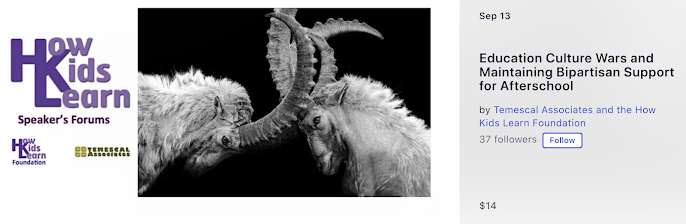
On September 13, 2022, Temescal Associates and The How Kids Learn Foundation will be sponsoring a webinar on this topic to further discuss the issues behind the current education culture wars and how it affects afterschool. Panelists will include Terry Peterson (Afterschool Alliance), Michael Funk (CDE), Bridget Laird (WINGS for Kids), Melissa Schlinger (CASEL) and Femi Vance (AIR). To learn more and register for this informative webinar, click here.

Tuesday, August 23, 2022

Afterschool and the Education Culture Wars (Part 1)

Source: Unsplash.com

By Sam Piha

We live in a political climate where differences are not explored, they are weaponized. In recent months schools and educators have been attacked under the guise of critical race theory, parent rights and the call to ban certain books. The PBS News Hour offered a good segment on critical race theory and book bannings.

Are there many citizens who are leading this fight or is it a manufactured controversy, which is a product of the internet? Below is a quote from an article (NEA News) that attempts to explain this.1

“As the nation continues to reckon with the role racism plays in our society, a tiny but extremely vocal minority of voices is determined to turn our classrooms into battlegrounds for their vicious culture wars. These radical groups are using social media to spread disinformation and stoke fear about race in the classroom, pushing for laws to ban books about Ruby Bridges, Martin Luther King, Jr. and other civil rights figures, and seeking to censor teachers and deny students the right to a truthful and honest education.” – Edward Graham, NEA News

Source: PBS News Hour

While afterschool programs have not been attacked directly, there are certain core values and program initiatives that have come under scrutiny. They include equity, identity (LGBTQ+ and racial), mindfulness, growth mindsets, grit and social emotional learning (SEL).

A HISTORY OF BIPARTISAN SUPPORT
Before we discuss how to not get entangled in the educational culture wars, it is important to note that the support for the afterschool movement over the last 30 years has largely been bipartisan. According to Dr. Terry Peterson (Afterschool Alliance), “The roots in California involved bipartisan support in some key cities in the late 1980’s, like Los Angeles, San Francisco, San Diego and Sacramento and then spread greatly with the strong leadership of a Republican Governor, Schwarzenegger, and then much later, now, a huge expansion by a democratic Governor Newsom. This type of local, state and national expansion of an initiative overtime is very unusual and very important. 

The roots of the 21st Century Community Learning Centers in the 1990’s clearly involved Republican and Democratic members of Congress and a Democratic Administration.”  The 21st CCLC quickly became one of the fastest growing social programs in the history of America. (We interviewed Dr. Peterson in a previous LIAS Blog).

Source: History of Afterschool in America

HOW TO AVOID ENTANGLEMENT IN THE EDUCATION CULTURE WARS
It is important to not take the support for afterschool for granted. There are things we can do to prevent that the afterschool movement is not damaged by the educational culture wars. 

Be aware of what’s happening in your area and in the larger field. 
“In this environment, anything can be politicized,” said John Bridgeland, the CEO of Civic Enterprises, a public policy firm, who has worked extensively on building bipartisan support for SEL programs in schools.

To get a better sense of what’s happening in the larger field, below we cite some titles from articles with endnote references that have been published recently:

  • Socio-Emotional Learning (SEL) Is Anti-White, Anti-Christian, and Anti-American Indoctrination 2
  • Social Emotional Programming: The SEL Agenda to Enforce Thought Reform, Conformity, and Control 3
  • Schools Face Fears of ‘Critical Race Theory’ as They Scale Up Social-Emotional Learning 4
  • Hijacking Their Minds: How ‘Safe Schools’ & Social Emotional Learning Indoctrinate Our Children 5
Below we cite quotes that illustrate the thinking behind the culture wars:
  • “This curriculum goes far beyond helping first-graders get along with their peers and delves into political manipulation. It’s never too early, apparently, to use SEL to create little community organizers.” 6
  • “Book-banning attempts have grown in the U.S. over the past few years from relatively isolated battles to a broader effort aimed at works about sexual and racial identity.” 7
  • “Minnesota’s Child Protection League, a group active on conservative issues, said social-emotional learning is a vehicle for critical race theory, an effort to divide students from their parents, emotional manipulation and “the latest child-indoctrination scheme.” 8
  • “Students in several #US states are forced to participate in #Buddhist-based meditation. If a child refuses, he or she is moved to the hall as if being punished. These schools are indoctrinating our children.” 9
  • (VIDEO) Stella Morabito Presentation on Social Emotional Programming from Child Protection League Action on YouTube. 10

We continue our look into the education culture wars and offer more tips on how to avoid entanglement in the misinformation in part 2.


END NOTES

  1.  Edward Graham, Who is Behind the Attacks on Educators and Public Schools?
  2.   Savanah Hulsey Pointer, Socio-Emotional Learning (SEL) Is Anti-White, Anti-Christian, and Anti-American Indoctrination
  3.   Stella Morabito, Social Emotional Programming: The SEL Agenda to Enforce Thought Reform, Conformity, and Control
  4.   Arianna Prothero and Evie Blad, Schools Face Fears of ‘Critical Race Theory’ as They Scale Up Social-Emotional Learning
  5.   Karen Effrem, Hijacking Their Minds: How Social Emotional Learning Indoctrinates Children
  6.   Karen Effrem, M.D. and Jane Robbins, J.D., Social-Emotional Learning: K–12 Education as New Age Nanny State 
  7.   Claire Moses, The Spread of Book Banning
  8.   Laura Meckler, In ‘social-emotional learning,’ right sees more critical race theory
  9.   Katherine Hignett, Conservative Christians Want to Stop Kids Meditating At School
  10.   Stella Morabito: Social Emotional Programming (Video)


To learn more about the education culture wars and afterschool and to register for this informative webinar, click here.

Wednesday, August 17, 2022

Maintaining Bipartisan Support for Afterschool


By Sam Piha

We wanted to get a better understanding of the bipartisan support for afterschool, of the past and present. We interviewed Dr. Terry Peterson who was the Chief Counselor for former US Secretary of Education and Governor, Dick Riley. Terry was involved in the launching of the 21st Century Community Learning Center Initiative. 

Q: Can you say something about the bipartisan roots of the afterschool movement?
A: I find it very useful to trace overtime the bipartisan roots and continuing support for expanding, funding and improving summer enrichment and comprehensive afterschool and expanded learning opportunities and partnerships.


The “roots” of the 21st Century Community Learning Centers in the 1990’s clearly involved Republican and Democratic members of Congress and a Democratic Administration.  

The roots in California involved bipartisan support in some key cities in the late 1980’s, like Los Angeles, San Francisco, San Diego and Sacramento and then spread greatly with the strong leadership of a Republican Governor, Schwarzenegger, and then much later, now, a huge expansion by a democratic Governor Newsom. This type of local, state and national expansion of an initiative overtime is very unusual and very important.  

Q: What kind of politics are needed to support afterschool, summer and expanded learning programs?
A: It is critical to keep this bipartisan support for afterschool, summer and expanded learning. Unfortunately, in these highly politicized times, certain concepts and especially acronyms and initials are magnifying the polarization. Because of the benefits seen for many years of bipartisan support for more and better afterschool and summer opportunities and partnerships, I think we have a special obligation for our children, youth and families served by afterschool, summers, and expanded learning to try to stay above these battles when representing the afterschool, summer, expanded learning and community school movements.  

One way to stay above the fray is to go back to our simple roots and concepts, like expanding opportunities and developing more community connections for children, youth and families that want and need afterschool and summer programs to better succeed in school and life. By the way, this is not just good education and youth development but good “politics”. Most voters and parents of most political persuasions appreciate terms like “expanding opportunities” and building more "community connections” and "local partnerships." 

Another way is to approach voters and parents differently using everyday common-sense ways. For example, we know that in some localities, states and nationwide, certain terms like SEL and related terms are “offending” some Republicans and even Independents. While operating in the afterschool, summer, community schools and expanded learning arenas, why not use concepts that are similar, but that parents of many political persuasions approve of?

Q: There is a myth that Republican parents do not support funds for afterschool programs. Do we have research that suggests something different?
A: We have found that Republican parents support funding afterschool and summer programs as well as Democratic and Independent parents. Interestingly and importantly, they all support very similar content in the programs. And this content is similar to the research evidence too.

Unpublished analyses by the Afterschool Alliance done very recently, found:

Support for afterschool and summer learning programs is strong among Republican parents. More than 8 in 10 parents who identify as Republican agree that all young people deserve access to quality afterschool and summer programs (82%).

From providing children opportunities to build life skills to helping working parents keep their jobs, Republican parents overwhelmingly agree on the positive role afterschool programs play for children and families.

Strong majorities of parents who identify as Republican agree that afterschool programs:
  • help young people engage with their peers and reduce unproductive screen time (85%);  
  • learn life skills, like the ability to communicate and work in teams (81%); 
  • have opportunities to build confidence (80%); 
  • provide opportunities to build positive relationships with caring adults and mentors (76%); 
  • and become more excited about learning and interested in school (74%). 

Republican parents also agree that afterschool programs provide working parents peace of mind knowing that their children are safe and supervised (83%), help working parents keep their job (81%), and keep kids safe and out of trouble (74%).

Focusing on activities and supports, Republican parents are as likely as parents overall to report that opportunities for their child to build life skills were important in their selection of afterschool and summer programs. Similar to parents overall, most Republican parents report that opportunities for their child:
  • to build life skills, such as interacting with their peers, developing social skills, and responsible decision making, were important in their selection in their child's afterschool program (88% vs. 87%) 
  • and what their child did during the summer (94% vs. 94%).

Republican parents want public investment in afterschool and summer programs. 85% of parents who identify as Republican report that they support public funding of afterschool programs and 86% support public funding of summer learning programs.


MORE ABOUT… 
Terry Peterson
was the Chief Counselor for former US Secretary of Education and Governor, Dick Riley. During his decades-long tenure in public service, Terry held senior state- and federal-level positions in which he developed numerous education policies and funding streams, including at the U.S. Department of Education where he helped create the 21st CCLC initiative. Terry currently serves on the board of the Afterschool Alliance and is also the executive editor of, Expanding Minds and Opportunities: Leveraging the Power of Afterschool and Summer Learning. He is also featured in the History of Afterschool in America documentary.


Over the past 30 years the afterschool movement has enjoyed public support and the support of elected leaders from both sides of the aisle, at the local, state and federal levels. However, this is being threatened by a political climate that is plagued by polarization, misinformation and the rise of education culture wars. The core values of many afterschool programs are being scrutinized including issues concerning equity, mindfulness, identity (racial and LGBTQ+), growth mindsets and social emotional learning (SEL).

In this upcoming Speaker''s Forum, our panelists will review afterschool’s bipartisan history, the rise of today’s education culture wars, and ways that afterschool programs can avoid entanglement in these controversies and promote bipartisan support. Join us on September 13, 2022 from 10:00am-12:00pm PST. To learn more and register, click here.

Wednesday, January 16, 2019

The History of Afterschool in America

By Stacey Daraio

Stacey Daraio
Afterschool programs are now a part of the community landscape. But, few are aware that afterschool has been around for over a hundred years, making important contributions to families and the larger society. 

To ensure that afterschool stakeholders appreciate the long history of afterschool youth programs in America, Temescal Associates and the How Kids Learn Foundation have created a video to document this history. In this documentary, we attempt to tell the full story of the history of afterschool, it’s important role as a unique institution serving low-income youth. It also looks at the contemporary afterschool field, and look to the future of afterschool programs.


Below we interview Sam Piha, Co-Director of Temescal Associates and producer of the documentary, The History of Afterschool in America.

Q: What inspired you to produce this documentary?
A: I was initially inspired by Robert Halpern’s book, Making Play Work. In this book, he offered a detailed history of out-of-school programs serving the needs of low-income youth. After reading this book, I created a series of Power Point slides on the history of afterschool, which I included in all of my presentations to afterschool stakeholders. Youth workers always responded with great interest and excitement in learning that they belong to something that was an important part of American history. From those experiences, I decided it was important to create a video documentary on the subject. 

Q: How was The History of Afterschool in America made?
A: This project took several years to complete. We identified nearly 20 afterschool leaders across the country and attained their agreement to participate in video interviews. We then contacted local youth media programs across the country that would lead these video recorded interviews for us. After researching this subject, we prepared a list of interview questions. We also simultaneously raised funds through private donations and small grants to begin this process. Change Agent Productions, a social enterprise dedicated to providing high quality media services while providing workforce opportunities for teens, agreed to assist us with producing a brief trailer and the final 60-minute documentary. 

Q: Who were the afterschool leaders that you interviewed? 
Karen Pittman
A: We were interested in enlisting leaders at the national, state, and local levels. National leaders included Karen Pittman (Forum for Youth Investment), Ellen Gannett (NIOST), Robert Granger (formerly WT Grant Foundation), Terry Peterson (Afterschool Alliance), Jodi Grant (Afterschool Alliance), and Pedro Noguera (UCLA), who served as our narrator. State leaders included Bonnie Reiss (USC), Brian Lee (Fight Crime - Invest in Kids), Jennifer Peck (Partnership for Children and Youth), and Sylvia Yee (formerly Haas, Jr. Fund). We also included interviews with youth, program and technical assistance leaders. 

Q: How is The History of Afterschool in America structured? 
A: The 60-minute documentary is broken into 12 brief chapters. This allows the flexibility to select those chapters that are most relevant to the audience. Chapters 1 through 3 examine the social upheaval beginning in the late 1800s, which served as the pre-conditions for the early afterschool movement. Chapters 4 and 5 introduce the growing need for child supervision, leading to the playground movement and the rise of afterschool youth programs. Chapters 6 through 12 look at the milestones and events that gave rise to the modern and greatly expanded afterschool movement we see today, and important program concepts and trends. 

Q: How can this documentary be used and who is the intended audience?
A: The intended audience includes afterschool staff and their stakeholders, older youth, and adults in higher education studying for a career working with young people (education, social work, leisure studies, child and adolescent development, etc.). This documentary is an excellent resource to orient and train new and existing youth program staff. 


Q: How can afterschool stakeholders use and/or promote The History of Afterschool in America documentary?  
A: 
  • Sponsor a viewing: Show this documentary to interested audiences. Because this documentary is lengthy, users may want to share it in its entirety, but in more than one sitting. 
  • Trailer: Build awareness of this documentary by showing the 2.5 minute trailer at conferences and other gatherings of afterschool stakeholders. 
  • Staff development: This documentary is an excellent resource to orient and train new and existing program staff.
  • Newsletters and social media: Organizations and individuals can promote awareness of this resource through their newsletters and social networks. 
  • Higher education: Instructors can show this documentary to students who are studying to enter a career working with youth. 

Q: Are there tools to assist those who want to use or promote this documentary? 
A: We are in the process of developing a media kit and learning guide for this purpose. The learning guide includes activities and discussion questions. This guide also includes a list of keywords and their definitions, and a historical timeline. The media kit will include information on the documentary such as a Q&A and sample text for use in newsletters, social media posts, etc. 

Q: How can people view and access the trailer and full documentary?
A: These can be downloaded for free. The documentary can also be purchased on DVD by contacting Temescal Associates. 


--------------


Sam Piha is the founder and principal of Temescal Associates, a consulting group that was formed in 2001. It is dedicated to building the capacity of leaders and organizations in education and youth development. Sam began his career in 1974 as an afterschool worker, an experience that led to 10 years of classroom teaching, and later work as a child and family counselor and school social worker. Between 1989 and 2001, Sam developed and managed school-based youth programs at the regional and national levels.


Wednesday, August 2, 2017

Afterschool Change Maker: An Interview with Terry Peterson

By Sam Piha


Terry Peterson, Board Chair of the Afterschool Alliance, has been a leader in the afterschool movement for many years. We conducted a video interview with Terry after the 2016 elections. Below we have provided an edited version of this video interview. 

We also selected some responses from the longer video interview, which you can read below. 


Q: Can you offer any positive advice with the election of President Trump?

A: Obviously, everybody's tuned into the Presidential results from the 2016 election, and they're very important, but we need to keep in mind that much of the programming, and even funding for afterschool comes locally, from municipalities, school districts, United Way's, and other local foundations. 

In some states such as California, New York, Illinois, Connecticut, Tennessee and others, public funding comes from the city, state, and federal levels. What I would recommend to people is that they work at all those levels to expand the number of programs locally. 

Q: What have we heard from President Trump that may predict future opportunities for afterschool?

A: I would consider the following:
• Tax credits: His daughter, actually put forth in the election, a proposal to increase the tax credits in refundable tax credits for families who pay for childcare, which would be a whole new interesting way to support families. They would have to put some out-of-pocket expenses in, but they might get part of it back. Many parents pay 4,000 - 5,000 dollars a year, per child, for afterschool and summer programming. If they could perhaps get some of that back, as a tax deduction, or if they're a low income family, we'd get a tax rebate, that might really help us expand the field. It's a very different way than direct funding, but we need to look at that.

• Infrastructure: President Trump has proposed a big infrastructure building program. I don't know what it's going to include, but he has mentioned schools. 

What about if schools that are being remodeled, they create an afterschool community learning wing, with the latest technology for kids and families? That might be a possibility. It is a very different approach, but we need to reiterate, we need to keep working at the local level with local foundations, city, state, and federal levels, maybe in some new ways and see if we can continue to move this field forward.

Q: What are recent developments in the afterschool field that you think are important?

A: We now have what you might call an afterschool infrastructure or platform, but not everywhere. We still have a lot of places where we don't have any programs – places where we might need them the most. 

In many places in the country, we have quality afterschool programs that allow us to use afterschool partnerships and programming to get into new areas where young people need support.  A couple of areas of recent developments that I think are particularly exciting:

• College and Career Readiness – There is a growing concern that middle and high school students don't have a real clear path to graduate from high school. "How do I go to college? How do I get a job? What kind of workforce skills could I get, or do I need?" We could start working on those workforce skills and college and career readiness in afterschool programs by partnering with businesses and community colleges. 

• STEM and STEAM - There's real interest right now in science, technology, engineering, and math (STEM) fields. When you throw arts in there, it's STEM + the arts, it's STEAM. There is a lot of interest in how you could use afterschool and summer programs to interest students in STEM or STEAM.

Some really good examples around the country have been able to take students that said, "Ooh, science, math, I can't do that". They go through the summer program, afterschool program, build robots, use dance and drama to learn technology or science, or learn coding and come out saying, "I think I can do that". 


Photo Credit: http://www.farbrook.org/
One of the award-winning summer learning programs named by the National Summer Learning Association, was a STEAM Summer Learning Program that I'm very familiar with. They have a five-week program where they teach STEM only through the arts - through dance, drama, visual arts, and music. It's an all day program and attendance is about 90 percent. You walk in there and they're engaged fully. I think we need to find ways to bust out from just sort of our typical way of delivering programs.


Photo Credit: The Star Online
• Entrepreneurial education - A lot of young people say, "I don't want to work for a company. I want to start my own business". You can run entrepreneurial learning, community service, and afterschool and summer programs that really help young people engage in their community, and in their growth in some new ways.

• Credits for participation – Older youth can earn credits in afterschool and summer programs. For children who are struggling in school, if they fail a subject or two, they never get to interesting advanced content. They bubble along at the bottom of the courses, so they never see the power of taking more advanced courses. They can't get to the design course in arts or career and technical fields. 

A few places are now experimenting with offering credits in afterschool and summer programs. In addition to the credits offered during the school day, they can be involved in another program afterschool, weekends and summer, and earn another credit or two. 

Think about that. For five years, you can earn almost a semester worth of credit. For some kids, those credits are powerful door openers to get into community college or a four-year college. That's another area we need to explore, and there's starting to be interest in.

-------------------------------
Dr. Terry K. Peterson is Board Chair of the Afterschool Alliance and Senior Fellow at the Richard Riley Institute at Furman University and College of Charleston. Former U.S. Secretary of Education Dick Riley has called Terry “the king of afterschool.” During his decades-long tenure in public service, Terry held senior state- and federal-level positions in which he developed numerous education policies and funding streams, including at the U.S. Department of Education where he helped create the 21st Century Community Learning Centers initiative.

_________________________

You can read other blogs by the LIAS project by going to: 

  • Expanded Learning 360°/365 Project website
  • LIAS Blog Written for the California Afterschool Network

Wednesday, February 13, 2013

Expanding Minds and Opportunities: Leveraging the Power of Afterschool and Summer


By Sam Piha

I was honored to be a contributor to an important new book that was just released entitled Expanding Minds and Opportunities: Leveraging the Power of Afterschool and Summer Learning for Student Success. 

This compendium was edited by Terry K. Peterson, Ph.D. and includes a number of studies, reports, and commentaries by "more than 180 thought leaders including community leaders, elected officials, educators, researchers, advocates, and other prominent authors. This landmark collection of nearly 70 articles is being met with great acclaim, as it presents bold and persuasive evidence and best practices from the field that quality expanded learning opportunities:


Terry K. Peterson, Ph.D.
• promote student success and college and career readiness,
• build youth assets such as character, resilience and wellness,
• foster partnerships that maximize resources and build community ties, and
• engage families in their children’s learning in meaningful ways". (You can view an email that describes this new release and share it with friends.)

Every article in the book is available for free download by clicking here and the entire book is available on hard copy through Amazon.com. Check it out! 


During my years at CNYD, I managed a team project to create a guide to introduce California's burgeoning afterschool movement to CNYD's youth development framework. That publication entitled Youth Development Guide: Engaging Young People in After-School Programming is now available as a free download. It is an excellent guide that has withstood the test of time.  

Wednesday, March 21, 2012

A Conversation with Terry Peterson About the News Literacy Project (Part 2)

By Sam Piha

Terry Peterson has been an important figure in education and afterschool learning since before his service to the Clinton administration. See his full bio below. 

Q: Do you have any ideas of how we can bring the News Literacy Project into afterschool?

Terry Peterson
A: NLP is expanding in its three current locations: New York City, Chicago and the Washington, DC region. It is seeking new partners as well as funding to support the program in these areas. It is also seeking partners and financial support to expand the project to other locations, including Los Angeles.
 
Q: In the Learning in Afterschool & Summer Project, we promote 5 important learning principles: learning that is active, collaborative, and meaningful, expands horizons and promotes mastery.  How does this align with what you know about learning and engagement? 


A: Your learning principles fit very well with what we know about effective and engaging afterschool and summer learning programs.  These principles are even more important for older youth. 


Q: How do these principles align with the News Literacy Project?


A: These principals dovetail with NLP’s programs, both in the classroom and after-school. The project’s lessons are interactive and engaging. It stresses collaboration in its student projects. The focus is meaningful for students because it reaches them where they live – in a world saturated with news and information and through their devices, which is where they receive much of it. It expands horizons by bringing journalists and the world they cover into the classroom with authentic learning. It also encourages students to tell the stories of their communities and empowers them with the tools to do so accurately and fairly. Finally, NLP promotes mastery by giving students the critical-thinking skills to sort the credible from the incredible and helping them learn and use digital skills to engage effectively in the local, national and international conversation. 
Here is an example of bringing those principles to bear this fall in a classroom program: Youth Violence was produced by middle-school students in Chicago in 2011


Q: In California, all the dollars supporting afterschool learning opportunities for high school youth come from federal 21st CCLC funds (most of the funding for elementary and middle school programs come from protected state funds); how important do you think it is that we include high school age youth in the afterschool equation? 
A: It is very important that we include high school age youth in the afterschool equation. Nationwide this is a fairly new field of endeavor, so we don’t know a lot about how to do it well yet.  But this should not be an excuse to avoid working hard on developing more effective and efficient programming in afterschool and summer for older youth.  The reasons for providing quality expanded learning opportunities may be even more important for older youth, even though it is often more difficult to put all the key elements in place successfully.   Many high school age youth need more and better opportunities, time and helping hands to catch up, keep up and get ahead.

In this economy, graduating from high school and having the educational and personal experiences to possibly continue with career training or college beyond high school are critical if our young people today are going to be self sufficient and an active part of the American workforce, our democracy and economy.  Yet many middle and high school students get off track:

  • by not being able to find subjects or occupations of interest so they are bored, 
  • by failing core courses,
  • by not accumulating enough of the “right courses” to graduate or prepare for future training or education, 
  • by missing too many days of school or not turning in homework, or
  • by not seeing the relevancy of the regular curriculum so they may disengage or act out. 
Expanded learning opportunities afterschool and/or summers can help some of these young people to get and keep on track.  Effective programs are engaging and personalized, utilize caring and energetic community and classroom teachers, tap into learning opportunities in the community, capture the creativity of the arts and/or excitement of discovery in science and involve families.

Clearly the Learning in Afterschool Project’s 5 important principles of learning that include being active, collaborative, and meaningful and that expand horizons and promote mastery are terrific starting points for designing and delivering afterschool programming for high school age students. 

There is growing concern that some of the proposals to extend the school day or year will simply extend the same typical school day or year and won’t include these principles in a meaningful way.  Just doing more of the same longer won’t make a positive difference for struggling students.  In addition, this approach is very expensive, potentially reducing or eliminating resources for expanding learning opportunities in better, less costly, partnership, and innovative ways afterschool, weekends and summers.

____________________
Dr. Terry K. Peterson served as counselor to former Education Secretary Richard Riley. Terry spearheaded numerous national education initiatives during the Clinton administration as well as state reforms as education adviser to Riley during his governorship of South Carolina. In both positions, Riley said, Terry was his “right-hand man.” He remains deeply involved in education as a senior fellow at the College of Charleston, director of the Afterschool and Community Learning National Network and chairman of the national Afterschool Alliance. Terry called the News Literacy Project "very impressive" and "a very important effort." 

Wednesday, March 14, 2012

A Conversation with Terry Peterson About the News Literacy Project (Part 1)

By Sam Piha


Terry Peterson has been an important figure in education and afterschool learning since before his service to the Clinton administration. See his full bio below. 

Q: Much has been written about the need to prepare young people for the 21st Century, and there has been an emphasis on critical thinking skills. What do we really mean when we talk about critical thinking skills? 

Terry Peterson
A: Because we are in such a rapidly changing world, knowing the basics is important but not sufficient to becoming an informed citizen and productive member of the American workforce.  As a result, there is a growing interest in afterschool and summer programs that can help students solve problems in creative and innovative ways. Students need to be able to compare and contrast solutions to problems. Also in this media and internet saturated environment there is a growing realization that “all information and news are not created equally, fairly and accurately.”  Thus, more than ever, our young people need to be critical thinkers and problem solvers. They also need the tools to be responsible and effective creators of news and information themselves.
 
Q: You recently were re elected to the board of the News Literacy Project and a member of the founding board. Can you briefly describe the mission and goals of this project? How does the News Literacy Project align with the need to develop critical thinking skills? 

A: The News Literacy Project connects seasoned journalists with schools and youth media programs to give students the critical-thinking skills to sort fact from fiction in the digital age. NLP also seeks to develop an appreciation of the standards of quality journalism and to light a spark of interest in news and information that matters. The project’s goal is to give young people the tools to become better students today and better-informed citizens tomorrow. It also wants to share those tools with teachers, librarians and other educators to reach as many students as possible. Working with educators, students and journalists, NLP has developed original curriculum materials that focus on such topics as discerning news from opinion, advertising and propaganda; determining the credibility of sources; the importance of the First Amendment; viral email; using Google and other search engines to find information, and the ethics of blogging. Most of the activities include one or more of the following elements: student discussion, engagement with journalists, and interactive challenges. Many require the use of multi-media technology, a focus that NLP encourages with its educators and journalist fellows. The curriculum is built on four pillars that address questions of critical importance:
• Why does news matter?
• Why is the First Amendment protection of free speech so vital to American democracy?
• How can students know what to believe?
• What challenges and opportunities do the Internet and digital media create?
The project aligns with critical thinking by getting students to ask questions about the credibility, accuracy and fairness of the news and information that students read, see and hear. It also helps to give students the tools to be responsible and effective creators of news and information themselves.
The project views news literacy as tantamount to literacy for the 21st century and the skills it embodies essential to success as a student, a consumer and a citizen.


Q: Do you think this project is a good match for afterschool with older youth? If so, is it better designed for middle school youth or high school age youth? 

A: The project has already worked with students in after-school programs in New York and Chicago. The flexibility and additional time permits students to work collaboratively with each other and with NLP journalist fellows to learn valuable digital skills and to create compelling and substantive video and audio reports. In the case of the three pieces listed below, the students also presented their work to the community at showcase events. All three pieces are posted on NLP’s YouTube channel and the two audio pieces done in Chicago are on the PBS site as well. NLP has been successful at the middle-school level with its afterschool programs and feels this would also be a good fit at the high-school level. 
• East Harlem IS was produced by middle school students in New York City in partnership with NLP and Citizen Schools in 2009
• Peer Pressure was produced by middle-school students in Chicago in 2010 
• Video Games was produced by middle school students in Chicago in 2011


_______________________
Dr. Terry K. Peterson served as counselor to former Education Secretary Richard Riley. Terry spearheaded numerous national education initiatives during the Clinton administration as well as state reforms as education adviser to Riley during his governorship of South Carolina. In both positions, Riley said, Terry was his “right-hand man.” He remains deeply involved in education as a senior fellow at the College of Charleston, director of the Afterschool and Community Learning National Network and chairman of the national Afterschool Alliance. Terry called the News Literacy Project "very impressive" and "a very important effort." 

How the Meta Settlement Can Benefit Afterschool Programs

Source: www.pexels.com This blog by Dan Gilbert has been reposted from Afterschool Alliance’s Afterschool Snack Blog. Meta's new settlem...