Showing posts with label high school. Show all posts

Monday, July 3, 2023

You Can't "De-Gay" Our GSA

There have been many attacks on LGBTQ+ youth in political rhetoric and state house legislation recently. This blog was written by Joshua Kilburn when he was a student at South Garland High School in Garland, Texas. It was originally published by the Texas ACLU

YOU CAN'T "DE-GAY" OUR GSA By Joshua Kilburn 

Joshua Kilburn
My school, South Garland High School in Garland, Texas, is really large and diverse. It’s also right outside of Dallas, so it’s not like the fact that gay people exist is something new here. But I do still sometimes hear the word “faggot” thrown around in the hallway. Sometimes it can be a scary place to be gay.

That’s why I decided to start a Gay-Straight Alliance. GSAs can provide a safe space for LGBT students and their friends to be who they are without having to hear that kind of thing. They make schools a safer place for everyone, and thankfully, they’re in thousands of schools all over the country and have been around since the 1990s.

With over 2,000 students here, it’s not surprising that we have more than 50 different student clubs and organizations. There are cultural groups like Sabor Latino and religious clubs like Fellowship of Christian Athletes. And, there are all sorts of clubs that are just about things people are interested in like: Table-Top Gaming Club, Fashion Club, Chess Club, and Comedy Improv Troupe. With so many clubs at our school, my friends and I didn’t think getting approval for a GSA would be a problem at all.

We lined up four faculty sponsors who were willing to help us out and came up with a plan to call our club the PRIDE (Promoting Relationships in Diversity Education) GSA. We planned a bunch of activities like a Rainbow Day in the spring when we’d all wear rainbow t-shirts and have a little pride party after school with snacks and music. One of the first things we wanted to do this semester was Ally Week. Created by the Network (GLSEN), it’s a time to talk about how we can all be better allies to LGBT students while helping to fight bullying and harassment.

There was some confusion while we were trying to make plans for the year, and for a while there we thought the school wasn’t going to let us call it a Gay-Straight Alliance, so the name would have to be just PRIDE. We also were told it shouldn’t be about LGBT stuff, but more of a general diversity club, doing stuff about Latino American culture and Black History Month even though there are already clubs that celebrate those things. And we were under the impression that we couldn’t have Rainbow Day or Ally Week.

I went to the GLSEN website looking for help, and that’s when I found a link to the ACLU’s resources for LGBT students. I learned that federal law says that if a public school allows any noncurricular clubs like Table-Top Gaming Club or Fellowship of Christian Athletes, then it can’t say no when students want to start other noncurricular clubs like a GSA. The school also can’t act like it’s allowing a GSA and then just de-gay everything about our club – including the name. And best of all, I found out how to contact the ACLU for help.

So that’s why the ACLU LGBT Project and the ACLU of Texas worked with my school district last week to make sure they understood we have the legal right to form a club with GSA in the name and talk about LGBTQ issues. And, it was a big relief when the school told us that we could do all of the things we’d hoped for, including hosting Ally Week and Rainbow Day. More importantly, I learned that we had a right to equality, and I wasn’t alone.

All we want is to make South Garland High School a safer school, not just for LGBT students but for everyone. We’re glad our school has decided to become an ally, too, and help us make that happen, especially to take the “scary” away from being gay at South Garland High.

Learn more about LGBTQ news and other civil liberties issues: Sign up for breaking news alerts, follow the Texas ACLU on Twitter, and like them on Facebook

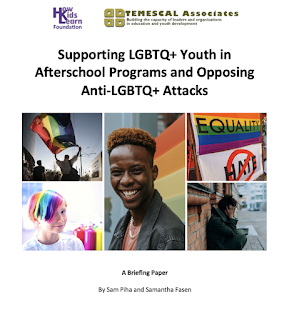
In an effort to speak out against recent political attacks on LGBTQ+ youth, Temescal Associates and The How Kids Learn Foundation have posted several LIAS blogs and authored a briefing paper entitled, Supporting LGBTQ+ Youth in Afterschool Programs and Opposing Anti-LGBTQ+ Attacks. Feel free to share these resources with your network. 

Wednesday, March 21, 2012

A Conversation with Terry Peterson About the News Literacy Project (Part 2)

By Sam Piha

Terry Peterson has been an important figure in education and afterschool learning since before his service to the Clinton administration. See his full bio below. 

Q: Do you have any ideas of how we can bring the News Literacy Project into afterschool?

Terry Peterson
A: NLP is expanding in its three current locations: New York City, Chicago and the Washington, DC region. It is seeking new partners as well as funding to support the program in these areas. It is also seeking partners and financial support to expand the project to other locations, including Los Angeles.
 
Q: In the Learning in Afterschool & Summer Project, we promote 5 important learning principles: learning that is active, collaborative, and meaningful, expands horizons and promotes mastery.  How does this align with what you know about learning and engagement? 


A: Your learning principles fit very well with what we know about effective and engaging afterschool and summer learning programs.  These principles are even more important for older youth. 


Q: How do these principles align with the News Literacy Project?


A: These principals dovetail with NLP’s programs, both in the classroom and after-school. The project’s lessons are interactive and engaging. It stresses collaboration in its student projects. The focus is meaningful for students because it reaches them where they live – in a world saturated with news and information and through their devices, which is where they receive much of it. It expands horizons by bringing journalists and the world they cover into the classroom with authentic learning. It also encourages students to tell the stories of their communities and empowers them with the tools to do so accurately and fairly. Finally, NLP promotes mastery by giving students the critical-thinking skills to sort the credible from the incredible and helping them learn and use digital skills to engage effectively in the local, national and international conversation. 
Here is an example of bringing those principles to bear this fall in a classroom program: Youth Violence was produced by middle-school students in Chicago in 2011


Q: In California, all the dollars supporting afterschool learning opportunities for high school youth come from federal 21st CCLC funds (most of the funding for elementary and middle school programs come from protected state funds); how important do you think it is that we include high school age youth in the afterschool equation? 
A: It is very important that we include high school age youth in the afterschool equation. Nationwide this is a fairly new field of endeavor, so we don’t know a lot about how to do it well yet.  But this should not be an excuse to avoid working hard on developing more effective and efficient programming in afterschool and summer for older youth.  The reasons for providing quality expanded learning opportunities may be even more important for older youth, even though it is often more difficult to put all the key elements in place successfully.   Many high school age youth need more and better opportunities, time and helping hands to catch up, keep up and get ahead.

In this economy, graduating from high school and having the educational and personal experiences to possibly continue with career training or college beyond high school are critical if our young people today are going to be self sufficient and an active part of the American workforce, our democracy and economy.  Yet many middle and high school students get off track:

  • by not being able to find subjects or occupations of interest so they are bored, 
  • by failing core courses,
  • by not accumulating enough of the “right courses” to graduate or prepare for future training or education, 
  • by missing too many days of school or not turning in homework, or
  • by not seeing the relevancy of the regular curriculum so they may disengage or act out. 
Expanded learning opportunities afterschool and/or summers can help some of these young people to get and keep on track.  Effective programs are engaging and personalized, utilize caring and energetic community and classroom teachers, tap into learning opportunities in the community, capture the creativity of the arts and/or excitement of discovery in science and involve families.

Clearly the Learning in Afterschool Project’s 5 important principles of learning that include being active, collaborative, and meaningful and that expand horizons and promote mastery are terrific starting points for designing and delivering afterschool programming for high school age students. 

There is growing concern that some of the proposals to extend the school day or year will simply extend the same typical school day or year and won’t include these principles in a meaningful way.  Just doing more of the same longer won’t make a positive difference for struggling students.  In addition, this approach is very expensive, potentially reducing or eliminating resources for expanding learning opportunities in better, less costly, partnership, and innovative ways afterschool, weekends and summers.

____________________
Dr. Terry K. Peterson served as counselor to former Education Secretary Richard Riley. Terry spearheaded numerous national education initiatives during the Clinton administration as well as state reforms as education adviser to Riley during his governorship of South Carolina. In both positions, Riley said, Terry was his “right-hand man.” He remains deeply involved in education as a senior fellow at the College of Charleston, director of the Afterschool and Community Learning National Network and chairman of the national Afterschool Alliance. Terry called the News Literacy Project "very impressive" and "a very important effort." 

Thursday, January 26, 2012

Afterschool for Older Youth and More: An Interview with Karen Pittman, Part 2


By Sam Piha

Karen Pittman
Karen Pittman is President and CEO of Forum for Youth Investment and is known nationally as the leading advocate for youth development. Many credit her with launching the youth development movement and being an important thought leader promoting policies and systemic approaches to supporting young people's development, including the Ready By 21 initiative. See her full bio below. 

Q: In California, all the dollars supporting afterschool learning opportunities for high school youth come from federal 21st CCLC funds (most of the funding for elementary and middle school programs   come from protected state funds); how important do you think it is that we include high school age youth in the afterschool equation?

A: It’s critically important that teenagers, and especially our most vulnerable youth, have access to supports and opportunities geared toward helping them build skills, connect with positive adults, and navigate the transition to adulthood. This is especially important given how many young people are not on track to graduate and how many more are not on track to graduate college and career-ready. California’s funneling all of its 21st CCLC dollars to high school programming has been a boost for the field as you all have had a chance to innovate programmatically and experiment with things like credit recovery.


Q: What do you see as the major risks and opportunities facing the out-of-school time (OST) movement?

A: I think the conversation that is unfolding about expanded learning opportunities represents a real opportunity for the field. The education community is acknowledging schools alone cannot ensure all young people are ready for college, work and life. The business community is acknowledging that young people need more opportunities to develop 21st century skills. Communities are building infrastructure to support broad goals, meaningful partnerships, and shared data. Now is the time for OST programs to shore up their commitment to quality and to put a stake in the ground about the kinds of outcomes they want to be held accountable for. If test scores and grades are not necessarily the best things to measure success by – what is? The development of communication, collaboration, and critical thinking skills? Creativity? Hope? We need to do a better job of naming and measuring outcomes we know are critical to youth success and that programs can influence.   


_________________________________________________________________________
Karen Pittman is a co-founder, President and CEO of the Forum for Youth Investment. She started her career at the Urban Institute, conducting numerous studies on social services for children and families. Karen later moved to the Children’s Defense Fund, launching its adolescent pregnancy prevention initiatives and helping to create its adolescent policy agenda. In 1990 she became a vice president at the Academy for Educational Development, where she founded and directed the Center for Youth Development and Policy Research and its spin-off, the National Training Institute for Community Youth Work.
In 1995 Karen joined the Clinton administration as director of the President's Crime Prevention Council, where she worked with 13 cabinet secretaries to create a coordinated prevention agenda. From there she moved to the executive team of the International Youth Foundation (IYF), charged with helping the organization strengthen its program content and develop an evaluation strategy. In 1998 she and Rick Little, head of the foundation, took a leave of absence to work with ret. Gen. Colin Powell to create America’s Promise. Upon her return, she and Irby launched the Forum, which later became an entity separate from IYF.

Summer Learning Meets The LIAS Principles

Source: Learning in Afterschool & Summer From the LIAS Archives By Guest Blogger, Katie Brackenridge, Glen Price Group A child’s need fo...