Tuesday, April 27, 2021

Leveraging Summer Programs: A Downpayment on Long- Term Change

Source: www.afterschoolalliance.org

Some young people are now returning to school, in a face- to- face or hybrid model. This after a full year of isolation. This fall youth are likely returning to school full time. Summer programs will be an important gateway to returning to school and healing from a year of isolation. 

Below we offer excerpts from an article authored by Karen Pittman with the Forum for Youth Investment on the importance of summer programs in 2021. Please note: this is just an excerpt from her article posted from Medium.com. You can read the entire article here.

Almost a full year into the COVID-19 pandemic, we once again find ourselves at a critical juncture. As we head into the spring, schedules are still uncertain. But there is growing confidence schools will reopen in the fall. 

With this anticipation of reopening, there is broad commitment to build back better. There is increased recognition of the role that community partners and families can play and that the impact of the last year on teens and young adults will have lasting ramifications. COVID and the racial reckonings have exposed inefficiencies and inequities. This means we are now face to face with a tangible opportunity to challenge and support school districts and community partners in creating equitable learning and development ecosystems that unleash the potential of all learners, recognize the power of all committed adults, and optimize all learning settings and approaches. 

If we are truly intent on not going back to normal, we must recognize the interdependence of systems and center on young people and their families. To do so, school and community leaders must work collaboratively to reflect and take stock to identify innovations and understand roadblocks, look at the ways school, family, and community leaders worked or did not work together, and hear the lessons learned from students, families, and front-line staff. 

Source: www.medium.com
While we saw pockets of exceptional supports for young people and innovation, for the most part young people went without opportunities to connect in meaningful relationships, without opportunities for engaging learning experiences, and without summer jobs to earn money critical to their future goals. 

Summer 2021 shouldn’t look like 2020. The young people across the nation deserve more. It also shouldn’t look like summers of years past. Summer has traditionally been a time when schools stepped back, families stepped in and community organizations stepped up. This division of labor made sense because the stakes are not only lower in summer (no requirements, no grades, no tests) and the success metrics are different (keep academic skills sharp while having fun, mastering new skills, taking on family responsibilities, having different experiences). If we are intent to Build Forward Together our roles in and focus on summer will have to shift. 

This summer can begin to preview “the new normal” and to make a down payment toward the equitable learning ecosystems we hope to create. Where instead of some stepping back and others stepping in, we see communities working collaboratively. We are confident there are many communities that see value in finding some way to use Summer 2021 to document, design, test, or even scale up some ways to BUILD FORWARD TOGETHER to make a down payment on the idea that by the summer of 2022, every student should have equitable opportunities for learning and development because every young person and their family has the support needed to create learning pathways across the ecosystem that are attractive, accessible, affordable, appropriate, affirming, and assessable. 

The Readiness Projects are challenging local school, government and community leaders to: 
  1. Use summer as a low-stakes testing ground to document, test, and scale different ways to leverage school, family, and community assets in support of accelerated learning and development that can help us build forward together post-COVID. 
  2. Prioritize children and youth most challenged by the pandemic who are also the least likely to have resources for summer programs. 
  3. Place focused attention on teens, especially those whose success trajectories are threatened. 
  4. Ask how you will know how many young people had great summers and why, so you can bring that data into the school year and have a baseline for improvement in 2022. 
After a full year of learning isolation, young people are just now returning to school, in a face- to- face or hybrid model. This Fall youth are likely returning to school full time. 

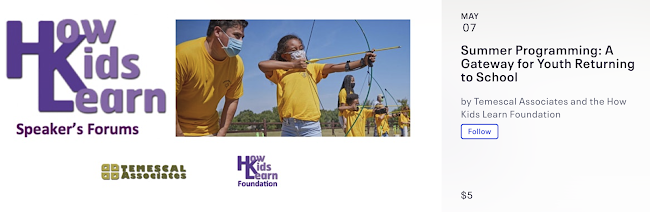
Summer youth programs will be an important gateway to returning to school and healing from a year of isolation. But how should we be thinking about our gateway summer youth programs? What do youth need from their summer program experiences? How will this year's summer programming differ from past years?

On Friday, May 7, 2021, we are sponsoring a Speaker's Forum/ webinar discussion on this topic. It will be facilitated by Ayala Goldstein (Director of Programs, California School- Age Consortium). She will be joined by Aaron Dworkin (CEO of National Summer Learning Association), Autrilla Gillis (Director of Expanded Learning, ISANA Academies) and other summer program experts and practitioners who will be sharing their thoughts and responding to your questions. To register and learn more, click here.


Karen J. Pittman
served as the President & CEO of the Forum for Youth Investment (FYI) until February 2021 then transitioned to a senior fellow role to dedicate more of her time and energy to thought leadership. FYI is a national nonprofit, nonpartisan “action tank” that combines thought leadership on youth development, youth policy, cross-system/cross-sector partnerships and developmental youth practice with on-the-ground training, technical assistance and support. Karen is a respected sociologist and leader in youth development. Prior to co-founding the Forum in 1998, she launched adolescent pregnancy prevention initiatives at the Children’s Defense Fund, started the Center for Youth Development and Policy Research, and served as senior vice president at the International Youth Foundation. She was involved in the founding of America’s Promise and directed the President’s Crime Prevention Council during the Clinton administration. 

Friday, April 16, 2021

Chess, Youth and Afterschool

By Sam Piha

"The Queen's Gambit"

Chess has been in the news lately due to the well-deserved popularity of Netflix’s “The Queen’s Gambit”. These headlines remind us of an excellent documentary on chess and afterschool entitled, “Brooklyn Castle.” Several years ago, we hosted a screening of Brooklyn Castle and featured an interview with the Director and Producer, Katie Dellamaggiore on our LIAS Blog. 

The kids are happy to be at school and to stay at school past 3 p.m. because they know they are going to get to participate in the activity that they've chosen, and that they're starting to build a passion for.” - 
Katie Dellamaggiore, Director and Producer of Brooklyn Castle. 

Brooklyn Castle is a documentary about Intermediate School 318 – a Title I school where more than 65 percent of students are living below the federal poverty level, that happens to have the best junior high chess team, bar none, in the country. The movie is being re-released March 5, 2021 for viewing in theaters or can be streamed on Showcase Now. We highly recommend that you take a look. 

I guess the most important (LIAS Principle) I witnessed was that learning should expand the horizons of participants.”-Katie Dellamaggiore, Director and Producer of Brooklyn Castle.  


The same afterschool program featured in Brooklyn Castle are well known for increasing the participation of girls. Check out this video: These NYC Girls are Dominating Youth Chess


We also recommend another movie about a child and his love of chess entitled, “Searching for Bobby Fischer”, which can be streamed on Netflix.


Friday, April 9, 2021

Youth and News Literacy


By Sam Piha

Over the past two decades afterschool programs have invested in equity issues around digital access. We have built and expanded computer labs and instruction on how to use the internet, which many young people depend on to get their news. However, many have not trained staff how to help youth become news-literate.

A news-literate student is empowered to be reliably informed. They recognize the differences between news and opinion, identify misinformation, apply fact-checking and logic-checking tools and recognize cognitive biases. They prioritize information from verified sources of news and information to be active and engage in the civic life of their communities.

The News Literacy Project is a nonpartisan national education nonprofit, providing programs and resources for educators and the public to teach, learn and share the abilities needed to be smart, active consumers of news and information and equal and engaged participants in a democracy. John Silva is their Senior Director of Education and Training. Below are some of John's responses to a recent interview. 

Q: What is "News Literacy"?

A: The ability to determine the credibility of news and other content, to identify different types of information, and to use the standards of authoritative, fact-based journalism to determine what to trust, share and act on.

Q: Why is it important now for youth?

A: Our vision is to see news literacy embedded in the American education experience, and people of all ages and backgrounds know how to identify credible news and other information, empowering them to have an equal opportunity to participate in the civic life of their communities and the country.

Q: Do you have a newsletter?

A: We have three actually. You can learn more about them and subscribe at https://newslit.org/subscribe/

Q: Does your organization offer trainings for youth programs?

A: We offer professional learning for educators across subject areas, grade levels and educational environments.

John Silva is the News Literacy Project’s Senior Director of Education and Training. He joined NLP in March 2017 with 13 years of experience as a middle and high school social studies teacher with Chicago Public Schools. He first became involved with news literacy in 2014 when his students engaged in NLP’s original classroom program. A U.S. Marine Corps veteran, John spent several years in corporate telecommunications positions before deciding to become a teacher.


Monday, April 5, 2021

A Summer Youth and Community Engagement Model: Play Captains

By Sam Piha

Source: www.playcaptains.com

The Play Captain model is an excellent way to engage older youth over the summer in community service and promote safety for younger kids. This model was developed in Philadelphia by Rebecca Fabiano and her organization, Fab Youth Philly. Below Rebecca responds to a few of our interview questions. If you are interested in learning more or having an exchange with Rebecca, contact us and we will arrange a Zoom discussion. Rebecca is also available for remote or in-person training.

Q: Can you briefly describe the Play Captain’s Initiative?

Source: www.playcaptains.com
A:
Coined after the Block Captain and Jr. Block Captain roles, the Play Captains Initiative is a workforce development and civic-engagement initiative with the mission to empower and train teens in leadership, playful learning and facilitation to make the Playstreets and neighborhoods of Philadelphia more playful. 

There are over 400 Playstreets in Philadelphia every summer, which are part of the Free Summer Meal Program, overseen by Parks & Recreation and serve as a safe place for children to receive two free meals a day during the summer. The Playstreets are closed off to cars between 10am-4pm and a resident on the block applies to be a Playstreet Supervisor; they distribute the meals. Not all of the Play Streets are as ’playful’ as they could be, which is why I created this initiative. I saw the opportunity to tap-in-to two underutilized resources in our City; the Playstreets and teens. 

Q: Do you provide training for the Play Captains? 

A: We do provide training for the Play Captains. Play Captains are teens ages 15-19 and they receive about a week (35 hours) of pre-employment training where they learn about concepts like playful learning and effective facilitation. They spend a lot of time playing games and learning how to modify them for a number of conditions and situations they may face on the Playstreet. They ALSO receive weekly professional development (PD) on Fridays on a variety of topics. They are paid ($9/ hr) for their time in training and for PD.

Q: How do you work with the community?

A: We work all year round with the community to build relationships with both individuals and other organizations. We attend community meetings both to learn about the happenings in the neighborhood and to promote the program. We also work with the Police Department and the Community Relations Officers (CROs) and created a “how to work with our Play Captains” guide for the CROs to encourage positive interactions.

Q: How are youth selected and assigned? 

A: Youth complete an application and typically participate in a group interview. For most teens (over 85%) this is their first job and so we want them to have a positive experience that really reflects what it takes to get a job. If we don’t hire a teen, we provide them with resources where they can keep looking for jobs. 

Source: www.playcaptains.com

The Play Captains work on a team of 5 teens, supported by 1 adult Group Leader. The Group Leaders are youth work professionals that we hire and train. We are often able to hire youth work professionals that are from the neighborhoods where we are playing/on the Playstreets, which helps in a number of ways. They are often known to others, so that helps bridge a connection between our organization and the community and, then after the program is over, they are able to maintain connections to the teens. We prioritize placing teens on Playstreets in the neighborhoods where they live. Then, day to day, they follow a schedule where they rotate to a number of Playstreets throughout the day, for a total of 4 days per week (Mon-Thur) for 5 weeks. They go to the same streets over the course of their employment in order to build consistency and relationships with the children that play on the Playstreets.

Q: How are you amending the model in response to the COVID pandemic? 

A: We ran the program last summer in the height of the Pandemic and put several safety measures into place, which we plan to put into place again this summer. For example: everyone wore masks indoors and outside; we did a deep clean of our indoor space 3x per day; we deep cleaned all of the supplies (balls, jump ropes, etc.) at the end of each day; and we created special socially distance arm signals to help the children on the play streets keep a distance. For example: Airplane arms (arms out to the side) when we wanted to have them stand in a circle or near each other, Frankenstein arms for when we needed them to line up and maintain some distance and Hands on Hips, once they are in their socially distance position.  

Q: What do you believe are the benefits to the youth participants? 

A: One of the biggest benefits is that this opportunity provides teens with a first job experience. About a quarter of our teens go on to get afterschool jobs the fall after they are a Play Captain. Other benefits that the teens often report include: feeling valued by their community and feeling like they can make a difference in the lives of younger children; and many teens that self-define as shy say that they had a chance to meet new people and “come out of their shell.”

Q: What do you believe are the benefits to the community? 

A: I’ve been told by residents how much they appreciate seeing the teen Play Captains engaged in something positive and that they feel it is good for the community that the teens have something meaningful to do. 

Q: How do you assess the impact of the program? 

A: For the past three years we’ve worked with a Playful Learning Landscape Action Network (PLANN) who developed a data collection tool and who train data collectors to collect data on the Playstreets to see if the activities the Play Captains facilitate help foster the Six Cs of Playful learning (collaboration, communication, content, critical thinking, creative innovation, and confidence). We also pre/post survey our teens to understand what they learn during training, and what they retain over the course of their employment. We conduct exit interviews with staff and engage in post programming focus groups with residents, Street Supervisors and other stakeholders. We use the data to revise training and to improve the selection of the activities that the teens facilitate on Playstreets, as some examples of how we strive to be a data-driven project. 

Q: If there is interest, would you be able to assist others in replicating this initiative?  

Source: www.playcaptains.com
A: Absolutely! We’ve built a program based on best practices in youth development, workforce development and community engagement, yet it is adaptable and flexible. I would encourage people to check out our website: www.playcaptains.com and watch our videos on YouTube to see the Play Captains in action. 


Rebecca Fabiano (She/Her/Hers) is the President and Founder of Fab Youth Philly and The Play Captain Initiative. For nearly 25 years, Rebecca has worked in various capacities across nonprofit and youth-serving organizations, served on boards and helped to build solid youth programs that engage, encourage, and create spaces for positive development. As a program leader, she has successfully raised funds and managed program budgets; hired and supervised staff; developed and sustained strong community partnerships and designed award-winning programming.​

Tuesday, March 30, 2021

Defining Dominant Culture in Your Organization: Name it to Tame it


Before we share the guest blog below, we want to acknowledge and stand in solidarity with the Asian and Asian American/ Pacific Islander community given the rise of racist violence and the attacks in Atlanta.


Sangita Kumar is the Principal and Founder of Be the Change Consulting, an organization that provides high quality learning experiences and consulting for organizations to reach their creative potential. I had the pleasure of working alongside Sangita years ago. She is a bold training designer and leader. Recently, Be the Change Consulting developed a four-month virtual training series featuring over 40 learning experiences that examine six areas of organizational practice to de-center white dominant culture and support organizations to build inclusive and equitable outcomes. Below is a guest blog by Sangita Kumar. 

By Guest Blogger, Sangita Kumar

What is Dominant Culture? 

We define dominant culture as the practices and beliefs that form the blueprint for behavior. In an organization, your dominant culture sends explicit and implicit messages to your team about what is important, valued, and rewarded. Creating intentional culture is a great way to ensure equity and inclusion.


Source: Be the Change Consulting

Have you ever heard any of these terms used?

  • “Let’s be Professional.”
  • “That wasn’t Respectful.”
  • “Please be Appropriate.”

What ideas come to our mind with these statements? Who defined the expectations of professionalism, respect, appropriateness? When and where did we agree to these definitions?  

When pushed to unpack what is meant by these terms, expectations often vary greatly from person to person. Our organizations are held together by invisible agreements, that often negatively impact those who hold identities outside the dominant culture. But it’s really hard to define - it’s like trying to describe oxygen - it’s all around us, we interact with it, but it’s so commonplace that it becomes invisible.

Why Dominant Beliefs are Often Invisible

Imagine you are walking down the street, a bus comes barreling down it and hits you. Now imagine you are laying in the street, bleeding and the bus driver comes up to you and says, “What are you doing down there?” You say, “You hit me with your bus!” Then the bus driver says, “No I didn’t, what are you talking about? When? Where? Prove it!” Now the emphasis is on you, the person laying on the ground and bleeding, to both attend to your wounded body, experience a traumatic interaction with the bus driver, and then figure out how to describe your visible trauma to another person who says it is invisible. This is a huge burden on you, to say the least.

This exhausting interaction is what happens when bodies of culture are hit by dominant culture. The bus driver, from their vantage point, can’t see what’s going on down on the street, or maybe never walks anywhere, so doesn’t even know what the dangers to pedestrians are. But the people walking around on the street know all too well the dangers of the bus, and the powerful ignorance of the bus drivers.

If this example is not resonating for you, you might be more like the bus driver in this example than the pedestrian. See what happens if you share this metaphor with three people - perhaps a woman, a Black-identified  professional, or anyone who identifies as neurodiverse, and see what they say.  

A great tool to define the running waters of dominant culture is an article called White Supremacy Culture, produced by Dismantling Racism. This article describes fifteen practices that often plague organizations and stem from a white supremacy belief system. They list practices like Right to Comfort, Worship of the Written Word, Paternalism, and Sense of Urgency. When I read them, right away very concrete examples of where these patterns of behavior live in my own organization spring to mind. -The more I get curious about the experiences of my team, the more examples I discover!

Source: Be the Change Consulting


Why Common Language is Critical for Antiracism Work

Without intentional language for these behaviors, we have busses driving out of control, and bus drivers with no clue of the impact of their actions. For those who are hit by a bus, we know that we will need to then describe what just happened, and establishing some common language before a conflict occurs can help bridge the gap between these divergent experiences. We need a common language because we don’t share common experiences. Giving language to our bus drivers can allow everyone in an organization, regardless of identity or position, explore where these practices show up and hold the labor of naming and taming them together. Wouldn’t that be a relief?

Dealing with the Shame that Springs Forward when we Name Dominant Culture
 
The work of visibilizing dominant culture in our organizations is bound to bring up an existential crisis for those who enjoy positional or identity-based privilege, because we will rapidly realize many ways that privilege helps us maintain a status quo, even though we can see the disproportionate impact on our teams, society, and the world at large. I personally struggle to take in the evidence of dominant culture in my own organization. It feels gross and embarrassing to get feedback on my own mental blindspots. And the more I am in this work, the more I realize that I can move from the heavy weight of embarrassment or shame into an empowered place. If I’m making it bad, then I can fix it!

How Privilege Creates Mental Blindspots

From time to time, we are asked by training participants to explain the rationale for this research. To understand this work will surely require all of us to grapple with the content. Everyone deserves the space to sometimes push back as a way to make better sense of the information. AND, for everyone in an identity that mirrors dominant culture - white people, cis-gendered men, able-bodied, those who speak English as a first language, or identify as part of the gender binary, etcetera… we can add our privileged identities in front of our questions, so that we take responsibility for what we probably aren’t seeing from inside the bus. Because someone from the street is likely doing the labor to explain it to us.

Here is what I mean: What’s different when you hear this question? As a white man, I would love to understand why visibilizing dominant culture is so impactful to antiracism work?

The struggle to understand all of this is a productive struggle. Onward!


Sangita Kumar is the Principal and Founder of Be the Change Consulting. She is a results-based organizational development consultant and facilitator dedicated to the empowerment of individuals and our communities. Sangita’s experience over the past 15 years ranges from coaching, professional development, strategic planning, program design, and curriculum development. Sangita holds a Masters Degree in Organizational Development, is a Certified Life Coach, and completed a two-year certification in Somatics and Trauma.

Tuesday, March 23, 2021

Exploring Girls' Engagement in STEM Activities

By Guest Blogger Kathryn A. Wheeler, NIOST

(Originally Published by National Institute on Out-of-School Time)

Source: TechBridge Girls

There are at least three reasons why it’s important to encourage youth in STEM (science, technology, engineering, and math): (1) we need more young people pursuing STEM careers to meet the workforce demand; (2) whether or not someone chooses a career in STEM, they need to be science literate in today’s society so they can make informed decisions about issues like health care, food, the environment, and technology; and (3) STEM activities are fun and engaging!

But some groups, such as girls, youth of color, and youth from rural areas often find themselves marginalized and underrepresented in STEM learning opportunities and career pathways. GEMS (Girls Excelling in Math and Science) is a program designed to counteract these trends.

GEMS was founded by a former teacher when her daughter shied away from advanced math classes because they were “hard.” GEMS is now an international network of hands-on, activity-based, out-of-school time clubs focused on increasing girls’ curiosity, interest, and persistence in STEM. It is designed especially, but not exclusively, for rural girls.

Source: Girls Inc.
The National Institute on Out-of-School Time (NIOST) recently completed a research study of two GEMS clubs in the Venango County area of Pennsylvania. GEMS hosts 16 clubs in Venango County through afterschool, library, and summer programs, and serves more than 250 girls in grades 2-12. The study included program observation and analysis. There were three research questions related to STEM engagement that guided club observations:

  • What types of science behaviors did girls engage in most frequently?
  • How actively involved were girls in the STEM activities?
  • What was the affect of girls while doing the STEM activities?

This research was grounded in the Science Learning Activation Framework which posits that youth who have positive early STEM experiences will be more likely to show growth in STEM interest and curiosity, valuing of science as useful, confidence in their ability to do STEM, and desire for more STEM experiences (Dorph, Schunn & Crowley, 2017). 

What We Learned

NIOST director and senior research scientist Georgia Hall, Ph.D., research associate Kathryn A. Wheeler, Ed.D., and student intern Jenn Yu, ‘22, presented their findings virtually to GEMS educators and program providers in December 2020. Researchers found that:

  • GEMS girls were actively involved in STEM projects in a hands-on way.
  • In club activities, girls engaged in a wide range of science behaviors such as exploring, experimenting, observing, discussing, using tools, and asking questions.
  • Girls enjoyed the process of creating, innovating, and solving challenges. They were frequently amazed and joyful about what they were discovering.
  • At no time were girls observed to be feeling frustrated, upset, or distressed when they encountered a challenge.
  • Girls were activated by the challenges they confronted and eager to try to solve them and to connect with each other for help when needed.
  • Girls were persistent in their activities and faced challenges by working together. 

Source: www.apresgroup.com

Implications for Effective Practices

These findings help us to think about strategies for keeping STEM learning strong for rural girls and others during their early experiences in informal STEM learning. Some recommendations: 

  1. Keep girls absorbed in STEM activities by ensuring that the activities are hands-on and truly challenging. If they are too easy, engagement and learnings may decrease.
  2. Engage girls directly in the scientific process of identifying a problem, researching it, hypothesizing, experimenting, collecting data, analyzing data, drawing conclusions, and then trying again. Explicitly name this process as “science.”
  3. Aim to get girls thinking beyond just following set procedures to produce a product or outcome. Try to design activities that encourage creativity so girls can explore, invent, and gain a deeper understanding of science concepts.
  4. Encourage girls to work together. If girls have questions, for example, instruct them to talk to each other to share resources and ideas before asking adults to help. This process will help foster confidence, collaboration, innovation, and persistence.
  5. Pay attention not only to what girls are doing and thinking, but how they are feeling. If girls aren’t showing that they are having fun doing a STEM activity, then it’s time to try a new approach or activity.
  6. Help girls make connections between what they are doing and what professional scientists do in their jobs, so girls start to view themselves as scientists-in-training.
  7. Give girls resources on how they can maintain their interest in STEM after the program has ended, including suggestions for online activities and out-of-school time programs, as well as in-school classes.
  8. Be a STEM role model for girls—one who is visibly intrigued by STEM questions and the scientific process of testing, problem solving, and being persistent. And most important, have fun with STEM yourself while you are working with youth!

ADDITIONAL RESOURCES


Kathryn A. Wheeler, Ed.D. (Katie) is a Research Associate at the National Institute on Out-of-School Time (NIOST). Her area of expertise is in assessing the quality of out-of-school-time programs, and she has a special interest in programs designed to empower girls.


As schools prepare to re-open, afterschool program staff need to consider the experiences of youth who have been away from school and their friends due to the COVID-19 pandemic. We know these vary greatly depending on family income and racial/ ethnic background. What are young people's needs? What should we, as afterschool staff, do to help youth thrive when they return to afterschool programs post COVID? How might we build back school and program culture and a sense of "family" spirit and connection in our afterschool programs? Join Stu Semigran and a panel of afterschool program experts to learn how best to help youth thrive as they return to school and afterschool. To get more information and to register for our next Speaker's Forum, click here.

Tuesday, March 16, 2021

Evergreen Learning Principles for Afterschool Programs

Source: Learning in Afterschool & Summer
By Sam Piha

We launched the Learning in Afterschool & Summer (LIAS) project ten years ago. At the time, there was a great debate as to whether afterschool programs should be focused on academic or youth development outcomes. The LIAS project was designed to unify the field of afterschool and focus the movement on promoting young people’s learning. This is especially important as youth return to afterschool programs after a year of isolation.  

We believe that if afterschool programs are to achieve their full potential, they must be known as important places of learning that excite young people in the building of new skills, the discovery of new interests, and opportunities to achieve a sense of mastery. The LIAS Learning Principles became a foundational part of the California Quality Standards for Expanded Learning Programs.

"We spend so much time focused on 'achievement' and so little time focused on how to motivate students to learn.  The principles advocated by LIAS strikes the right balance and make sense… The principles contained in LIAS promote such an approach, and if applied with fidelity, could lead to real improvements in educational outcomes for kids."
- Pedro Noguera
Dean, USC Rossier School of Education


The LIAS project promotes five core, evergreen learning principles that should guide the design and implementation of afterschool programs. These learning principles are strongly supported by recent research on brain development, education, youth development, and the growing science of learning. They are also well aligned with the 21st century learning skills and workforce skills that young people will need to succeed in the years ahead, as well as efforts to increase young people’s interest in science, technology, engineering, and math (STEM). Each of the learning principles cited below support each other and together provide an important framework for afterschool programming.

"All five principles are critical. They collectively provide the relevance so desperately needed for students to become engaged and for learning to become alive for them. They also provide the deeper understanding and the discovery of learning that is critical for success in school and life."
- Dr. Willard Daggett
Founder and Chairman
Int'l Center for Leadership in Education

Below are the LIAS Learning Principles.

1. Effective Learning is Active: 
Learning and memory recall of new knowledge is strengthened through different exposures – seeing, hearing, touching, and doing. Afterschool learning should be the result of activities that involve young people in “doing” – activities that allow them to be physically active, stimulate their innate curiosity, and that are hands-on and project-based. Hands-on learning involves the child in a total learning experience, which enhances the child’s ability to think critically.


"Either we work to replicate limiting, and even oppressive, conditions for learners or we create experiences that empower them to fully realize their potential as individuals and to engage in transformative action that promotes justice and equity. I think that the LIAS principles are essential to guaranteeing an education for freedom and for fully realizing the promise of all students and that of our great nation of immigrants."
- Pilar O’ Cadiz
Education Director, TANMS Engineering Research Center at UCLA


2. Effective Learning is Collaborative:
Knowledge should be socially centered, as collaborative learning provides the best means to explore new information. Afterschool programs are well positioned to build skills that allow young people to learn as a team. This includes listening to others, supporting group learning goals, resolving differences and conflicts, and making room for each member to contribute his or her individual talents. Collaborative learning happens when learners engage in a common task where each individual depends on and is accountable to each other.
  • 1st degree conn

Source: Club Timberwolf

3. Effective Learning is Meaningful: 
Young people are intrinsically motivated when they find their learning meaningful. This means having ownership over the learning topic and the means to assess their own progress. Motivation is increased when the learning is relevant to their own interests, experiences, and the real world in which they live. Community and cultural relevance is especially important to new immigrant youth and those from minority cultures.

Rather than learning that is focused on academic subjects, young people in afterschool can apply their academic skills to their areas of interest and real world problems. Also, when learning involves responsibility, leadership, and service to others, it is experienced as more meaningful.

4. Effective Learning Supports Mastery: 
Young people tell us they are most engaged when they are given opportunities to learn new skills. If young people are to learn the importance and joy of mastery, they need the opportunity to learn and practice a full sequence of skills that will allow them to become “really good at something.” Afterschool activities should not promote the gathering of random knowledge and skills. Rather, afterschool learning activities should be explicitly sequenced and designed to promote the layering of skills that allows participants to create a product or demonstrate mastery in a way they couldn’t do before. Programs often achieve this by designing activities that lead to a culminating event or product that can be viewed and celebrated by peers and family members. For older youth, many programs are depending on apprenticeship models to assist youth in achieving a sense of mastery.

5. Effective Learning Expands Horizons: 
Young people, especially those from low-income families and neighborhoods, benefit by learning opportunities that take them beyond their current experience and expand their horizons. Learning about new things and new places promotes a greater sense of potential of what they can achieve and brings a sense of excitement and discovery to the learning environment. Afterschool programs have the flexibility to go beyond the walls of their facilities. They can use the surrounding community as a classroom and bring in individuals and businesses that young people may not otherwise come into contact with. Expanding young people’s horizons also includes helping them to develop a global awareness. This includes increasing their knowledge of other cultures and places and their understanding of the issues and problems we have in common across cultural and political divides.

"The five LIAS principles are perfectly aligned with a 21st century learning approach – active, meaningful, collaborative learning projects that provide opportunities to expand one’s horizons and master important knowledge and skills – this is the heart of 21st century learning."
- Bernie Trilling
Founder & CEO,
21st Century Learning Advisors


We have developed a number of resources to guide the design and implementation of afterschool programs. These resources include videos, reports on exemplary practices, educational materials and program guides. These all can be found on our LIAS website.


As schools prepare to re-open, afterschool program staff need to consider the experiences of youth who have been away from school and their friends due to the COVID-19 pandemic. We know these vary greatly depending on family income and racial/ ethnic background. What are young people's needs? What should we, as afterschool staff, do to help youth thrive when they return to afterschool programs post COVID? How might we build back school and program culture and a sense of "family" spirit and connection in our afterschool programs? Join Stu Semigran and a panel of afterschool program experts to learn how best to help youth thrive as they return to school and afterschool. To get more information and to register for our next Speaker's Forum, click here.

Tuesday, March 9, 2021

The Impact of COVID-19 on Families

By Sam Piha

Many of the young people we serve in afterschool come from low-income communities, in both urban and rural settings. Many of these are communities of color. These communities have been disproportionately impacted by COVID-19. Afterschool and summer learning programs were a lifeline for underserved communities before the pandemic and now they are more important than ever as families with limited resources struggle to adapt to newly designed school days and years. 

Source: www.hrw.org

Expanded learning opportunities that complement the school day will be key to helping all young people and their families through this crisis. In preparing for young people to return to our programs, it is important that we have a snapshot of how our children and families have been impacted by the pandemic.
 
“One of the certainties as we navigate through this pandemic is that all children will benefit from being well known, well cared for, and well prepared. Afterschool programs have a long history of designing programs based on what young people need in order to help them be healthier and more ready to learn. Together schools and community organizations can co-design the future of learning in ways that interrupt historic inequities and help all young people emerge from this crisis strong, resilient and hopeful.” 
- Tony Smith, former Illinois State Superintendent and Oakland Unified School District Superintendent 

“The Impact of Coronavirus”, a five-part poll conducted by NPR, the Harvard T.H. Chan School of Public Health, and the Robert Wood Johnson Foundation, offers a national look at the problems emerging from the pandemic relating to household finances, jobs, health care, housing, transportation, caregiving, and well-being. Below are some of their key findings and you can learn more here.

Source: Getty Images

Key Findings 
  • At least half of households in the four largest U.S. cities—New York City (53%), Los Angeles (56%), Chicago (50%), and Houston (63%)—report serious financial problems including depleted savings, and trouble paying bills or affording medical care. 
  • Many of these experiences are concentrated among Black and Latino households; households with annual incomes below $100,000; and households experiencing job or wage losses since the start of the outbreak. 
  • At least four in ten Latino, Black, and Native American households report using up all or most of their household savings during this time. 
  • One in five households in the United States (20%) report household members unable to get medical care for serious problems. A majority unable to get care when needed (57%) report negative health consequences as a result. 
Source: www.nationalnews.com
  • More than 1 in 3 households that include anyone with a disability report facing serious financial problems, many experiencing difficulty affording utilities and food. 
  • More than one in three (36%) households with children face serious problems keeping their children’s education going, and among working households, nearly one in five (18%) report serious problems getting childcare when adults need to work. 
  • About one in three households with children (34%) either do not have a high-speed internet connection at home or report serious problems with their connection while doing schoolwork or their jobs during the pandemic. 
  • 43 percent of rural households report adult household members have lost their jobs, been furloughed, or had wages or hours reduced since the start of the outbreak, with two- thirds of these households (66%) reporting serious financial problems. 
The next step is considering what we need to do in afterschool to address the stresses related to these findings. To this end, we are sponsoring a webinar on Monday, March 29, 2021 entitled, “Helping Youth Thrive When They Return to Afterschool Programs Post COVID.” This webinar will be facilitated by Stu Semigran (EduCare Foundation) and features panelists Dr. Gil Noam (Harvard), Gloria Halley (Butte County Office of Education), Jose Luis Navarro IV (Principal and former California Teacher of the Year), and Autrilla Gillis (Director of Expanded Learning, ISANA Academies). You can click here to learn more about the webinar. 


What We Can Do to Support Children with ADHD Features

Source: www.pexels.com By Sam Piha ADHD can be diagnosed by a mental health professional if a child presents with a number of features liste...