Monday, June 19, 2023

Political Attacks on LGBTQ+ Youth: The Role of the Afterschool Community and Funders

Source: Temescal Associates
By Sam Piha

As LGBTQ+ youth are being politically attacked across the country, many are asking how should the afterschool community and funders respond? Below we weigh in on this question.

THE ROLE OF THE AFTERSCHOOL COMMUNITY
The answer to the question of how the afterschool community should respond to the current anti-LGBTQ+ youth actions is complex. First and foremost, afterschool programs should focus on creating a safe and supportive environment for all youth, including LGBTQ+ youth and ensuring that all of their participants feel seen and supported. 

Afterschool programs can: 

Build Awareness
  • Stay informed by following news about LGBTQ issues in your state and around the country. Sign up for newsletters or alerts from organizations like The Trevor Project or the ACLU and follow their social media accounts to stay up-to-date on the latest developments.
  • Educate others in their networks and community.

Improve Program Practice
  • Hire knowledgeable and diverse staff, especially from the LGBTQ+ community.
  • Ensure that staff are fully informed and know the risk factors for LGBTQ+ youth.
  • Really listen to young people.
  • Build positive relationships among adults and youth.
  • Provide opportunities for all youth to express themselves.
  • Promote positive peer interaction, respect and support.
  • Provide opportunities for youth to make their voices heard in policy discussions.
  • Provide opportunities for youth to form Genders & Sexualities Alliance  or Gay/Straight Alliance (GSA) clubs.
  • Know how and when to communicate and collaborate with the school and parents regarding the importance of supporting the safety and acceptance of all youth, including LGBTQ+ youth. 
  • Introduce efforts to prevent meanness and promote kindness.
  • Provide professional development opportunities to build knowledge and skills of afterschool staff. 

Source: Hart Van Denburg/ CPR News
Directly Oppose Anti-LGBTQ+ Legislation and Attacks
Afterschool programs and leaders are not equipped to end the political attacks on LGBTQ+ youth alone. However, they and their allies can still act. If history is any teacher, systemic oppression begins with targeting the most vulnerable. 
“Whatever we do, we cannot choose to ignore this moment or shrink from scrutiny. That will not make these problems go away. It simply offloads them onto the shoulders of youth. And of any of the options before us right now, that is the least conscionable.” Katy Swalwell & Noreen Naseem Rodriguez, How to Thwart an Anti-Equity Agenda: Advice for Teachers, Administrators, and Families


The afterschool community can advocate in support of LGBTQ+ youth by:
  • Speaking out against anti-LGBTQ+ attacks.
  • Finding a state or local organization that’s working to fight back against anti-LGBTQ+ bills. 
  • Reaching out to their legislators and share your views.
  • Watching or following related hearings and legislative sessions.


“It’s clear that lawmakers should be taking an intersectional approach to public policy, not working overtime to target the most marginalized young people, particularly those who are transgender or nonbinary, for partisan political points. We all must play a role in promoting LGBTQ acceptance and creating a more supportive world for all young people.” – Josh Weaver, The Trevor Project 


A Caution for Afterschool Networks and Providers
It is important that each organization determine how best to respond to the anti-LGBTQ+ youth legislation and political rhetoric, in consideration of the local climate regarding LGBTQ+ issues.

A national afterschool leader we interviewed shared, “If leaders were to speak out in opposition to the legislators in power about actions, they may be adding fuel to the “culture wars”- whether it be at the local, state or national level. They may run the risk of losing funding for the children they serve and getting into a fight where we can’t win without hurting kids we care so much about. Instead, we can showcase by actions how to treat people and children with love- not hate - and not engaging on terms that will inflame tensions and hurt our ability to serve kids.”

“Educators committed to inclusive, equitable, information-rich schooling are asking: How can we avoid becoming targets for right-wing smear campaigns? What might get us in trouble with a zealous school board? What if we get fired—or even prosecuted? Should we quit rather than comply with a policy that hurts youth?”– Katy Swalwell & Noreen Naseem Rodriguez, How to Thwart an Anti-Equity Agenda: Advice for Teachers, Administrators, and Families


THE ROLE OF AFTERSCHOOL AND YOUTH DEVELOPMENT FUNDERS
Many funders are not clear as to how they can get involved. A consultant and advisor to foundations we interviewed shared “After many foundations jumped to creating statements against the George Floyd murder and other atrocities, board of directors started requesting policies regarding when it is appropriate for an organization to take a stand and when it’s not (e.g., should we make a statement for EVERYTHING?).”

However, afterschool and youth development funders can respond to this wave of anti-LGBTQ legislation and attacks in several ways. In A New Wave of Anti-LGBTQ Bills – What Can Funders Do?, author Andrew Wallace offers suggestions on how funders can respond. Below we present excerpts from this article. 

Source: Temescal Associates
“Foundations and corporations can respond to this wave of anti-LGBTQ legislation in a number of ways – and many are already doing so. Here are a few of the ways that funders are standing up for LGBTQ rights in the face of a new wave of backlash:

1. Make a public statement. As anti-LGBTQ+ bills have surfaced around the country, so has rhetoric that scapegoats LGBTQ people, especially transgender people. It can be powerful for a respected foundation to simply make a public statement that your foundation believes in full dignity and equality for LGBTQ people…”

 
La June Montgomery
“The W.K. Kellogg Foundation (WKKF) stands with businesses, organizations and individuals seeking to protect the human rights of the LGBT communities in North Carolina, as well as other states where similar laws are being considered. We are heartened by the broad coalition of public sector, non-profit, business and civic leaders who are speaking out against this injustice. WKKF is proud to join their ranks.”
 
- La June Montgomery, CEO of WKKF

2. Advocate for partners to take a stand too. Foundations can have influence even when based outside of states where anti-LGBTQ laws are being considered. For example, The California Endowment sent letters to Georgia-based corporations where the Endowment held investments, asking them to take a stand against the state’s anti-LGBTQ legislation. In addition to that kind of shareholder advocacy, foundations and funder networks also hold conferences and events around the country. Many funders and networks are considering moving meetings to states that have more LGBTQ-affirming laws. Even if moving your event doesn’t make sense, you can use it as an opportunity to foster dialogue and raise awareness of the real harm caused by anti-LGBTQ laws.”


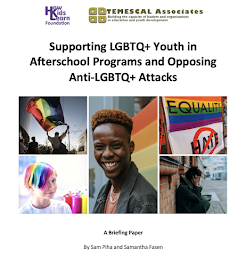
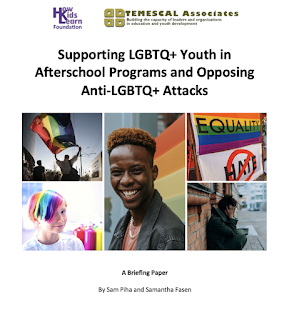
In an effort to speak out against recent political attacks on LGBTQ+ youth, Temescal Associates and The How Kids Learn Foundation have posted several LIAS blogs and authored a briefing paper entitled, Supporting LGBTQ+ Youth in Afterschool Programs and Opposing Anti-LGBTQ+ Attacks. Feel free to share these resources with your network. 
Monday, June 12, 2023

In Case You Missed It

By Sam Piha
 
We’ve been very busy during the first half of 2023 addressing many of the cutting edge issues faced by the afterschool field. We have written many LIAS blogs (23), published several briefing papers (3), and sponsored several training webinars (7). Below we share several of our most popular resources and some of our favorites from 2023. 
 

BLOGS


BRIEFING PAPERS


RECORDED WEBINAR TRAININGS
 
For a comprehensive catalogue of our afterschool resources, click here
 
MORE ABOUT...

Temescal Associates and the How Kids Learn Foundation (a 501(c)3) are dedicated to building the capacity of leaders and organizations in education and youth development who are serious about improving the lives of young people. Our clients include leaders of youth serving institutions and organizations, school and youth program practitioners, public and private funders, intermediary organizations, and policy makers. Our work ranges from building large scale youth and community initiatives to providing services to young people on a day-to-day basis.


Monday, June 5, 2023

Make It A Summer of Service

By Sam Piha

Source: www.pexels.com

Afterschool summer programs are a great time to engage young people in activities that serve others. These could be community service projects (which are often unpaid) or service within the afterschool program, such as tutoring, mentoring, yard supervision, leading games, etc. (These can be unpaid or volunteer). Summer schedules are more flexible, we have longer days and there is usually good weather. These opportunities can be one time or 1 or more times a week. 

Below we cite some benefits of community service and volunteering, additional resources on community service ideas and other information to help get started engaging youth through volunteering. (If it is too late to include in your summer program, consider it for the fall program.)

“Teenagers are not only a valuable source of energy, goodwill and creativity, but they’re also the key to our future. Volunteering allows them to tap into all those values while also learning about the world around them.” St. Louise Children’s Hospital, Teaching Teens the Importance of Community Service

Source: www.help4kidssc.org
Benefits 
There are many benefits that participants accrue when youth engage in community service and/or volunteering. Research has shown that teens who volunteer are:

  • more responsible
  • have higher self-esteem and greater self-confidence.
  • gain skills such as leadership, good communication, time management and decision making.  
  • more likely to build connections with others. 
  • more likely to do well in school, graduate, vote and build a stronger resume for college and scholarship applications.
  • 50% less likely to abuse alcohol, cigarettes, become pregnant, or engage in other destructive behavior.
  • gain practical life skills while feeling valued and appreciated. 
  • less depressed, experience increased positive emotions, and experience reduced stress.

Source: www.goodfreephotos.com
“The Dalai Lama said it best in a post that has been shared all over the world. ‘When you care for others, you manifest an inner strength despite any difficulties you face. Your own problems will seem less significant and bothersome to you. Reaching beyond your own problems and taking care of others, you gain confidence, courage, and a greater sense of calm.’”Kidz That Care, Volunteering and Teen Mental Health

Teens Have Their Own Reasons. 
According to the University of Nevada, Reno, the “major reasons cited by teens for volunteering:

  • Youth feel compassion for people in need
  • They can do something for a cause in which they believe
  • They believe that if they help others, others will help them.
  • Seventy-three percent of young people think their efforts can have a positive impact on their communities.
  • Teens rank volunteering, the environment and eating healthy, as top three activities they consider ‘cool’.
  • Youth who volunteer gain important job skills and experience, while exploring career options.
  • Young volunteers expand their social circle and enhance their social awareness.
  • Teens say the benefits received from volunteering are: Learning to respect others; learning to be helpful and kind; learning to understand people who are different; developing leadership skills, becoming more patient, and better understanding of citizenship.”

Source: www.pexels.com
How to Choose
If your program is school-based, check if your school already has a community service partnership with a local non-profit. It is best when your young people select the cause and activity they are most interested in. They can do research and/or map the neighborhood for possible partner organizations. For instance, afterschool youth interviewed workers at a local homeless shelter and determined that collecting donations of warm gloves was what was needed. Another afterschool program in North Dakota decided after doing research, that they wanted to collect and distribute ice skates for kids in low-income families. 

Service activities can also focus on the needs of the other children in the afterschool program offering tutoring, mentoring, yard supervision, leading games, etc. 

It is important to consider the interests and abilities of your program participants, the time that is required, the attitude of the staff they may be working with, as well as how they will get to and from the location of the partner organization. 

Project Ideas
There are many possible service project ideas. Below are some links that can assist you and your program participants in considering ideas for service projects:

Service projects can also focus on educating the community on local issues like hunger, homelessness or environmental issues. 

Other Resources and Links

Source: Youth Service America

In addition to the links in the blog, additional information may be found using the links below: 


Monday, May 29, 2023

LGBTQ+: Important Terms and Definitions


Source: www.publicdomainvectors.org

By Sam Piha

"Many LGBTQ+ people use labels to express who they are. These labels can help listeners like you and me understand who that person is and how they wish to identify."It Gets Better Project

As the mainstream culture diversifies, our language is also evolving, which includes new terms related to sexual identity. It’s important that afterschool workers expand their vocabulary. Below are some LGBTQ+ terms and definitions. These definitions are not intended to label youth but rather to assist in understanding some frequently used terms. Youth may or may not use these terms to describe themselves. 

Source: www.cem.org

 “Language is an extremely powerful tool. It allows us to generate ideas, share stories, and learn and grow from others. Whether spoken, signed, or written, all languages are constantly evolving, and, despite their imperfections, can help us better understand our world and communicate our perspective with others.” It Gets Better Project

1. LGBTQ+: This stands for lesbian, gay, bisexual, transgender, queer (or sometimes questioning), and others. The "plus" represents other sexual identities including pansexual and Two-Spirit. The first four letters of the acronym have been used since the 1990s, but in recent years there has been an increased awareness of the need to be inclusive of other sexual identities to offer better representation. 

2. Bisexual: Bisexual indicates an attraction to all genders. The recognition of bisexual individuals is important, since there have been periods when people who identify as bi have been misunderstood as being gay. Bisexuality has included transgender, binary and nonbinary individuals since the release of the "Bisexual Manifesto" in 1990.

3. Transgender: Transgender is a term that indicates that a person's gender identity is different from the gender associated with the sex they were assigned at birth. 

Source: www.pexels.com
4. Queer or Questioning: Though queer may be used by people as a specific identity, it is often considered an umbrella term for anyone who is non-cisgender or heterosexual. But it is also a slur. It should not be placed on all members of the community and should only be used by cisgender and heterosexual individuals when referring to a person who explicitly identifies with it. Questioning refers to people who may be unsure of their sexual orientation and/or gender identity.

5. + (Plus): The 'plus' is used to signify all of the gender identities and sexual orientations that are not specifically covered by the other five initials. 
Source: www.namidanecounty.org

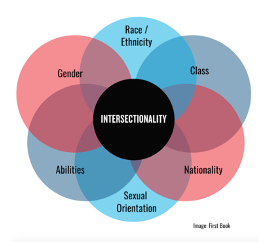
6. Intersectionality: According to the Merriam Webster Dictionary, this term is “used to refer to the complex and cumulative way that the effects of different forms of discrimination (such as racism, sexism, and classism) combine, overlap, and yes, intersect—especially in the experiences of marginalized people or groups.” To learn more, see The Trevor Project- What is Intersectionality, Really? 

7. Gender identity: A person’s deeply held sense or psychological knowledge of their own gender, regardless of the gender they were assigned at birth. Everyone has a gender identity. 

8. Gender expression: This refers to the way a person expresses gender, such as clothing, hairstyles, activities, or mannerisms. 

Source: www.pexels.com

9. Gender Nonconforming: Describes people whose gender expression differs from stereotypical expectations, such as “feminine” boys, “masculine” girls, and those who are perceived as androgynous. 

10. Genders & Sexualities Alliance (GSA): Genders & Sexualities Alliances, or GSAs for short, are student-run organizations that unite LGBTQ+ and allied youth to build community and organize around issues impacting them in their schools and communities. GSAs have evolved beyond their traditional role to serve as safe spaces for LGBTQ+ youth in middle schools and high schools and have emerged as vehicles for deep social change related to racial, gender, and educational justice.

11. Nonbinary: A person whose gender identity does not conform to the gender binary, which is the erroneous idea that only two distinct and opposite genders exist, male and female.

12. Pronoun: A word used in place of a name to refer to someone, often in relation to their gender. Gendered pronouns include she/her/hers and he/him/his. (For example, "She marched in the Pride Parade.") Gender-neutral pronouns include they/them/theirs, used in the singular. (For example, "They are a member of the GSA.") There are also neopronouns that include ze/zir/zirs, ey/em/eirs, and per/per/pers, as well as many others. To learn more, see Pronouns 101 from The Human Rights Campaign.

13. Afterschool programs: Community-based and school-based youth programs that are conducted before or after the school day and during the summer. These programs are also referred to as afterschool, out-of-school time (OST), youth programs or summer learning programs. 

(Definitions 1-5 were drawn from an article by Kendra Cherry on www.verywellmind.com; definitions 7-9 were drawn from an article by the California Safe School Coalition); definition 10 is drawn from The Genders & Sexualities Alliance Network; definitions 11- 12 were drawn from the It Gets Better Project). 

For more terms and definitions, see the LGBTQ+ Glossary from the It Gets Better Project.

To see additional tools to ensure a sense of safety for all youth, see our Youth Development Guide 2.0 here. Also available is a new briefing paper on supporting LGBTQ youth. Feel free to share these resources with your network.

Monday, May 22, 2023

Moving From Grief to Wellness in Our Schools

Source: www.pexels.com

We know that many young people suffer from grief and the loss of loved ones due to COVID, gun violence, etc. In response we have posted several LIAS blogs, a briefing paper and webinar trainings for the afterschool community.

Guest blogger, Vicki Zakrzewski, Education Director for Greater Good Science Center, recently interviewed pediatrician, Dr. David Schonfeld on addressing young people‘s grief in school settings. Below she shares a few excerpts from her interview. (To read the full interview, click here.) 

Zakrzewski: What is the difference between trauma and grief?

Schonfeld: We’ve tried so hard to be trauma-informed that we often forget to also be grief-sensitive. When you’re dealing with trauma, you’re helping people deal with something that happened. When you’re dealing with grief, you’re trying to support them as they face the loss of someone or something important to them. The interventions are very different. And trauma is not intrinsically more important than grief.

Some assume that trauma is more important or serious than grief because it’s been talked about more among mental health professionals. Reactions that are due to trauma are labeled symptoms and may lead to the diagnosis of trauma disorders, and then we recognize the need for mental health treatment from licensed and credentialed professionals. But since bereavement is considered a normative life experience and not a mental illness, even the same reactions aren’t viewed as an illness, and we don’t provide treatment for grief. Instead, we offer support delivered by lay people or faith-based professionals. It’s generally free since most health insurances won’t pay for grief support.

Source: Artwork by Lauren Coakley. Added by Temescal Associates

Zakrzewski: What advice would you give to education professionals who are not sure how to respond to grief and loss? 

Schonfeld: I think we need to acknowledge that it’s OK to be uncomfortable with grief, but that sometimes you have to do things you’re uncomfortable with when they’re important. A lot of times people will share with me this “secret” that it’s hard for them. I tell them that that’s a given.

We just have to acknowledge that this is really tough and it’s all right to feel some discomfort. It’s all right to recognize that you don’t know exactly what to say or how to do it—but it’s not all right to not do anything.

A lot of people think that because they don’t know what to say to a grieving student, it’s better to say nothing. Nothing is exactly the wrong thing to say. It communicates to kids and adults that you’re clueless, you don’t care, you don’t think they can handle it, you can’t handle it, or you don’t want to waste your time. Those are all really horrible messages for people in crisis. So we try to give school professionals basic skills to support students and staff after crisis and loss—but acknowledge that it’s still hard. We let them know that we’re going to help them do it.

“After my brother died, life was so hard to live. There were days that I sat there and I didn’t think I could live anymore without my brother. Whenever a birthday, holiday or special occasion would come along, I would always end up shedding at least a few tears. Nothing was the same without my brother.” —Jeniffer, 16, Children’s Grief Awareness Day (Note: added by Temescal Associates)

Zakrzewski: What kind of support do teachers and students say helps them the most?

Schonfeld: For the education professionals, the common advice given is about self-care. But organizational approaches can be more effective than personal self-care alone. However, you really need both. If we imply that if you are upset when you have an upsetting job it’s because you’re not professional enough and didn’t do enough to take care of yourself, we risk blaming the professional for stress that is inherent in the work. We have to disavow that from the beginning, and instead do our best to establish organizational support structures and minimize the stress associated with the positions and create an organizational culture that values staff support.

I think for a lot of kids, figure out what type of academic and, to some degree, social support to offer, and then be there to listen to them. Be present and empathic, and that’s probably a large part of what an educator has to do.

Zakrzewski: How do you suggest schools respond to the range of cultural approaches to grief within their respective communities? 

Schonfeld: Death is a universal experience, and we should focus more on how it’s the same and less on how it can be manifested in different ways. There’s a tendency for us to feel uncomfortable supporting people of other backgrounds. Start with one culture, maybe your own. If you know how to support a grieving student in that culture, you can do it with students of any culture—you just have to realize that there are differences.

It’s not important that you learn everything about different cultures. Instead, ask them, “Could you help me understand what’s important to you and your family, so I can better understand how to help you?” I’ve never had a family say, “I’m not going to tell you.” They want to share their beliefs and their culture so you can better help them.

After a presentation, people will often come up to me and say, “I said the wrong things.” And I reassure them that even though the advice I gave sounds easy, I’ve made the same mistakes. As long as people know you care and are trying to help them, they’re pretty open to forgiving you. They’re less likely to do so if you appear disinterested or insensitive.

MORE ABOUT…

Vicki Zakrzewski, Ph.D., is a former teacher and school administrator, and the founding education director at the Greater Good Science Center, where she translates the science of compassion, empathy, gratitude, awe, forgiveness, and other social, emotional, and ethical skills to improve the well-being of students and educators. She writes articles, gives talks and workshops all over the world, designs online courses for educators, and is the creative lead for the GGSC’s new online resource for educators, Greater Good in Education. Vicki also serves as the co-associate editor of SEL practice for Social and Emotional Learning: Research, Practice, and Policy, sits on several advisory boards, and consults and collaborates with educational organizations.  

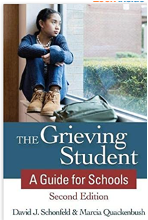
David J Schonfeld, MD, Fellow of the American Academy of Pediatrics (FAAP), is a developmental-behavioral pediatrician; he founded and directs the National Center for School Crisis and Bereavement at Children's Hospital Los Angeles. Dr. Schonfeld is Professor of Clinical Pediatrics at Keck School of Medicine. His recently published book is entitled, The Grieving Student: A Guide for Schools and it can be ordered here.  

The Greater Good Science Center studies the psychology, sociology, and neuroscience of well-being and teaches skills that foster a thriving, resilient, and compassionate society. Based at the University of California, Berkeley, one of the world’s leading institutions of research and higher education, the GGSC is unique in its commitment to both science and practice: They sponsor groundbreaking scientific research into social and emotional well-being and help people apply this research to their personal and professional lives.

To see additional tools to ensure a sense of safety for all youth, see our Youth Development Guide 2.0 here. Also, a new briefing paper on supporting LGBTQ youth. Feel free to share this resource with your network.


Monday, May 15, 2023

Employing Youth and Workforce Development in Afterschool


Source: Fab Youth Philly

By Sam Piha

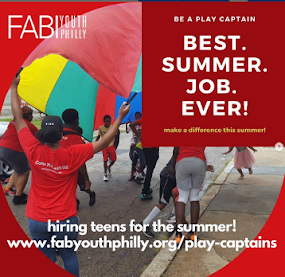
When asked, older youth cite they are most interested in opportunities to gain work experience that is meaningful, making the real world a better place, and that can translate into their ability to earn their own money. Fab Youth Philly (FYP) is a Philadelphia-based youth development organization that provides innovative, award-winning programming for youth, with a programmatic focus on workforce development opportunities for teens ages 15-19. Below we interview Rebecca Fabiano, Founder and ED of Fab Youth Philly about their program offerings that promote youth employment and workforce development.  

Source: Fab Youth Philly

Q: FAB Youth Philly has emphasized the importance of engaging youth in work through your summer program and school year offerings. Why is this? 

A: We have emphasized the importance of engaging youth in work/employment during the summer for several reasons. First, the summer presents an opportunity for deeper and extended engagement with teens. We can see them five days a week for 5-8 weeks, which allows us to build and deepen our relationships with them, and for them to build and deepen relationships with their peers, other stakeholders (partner organizations, community members, etc.). That can be up to 200-250 hours of time to support teens developmental needs, including establishing financial independence, exploring their passions and interests, and building social capital & professional networks. We know that people who are employed in their teens are more employable as an adult and have greater lifetime earnings than those that do not. 

Q: Many of your program offerings engage youth in work that serves their community. Why is this important? 

A: Our work is guided by three youth development principles: 

  • Positive relationships;
  • Clear, fair and high expectations;
  • Opportunities for teens to connect, navigate and be productive. 

We are also keenly aware of teens developmental needs and with these things in mind, we know that teens need and want the opportunity to give back to their community. 

For our Play Captain, Safety Captain and our new Lifeguard Training Certificate, the teens often talk about what drew them to these opportunities was to be of service to their community. They talk with pride as a Play Captain about their work “decreasing summer slide and helping children to return to school prepared to learn”; as a Safety Captain, they talk about “a desire to solve problems in their community”, and our new Lifeguard trainees, talk about wanting to “help open pools in their neighborhood so kids have a fun place to go in the summer”.

“Many of our Play Captains report that they enjoy being a Play Captain because they can help children reduce the summer learning slide from the games and activities they play and facilitate.” – Rebecca Fabiano 

Q: Can you describe each of your youth employment program components?  

A: Work Permits for Teens: In many cities, teens need a “work permit” or “working paper”. Our staff has been trained to provide that permit to youth in Philadelphia. It is considered one of the (MANY) vital documents they need to be able to work.

Source: Play Captain Initiative
Play Captain Initiative: Every summer, Fab Youth Philly implements our award-winning Play Captain Initiative (PCI): a workforce development and civic engagement initiative with the mission to empower and train teens in leadership, playful learning and facilitation to make Playstreets, playgrounds and neighborhoods in Philadelphia more playful. Each year we get up to 200 applications and we are able to hire about 50 teens. Those teens facilitate over 70 hours of playful learning activities. During the spring and fall, our Play Captains facilitate activities at neighborhood parks and playgrounds, providing an opportunity to continue working throughout the year. 

“For more than 85% of our teens, this is their first job experience; and we take that very seriously. We build in from application to exit survey opportunities for them to experience and practice things they may encounter again with future employers.” – Rebecca Fabiano 

Source: Fab Youth Philly
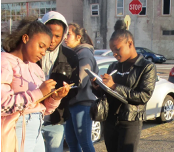
Safety Captain Initiative: Teens are paid to use a project-based-learning approach to answer questions like: What makes a neighborhood youth-friendly? What makes a neighborhood safe for teens? They conduct research, complete community asset mapping, go on field trips and have guest speakers. Upon completion of the 12-week program, they present their findings to the public. 


Source: Fab Youth Philly
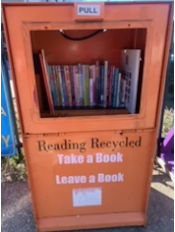
Little Library Stewards: In November 2022, we launched a new initiative called the Little Library Stewards (LLS). LLS creates a job for teens and helps a community asset from becoming a community nuisance. Many little libraries, where you can take a book and/or leave a book in a former newspaper box, are cared for by a resident or are left without a caretaker. As a Steward, teens are responsible for maintaining, cleaning, and stocking little libraries. We have piloted this initiative with some of our older teens, though in the fall, we are looking to make this opportunity available to 14-year-olds (the youngest age a teen can legally work in Pennsylvania), as way for them practice and develop various workplace “muscles,” such as punctuality, communication, attendance, and workplace technology.  

Youth Advisory Board: In December 2022, we launched our Youth Advisory Board with eight teens, who have been part of previous FYP programming. Being on the Youth Advisory Board is a paid position and members meet weekly between the months of September and May. The Youth Advisory Board is tasked with planning events, reviewing Play Captain & Little Library training, supporting participant recruitment and outreach. They are learning about budgeting, planning and decision making. We plan to keep these numbers relatively low, employing up to 10 teens per year.

Source: Fab Youth Philly
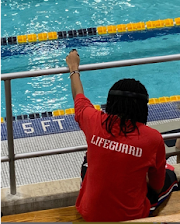
Lifeguard Certification Training: One of our newest initiatives is our Lifeguard Certificate Training program in collaboration with Philadelphia Parks & Recreation (PPR). We had 248 applicants for 15 slots. Every summer PPR needs to hire nearly 300 lifeguards to be able to open all of the public pools, but falls short every year, leaving some pools closed in the neediest neighborhoods. With this in mind and knowing that teens are looking to establish financial independence, we have established a partnership that capitalizes on each organization's assets. Drexel University is providing the pool, PPR is providing the Water Safety Instructors, and we have raised funds with our partner Drexel’s West Philadelphia Promise Neighborhood to pay teens and to outfit each of them with a bathing cap, goggles, bathing suits, towel, and flip flops. The teens participate in weekly workshops about how to create a resume and a cover letter, as well as how to apply for and interview for lifeguard positions. 

Our plan in the fall is to pay teens $10 to learn how to swim (thereby increasing the number of young people who have this important life skill, possibly decreasing water safety issues at public pools); then, for those who want to, they can test into the Lifeguard Certification program at $12 hour, and then be hired by PPR at $16 in the summer. Teens learning to swim will go on field trips and have guest speakers to help connect them to the rich history of public pools and swimming and to help develop their identity as a swimmer, while the teens in the Lifeguard Training program will continue to get workforce development workshops.

Q: For many youth participants who obtain first time jobs, do you offer any financial literacy info on how to handle their money? 

A: Yes. We provide a workshop on How to Read Your First Paycheck, one on creating a budget and in January, we invite them back for a workshop called I Got My W2, Now What Do I Do? so they learn about filing taxes.

Q: How can programs learn more about replicating one of these components and does your organization offer any staff trainings or coaching for youth programs outside of Philadelphia? 

A: We LOVE to visit other cities and conduct trainings on a WIDE range of topics pertaining to workforce development, youth development, trauma-informed youth development practices, and effective facilitation. For more information you can contact me at rebecca@fabyouthphilly.com.

MORE ABOUT...

For nearly 25 years, Rebecca Fabiano (She/Her) has worked in various capacities across nonprofit and youth-serving organizations, served on boards and helped to build solid youth programs that engage, encourage, and create spaces for positive development. As a program leader, she has successfully raised funds and managed program budgets; hired and supervised staff; developed and sustained strong community partnerships and designed award-winning programming. 

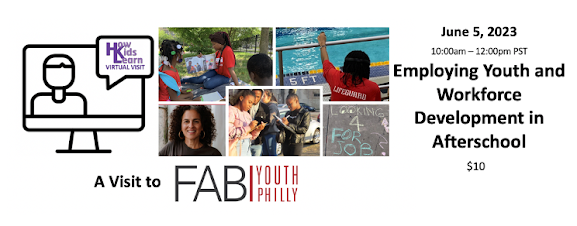
To learn more from Rebecca on the topic of program strategies to promote youth employment and workforce development, join us for this webinar:

Other resources you may find useful: 


Tuesday, May 9, 2023

Four Things to Remember About Supporting LGBTQ Youth

Source: National Afterschool Association

There has been an uptick in targeting LGBTQ+ youth in political rhetoric and state house legislative bills across America. According to the Trevor Project, these actions have ranged from "censoring LGBTQ-related curriculums and books, banning transgender student-athletes from participating in sports that match their gender identity, and criminalizing doctors and families who support youth with transgender medical care."

In response to this, we are posting a series of blogs, some from guest bloggers. This blog was originally published by the National Afterschool Association (NAA), written by Eileen Wise, a youth development specialist at Penn State Better Kid Care and primary author of their Professional Youth Development series.

By Guest Blogger Eileen Wise

FOUR THINGS TO REMEMBER ABOUT SUPPORTING LGBTQ YOUTH

1. Know basic facts about gender and sexual orientation.

Even if you're a sensitive and caring youth development professional, there may be some things you don't know about the LGBTQ—gay, lesbian, bisexual, transgender or questioning—community. For example: What is the difference between gender identity and gender expression? Is using the word "queer" a sign of being well-informed or is it an insult to an individual who is LGBTQ? Why is it important to be able to talk about gender in a "non-binary" way?

We know that a small but significant number of children in our care will grow up to become gay, lesbian, bisexual, transgender or questioning—about 5 percent of children, according to statistics. For any group of children of about 20 or more, there will be at least one child developing as a sexual minority. Like all children, they need our respect, understanding and support.

The National AfterSchool Association (NAA) Code of Ethics calls on all youth development professionals to support all types of diverse youth, including LGBTQ youth.

To be truly supportive, youth development professionals need to learn the basic facts about diversity in gender and sexual orientation. A new online learning module titled "Supporting LGBTQ Youth" is available to support this need. The book The ABC's of LGBT+ is another helpful resource.

When you make the effort to know the facts and vocabulary, youth are more likely to feel you genuinely care and will begin to trust you.

2. Realize how important you are.

Children as young as 5 years old may begin to feel uncomfortable about their identity as a male or female, and it's common for children to become aware of their sexual orientation as they enter puberty. What this means is that some children may experience feelings of being different from the norm in their gender and sexual orientation throughout their elementary years. Minority youth are listening and watching our expressions, dress, and body language. They are "reading" us all the time, because we are trusted role models and respected authority figures.

Afterschool and out-of-school programs can provide a safe haven for gender and sexual orientation minority youth when they implement these elements:

  • Create a welcoming atmosphere.
  • Establish behavior guidelines.
  • Promote inclusion.
  • Call out discriminatory speech and actions.
  • Apply consequences consistently.

When you recognize your authority and take charge of the out-of-school program space, you are giving gender and sexual orientation minority youth the room to feel safe, accepted, and able to explore their identities.

3. Know it's OK to make mistakes.

We have all been socialized to think and speak in a binary way about gender. We may be in the habit of addressing a group of children as "boys and girls." We may have grown up dividing children into groups or teams by gender. We may also be used to remarking about how an article of clothing or a person looks "pretty" or "handsome."

These types of expressions and habits can be off-putting to LGBTQ youth. They can signal that adult professionals are not really understanding the effects of their words on gender and sexual orientation minority youth.

However, if youth development professionals can catch themselves and correct their statements into a gender-neutral way of speaking, this can make a big difference to youth. Youth are forgiving if they see we are trying to be more inclusive and understanding.

When you make a mistake, quickly apologize and correct your speech or action. Youth will realize that you are sincerely learning and trying, and they will accept and appreciate your efforts.

4. Really listen to young people.

We can learn a lot about the concerns and issues facing youth by asking questions and listening to their answers. Youth culture changes quickly, and the trends and jargon among LGBTQ youth may change even more quickly. Often, books and articles cannot keep pace with the facts on the ground.

For those of us who work on a daily basis with children and youth, our ability to "really listen" may be our most important skill. By listening intently and with open minds and hearts we may be able to tune in to LGBTQ youth who are suffering from stress and rejection at home, at school or in their neighborhoods. We may be the lifeline they desperately need to grow beyond what they are experiencing today and to ultimately realize their full potentials. 

Our ability to listen intently and respond with care may be a lifeline for LGBTQ youth.

References: Mardell, Ashley. 2016. The ABC's of LGBT+. Mango Media Inc.; Penn State Better Kid Care. "Supporting LGBTQ Youth." Online professional development module.

To see additional tools to ensure a sense of safety for all youth, see our Youth Development Guide 2.0 here. Also, a new briefing paper on supporting LGBTQ youth. Feel free to share this resource with your network.


Monday, May 1, 2023

Our Resolution: Defeat Anti-LGBTQ Bills in 2023


By: Guest Blogger Ryan Bernsten, The Trevor Project
 
As we start a new year, we enter a hostile political landscape for LGBTQ young people in states across America. In 2022, 220 anti-LGBTQ bills were considered in a majority of states across the country — a record number. In 2023, this trend is set to continue, as state houses around America are considering legislation that targets LGBTQ young people, ranging from censoring LGBTQ-related curriculums and books, banning transgender student-athletes from participating in sports that match their gender identity, and criminalizing doctors and families who support youth with transgender medical care.  

Source: The Trevor Project
That’s the bad news. However, there is reason for optimism: nearly 90% of harmful bills considered in 2022 were defeated by LGBTQ advocates and allies.  

These wins don’t just happen organically. They’re a result of targeted grassroots efforts of educating legislators about the real impacts and harm these policies cause. We know that to many families, the prospect of another tough year is daunting. For those new to LGBTQ advocacy, joining in to defend our young people can seem overwhelming. Our best power and momentum lies when we stay informed and work together. So, at the Trevor Project we’re making a New Year’s resolution to support advocates in state legislatures across the country who are standing up for LGBTQ youth, especially trans and nonbinary youth. We hope you’ll join us.

Source: The Trevor Project

As an advocate for LGBTQ rights, it’s important to stay informed about these bills and to be ready to take action to fight back against them. Here are some steps you can take to make a difference:

Stay informed: Follow news about LGBTQ issues in your state and around the country. Sign up for newsletters or alerts from organizations like The Trevor Project or the ACLU, and follow their social media accounts to stay up-to-date on the latest developments.

Get involved: Find a state or local organization that’s working to fight back against these bills. Consider joining their efforts and getting involved in their campaigns. Volunteering your time, donating money, or even just sharing information on social media can make a difference. You can find local organizations here.

Reach out to your legislators: Remember that politics is local. If you live in a state where an anti-LGBTQ bill is being considered, reach out to your state legislators and let them know how you feel. You can do this through email, phone, or even by writing a postcard or letter. Make sure to explain why the bill is harmful and why you oppose it. You can even visit them at their offices to have a face-to-face conversation with their staff. You can find your state legislator here

Watch hearings and state legislative sessions: As these bills are being debated, they often go through a public hearing process. Find out where and when these bills are being discussed and show up or watch them online. Let the legislators know that there is an audience that doesn’t agree with these harmful bills. Remember that politicians want to be re-elected. Presence is pressure.

Educate others: One of the most powerful things you can do to protect LGBTQ young people is to speak to the people in your life about why these bills are so harmful. Visit our Resource Center to find guides and educational materials. Remember, you don’t have to have all the correct language to make a difference. You just have to speak from your heart and practice empathy. If you have a platform or writing skills, you can also contact local publications to write op-eds or letters to the editor about these issues. 

The Trevor Project is fighting every day for a more inclusive world for LGBTQ young people, but we can’t do it alone. We all have the power to change hearts and minds through people-to-people conversations, local and state advocacy, and the ballot box. Make a resolution this year to stay involved and ensure that we defeat as many of these harmful bills as possible.

MORE ABOUT...

Ryan Bernsten is a Senior Managing Editor at The Trevor Project, a suicide prevention and mental health organization for lesbian, gay, bisexual, transgender, queer & questioning (LGBTQ) young people.


The Trevor Project
'
s mission is to end suicide among lesbian, gay, bisexual, transgender, queer & questioning young people. Their vision is a world where all LGBTQ young people see a bright future for themselves.

A Book Drive for Children's Books Makes for a Fabulous Service- Learning Project

Source: The Children's Book Project  By Sam Piha   In our previous paper entitled, Reading Buddies: Promoting Literacy and Community Eng...