Showing posts with label supporting youth grief. Show all posts

Monday, August 21, 2023

Young People and Grief

Source: Experience Camps

By Sam Piha

Experience Camps, founded in 2009 as a 501c3 organization, is a national, no-cost program for grieving children who have experienced the death of a parent, sibling or primary caregiver. 

“We know that over 250,000 children are grieving the death of a primary caregiver due to Covid and that 6 million children will have experienced the death of a parent, sibling, or primary care giver by age 18.” - Liza Buck, Experience Camps

Because of the prevalent issue of childhood grief for afterschool participants, we interviewed Liza Buck, the Regional Program Manager for Experience Camps. Below are her responses to our questions.

Q: Can you briefly describe your program, Experience Camps?

A: Experience Camps provide no-cost, one-week sleep away camp programs to kids who have experienced the death of someone significant in their lives. We believe that every child deserves to live a life full of possibility and have seen camp "return" certain elements of childhood to them that may have been consumed by their grief.

Source: Experience Camps

Q: What ages of youth do you serve and how are staff prepared and trained?

A: Our camps welcome kids who will be entering grade 4 through grade 12 - approximately ages 9-18. These campers spend the week with other kids who "get it," who get what it's like to be the only one in class who is grieving someone's death, and who understand that they feel an array of emotions, not always sadness. The bunk counselors who volunteer to staff our camps know how important it is to create that safe space that doesn't always exist outside of camp, and receive training in the months leading up to camp as well as an in-person orientation before the campers arrive. Trainings cover the history of Experience Camps, grief, inclusion, risk management, mandated reporting, and understanding developmental stages. 

Source: Experience Camps

Q: Have you seen an increase in the number of youth who are experiencing grief due to COVID? 

A: Yes, we know that over 250,000 children are grieving the death of a primary caregiver due to Covid and that 6 million children will have experienced the death of a parent, sibling, or primary care giver by age 18. This means that 1 in 5 kids will grieve the death of someone by 18. Most of our campers are grieving the death of a parent, sibling, or primary caregiver.

Q: You are utilizing an online program called ExperienceCraft, a world in Minecraft built with and for grieving kids. Can you say more about this? 

A: As far as we know, we have the first Minecraft server of its kind. It's a safe server which means that kids are unable to participate unless the server is open and monitored by staff. We partnered with Connected Camps to invite kids who have experienced grief to our server and Discord channel (also protected) on Friday, Saturday, and Sundays where they get to interact with peers in a virtual environment. There are different "worlds" within ExperienceCraft, including a creative world where kids can create endlessly and add to a memorial garden and not fear anyone destroying their creations since that feature is disabled in the creative world. It's another way for us to try and reach more kids who either do not want to or cannot attend physical camp. Learn more here

Source: Experience Camps

Q: Afterschool programs include a number of youth who are experiencing grief. Can you offer any advice or activities for afterschool workers to address the grief experienced by their youth?

A: Being there for the child can look different depending on the day and the kiddo you're showing up for. Some days it may look like being a physical presence that they know is there, others it may be intently listening to them as they talk about something they're interested in, and the best days will be when you ask about their person. When you do ask about their person, say their name, say the word "died" or "death," and ensure your face is conveying interest and not pity. Kids are extremely perceptive, and if they see us flinch, they're less likely to share. The more you listen (with your eyes and ears) the easier it will be to follow their lead on how much they want to talk. Again, what’s important is that they show up for these kids, and not just once, but consistently. 

Q: I noted on your website that camps are held in venues across the country. If an afterschool worker wanted to refer youth to attend, are there certain requirements needed and how would they proceed? 

A: A lot of campers are referred by teachers and after school staff or coaches! The best thing to do is introduce them to our website, and if they're interested, directing their caregiver to the online application. If they need assistance they can always reach out to us. Kids who have experienced the death of a parent, sibling, primary caregiver, or another significant figure in their life are eligible to apply and will complete an intake with us to see if camp is a good fit.

Q: Are there any resources to help the youth with transportation required to attend the camp?

A: Campers arrive at each of our six locations and twelve programs by buses chartered by Experience Camps, and each location has several bus stops to try and accommodate as many families as possible. However, we never want transportation to be a barrier so travel scholarships are also available through an application process.

Source: Experience Camps

Q: Do you have any resources you would recommend to assist afterschool leaders in learning more about this work?

A: We have a list of resources, additional information and answers to any of your questions on our website.  

MORE ABOUT… 

Liza Buck (she/her) is the Regional Program Manager for Experience Camps. She has been a teacher, CAD counselor, and has been involved with Experience Camps since 2014, beginning as a bunk counselor and most recently operating as the Program Director for CalEx Girls. In addition to her teaching degrees, she is in the process of completing her MSW at the University of Maine. Liza has a passion for kids and mission-driven work which is why Experience Camps feels like “home.” When she’s not doing “the best work ever,” she is most likely outside with her dog or baking a batch of cookies.

Experience Camps, founded in 2009 as a 501c3, is a national, no-cost program for grieving children who have experienced the death of a parent, sibling or primary caregiver. Their one-week, overnight summer camps, year-round programs, and content help to reframe the experience of grief, and empower kids with the necessary coping skills to move forward with their lives. Through compassion, connection, and play, Experience Camps allows grieving children to embody a life full of hope and possibility.

Monday, May 22, 2023

Moving From Grief to Wellness in Our Schools

Source: www.pexels.com

We know that many young people suffer from grief and the loss of loved ones due to COVID, gun violence, etc. In response we have posted several LIAS blogs, a briefing paper and webinar trainings for the afterschool community.

Guest blogger, Vicki Zakrzewski, Education Director for Greater Good Science Center, recently interviewed pediatrician, Dr. David Schonfeld on addressing young people‘s grief in school settings. Below she shares a few excerpts from her interview. (To read the full interview, click here.) 

Zakrzewski: What is the difference between trauma and grief?

Schonfeld: We’ve tried so hard to be trauma-informed that we often forget to also be grief-sensitive. When you’re dealing with trauma, you’re helping people deal with something that happened. When you’re dealing with grief, you’re trying to support them as they face the loss of someone or something important to them. The interventions are very different. And trauma is not intrinsically more important than grief.

Some assume that trauma is more important or serious than grief because it’s been talked about more among mental health professionals. Reactions that are due to trauma are labeled symptoms and may lead to the diagnosis of trauma disorders, and then we recognize the need for mental health treatment from licensed and credentialed professionals. But since bereavement is considered a normative life experience and not a mental illness, even the same reactions aren’t viewed as an illness, and we don’t provide treatment for grief. Instead, we offer support delivered by lay people or faith-based professionals. It’s generally free since most health insurances won’t pay for grief support.

Source: Artwork by Lauren Coakley. Added by Temescal Associates

Zakrzewski: What advice would you give to education professionals who are not sure how to respond to grief and loss? 

Schonfeld: I think we need to acknowledge that it’s OK to be uncomfortable with grief, but that sometimes you have to do things you’re uncomfortable with when they’re important. A lot of times people will share with me this “secret” that it’s hard for them. I tell them that that’s a given.

We just have to acknowledge that this is really tough and it’s all right to feel some discomfort. It’s all right to recognize that you don’t know exactly what to say or how to do it—but it’s not all right to not do anything.

A lot of people think that because they don’t know what to say to a grieving student, it’s better to say nothing. Nothing is exactly the wrong thing to say. It communicates to kids and adults that you’re clueless, you don’t care, you don’t think they can handle it, you can’t handle it, or you don’t want to waste your time. Those are all really horrible messages for people in crisis. So we try to give school professionals basic skills to support students and staff after crisis and loss—but acknowledge that it’s still hard. We let them know that we’re going to help them do it.

“After my brother died, life was so hard to live. There were days that I sat there and I didn’t think I could live anymore without my brother. Whenever a birthday, holiday or special occasion would come along, I would always end up shedding at least a few tears. Nothing was the same without my brother.” —Jeniffer, 16, Children’s Grief Awareness Day (Note: added by Temescal Associates)

Zakrzewski: What kind of support do teachers and students say helps them the most?

Schonfeld: For the education professionals, the common advice given is about self-care. But organizational approaches can be more effective than personal self-care alone. However, you really need both. If we imply that if you are upset when you have an upsetting job it’s because you’re not professional enough and didn’t do enough to take care of yourself, we risk blaming the professional for stress that is inherent in the work. We have to disavow that from the beginning, and instead do our best to establish organizational support structures and minimize the stress associated with the positions and create an organizational culture that values staff support.

I think for a lot of kids, figure out what type of academic and, to some degree, social support to offer, and then be there to listen to them. Be present and empathic, and that’s probably a large part of what an educator has to do.

Zakrzewski: How do you suggest schools respond to the range of cultural approaches to grief within their respective communities? 

Schonfeld: Death is a universal experience, and we should focus more on how it’s the same and less on how it can be manifested in different ways. There’s a tendency for us to feel uncomfortable supporting people of other backgrounds. Start with one culture, maybe your own. If you know how to support a grieving student in that culture, you can do it with students of any culture—you just have to realize that there are differences.

It’s not important that you learn everything about different cultures. Instead, ask them, “Could you help me understand what’s important to you and your family, so I can better understand how to help you?” I’ve never had a family say, “I’m not going to tell you.” They want to share their beliefs and their culture so you can better help them.

After a presentation, people will often come up to me and say, “I said the wrong things.” And I reassure them that even though the advice I gave sounds easy, I’ve made the same mistakes. As long as people know you care and are trying to help them, they’re pretty open to forgiving you. They’re less likely to do so if you appear disinterested or insensitive.

MORE ABOUT…

Vicki Zakrzewski, Ph.D., is a former teacher and school administrator, and the founding education director at the Greater Good Science Center, where she translates the science of compassion, empathy, gratitude, awe, forgiveness, and other social, emotional, and ethical skills to improve the well-being of students and educators. She writes articles, gives talks and workshops all over the world, designs online courses for educators, and is the creative lead for the GGSC’s new online resource for educators, Greater Good in Education. Vicki also serves as the co-associate editor of SEL practice for Social and Emotional Learning: Research, Practice, and Policy, sits on several advisory boards, and consults and collaborates with educational organizations.  

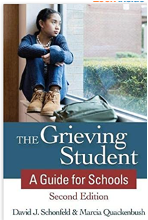
David J Schonfeld, MD, Fellow of the American Academy of Pediatrics (FAAP), is a developmental-behavioral pediatrician; he founded and directs the National Center for School Crisis and Bereavement at Children's Hospital Los Angeles. Dr. Schonfeld is Professor of Clinical Pediatrics at Keck School of Medicine. His recently published book is entitled, The Grieving Student: A Guide for Schools and it can be ordered here.  

The Greater Good Science Center studies the psychology, sociology, and neuroscience of well-being and teaches skills that foster a thriving, resilient, and compassionate society. Based at the University of California, Berkeley, one of the world’s leading institutions of research and higher education, the GGSC is unique in its commitment to both science and practice: They sponsor groundbreaking scientific research into social and emotional well-being and help people apply this research to their personal and professional lives.

To see additional tools to ensure a sense of safety for all youth, see our Youth Development Guide 2.0 here. Also, a new briefing paper on supporting LGBTQ youth. Feel free to share this resource with your network.


A Book Drive for Children's Books Makes for a Fabulous Service- Learning Project

Source: The Children's Book Project  By Sam Piha   In our previous paper entitled, Reading Buddies: Promoting Literacy and Community Eng...