Tuesday, June 1, 2021

Dr. Deborah Lowe Vandell and the Longitudinal 26- Year Afterschool Study

​Ongoing research on out-of-school time programs is essential to help shape our practice and ensure ongoing support from policy makers. Dr. Deborah Lowe Vandell, founding Dean Emerita of Education at the University of California Irvine, has been a leading researcher on expanded learning programs since 1985. Dr. Vandell appeared in our video on the Learning in Afterschool & Summer Learning Principles and our documentary on the History of Afterschool in America. She also shared her thoughts in a plenary presentation and workshop at the How Kids Learn VIII conference and has been interviewed for past LIAS Blogs

In a recent article from the Mott Foundation she was interviewed about the release of a 26- year study on the impacts of early childhood and afterschool programs. “As one of the principal investigators with the National Institute of Child Health and Human Development (NICHD) Study of Early Child Care and Youth Development, she has conducted an intensive study of the development of 1,300 people from birth to 26 years. This work is viewed by many social scientists as one of the most comprehensive studies of the short- and long-term effects of early care and afterschool education to date.”  

Below we quote some excerpts from the interview with Dr. Vandell published by the Mott Foundation. You can read the full Mott interview here.

Q: What has research on afterschool programs revealed since you first started working in this field? 

Deborah Lowe Vandell
Photo: Steve Zylius
 
A: Many researchers in both the United States and other countries are now studying afterschool programs and activities in childhood and adolescence. The good news is that our science has now substantially increased what we know about these important developmental contexts, and we are now much better situated to meet the needs of children and adolescents by providing accessible, affordable, high-quality afterschool learning opportunities. 

We’ve also identified many of the key ingredients needed for out-of-school time to have positive effects. This work has shown that consistent and sustained participation in high-quality afterschool programs is linked to positive academic and social outcomes for both children and adolescents. However, findings are less clear (and sometimes even negative) when participation is sporadic or activities are lower in quality, so we have to pay close attention to program quality and to participation over time. 

Q: Tell us about your latest study. What were the biggest questions? 

A: My latest study is one that circles back to that first afterschool study. This latest study looked at children’s early care and education and their organized afterschool activities in elementary school and asked how these two sets of experiences (early care and afterschool care) are related to children’s academic and social functioning in high school. 

In this study, my coauthors and I followed almost 1,000 children over time and asked if both early care and education (ECE) and afterschool organized activities during elementary school are related to how students are doing in high school — both academically and socially. We focused on ninth graders because the high school transition is challenging for many adolescents, and we wanted to know if children’s early care and afterschool activities in elementary school could help adolescents to meet these challenges. 

Q: What did you and your coauthors find?

A: We found that both early child care and out-of-school time during elementary school predicted higher academic achievement at age 15. 

Children who received higher quality ECE and who had sustained participation in afterschool organized activities demonstrated higher academic achievement in high school. These effects on academic achievement were additive — with the effects associated with afterschool programs building on or adding to the early care effects. Importantly, the effects associated with early care and afterschool care also were exactly the same size, indicating that both are good investments. 

In this paper, we also found that early care and out-of-school time were related to different aspects of behavioral development. Higher quality ECE predicted fewer behavioral problems in adolescence, whereas afterschool organized activities were linked to greater social confidence. 

We found that consistent participation in afterschool was important for building children’s social competence — including feeling more confident about meeting new people and interacting with peers and adults — which bodes well for students’ future success in school and in the workplace. These benefits were not associated with ECE experiences, suggesting that afterschool programs serve a unique role in this respect. 

Q: What makes this body of work unique and its findings important? 

A: There are several factors that make the study noteworthy, I think. The first is the effort to examine early care and education and out-of-school time in relation to later development. For the most part, these two important developmental contexts have been studied separately. 

Second, the study finds effects of these earlier experiences on longer term outcomes in adolescence. These effects, evident in the 15-year-olds, suggest that the benefits of early care and elementary school activities do not fade away, but persist over time. Now we are asking if the effects continue to be evident in adulthood. 

Third, the sample in this study was economically, geographically and ethnically diverse, suggesting that these findings on the benefits of afterschool programming have wide generalizability for children in the United States. 

This work is consistent with and extends prior research by showing that sustained participation in high- quality afterschool programs in elementary school is linked to positive academic and social outcomes in high school and that those effects persist. 

Q: What does the study imply for post-COVID-19 recovery? 

Source: www.njsacc.org
A: Researchers and educators are deeply concerned about the effects of COVID on children’s learning and development — and the impact of school closures, disruptions and trauma brought on by the pandemic. 

In one set of studies released by NWEA, a nonprofit research organization, researchers documented a significant widening of academic achievement gaps by income and race last spring, which was further exacerbated by school closings and disruptions this fall. Other researchers are reporting increases in students’ social-emotional problems as a result of the trauma and disruptions brought on by COVID. 

The work by NWEA and others is highlighting that children growing up in under-resourced families and communities are going to be in particular need of high-quality afterschool and summer programs. However, because of the financial disruptions being experienced by many low-income and working families — and because of the budget shortfalls facing many communities — children who most need high-quality afterschool programs will likely have less access to these programs and services. To address these serious issues, a coordinated response is going to be needed — one that brings together the resources of early childhood programs, afterschool programs and schools. 


Source: www.whitehouse.gov


President Biden's COVID Relief Bill contains billions of dollars for afterschool and summer learning programs. To learn more:

Tuesday, May 25, 2021

ODE To This Thing Called Family

Sheila McKinney,
Richmond, CA's Youth Poet Laureate

RYSE Youth Center announced Sheila McKinney as Richmond CA's first Youth Poet Laureate (YPL)! The YPL is a new role for the city of Richmond that highlights the artistic endeavors and artistry of youth within their community, while bridging the gap between youth and adults. She is mentored by the former Richmond Poet Laureate and RYSE Media, Arts, & Culture Manager, Ciera Jevae, and will work with youth and adult poets nationally.

Sheila McKinney is a 16 year old poet attending Pinole Valley High (West Contra Costa School District, Ca). She serves on the Debate team, the African American Student Union, as well as WISE (Women in STEM Education). She recently started writing and performing over this past year, and is already co-facilitating a series of poetry workshops on the national level. Sheila uses poetry as a form of activism and as a tool for moving the world into a more just and loving place.  

We asked Sheila to submit a poem for our LIAS Blog which is presented below. 

ODE To This Thing Called Family 
By Sheila McKinney 

Ode to that smacking I hear
I hate when you do it but miss it when you not here
Passed down recipes from ancestors that show up every now and again 
And in honor of you
We eat gracely
With bowed heads we say Amen
The taste that opens heaven gates on my tongue 

Ode to those who were once young
Tellin stories nobody knew
Surprised faces with a burst of comfort feels the room 
The long talks that have my eyes open
Ears perked like a dog
Even when you’re miles away
I vision the moments we have shared
The thoughts that evolved 

People that I’m always around 
Knows me like the back of my hand 
Enough love to last my whole life 
Enough friction to create strife
Ode to this thing we call family 

RYSE is a Youth Serving Organization based in Richmond, Ca. RYSE consists of 4 departments; Community Health, Education & Justice, Youth Organizing, and the Media Arts, and Culture Department. Their aim is to eliminate any barriers youth may face in the pursuit of education, life goals, and liberation, as well as create platforms that elevate youth voice and youth leadership in the present and the future. 

Tuesday, May 18, 2021

The Well-Being of Adolescents During COVID-19

Source: www.cdc.gov

In our work with young people, it is important that we think about the many ways they may have been impacted by COVID-19. According to the Centers for Disease Control (CDC), "Coronavirus disease (COVID-19) can affect adolescents directly and indirectly. Beyond getting sick, many adolescents’ social, emotional and mental well-being has been impacted by the pandemic. Trauma faced at this developmental stage may have long-term consequences across their lifespan."

The CDC offers several briefing papers on how the pandemic has impacted the mental health of young people. They offer 4 papers by age group. Below we include excerpts from Social, Emotional, and Mental Well-being of Adolescents during COVID-19. You can read the complete paper here.

CHALLENGES

Change in Routines- In addition to everyday steps to prevent COVID-19, physical or social distancing is one of the best tools we have to avoid being exposed to the virus and to slow its spread. However, having to physically distance from someone you love – like friends, boyfriend or girlfriend, family or your worship community – can be hard. Adolescents may struggle when asked to change their social routines – from choosing to skip in-person gatherings, to consistently wear masks in public settings. It is important for adults to help adolescents take personal responsibility to protect themselves and others, as well as support them in safely taking time to connect with friends and family remotely. 

Break in Continuity of Learning- School closures due to COVID-19 have meant that adolescents have been participating in learning from home. Online platforms and communities have become essential, as families turn to digital solutions more than ever to support students’ learning. Unfortunately, the immediate need for virtual learning environments brought to light inequity in resources, access and connectivity across families and communities. School closures have also meant a break in access to some essential developmental services like occupational, behavioral, or speech therapy. It could also have impeded continuity in adolescents’ development of athletic or hands-on vocational skills, with potential impacts on their higher education and professional future. It is important to understand how virtual learning could make learning increasingly challenging for students with limited resources or special needs. Moreover, some children may experience anxiety about going back to school in-person or virtually. Some may also experience fatigue from online video conferencing— commonly referred to as “zoom fatigue .” 

Break in Continuity of Health Care- Parents may have avoided seeking health care for their adolescents due to stay-at-home orders and may continue to do so because they are afraid of getting sick with COVID-19. This includes important well-child visits, immunizations and oral health care. Additionally, school closures have impacted many adolescents’ ability to receive mental health, speech therapy and occupational health services on campus. It is important to ensure adolescents receive continuity of health care, including continuing mental health, occupational and speech therapies (e.g. via telehealth), and receiving vaccines – including COVID-19, when it becomes available.

Source: www.cdc.gov
Missed Significant Life Events- Physical distancing can feel as if one is placing life on hold. The truth is that the clock keeps ticking. Birthdays, graduations, proms, homecoming, vacation plans, births and funerals are just a sample of the many significant life events that adolescents may have missed experiencing during COVID-19. Social distancing, stay-at-home orders and limits to gatherings have affected their ability to gather in person with friends and family to celebrate or grieve in typical ways. Grief is a normal response to losing someone or something important to you. It is important for family and friends to help adolescents and alternate, creative and safe ways to connect and support each other at a distance. 

Source: www.cdc.gov
Loss of Security and Safety- Job loss and lost wages affected the household income of many adolescents’ families during COVID-19. Economic insecurity is consistently linked to adverse development, academic achievement, and health outcomes. It may affect adolescents’ ability to consistently access healthy foods, safe transportation and housing. Mounting economic stressors can increase their risk for exposure to violence. Along with stay-at-home orders during COVID-19, some adolescents may have been increasingly exposed to abuse and neglect, intimate partner violence at home, and sexual violence. Their increased online activity also puts them at increased risk for online harms, such as online sexual exploitation, cyberbullying, online risk-taking behavior, and exposure to potentially harmful content. It is important for parents and other prosocial adults to maintain a trustworthy relationship and open communication with adolescents, watching for behavior changes that may signal distress.

WHAT CAN YOU DO?

Recognize and Address Fear and Stress- Adolescence is a time of big changes. Adolescents can be particularly overwhelmed when stress is related to a traumatic event, expressed as excessive worry or sadness, unhealthy eating or sleeping habits, and difficulty with attention and concentration. Adults can provide stability and support to help them cope, as well as facilitate access to professional help and distress emergency hotlines, as needed. 

Source: www.news-medical.net
Teach and Reinforce Everyday Preventive Actions- There are actions we can take to protect others, prevent getting sick and slow the spread of COVID-19. Encourage adolescents to be good role models— if they wash their hands often, stay at least 6 feet apart from others, and wear their masks in public spaces to help protect themselves and others, then younger children – and even their peers – are more likely to do the same.

Help Keep Adolescent Children Healthy- Teach adolescents the importance of taking care of their health. Engage them in scheduling routine check and immunizations visits. Ensure continuity in their mental health and occupational health care. Encourage them to eat healthy, drink water – instead of sugar sweetened beverages – for strong teeth, be physically active, or learn something new. It can help them stay healthy and focused.

Help Adolescents Stay Socially Connected- Encourage adolescents to reach out to friends and family via phone, video chats, social media, or even via video games. Schools may have tips and guidelines to help support their social and emotional needs.

Steps to Help Provide Stability and Support to Adolescents

  • Maintain a normal routine
  • Talk, listen, and encourage expression
  • Give honest and accurate information
  • Teach simple steps to stay healthy
  • Be alert for any change in behavior
  • Reassure adolescents about their safety and well-being

RESOURCES 

Tuesday, May 11, 2021

The Missing Hours: COVID Shutdown and Afterschool

By Sam Piha

This fall, after nearly a year of isolation, youth are likely returning to school full time. What did young people experience during this time? A recent article in the NY Times, The Missing Hours: 7 Students on Losing a Year of After-School Activities, by Juliana Kim, quoted young people about their experience during the last year of shut down. 

Julianna writes, “From 3 p.m. to 6 p.m. That block of time, between the end of classes and the beginning of dinner, were for millions of teenagers everywhere the golden hours of the day. They provided a release from the pressures of school or an escape from a stressful home. It was a time for friendship and fun.”  

Below we provide some excerpts from this article. To read the full article, click here

Source: NY Times,
Lila Barth

I’ve done the Y.M.C.A. from sixth grade onward. It started because my mom was working, my dad was working, my sister was working, so my mom needed to find somewhere I could spend my time instead of staying home alone. I haven’t gone to the Flushing Y in a year; it’s tough. I really miss going. We still have our meetings but they’re online — very rarely do I get to go outside and see my friends or counselors, so it’s a big adjustment. Sometimes I feel like I’m just far away from the world.”— Samir, 16 


Source: NY Times,
Lila Barth
The 96th street library on the East Side was my second happy place, after home. I would go there after school, get my work done, then go home. The security guard knows me, some staff know me. It was like a family to me over there… Libraries were the place you could rely on and have peace. I’ve been through shelters since I was 8 years old. My dad kicked out my mom, and she took me and my little sister with her. It was a lot of back and forth. Some kids out there might go to a cafe, but they have to buy something if they want to study. So it’s hard. The library is really the only option. When they were opening up schools, I was like, OK, are they going to open up the library? But they mentioned nothing about the library. What’s the whole point of opening up schools if you can’t go to the library?” — Sam, 18


Source: NY Times,
Lila Barth
 . This year, remote learning has been very isolating for me. My mom works at a hospital and my dad is a taxi driver so it can feel very lonely at home. And I haven’t danced after school since March. There’s no space to dance but also, I’ve become more self-conscious. I realize how important it is to have company when you do activities that might spark insecurities, like dancing. I feel like there’s been an insensitivity about youth mental health. There’s a huge emphasis on taking care of and making time for yourself, but the best way to take care of myself was through my extracurriculars. I feel like a part of myself has been erased.” — Meril, 17


Source: NY Times,
Lila Barth

These activities and organizations are so important. They might just save somebody’s life, you know?” — Rafael, 15


Tuesday, May 4, 2021

Summer Programs: A Gateway to the Return to School

Miguel Cardona, U.S. Secretary of Education
Source: Edweek.org
By Sam Piha

Summer programs will be an important gateway to returning to school and healing from a year of isolation. However, these programs should not be pressured to fix the pandemic induced learning loss. Two available articles on focusing on learning loss deserve a read: Too Much Focus on ‘Learning Loss’ Will Be a Historic Mistake and Our Kids Are Not Broken.

Our kids have lost so much—family members, connections to friends and teachers, emotional well-being, and for many, financial stability at home. And, of course, they’ve lost some of their academic progress. The pressure to measure—and remediate—this “learning loss” is intense; many advocates for educational equity are rightly focused on getting students back on track. But I am concerned about how this growing narrative of loss will affect our students, emotionally and academically. Research shows a direct connection between a student’s mindset and academic success. – Ron Berger, Senior Advisor at EL Education 

We’re in the throes of a pandemic. Put yourself in the perspective of a 9-year-old. Students have been looking at a computer for the better part of a year as they learn. So, any summer learning enrichment experience really needs to be re-engaging students in a community of learners. That’s done through experiential learning, getting outdoors, doing projects, [while] maintaining the health and safety standards that are required, to really re-engaging them with experiences. It could be connected to a museum visit. It could be connected to a summer camp where they have experiences. – Miguel Cardona, U.S. Secretary of Education  

How should we be thinking about our “gateway” summer youth programs? What do youth need from their summer program experiences?  How will this year's summer programming differ from past years? We asked some youth program professionals to share their thoughts on how we should we be thinking about summer programs.

Brad Lupien, ARC
President & CEO
This summer is a chance to test theories and demonstrate excellence in collaborative, active, meaningful experiences. We may only get this chance, at this scale, once. The hypothetical question, “if you had [nearly] unlimited funding for summer learning, what would you try, change, experiment with?” is now a reality. This is the time for innovators. 


Bill Fennessy,
A World Fit for Kids
There certainly is great academic learning loss, no question. The social emotional learning loss, however, coupled with the loss of daily personal human contact will have left students with an acute need for programming, activities, and play that intentionally address those needs. As we all know, these basic and critical human needs must be addressed, before there can be any real academic learning. Training to help understand and identify students' mental health issues, coupled with knowing how to refer them to services, will likely be the long-term challenge.  

Autrilla Gillis,
ISANA Academies
This year’s gateway summer youth programs must be multi-faceted. There is a strong need for social-emotional supports, academic interventions and enrichment opportunities. Programs will play an integral role in re-acclimating students to a structured environment to lay the foundation for their successful return to full-time on-campus instruction. Youth need structured, supportive, well-organized, and focused hubs to support these healthy transitions and provide a break from the monotony of life during the pandemic. While we’re a long way from our old normal, the ability to craft programs that are safe, supportive, and engaging are endless. This year’s return to summer programming has never been more important. As we approach summer programming, we must maximize the opportunity to reach all students. While data will indicate which students are most at-risk and in need of targeted supports, there is also a very real need to maintain contact with and provide supports for students that are at grade-level or above.


Stu Semigran,
EduCare Foundation
This summer, our young people will need the time to breathe, to play, to reconnect, and to enjoy themselves and one another. In many ways, it can be similar to reuniting a family after being apart for so long... to tell their stories, to share their experiences, and to begin the process, welcomed for some and awkward for others, of being together again. This time for healing and reconnecting with their peers and teachers will hopefully rebuild communities of safety, renewed comfort, and stability that can then serve as a foundation for reigniting learning.  Being patient and allowing space for the awkwardness of reestablishing connections and for the opportunities to address the trauma and pain of this pandemic year will be essential as we focus on the social-emotional needs of us all- both students and adults.


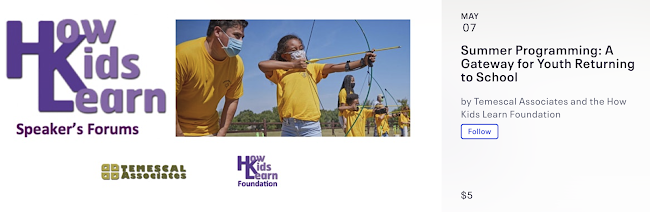
After a full year of learning isolation, young people are just now returning to school, in a face- to- face or hybrid model. This Fall youth are likely returning to school full time. Summer youth programs will be an important gateway to returning to school and healing from a year of isolation. But how should we be thinking about our gateway summer youth programs? What do youth need from their summer program experiences? How will this year's summer programming differ from past years?

On Friday, May 7, 2021, we are sponsoring a Speaker's Forum/ webinar discussion on this topic. It will be facilitated by Ayala Goldstein (Director of Programs, California School- Age Consortium). She will be joined by Aaron Dworkin (CEO of National Summer Learning Association), Autrilla Gillis (Director of Expanded Learning, ISANA Academies) and Selekha Ramos (Mighty Writers) who will be sharing their thoughts and responding to your questions. To register and learn more, click here.

Tuesday, April 27, 2021

Leveraging Summer Programs: A Downpayment on Long- Term Change

Source: www.afterschoolalliance.org

Some young people are now returning to school, in a face- to- face or hybrid model. This after a full year of isolation. This fall youth are likely returning to school full time. Summer programs will be an important gateway to returning to school and healing from a year of isolation. 

Below we offer excerpts from an article authored by Karen Pittman with the Forum for Youth Investment on the importance of summer programs in 2021. Please note: this is just an excerpt from her article posted from Medium.com. You can read the entire article here.

Almost a full year into the COVID-19 pandemic, we once again find ourselves at a critical juncture. As we head into the spring, schedules are still uncertain. But there is growing confidence schools will reopen in the fall. 

With this anticipation of reopening, there is broad commitment to build back better. There is increased recognition of the role that community partners and families can play and that the impact of the last year on teens and young adults will have lasting ramifications. COVID and the racial reckonings have exposed inefficiencies and inequities. This means we are now face to face with a tangible opportunity to challenge and support school districts and community partners in creating equitable learning and development ecosystems that unleash the potential of all learners, recognize the power of all committed adults, and optimize all learning settings and approaches. 

If we are truly intent on not going back to normal, we must recognize the interdependence of systems and center on young people and their families. To do so, school and community leaders must work collaboratively to reflect and take stock to identify innovations and understand roadblocks, look at the ways school, family, and community leaders worked or did not work together, and hear the lessons learned from students, families, and front-line staff. 

Source: www.medium.com
While we saw pockets of exceptional supports for young people and innovation, for the most part young people went without opportunities to connect in meaningful relationships, without opportunities for engaging learning experiences, and without summer jobs to earn money critical to their future goals. 

Summer 2021 shouldn’t look like 2020. The young people across the nation deserve more. It also shouldn’t look like summers of years past. Summer has traditionally been a time when schools stepped back, families stepped in and community organizations stepped up. This division of labor made sense because the stakes are not only lower in summer (no requirements, no grades, no tests) and the success metrics are different (keep academic skills sharp while having fun, mastering new skills, taking on family responsibilities, having different experiences). If we are intent to Build Forward Together our roles in and focus on summer will have to shift. 

This summer can begin to preview “the new normal” and to make a down payment toward the equitable learning ecosystems we hope to create. Where instead of some stepping back and others stepping in, we see communities working collaboratively. We are confident there are many communities that see value in finding some way to use Summer 2021 to document, design, test, or even scale up some ways to BUILD FORWARD TOGETHER to make a down payment on the idea that by the summer of 2022, every student should have equitable opportunities for learning and development because every young person and their family has the support needed to create learning pathways across the ecosystem that are attractive, accessible, affordable, appropriate, affirming, and assessable. 

The Readiness Projects are challenging local school, government and community leaders to: 
  1. Use summer as a low-stakes testing ground to document, test, and scale different ways to leverage school, family, and community assets in support of accelerated learning and development that can help us build forward together post-COVID. 
  2. Prioritize children and youth most challenged by the pandemic who are also the least likely to have resources for summer programs. 
  3. Place focused attention on teens, especially those whose success trajectories are threatened. 
  4. Ask how you will know how many young people had great summers and why, so you can bring that data into the school year and have a baseline for improvement in 2022. 
After a full year of learning isolation, young people are just now returning to school, in a face- to- face or hybrid model. This Fall youth are likely returning to school full time. 

Summer youth programs will be an important gateway to returning to school and healing from a year of isolation. But how should we be thinking about our gateway summer youth programs? What do youth need from their summer program experiences? How will this year's summer programming differ from past years?

On Friday, May 7, 2021, we are sponsoring a Speaker's Forum/ webinar discussion on this topic. It will be facilitated by Ayala Goldstein (Director of Programs, California School- Age Consortium). She will be joined by Aaron Dworkin (CEO of National Summer Learning Association), Autrilla Gillis (Director of Expanded Learning, ISANA Academies) and other summer program experts and practitioners who will be sharing their thoughts and responding to your questions. To register and learn more, click here.


Karen J. Pittman
served as the President & CEO of the Forum for Youth Investment (FYI) until February 2021 then transitioned to a senior fellow role to dedicate more of her time and energy to thought leadership. FYI is a national nonprofit, nonpartisan “action tank” that combines thought leadership on youth development, youth policy, cross-system/cross-sector partnerships and developmental youth practice with on-the-ground training, technical assistance and support. Karen is a respected sociologist and leader in youth development. Prior to co-founding the Forum in 1998, she launched adolescent pregnancy prevention initiatives at the Children’s Defense Fund, started the Center for Youth Development and Policy Research, and served as senior vice president at the International Youth Foundation. She was involved in the founding of America’s Promise and directed the President’s Crime Prevention Council during the Clinton administration. 

Friday, April 16, 2021

Chess, Youth and Afterschool

By Sam Piha

"The Queen's Gambit"

Chess has been in the news lately due to the well-deserved popularity of Netflix’s “The Queen’s Gambit”. These headlines remind us of an excellent documentary on chess and afterschool entitled, “Brooklyn Castle.” Several years ago, we hosted a screening of Brooklyn Castle and featured an interview with the Director and Producer, Katie Dellamaggiore on our LIAS Blog

The kids are happy to be at school and to stay at school past 3 p.m. because they know they are going to get to participate in the activity that they've chosen, and that they're starting to build a passion for.”
Katie Dellamaggiore, Director and Producer of Brooklyn Castle. 

Brooklyn Castle is a documentary about Intermediate School 318 – a Title I school where more than 65 percent of students are living below the federal poverty level, that happens to have the best junior high chess team, bar none, in the country. The movie is being re-released March 5, 2021 for viewing in theaters or can be streamed on Showcase Now. We highly recommend that you take a look. 

I guess the most important (LIAS Principle) I witnessed was that learning should expand the horizons of participants.”-Katie Dellamaggiore, Director and Producer of Brooklyn Castle.  


The same afterschool program featured in Brooklyn Castle are well known for increasing the participation of girls. Check out this video: These NYC Girls are Dominating Youth Chess


We also recommend another movie about a child and his love of chess entitled, “Searching for Bobby Fischer”, which can be streamed on Netflix.


Friday, April 9, 2021

Youth and News Literacy


By Sam Piha

Over the past two decades afterschool programs have invested in equity issues around digital access. We have built and expanded computer labs and instruction on how to use the internet, which many young people depend on to get their news. However, many have not trained staff how to help youth become news-literate.

A news-literate student is empowered to be reliably informed. They recognize the differences between news and opinion, identify misinformation, apply fact-checking and logic-checking tools and recognize cognitive biases. They prioritize information from verified sources of news and information to be active and engage in the civic life of their communities.

The News Literacy Project is a nonpartisan national education nonprofit, providing programs and resources for educators and the public to teach, learn and share the abilities needed to be smart, active consumers of news and information and equal and engaged participants in a democracy. John Silva is their Senior Director of Education and Training. Below are some of John's responses to a recent interview. 

Q: What is "News Literacy"?

A: The ability to determine the credibility of news and other content, to identify different types of information, and to use the standards of authoritative, fact-based journalism to determine what to trust, share and act on.

Q: Why is it important now for youth?

A: Our vision is to see news literacy embedded in the American education experience, and people of all ages and backgrounds know how to identify credible news and other information, empowering them to have an equal opportunity to participate in the civic life of their communities and the country.

Q: Do you have a newsletter?

A: We have three actually. You can learn more about them and subscribe at https://newslit.org/subscribe/

Q: Does your organization offer trainings for youth programs?

A: We offer professional learning for educators across subject areas, grade levels and educational environments.

John Silva is the News Literacy Project’s Senior Director of Education and Training. He joined NLP in March 2017 with 13 years of experience as a middle and high school social studies teacher with Chicago Public Schools. He first became involved with news literacy in 2014 when his students engaged in NLP’s original classroom program. A U.S. Marine Corps veteran, John spent several years in corporate telecommunications positions before deciding to become a teacher.


Monday, April 5, 2021

A Summer Youth and Community Engagement Model: Play Captains

By Sam Piha

Source: www.playcaptains.com

The Play Captain model is an excellent way to engage older youth over the summer in community service and promote safety for younger kids. This model was developed in Philadelphia by Rebecca Fabiano and her organization, Fab Youth Philly. Below Rebecca responds to a few of our interview questions. If you are interested in learning more or having an exchange with Rebecca, contact us and we will arrange a Zoom discussion. Rebecca is also available for remote or in-person training.

Q: Can you briefly describe the Play Captain’s Initiative?

Source: www.playcaptains.com
A:
Coined after the Block Captain and Jr. Block Captain roles, the Play Captains Initiative is a workforce development and civic-engagement initiative with the mission to empower and train teens in leadership, playful learning and facilitation to make the Playstreets and neighborhoods of Philadelphia more playful. 

There are over 400 Playstreets in Philadelphia every summer, which are part of the Free Summer Meal Program, overseen by Parks & Recreation and serve as a safe place for children to receive two free meals a day during the summer. The Playstreets are closed off to cars between 10am-4pm and a resident on the block applies to be a Playstreet Supervisor; they distribute the meals. Not all of the Play Streets are as ’playful’ as they could be, which is why I created this initiative. I saw the opportunity to tap-in-to two underutilized resources in our City; the Playstreets and teens. 

Q: Do you provide training for the Play Captains? 

A: We do provide training for the Play Captains. Play Captains are teens ages 15-19 and they receive about a week (35 hours) of pre-employment training where they learn about concepts like playful learning and effective facilitation. They spend a lot of time playing games and learning how to modify them for a number of conditions and situations they may face on the Playstreet. They ALSO receive weekly professional development (PD) on Fridays on a variety of topics. They are paid ($9/ hr) for their time in training and for PD.

Q: How do you work with the community?

A: We work all year round with the community to build relationships with both individuals and other organizations. We attend community meetings both to learn about the happenings in the neighborhood and to promote the program. We also work with the Police Department and the Community Relations Officers (CROs) and created a “how to work with our Play Captains” guide for the CROs to encourage positive interactions.

Q: How are youth selected and assigned? 

A: Youth complete an application and typically participate in a group interview. For most teens (over 85%) this is their first job and so we want them to have a positive experience that really reflects what it takes to get a job. If we don’t hire a teen, we provide them with resources where they can keep looking for jobs. 

Source: www.playcaptains.com

The Play Captains work on a team of 5 teens, supported by 1 adult Group Leader. The Group Leaders are youth work professionals that we hire and train. We are often able to hire youth work professionals that are from the neighborhoods where we are playing/on the Playstreets, which helps in a number of ways. They are often known to others, so that helps bridge a connection between our organization and the community and, then after the program is over, they are able to maintain connections to the teens. We prioritize placing teens on Playstreets in the neighborhoods where they live. Then, day to day, they follow a schedule where they rotate to a number of Playstreets throughout the day, for a total of 4 days per week (Mon-Thur) for 5 weeks. They go to the same streets over the course of their employment in order to build consistency and relationships with the children that play on the Playstreets.

Q: How are you amending the model in response to the COVID pandemic? 

A: We ran the program last summer in the height of the Pandemic and put several safety measures into place, which we plan to put into place again this summer. For example: everyone wore masks indoors and outside; we did a deep clean of our indoor space 3x per day; we deep cleaned all of the supplies (balls, jump ropes, etc.) at the end of each day; and we created special socially distance arm signals to help the children on the play streets keep a distance. For example: Airplane arms (arms out to the side) when we wanted to have them stand in a circle or near each other, Frankenstein arms for when we needed them to line up and maintain some distance and Hands on Hips, once they are in their socially distance position.  

Q: What do you believe are the benefits to the youth participants? 

A: One of the biggest benefits is that this opportunity provides teens with a first job experience. About a quarter of our teens go on to get afterschool jobs the fall after they are a Play Captain. Other benefits that the teens often report include: feeling valued by their community and feeling like they can make a difference in the lives of younger children; and many teens that self-define as shy say that they had a chance to meet new people and “come out of their shell.”

Q: What do you believe are the benefits to the community? 

A: I’ve been told by residents how much they appreciate seeing the teen Play Captains engaged in something positive and that they feel it is good for the community that the teens have something meaningful to do. 

Q: How do you assess the impact of the program? 

A: For the past three years we’ve worked with a Playful Learning Landscape Action Network (PLANN) who developed a data collection tool and who train data collectors to collect data on the Playstreets to see if the activities the Play Captains facilitate help foster the Six Cs of Playful learning (collaboration, communication, content, critical thinking, creative innovation, and confidence). We also pre/post survey our teens to understand what they learn during training, and what they retain over the course of their employment. We conduct exit interviews with staff and engage in post programming focus groups with residents, Street Supervisors and other stakeholders. We use the data to revise training and to improve the selection of the activities that the teens facilitate on Playstreets, as some examples of how we strive to be a data-driven project. 

Q: If there is interest, would you be able to assist others in replicating this initiative?  

Source: www.playcaptains.com
A: Absolutely! We’ve built a program based on best practices in youth development, workforce development and community engagement, yet it is adaptable and flexible. I would encourage people to check out our website: www.playcaptains.com and watch our videos on YouTube to see the Play Captains in action. 


Rebecca Fabiano (She/Her/Hers) is the President and Founder of Fab Youth Philly and The Play Captain Initiative. For nearly 25 years, Rebecca has worked in various capacities across nonprofit and youth-serving organizations, served on boards and helped to build solid youth programs that engage, encourage, and create spaces for positive development. As a program leader, she has successfully raised funds and managed program budgets; hired and supervised staff; developed and sustained strong community partnerships and designed award-winning programming.​

A Book Drive for Children's Books Makes for a Fabulous Service- Learning Project

Source: The Children's Book Project  By Sam Piha   In our previous paper entitled, Reading Buddies: Promoting Literacy and Community Eng...