Showing posts sorted by relevance for query music. Sort by date Show all posts

Tuesday, October 25, 2022

What Researchers and Experts Have to Say: The Benefits of Music and Music Making for Young People


Source: The NAMM Foundation

By Sam Piha

We know through our own personal experience that music and music making is very important to youth. However, it is useful to identify research that speaks to this issue. We continue our spotlight on the power of music in afterschool. You can view our previous blogs here.

“Research expands understanding about the impact of music making and music education, the importance of music at every stage of life, and relationships between music and physical and emotional wellness… There is an increasingly robust literature of recent research findings that support the developmental importance of music in adolescence.” – The NAMM Foundation

There is an abundance of research on the importance of music for adolescent development. Below we offer a few findings from research on the benefits of music and music making for youth development.  

Belonging
“Music creates a much-needed sense of belonging in the lives of teenagers. Teenagers are known for feeling isolated from society and friends. Music, as an art form, can serve as an outlet to express the feelings of frustration that come with feeling isolated. Listening to music can also give teens the chance to feel connected to musicians and other fans of specific musicians. 

Music is also something that can be enjoyed fairly privately and away from judgement, allowing teens to tailor their experiences to what they actually would like to listen to or play. Learning how to play music also gives teens real, impressive, marketable skills, making them feel useful and capable. Writing and making music is also a way for teens to express themselves as privately or as publicly as they wish.” – Author and music therapist, Cara Jerniga 

Bridging Societal Gaps
“Our society tends to be very racialized, and experiences tend to be very different depending on race or ethnicity. Music provides the opportunity for teens of all races and ethnicities to share a common bond and learn about each other's cultures and backgrounds. For instance, much of the Rap and R&B genres are rooted in Black culture, and many of the prominent performers and names in those genres are Black. Music is also usually very personal to the experience of the artist, so through those things, music can be used as an educational tool for teenagers to learn about backgrounds differing from theirs.” – Author and music therapist, Cara Jerniga 

Executive Functions
“Music may expose the child to challenges and multi-sensory experiences which enhance learning abilities and encourage cognitive development. In particular, music can also engage cognitive functions, such as planning, working memory, inhibition, and flexibility. These functions are known as executive functions.” – Researcher, Dave Miranda

Source: Heart of LA

Developmental Resource 
“Music influences important aspects of adolescent development; music can represent a protective and a risk factor; and music can serve as an adjunct component in prevention and intervention. Therefore, it is proposed how music is a developmental resource in adolescence. It is argued that research on the developmental role of music can create a window to the everyday psychological, social, and cultural needs of contemporary adolescents.” – Researcher, Dave Miranda

Engagement 
“Music provides opportunities in school for teens’ engagement as performers, composers and intelligent listeners, and these activities and qualities appear to be deeply meaningful to them. For teens who are desperately seeking relevance, musical study may give them the balanced experience they require.” – NAMM 

Stress Relief and Coping 
“Music is a well known outlet for stress relief. Many people actively turn to music as a coping strategy when processing stress or sadness, because it helps shut out the noise of the world and the noise inside our heads. Furthermore, music is increasingly being used as a form of therapy, and music therapy in some capacity has existed for centuries. Teenagers, especially those going through puberty, conflicts with friends, or the college process, are under a high amount of stress. Listening to music has been seen to help teens process or release difficult sensations or emotions in a healthy way.” – Author and music therapist, Cara Jerniga

“Music helps adolescents release or control emotions and helps coping with difficult situations such as peer pressure, substance abuse, pressures of study and family, the dynamics of friendships and social life, and the pain of loss or abuse.” – The NAMM Foundation

Identity
“What music and music making means to teens? It helps define them as they grow up, it gives them purpose and meaning, and contributes to their success in school and in life.” – Joe Lamond, president and CEO, NAMM

Source: DJ Mackswell

“Music can also provide teenagers with a skill or hobby that is special to them, which can help further build identity and give teens something to be proud of during a period of life that is often characterized by low self-confidence. Music is an incredibly powerful tool that can be accessed and appreciated by people of all ages and backgrounds, and for that reason alone, it should be appreciated and utilized by anyone and everyone.” – Author and music therapist, Cara Jerniga

The Brain
“Research shows that making music changes the brain, and that these brain changes have tangible impacts on listening skills, learning and cognition.” – Nina Kraus, Ph.D., Director, Auditory Neuroscience Laboratory, Northwestern University

“Music training leads to greater gains in auditory and motor function when begun in young childhood; by adolescence, the plasticity that characterizes childhood has begun to decline. Nevertheless, our results establish that music training impacts the auditory system even when it is begun in adolescence, suggesting that a modest amount of training begun later in life can affect neural function.” – Tierney, Adam T., Jennifer Krizman, and Nina Kraus


VIDEOS
Below we cite 4 videos that explain the benefits of music and music making in the lives of young people. 


How Playing an Instrument Benefits Your Brain- Anita Collins


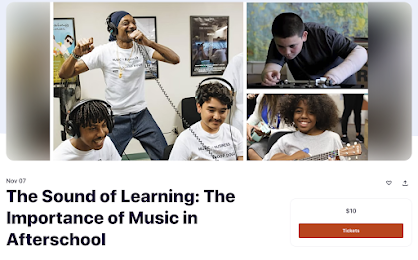
On November 7, 2022, from 10am- 12pm PST, Temescal Associates and The How Kids Learn Foundation will be sponsoring a webinar on this topic entitled, The Sound of Learning: The Importance of Music in Afterschool. Speakers will include researcher Patricia Shehan Campbell (UW), Les Peters (LBYMCA), Jon Bernson (BACR/SNBC), Kevin Peraza (Youth Institute Alumni) and Ren Daraio (Temescal Associates). To learn more and register for this informative webinar, click here.


Tuesday, September 13, 2022

Afterschool and the Power of Music

Source: Long Beach Youth Institute 

By Sam Piha

Because music is so important to young people’s development and identity, we wanted to interview an afterschool innovator on how his organization engages with young people through music. We first learned about the Youth Institute (YMCA of Greater Long Beach) many years ago when they were training young people and afterschool staff how to use computer technology to make movies. Below is an interview with the Youth Institute’s Director, Les Peters, on how they are paving the way for the use of music in afterschool. We also spoke with Kevin Peraza, a Youth Institute Alumni from 2007.

Q: In terms of your music program, what ages of youth do you serve?
A:
We manage afterschool programs for all ages of youth,  but our music programs serve youth ages 15 - 18 (High School). 

Q: Do you think music is important to youth? If yes, why?
A:
Yes, it is very important. It provides an opportunity to express themselves, if they have difficulties expressing feelings and emotions. It uses the same side of the brain as math and science. We teach digital music production, guitar, and drum lessons to our youth. 

Source: Long Beach Youth Institute 


Q: Currently how does your program engage youth in music? 
A: We currently engage youth with music by teaching participants how to play an instrument, teaching them Dj skills, how to make beats, record music and sponsoring youth to play in a band.

Q: Please describe one example of how your program engages youth with music?
A:
For the past 21 years, in the Long Beach Youth Institute (YI) we have used music as one of our engagement strategies to support academic success, creativity expression and workforce development. It began with teaching the guitar to introducing digital music production and keyboard (piano) basics to evolve into making beats for their short films. For those teens who progressed in guitar & piano playing they started to record themselves and other teens started to use them for their films. Guest musicians and producers would volunteer with the YI to further develop the skill sets of the youth. Those youth who were in band and orchestra in high school would practice at the YI, because they didn’t have the space at home. Our youth formed a rock band and organized a battle of the band event for local area youth. In 2017, the YI was fortunate to have a partnership with Levi’s and a local musician/artist who wanted to give back to their community. Rapper and North Long Beach local – Vince Staples came to the YI to provide his experience in the music business and Levi’s provides financial support to expand our Digital Music program. Levi’s shot a commercial at the YI, with our youth as extras. 

[You can view a brief video about the Levi's/ Snoop Dogg project that features Snoop Dogg working directly with kids.] 

Then in 2019, Levi’s came back to us with another opportunity – artist Snoop Dog wanted to work with us, and he spoke to the youth about his career, and he brought his producing staff and taught professional beat making, song arrangement, and DJ skills. Snoop Dog even purchased a few of the beats our youth made during that time. At our new building location, the YI has a dedicated music room, with all the equipment we received from Vince Staples, Snoop Dog, and Levi’s. This music room has created an opportunity for our youth to have space to express and create. Our youth have started to create Podcasts, recording, and practicing their drums and guitar.

Source: Long Beach Youth Institute 

Q: What benefits do you think come from youth engagement with music?
A: The benefits we see are creative expression, improved social skills, manage emotions & stress, self-esteem booster, and perform better academically. The Youth Institute (YI) historically has been recognized for its ability to engage youth at different levels with a vast array of program activities; with music being one of the most popular. Many of our youth pursue post-secondary degrees in music because of their engagement in the YI. Workforce development is another benefit, with our social enterprise business – Change Agent Productions. Some of our youth are hired to create background music, loops, and narrative for videos and commercials. 

Q: What benefits do you think carry into adulthood?
A:
As our youth transition into young adulthood, we have seen them have increased self-confidence, social growth, more creative and have a greater awareness of tolerance. We have seen youth come to us quiet, shy, non-social, but evolve to being social, leaders, and staff in the Youth Institute or other afterschool programs.


Below we share responses from YI’s 2007 alumni, Kevin Peraza.

Q: Do you think music is important to youth, If yes, why?
A:
I think music is an important part of finding identity. Culturally speaking. Different genres can affect a young person’s personality. Going further and learning how music is made allows youth to dissect the parts of music that resonate with them. Which can be a really cathartic experience.

Kevin Peraza playing in his band.

 Q: Give one example of how the Youth Institute program engages youth with music?
A: On a base level the YI gives youth their first and, in some cases, only experience with music. The equipment that’s readily available makes it so easy to try it. Whether it’s garage band on the macs or picking up a guitar that many mentors have lying around. In my experience the YI bought band equipment so that some of the youth could try their first experience at playing music with a collective group of like-minded individuals. In the past they have even held a battle of the bands for local Long Beach high school bands. Which was for most participants their first experience of being on stage performing for a crowd.

I think the YI understands the importance of music and the positive effect it can have on youth with a deep desire to express themselves.

MORE ABOUT...

Les Peters
Les Peters
currently works for the YMCA of Greater Long Beach, Youth Institute, a national recognized Teen Youth Development & Digital Media Arts program as the Executive Director of Youth Institute & Curriculum Development. He has over seventeen years of experience in youth development and over fourteen years in digital media arts technology. He develops and implements after-school and year-round programming for low-income urban youth of color, provides diversity training and develops creative academic & social skills through the use of multi-media technology.

Kevin Peraza
Kevin Peraza is a Youth Institute Alumni from 2007 who was fortunate to participate in all of their music activities: playing guitar, took part in YI’s youth band and did work with Change Agent Productions. Today Kevin is a young adult who is a filmmaker and still plays in a band. 

Tuesday, October 18, 2022

YOUTH VOICE: The Meaning of Music Participation In and Out of School

Source: www.pexels.com

By Sam Piha

“We will do well to listen to what teens tell us about music as a common need and a constant presence in their lives. Music is their social glue—a bridge for building acceptance and tolerance for people of different ages and cultural circumstances.”- Patricia Shehan Campbell, Ph.D.

Anytime we want to better understand what things mean to youth, we should ask them. Below are some summaries and statements on the importance of music in young people’s lives originally published on the National Association of Music Merchants (NAMM) Foundation website.

“Music is my life. It's a safe haven.” - Student at Skaneateles High School.

Source: Davis Sanchez, pexels.com

The study conducted by Patricia Shehan Campbell Ph.D (University of Washington), titled “Adolescents’ Expressed Meanings of Music in and out of School,” was based on responses by 1,155 teens who submitted student essays to Teen People magazine as part of an online contest. Throughout their essays, students expressed their thoughts regarding learning and playing music and revealed that they value music making as a central aspect of their identities.

“The findings include:

  • Playing music provides a sense of belonging for teens
  • Making music provides the freedom for teens to just be themselves; to be different; to be something they thought they could never be; to be comfortable and relaxed in school and elsewhere in their lives
  • Music helps adolescents release or control emotions and helps coping with difficult situations such as peer pressure, substance abuse, pressures of study and family, the dynamics of friendships and social life, and the pain of loss or abuse
  • Teens believe developing musical skills and performance is important since it paves the way to musical opportunities as skills develop
  • Teens long for more variety and options for making music in school, including the expansion to instruments and technology used in popular music
  • Adolescents are genuinely committed to their instruments and their school ensembles because they love to be involved in these musical and social groups
  • Teens believe that music is an integral part of American life, and that music reflects American culture and society
  • Teens feel that playing music teaches self-discipline such as “there are payoffs if you practice and stick with something”
  • Adolescents are of the opinion that playing music diminishes boundaries between people of different ethnic backgrounds, age groups and social interests
  • Teens associate playing music with music literacy, listening skills, motor ability, eye-hand coordination and heightened intellectual capabilities.”


A Good Resource for Research

The National Association of Music Merchants (NAMM) Foundation is a not-for-profit association dedicated to advancing active participation in music making across the lifespan by supporting scientific research, philanthropic giving and public service programs.


On November 7, 2022, from 10am- 12pm PST, Temescal Associates and The How Kids Learn Foundation will be sponsoring a webinar on this topic entitled, The Sound of Learning: The Importance of Music in Afterschool. Speakers will include researcher Patricia Shehan Campbell (UW), Les Peters (LBYMCA), Jon Bernson (BACR/SNBC), Kevin Peraza (Youth Institute Alumni) and Ren Daraio (Temescal Associates). To learn more and register for this informative webinar, click here.


Tuesday, October 4, 2022

An Afterschool Innovator: Bringing Urban Music to Afterschool

Source: Sunset Neighborhood Beacon Center

By Sam Piha

We first met Jon Bernson decades ago at the Sunset Neighborhood Beacon Center (A.P. Giannini Middle School, SF). Jon founded an urban music program, which taught young people the skills and business of being a DJ. This program has evolved over the years and Jon is now the Director of Creative Arts at Bay Area Community Resources. As an early innovator in afterschool music programs, I asked Jon a number of questions regarding the power of music in afterschool and below are his responses. 

Jon Bernson, SNBC

Q: What are the ages of youth served in your program?
A:
12 - 14 (Middle School).

Q: Do you think music is important to youth? If yes, why?
A:
To some youth, music is life-changing and transformational. To some, it does not speak as loudly, but in my experience, it has profound effects on most teens. Some reasons that come to mind: 
  1.  Music is the language of emotion, and has far more complex ways of communicating feelings than written or verbal language. Developing the ability to express oneself through music allows youth to communicate feelings that are often difficult for them to express with words alone. 
  2. To many, music is a shared interest that allows youth who may have little else in common the ability to come together around a shared passion. In this respect, it can break down geographic, language, cultural and age barriers that other forms of education and activism may struggle to provide. 
  3. Music soothes the soul. Simply put, listening to music takes the mind off of many youth's troubles. It cannot remove these troubles, but it can give them distance, so that when their troubles return to their consciousness, they have a better perspective, as a result of the distance they've gained. 
  4. Music is a conduit for inspiration. It is a way that artists can speak with one another across time and space. Without knowing another person, youth can feel that they are intimately connected to another artist, whether that is a friend, mentor or someone famous. By hearing another artist, youth get ideas, and are given a yardstick with which they can compare their results and aspire to greater heights. 

Q: How does your program engage youth in music? 
A:

  • Listening to music
  • Learning how to play an instrument
  • Dj skills
  • Making beats
  • Recording music

Q: Please describe one example of how your program engages youth with music?
A: Since 1997, we have been teaching youth how to DJ and produce their own music. During that time, we have produced 58 compilations of youth-produced music. In most cases, this series documents the first attempt our youth have ever made to create their own original piece of music. While most youth are encouraged to draw or paint original pieces in art classes, our education system rarely teaches and supports the mysterious pathway that leads to the creation of original work. 

Q: What benefits do you think come from youth engagement with music?
A:
Confidence, when youth stick with the process. The tools to express themselves. Community and a connection to a lineage of artists that spans many years, as well as the broader community of artists around the world. Because we use technology and touchscreens to make music, we have helped many youth to understand that our screens are not just passive devices but tools for creativity that can change and influence their peers, their community and their world. This is one of the greatest lessons we try to impart in our program: that it may be harder to create than consume, but it is far more rewarding. 

Source: www.pexels.com

Q: What benefits do you think carry into adulthood?
A: Creation over consumption is a lesson described above that we've seen many youth carry with them into whichever field they choose to pursue, whether musical or not. We are cognizant that most of our youth will not become professional musicians or DJ's (though some do), but everyone will have developed a deeper understanding and appreciation for the elements that are needed to create music. Not least of which is the courage to take the leap of faith and follow a spark of inspiration until they are finished making what they started. 

MORE ABOUT...

Jon Bernson, SNBC
Jon Bernson is BACR's Director of Creative Arts and is the founder and coordinator of SNBC's Urban Music Program (UMP). Jon is also the founder of Sunset Media Wave, a mixed-media blog run by high school students out of SNBC's community storefront. Outside of UMP, Jon is the songwriter behind several musical acts, including Exray’s, whose music can be heard in David Fincher's Academy Award-winning movie, The Social Network. Jon is also a resident playwright at Playwrights Foundation and was a 2015 artist-in-residence at the de Young Museum.


Tuesday, September 27, 2022

Meaning and Importance of Music Participation in the Lives of Youth: What Afterschool Leaders Say


Source: NAMM Foundation

By Sam Piha

We believe that opportunities for youth to participate in a music program is important for their development, especially in light of the fact that many schools have eliminated music education to make more time for math and reading instruction. We also believe that afterschool programs are perfectly positioned to fill this gap.

We will continue to post on the importance of music featuring interviews with innovative practitioners and a summary of research. To learn more, we reached out to afterschool programs across the country to share their thoughts on this topic. We heard back from program leaders across the country, serving all ages of youth. These programs reported that they engage youth with music in a number of ways, including listening to music, learning how to play an instrument, learning DJ skills, making beats, recording music, spoken word, playing in a band, song writing, singing and drumming.

Below are some of the responses we received from afterschool practitioners to our questions.

Do you think music is important to youth? If yes, why?

  • “We currently have a music program at our site and have witnessed the beauty of music. Kids love to learn and filter their emotions through the music.” – ELP Site Lead, San Joaquin, CA, serving youth ages 5-11.
  • “Music provides so many emotional development attributes, that can lead to social, academic, personal and economic accomplishments and endeavors throughout their lives. Further, it’s something that they get that is theirs and stays with them for the rest of their lives to be used whenever and however they want, it’s god's gift forever playing.” – Afterschool Staff, Cleveland, OH, serving youth ages 12-14.
  • “It builds confidence and teaches them how to work with other people. It’s a discipline that teaches students to persevere.” – Instructional Associate, Vista Verde, CA, serving youth ages 5-11.
  • “It allows a scholar to be creative. Music reaches the inner depth of a person. A good sound can resonate on the sternum of a person and create calmness. It can also create a release of energy, etc.” – Afterschool Staff, Redwood City, CA, serving youth ages 12-14.
  • “I believe music encourages self-reflection. Through reflective moments we are able to engage and analyze our thoughts to help us make more informed decisions.” – Afterschool Staff, Euclid, OH, serving youth ages 5-11.


Please describe one example of how your program engages youth through music.

  • “We have a community partnership which places teaching musicians in our programs to teach ukulele. These instruments are affordable for us and fill a needed gap now that our elementary schools no longer have music programs.” – School District Coordinator of Expanded Learning, Vallejo, CA, serving youth ages 5-14.
  • “We have had weekly drumming classes and have opportunities for these classes to play at our fund raisers, end of the year performances, as well as performances around the city.” – Director of Staff & Student Development, West Palm Beach, FL, serving youth ages 5-18
  • “We partner with Women’s Audio Mission every semester. We have apprenticeships on how to build instruments, like a guitar, we have offered spoken word apprenticeship courses.” – Afterschool Staff, Redwood City, CA, serving youth ages 12-14.

Source: Mark Pan4ratte, unsplah.com

What benefits do you think come from youth engagement with music?

  • “There are academic and social-emotional and engagement benefits to the way we engage with music in our expanded learning programs” – School District Coordinator of Expanded Learning, Vallejo, CA, serving youth ages 5-14. 
  • “It allows children the opportunity to build self-esteem in a skill or something that they love and enjoy.” – School Age Coach, Dayton, OH, serving youth ages 5-11.
  • “Youth in the project live mostly in communities that have a lot of high-risk challenges. Many have experienced direct and indirect traumas on a regular basis. Many are faced with making decisions everyday as to whether to fight or flight, being involved in out of school activities that include music is beneficial to their physical and emotional survival.” – Afterschool Staff, Cleveland, OH, serving youth ages 12-14.
  • “Children find their personalities in music, it can be soothing and calming in times of stress.” – Afterschool Staff, Redwood City, CA, serving youth ages 12-14.

Source: www.pexels.com, photo by nappy

What benefits do you think carry into adulthood?

  • “My hope and aspiration are that these experiences not only create fond memories for them, but that for some it sparks a lifelong desire to make music.” – School District Coordinator of Expanded Learning, Vallejo, CA, serving youth ages 5-14.
  • “Music helps connect people and is a great tool for social emotional development.” – School Age Coach, Dayton, OH, serving youth ages 5-11
  • “Many attributes carry into adulthood. First, they learn that if you practice, put in the time you will become proficient at your task. Second, they learn discipline, follow direction, and stick to the order given and your results will be good. Third, they learn the importance of teamwork, brother and sister hood and build relationships that can last a lifetime. Fourth, they learn the essence of commitment, how to live up to your decision, to show up on time, follow through on time and to be there on time all of the time.” – Afterschool Staff, Cleveland, OH, serving youth ages 12-14.

Friday, May 29, 2015

What it Means to be a Poor Child in America

Sam Piha
Many of our afterschool and summer programs are serving youth from low-income communities. We believe that poverty is a major issue affecting the learning of these youth.

Below, we repost a newsletter from the Broader, Bolder Approach to Education (BBA) on the topic of children in poverty. The BBA has been a strong supporter of the afterschool and summer movement, and of LIAS, specifically. Read the BBA Mission Statement and Accountability Statement to learn more. Use the BBA short video and infographic to spread the word. We urge you to visit their website and reflect on this issue.


This month we explore what it means to be poor in America and how that affects students and their families and schools. Growing up in poverty often means not having enough money for rent or food, but it’s much more than that. We devote this newsletter to various perspectives on the issue. In doing so, we hope to underscore the urgent need for a multifaceted, sustained approach to addressing the barriers to success that poverty poses and reducing its prevalence. Such an approach is critical not only to improving our children’s academic future, but a brighter future for our democracy.

We begin with thanks to Robert Putnam, whose seminal 2000 book, Bowling Alone, documented the growing fragmentation of American society, and the dangers to a democracy when its residents no longer interact regularly with people who have different political, economic, and cultural perspectives. Fifteen years later, Putnam’s warnings have come home to roost, as he writes in Our Kids: The American Dream in Crisis:  

It’s the American dream: get a good education, work hard, buy a house, and achieve prosperity and success. This is the America we believe in—a nation of opportunity, constrained only by ability and effort. But during the last twenty-five years we have seen a disturbing “opportunity gap” emerge. Americans have always believed in equality of opportunity, the idea that all kids, regardless of their family background, should have a decent chance to improve their lot in life. Now, this central tenet of the American dream seems no longer true or at the least, much less true than it was.

A recent commentary for Spotlight on Poverty and Opportunity shows that the US stands out not only for high rates of general and child poverty. We are also an outlier in how narrowly we define poverty. A “consensual” measure of poverty pioneered in Britain in 1983 and now employed across a range of nations – from wealthy Japan to Bangladesh – “measures poverty using the public’s views on what is an acceptable standard of living in contemporary society.” Based on the majority’s views of life necessities, poverty is defined as the point at which adults lack three or more necessities and children lack two or more, “a level of deprivation at which households are much more likely to experience a range of other significant disadvantages including poor health and serious financial difficulties.” The authors note that, while that standard “has support from all social groups, across classes, gender, age and, importantly, political affiliation,” the US stubbornly clings to an outdated definition laden with value judgments.

So while “the public endorses the idea that in a wealthy country such as Britain, no child should have to do without a decent minimum of essential clothing, or be prevented from going on a school trip because their parents can’t afford it,” a growing share of children in our even wealthier country grow up in exactly those deprived circumstances. Moreover, many politicians suggest that there is nothing we should do about it.

Indeed, music education, which many of us take for granted, isn’t a given among poor students, since “Music classes are usually cut first when schools reevaluate their budget.” This is especially upsetting given a new study showing that music classes enabled low-income students who would otherwise lose ground in reading to maintain their skill level. As the study protocol illustrates, children in low-income communities must rely on private organizations to fill that critical gap: “Forty-two children between the ages 6 and 9 were recruited from the waitlist of the Harmony Project, an organization that offers free music education to children from low-income communities. Children were then randomly placed in a music place or not, with none of the children having previously received music education.”

Last month, the Annie E. Casey Foundation looked back on its 25 years of investments in  documenting what it means to be a poor child in America.  In 2003, Casey popularized the term “the high cost of being poor,” spurring a host of federal, state, and local policies to address problems from predatory lending to food deserts. Perhaps most critical, the Foundation has provided advocates and policymakers with detailed state-by-state information to advance policies that help families avoid and stay out of poverty. Indeed, Casey President and CEO Patrick McCarthy joined The Hill to “explore policy ideas aimed at expanding opportunity for low-income children and their families -- from early childhood education and children's healthcare, to expanding the Child Tax Credit and Earned Income Tax Credit, to strengthening food assistance programs.” Check out the April 29 event summary here.

Finally, educators have weighed in on what education policy would look like if we were to take seriously the need to address these aspects of poverty and their impacts on students and schools. The Education Opportunity Network touts the California Build-and-Support model, and the Opportunity Dashboard advanced by Linda Darling-Hammond, over what it terms our current “test-and-punish” model. Targeted support for teachers is critical if school improvements are to succeed, given the difficult conditions teachers face every day in high-poverty schools, and the resulting low morale and high rates of turnover. In her recent YEP-DC Recess blog, a DCPS elementary school teacher agrees, pointing out Congress’ failure to include teachers in requests for “expert” input, and resulting wrongheaded policy choices.
______________________
About the Broader, Bolder Approach to Education (BBA) 
The BBA is a national campaign that acknowledges the impact of social and economic disadvantage on schools and students and proposes evidence-based policies to improve schools and remedy conditions that limit many children’s readiness to learn. 


Tuesday, September 24, 2019

Voices from the Field: Pay and Professionalism, Part 1

By Stacey Daraio


Rick Rood
Rick Rood has been on the front lines of Out-of-School-Time (OST) programs for over 25 years, working directly with children and front-line staff. (Note: OST programs are also referred to as afterschool or expanded learning programs.) Rick is an OST trainer, an author, and co-creator of the Beyond School Time Conference, and a bold thinker in the OST arena. He also serves on the Leadership Team of the California AfterSchool Network.

Below are some of Rick’s responses to our interview questions. This blog post will be broken into two posts and Rick’s bio will be presented in the second post.

Q: Tell us a little bit about your background.

A: I studied Computer Science and Applied Mathematics as an undergraduate, but my real passion was (is) music. During this time I got a part-time gig at a Montessori preschool there in Santa Fe, as their music teacher. I remember being amazed that they were paying me for this! After college, I came back to California to look for a job. I eventually accepted a position with a brand new afterschool program in Palo Alto, remembering how much I loved working with the kids in Santa Fe.

Q: How did your previous work inspire your passion for professional development?

A: First off, I had the amazing fortune of having a set of directors and mentors early on who really role modeled best practices in working with children and youth and molded my thinking of what quality afterschool programming looks like.

Around the same time, I attended what would be a life-changing event. I signed up for Anthony Robbins’ weekend conference – “Unleash the Power Within”. So, with Robbins, and a succession of other mentors like Zig Ziglar, Jim Rohn, and Jack Canfield, I really dove into the realm of personal development. I kept asking myself, why isn’t this kind of information available to the education community?  I started wanting to see the application of Positive Psychology principles for afterschool professionals. I couldn’t find this information available, so I started synthesizing them myself. 

Fast forward five years, and all this led to my applying to present a workshop at CalSAC’s State Conference in 1999. I had no idea what I was doing, but I had a lot of passion and I wanted to share some higher-level concepts with others who were working with kids during out-of-school time. I was beyond excited as these ideas were received with enthusiasm. After that, I was privileged to join the CalSAC Trainer Network and help them develop their Afterschool Development curriculum and serve as a Trainer of the Trainers for their first Trainer Network kickoff.

Q: After all of these years, what keeps you in this work? 

A: As a practitioner in the field, I have always been passionate about creating the very best in Out-of-School programming for children and youth. Serving as a trainer allows me to be out there with other professionals around California and sharing that passion and rallying front line staff to up their potential. One of the best things about being a trainer is when in a workshop or during a keynote, front-line staff and site coordinators really come face to face and connect with the impact that they have on the day to day lives of youth and families.

I still believe that the powerful principles of Youth Development and Positive Psychology are under-utilized in the field today. As a trainer, I love being a voice for this unique way of inspiring, motivating, and educating those that work in the OST Profession.

We’re starting to see some movement with the recent advent of Dweck’s work on Mindset, the GRIT philosophy, the reappearance of Youth Development Philosophy, and the resurgence of Social-Emotional Development. I think it’s a good time to espouse these Positive Psychology principles. In concert, I think it could mean a huge lift to the public’s perception of the importance of the OST Profession.
Source: CASEL

Q: What are you seeing as the greatest needs for educators in the non-school hours?

A: Two things: Pay and Professionalism. And they’re related. I feel like I have a bit of a reputation as being the “angry young man” around these issues.  And I have to admit, I do harbor a bit of angst around some of the policies of the leaders of the field.

OST programs have the potential to change lives and to open up new possibilities for children, youth, and families that wouldn’t be available otherwise. OST workers value continuing education and many have college degrees. Yet we treat these same workers as disposable – low wages, few hours, very few getting health insurance – while expecting them to be extraordinary in how they show up at work each day.

As a director, I can’t tell you how disheartening it is to lose fantastic employees to In-and-Out, Target, and other entry-level jobs where the pay is higher, hours are longer, and health insurance is available. Study after study has shown that staff turnover has a pronounced negative effect on OST program participants. Yet, we continue to think of our high rate of turnover as an “acceptable loss”. We all understand by now that having stable staff – significant adults – in the lives of children and youth has a profound positive effect on youth outcomes in the long run. I get very frustrated at how some administrators treat OST workers as disposable. 

I was at a workshop earlier this year on Afterschool Leadership Strategies, and the workshop leader, who was the CEO of a community-based organization that provided afterschool programs, said (paraphrasing), “… you don’t want kids coming back to the program after they graduate high school and see the same staff working there… what kind of example is that?”  I was irate at his comments because they demeaned not only the position of that teacher in the afterschool program, but they devalued the possibility of professionalism for any frontline staff in the workshop. The implicit message was that frontline positions aren’t “real jobs” – they should only be thought of as stepping stones to somewhere else.

The question of how to fund OST programs – which means funding the salaries of the OST Professionals staffing those programs – is a tough nut of a question.  I do think we need to look at some sort of compromise between the government-funded solutions of ASES and 21st CCLC and fee-for-service models. I think what we’ve seen is that you can’t balance the entire cost on the backs of either government or parents. The daily rates available to government-funded programs will always keep program staff turning over, and the fee-for-service model locks out 70% of families from having the resources to participate, and it becomes an equity issue.

Tuesday, January 3, 2023

Best of 2022

By Sam Piha

Temescal Associates and The How Kids Learn Foundation have created a large number of resources over the years. They are catalogued here. Below we have listed several of our favorites from 2022. 

Blogs


Blog Interviews


Guest Blogs


Most Viewed Blogs


Briefing Papers


Speaker’s Forums/ Webinar Recordings


Monday, October 12, 2026

Screen Time and Young People

Source: www.pexels.com

By Sam Piha

There’s a general consensus that too much screen time is bad for kids. While limiting screen time and establishing healthy digital habits has long been seen as the responsibility of parents, experts say that the burden should be shared by educators, youth program leaders and policymakers, too. In fact, Meta just settled a 17 billion-dollar lawsuit from several states claiming that their social media was intentionally designed to be addictive. Many school are restricting access to smart phones. Let’s take a closer look.


What is screen time? 
Screen time often refers to the total amount of time spent using devices with screens, such as smartphones, computers, televisions, and tablets. Too much screen use can lead to poor sleep, eye strain, and lower focus. 

“There is no single, universal definition for screen time, but generally watching TV, playing on video game consoles, and using computers, tablets, and smartphones for entertainment count as screen time. Common Sense Media, a nonprofit that researches and advocates for healthy technology use among youth, further breaks screen time into four different categories: passive, interactive, communication, and content creation.” [i]

Social Media
A large concern of screen time involves social media. These are “forms of electronic communication (such as websites for social networking and microblogging) through which users create online communities to share information, ideas, personal messages, and other content (such as videos).” [ii]

“Potential benefits of social media include:

  • Staying connected to friends
  • Finding community and support for shared interests
  • Creative pursuits, such as sharing artwork or music
  • Expressing themselves via posts or comments

Potential risks of social media include:

  • Exposure to harmful or inappropriate content (e.g., sex, drugs, violence, etc.)
  • Exposure to dangerous people (such as in the context of sextortion or trafficking)
  • Cyberbullying, a risk factor for depression and suicide
  • Radicalization or exposure to extreme ideas
  • Oversharing personal information
  • Exposure to inappropriate advertisements (e.g., cannabis, nicotine, fast food)
  • Privacy concerns including the collection of data about teen users
  • Comparison to unrealistic peer profiles, which damages self-esteem
  • Interference with sleep, exercise, homework, or family activities.” [iii]

How much time do teens spend on their phones? 
“Data on this varies, but it’s fair to say that teens—and increasingly younger children— spend a lot of time on screens, especially on their smartphones. According to a 2023 U.S. Centers for Disease Control and Prevention study, half of adolescents ages 12-17 spend more than four hours a day on screens.” [iv] 

Source: www.pexels.com

How often should parents talk to their kids about screen use?
“Natural transition times, such as holidays and summer breaks, are good times to set expectations about screen use. Parents can create a schedule for that temporary time period, and it can include solo use but also ways to connect and interact such as playing online games together as a family, or making video calls to relatives who live far away.” [v]

Promoting Healthy Screen Use among Children
“Reducing the negative impacts of harmful screen use requires acting with urgency and empowering caregivers and communities by providing them with evidence-based tools and strategies organized around the 5 Ds.

  • Discuss: Set expectations for all household members for healthy screen use. Discuss with youth what they are viewing, who they are interacting with, and how it makes them feel. Use parental controls and household rules that align with your goals.
  • Do: Model the healthy screen use behaviors you would like to see. Children and adolescents pay attention to the actions of their caregivers and trusted adults. Be conscientious about how much time you spend on screens and what type of content you consume. When using screens, do so together.
  • Delay: Delay screen time from the earliest age as long as possible and then establish and normalize age-appropriate limits on time and content accessible. Parents and caregivers can also delay access to different devices by age.
  • Divert: Provide alternatives so screen use is not the default when children are bored. Redirect attention and provide opportunities for healthy activities, such as physical activity. Prioritize completion of desirable activities first, such as chores, homework, music, or sports before screen use.
  • Disconnect: Create regularly scheduled, screen free times in everyone’s day, such as mealtimes where everyone disconnects. Practice screen free time before bedtime for better quality sleep and avoid sleeping next to devices. Avoid multitasking with screens during activities. Detox completely from certain devices, media, or platforms when they have become a problem or when another goal is more important.” [vi]

Source: www.pexels.com

Tips to Reduce Screen Time
  • “No phones at meals: Keep phones and tablets away during breakfast, lunch, and dinner.
  • Turn off screens early: Stop using devices one hour before going to bed to sleep better.
  • Take regular eye breaks: Look away from your screen every 20 minutes at something 20 feet away for 20 seconds.” [vii]


END NOTES
[i] Arianna Prothero, The Good, Bad, and Ugly of Screen Time: An Explainer
[ii] Merriam-Webster, Social Media
[iii] Google AI, What are the benefits and risks of social media on young people?
[iv] Arianna Prothero, The Good, Bad, and Ugly of Screen Time: An Explainer
[v] Jess Berthold, Is too much screen time bad for kids? It's complicated
[vi] U.S. Department of Health and Human Services, The Harms of Screen Use
[vii] Google AI, What are some tips to reduce screen time?

Showing Gratitude

We know that the holidays are a time to remind us to be thankful for what we have. From all of us at Temescal Associates and the How Kids Le...