Monday, March 3, 2014

Effective Strategies to Teach Collaborative Learning Skills

By Sam Piha

Sam Piha
The Learning in Afterschool & Summer learning principles have been widely embraced by educators, youth workers, and researchers alike. Learning that is collaborative is not only an essential 21st Century learning skill, it is an employability skill. But how do you actually teach this skill? We ask Allison Kenny, long-time youth worker and Co-Founder of Glitter & Razz Productions and Director of Go Girls! Camp. Her responses are below.

Q: Why do you think young people learning to work and learn collaboratively is important? 
Allison Kenny
A: For one thing, it's simply more fun. Even for kids who initially struggle with collaboration skills, the process of building them decreases loneliness and isolation. Kids who are having more fun and feeling a sense of belonging learn better and more importantly, are happier people. I think this is the most important antidote to violence in schools- addressing loneliness. 

Young people also deserve a chance to learn the job readiness skills that prepare them for life in our fast-paced, flexibly thinking world. Every job in every field requires you to be part of an effective team. Humans were built to work together. We just often forget how.

Q: We know that to do this requires that young people learn certain collaborative skills. What skills do you think are foundational to good collaborative learning?
A: Saying yes- it's a crucial skill in theater improvisation and in life. It means going along with, changing and adapting someone else's idea without shutting it down. "Saying yes" also gives permission to put your own idea out into the world without judgement.

Give & Take- another life skill the theater offers. It means tracking who is center stage and when to step up vs. step back.

Boundaries- Often when young people struggle with collaboration, they are feeling annoyed, invisible or overwhelmed in their work with others. Remembering their power to say what they do and do not want helps. Teaching young people to set and respect one another's boundaries is crucial for successful collaboration.  

Q: How are these skills taught to a group of young people who will be expected to work collaboratively? Can you cite some specific strategies?
A: At Go Girls! Camp, we use theater and expressive art to teach collaboration. Our girls experience how good it feels to say yes to one another's ideas in theater games. "Yes, Let's" is a perfect example. One girl takes center stage with an idea and says, "Hey Go Girls! let's...." and fills in the blank with something all the other girls can DO with her. Imagine she says, "Let's swim with sharks!" All the girls in the group respond with, "Yes, let's!" and pretend to swim with sharks. We play round after round and debrief at the end. "What does this game teach us about working together? How will that help us in real life?"

We teach give & take through our play-making process. Each young person creates a part for the play overall. They get to see how their character matters to the story overall and how to share the spotlight. 

The best way we've found to teach boundary setting is through the Kidpower curriculum by Irene van der Zande. She has amazing books and free articles on the Kidpower website. It's all based in role play and features real life scenarios for kids, teens and adults. 


Q: In designing activities that require effective collaboration, what are essential elements or expectations that the leader must introduce?
A: The leader must be sure each participant in the group has a role. Young people want to be clear on which part they get to be in charge of. There must be an expectation that everyone in the group participate in some way, using roles to address a variety of learning styles. They should be clear how and when to ask for help. They should be given an opportunity to reflect on their experience- both in how it was to work together and how successful they were at the given task.

Q: If young people were working together and learning together through collaboration, what would it look like?
A: The room would feel safe and charged. Young people would be finding and using their own materials, working in close proximity to those in their group, celebrating and cheering one another on, solving problems and addressing conflicts, asking for help only when they truly need it. Everyone would be included. No one left behind.

Q: Do you have any additional comments?
A: Celebrating and appreciating one another is essential for collaboration. Young people can learn how to give and receive compliments, how to bolster themselves up and build self esteem, how to look for the good in one another. This creates a sense of belonging and a way to work with the inner or outer critics that tell kids they have nothing to contribute. 


At Go Girls! Camp, we end every day with a celebration circle, where girls write or draw on the things they loved and learned that day. Other times they celebrate themselves, each other or their teachers. We also teach how to give and receive feedback, so kids can deepen their skills, grow and achieve even more.
______________________
Allison Kenny is an actor, writer, teaching artist, co-founder of Glitter & Razz Productions and Director of Go Girls! Camp. Since 2002, Allison has worked in the Bay Area as a theater teaching artist with kids ages 2-18. For 5 years, she studied Floortime Play Therapy with Dr. Ilene Lee and worked as an inclusion facilitator with kids on the Autism Spectrum. Allison served as a Youth Development Trainer and specialist with the YMCA of San Francisco and The Children, Youth and Families Minister at First Congregational Church of Oakland and an ECE Trainer to Preschool Teachers across Alameda County. In 2012, she became a Certified Instructor with Kidpower, Teenpower, Fullpower International and leads safety workshops for kids and families all over the Bay Area.

As a girl advocate, Allison believes women and girls are the world’s greatest natural resource. “We bring creativity, compassion, nurture, resilience, reliability and love to any challenge and situation. When we forget that, the whole world suffers.” Allison’s work is to create art, experiences, and books for girls and women to remember who we are and why we have value. In 2013, Allison published “Starring Celia,” a chapter book about a 4th grade girl who goes from being bullied to being a “Go Girl!”

Monday, February 24, 2014

How Out-of-School Programs Can Effect Academic Outcomes

By Sam Piha

Sam Piha
While educators wring their hands about low test scores and educational reformers struggle to show improved academic outcomes, another study has recently been released that shows how out-of-school programs that do not focus on remediation, can lead to improved school outcomes. 

Effects of an Out-of-School Program on Urban High School Youth’s Grades,” which was just published in the Journal of Community Psychology, examined the effect of the YMCA High School Youth Institute (YI) on grades, test scores and school attendance using a randomly selected matched comparison group. YI youth had significantly higher English-Language and Math test scores and somewhat fewer absences than the comparison group. Active YI participants had significantly higher academic GPAs and math test scores as well as somewhat higher total GPA. The findings suggest that high quality, comprehensive out-of-school programs can positively influence the academic performance of low-income youth. 

Below, we ask Bob Cabeza a number of questions about this study (Bob is the Vice President of Community Development, YMCA of Greater Long Beach and Founder of the Youth Institute).  

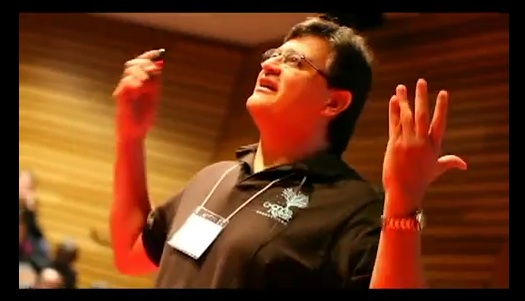
Bob Cabeza, How Kids Learn Conference
Q: Can you briefly describe what you think are the most important findings of this study? 
A: The most important findings in the study are the increases in GPA and grades as compared with the control group. Also, the real eye-opener was that the greater duration of the youth's involvement with the program, the more positive their grades and GPA became. Clearly showing that not just academic interventions, but learning engagement coupled with social supports in an out-of-school program makes a difference in a youth's in-school academic outcomes.

Q: What are you most excited about? 
A:  I am most excited about the fact that we knew that we were making a positive difference in young peoples' academic success and future, anecdotally and qualitatively, but now we really have some indisputable, quantifiable evidence to that fact. I am also excited that this article supports greatly what all of us in the high school afterschool field believe and are doing.

Q: You have spent much of your career defending youth development over pure remediation in afterschool as a way to promote school and life success. What in your program design and implementation would you point to that resulted in these findings? 
Photo Credit: Youth Institute, Long Beach
A: When youth are bonded to a pro-social adult who supports them academically and hold high expectations of them, they want to do well intuitively. And when those relationships are strong and long-term, young people feel cared for. They open themselves to academic and social interventions, as well as positive messages that they need. As a result, they try harder and do better academically. I also think that when young people are engaged in learning activities that they see as relevant to their lives and futures, they gain other skills that are transferable in academic environments - things like 21st Century skills. We are talking about abstract thinking, sequential thinking, problem solving, group work, and critical thinking. We see them use their love of learning, which all young people have, and they sometimes challenge the academic environment if it lacks relevance.

Q: The Learning in Afterschool & Summer (LIAS) project has stressed the importance of learning – we believe that learning IS development. How do you view and how do you use the LIAS principles in your program? 
A: Our whole programmatic philosophy is based on the LIAS principles. We design all of our curriculum and teaching approaches to these principles. For instance, we budget unique field trips to cities and national parks and do unique activities and bonding in these spaces to help young people become exposed to different environments. These experiences develop independent living skills, appreciation of their natural world, life sciences, cultural experiences, and different artistic as well as architectural environments. This experience directly relates to learning that expands horizons and connects a real world experience to an abstract exercise in school such as reading about the natural environment or studying about a city or culture. 

Photo Credit: Youth Institute, Long Beach

All of our creative digital arts assignments are project-based and require problem solving, exploration, group work, and an end product and celebration. Moving through a multi-dimensional activity where it's both research-based and active-based supports multiple learning principles. These approaches support learning that is collaborative, active, meaningful, supports mastery, and expand horizons.

Q: How important are the LIAS principles to achieving the kind of findings that your study showed?
A: We need to get young people excited about learning. We need to get them engaged in the learning process and we need to activate their innate developmental curiosity, passion, and intellect. That is what the LIAS principles do when approached correctly. When youth have a positive learning experience, it provides for the development of new skills and a greater sense of agency, which effects their performance in the academic environment.  

Monday, February 17, 2014

We Knew That...

By Sam Piha

Sam Piha
The covers of two national magazines serve as a good reminder for those of us who work with young people in afterschool and summer programs. The results of a recent poll also reinforces the Learning in Afterschool & Summer learning principles. 

1. The cover of the most recent TIME magazine features a story on the "Mindful Revolution". It states, "Educators are turning to mindfulness with increasing frequency--perhaps a good thing, considering how digital technology is splitting kids' attention spans too."

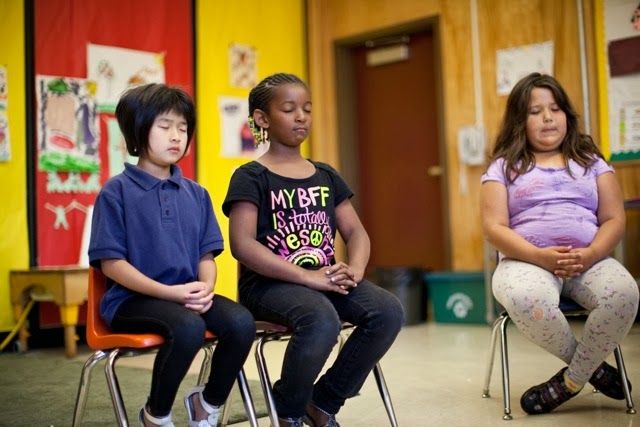
We have been promoting the value of Mindfulness in Afterschool, both as a wellness strategy for adult workers as well as a program for young people. We now have a 16-week curriculum and training that we offer to afterschool programs (now with matching funds from a local foundation). We hope to spread the practice of engaging young people in mindfulness exercises throughout the field of afterschool and summer programming. Below are a few quotes from afterschool practitioners (in Delano and Oakland, CA) who received our Mindfulness in Afterschool training:

- "Mindfulness has helped me in my life as a de-stressor when I’m overwhelmed." 

- "When I’m having a bad day, I realize that there may just be a bad situation or two but that actually there were more good situations than bad ones. It’s helping me focus on the good ones, which is making me happier and less sad."

- "We’ve starting doing mindfulness with the kids for 20 minutes. Doing a body scan and having them focus on their breath. The parents sit down and watch them and they are surprised because they’ve never seen the kids so quiet. It’s working really well."

Photo Credit: Mindful Impact

- "Before P.E., the instructor does mindful breathing. She also relayed that the Kindergarten school-day teacher had started to implement mindfulness when she saw the impact of it on her students. Co-incidentally, this same teacher stopped us in the hallway mid-program to let us know that the school-day teachers were talking about the positive effects of mindfulness on their 1st and 2nd graders who were having a particularly difficult year. When I inquired further to ask what specifically they were seeing as different, this teacher said that the youth were less volatile and less confrontational."

- "Mindfulness is effective in changing student behavior in a short amount of time. Students tell us that they enjoy it and will continue to use it in the future."  

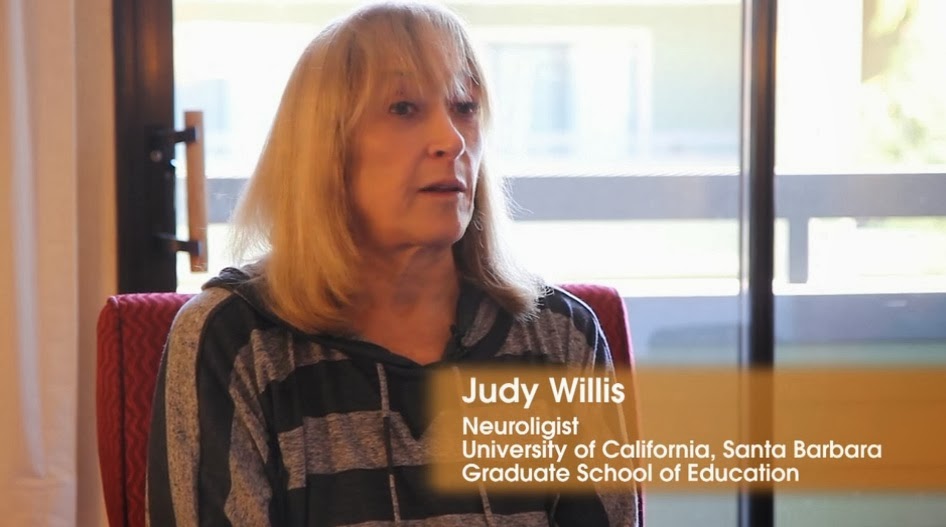
2. The latest cover of National Geographic serves as a reminder that our growing understanding of the brain and how we learn can shape our practices in youth programs. With the help of Youth Radio (Oakland, CA), we conducted two brief interviews with neurologist and classroom teacher, Judy Willis, on how we can use new learnings in brain research in our youth programs. You can view the two videos on our website by clicking here

- “As the neuroimaging evidence has shown, the more a student is engaged in a learning activity, especially one with multiple sensory modalities, the more parts of his/her brain are actively stimulated. When this occurs in a positive emotional setting, without stress and anxiety, the result is greater long-term, relational, and retrievable learning.”

- Judy Willis, M.D., M.Ed. , Board-Certified Neurologist, 
           Graduate School of Education, University of California, Santa Barbara


3. "A new survey finds that getting physically involved in learning something trumps reading about it. The results paint a picture of a very different kind of learning than what is typically found in most classrooms. The survey conducted for Everest College by Harris Interactive asked 1,000 adults what methods of learning worked best for them. Here's how the responses break down:" (Article written by Catherine Gewertz, Education Week)


Monday, February 10, 2014

More Resources on the Role of "Grit" in Learning

By Sam Piha


Sam Piha
Over the past year, we have dedicated several blog posts and portions of our last two How Kids Learn conferences to explore the importance of "grit" and persistence in young people's learning. According to research, grit is a strong indicator of GPA and graduation rates. And as we have noted in our exploration of grit, it is something that can be cultivated and taught. Part of this is developing in young people a "growth mindset", which Stanford Professor, Carol Dweck, claims is highly correlated with success. Below are some valuable resources that will help our readers continue their learning about grit and how to teach it. 


Carol Dweck, Author, Mindset: The New Psychology of Success 

True Grit: The Best Measure of Success and How to Teach It: A blog post from Edutopia, January 9, 2014. This post lists several other resources about "grit".

TED Video: Angela Lee Duckworth: The key to success? Grit: In this TED Talk, Ms. Duckworth discusses her experience regarding the role of grit in learning.  

Angela Lee Duckworth - TED Talk


Grit Scale: This survey, developed by Angela Duckworth and Chris Peterson, attempts to measure a person's "grit" and ability to persevere when challenged.

Resilience and Grit - Resource Roundup: This listing was assembled and published by Edutopia. It is a "curated collection of blogs, articles, interviews, and videos with information for parents and educators about the associated concepts of resilience and grit."


Monday, February 3, 2014

The New Quality Standards for Expanded Learning

By Sam Piha

Sam Piha
I was honored to join a group of afterschool leaders to develop a set of quality standards for expanded learning on behalf of the CDE After School Division. This group was selected through a competitive application process and met several times over the past year to complete its recommendations. After the quality standards were reviewed by stakeholders across the state, they were submitted to the After School Division in June 2013. 

CDE approved the recommendations for the 12 Quality Standards for Expanded Learning and have released them in a full report. 


The Learning in Afterschool & Summer learning principles (below in bold) are fully reflected in the following standards: 

- Active and engaged learning 
Program design and activities reflect active, meaningful and engaging learning methods that promote collaboration and expand student horizons.

- Skill building 
The program maintains high expectations for all students, intentionally links program goals and curricula with 21st-century skills and provides activities to help students achieve mastery.

There are 12 standards in all. You can view a full copy of the report here. A second quality committee is being formed to consider the terms that require further definition, the need for a self-reflection tool, and other tools to help field leaders make good use of the California Quality Standards for Expanded Learning. 


Monday, January 27, 2014

Digital Learning Day Challenge: #Make4DLDay

By Guest Blogger Jennifer Rinehart, Vice President, Research & Policy at the Afterschool Alliance

Jennifer Rinehart
On Feb. 5, thousands of educators will take part in the third annual Digital Learning Day, a nationwide celebration of common sense, effective applications of digital learning that support educators, improve learning and provide opportunities for students to achieve at their highest potential.  As part of this celebration, we’re excited to announce the #Make4DLDay challenge and want you to join the fun!

Thanks to digital media and technology, our
education system is undergoing a major shift in how, where and what students are learning.  The organizations collaborating in this challenge—the Afterschool AllianceEdutopia, and the National Writing Project (via its Educator Innovator Initiative and Digital Is platform)—share a common belief that this shift should reflect connected learning principles, including interest-driven, production-centered learning opportunities for youth, in school and out.  These principles allow youth to collaborate with peers and mentors in person and via the Web as they become producers of digital artifacts and not just consumers.


 To that end, we’re inviting you to join us in accepting the #Make4DLDay challenge—a set of digital storytelling activities that allow youth and adults to be makers for Digital Learning Day.  

So, what exactly are we making?  From remixing important historical events to educating peers about issues in their communities, we’re encouraging young people everywhere to create and share digital stories that reflect what interests them.

The #Make4DLDay challenge allows you to “level up” and participate in a number of ways, based on your familiarity with digital tools and access to technology.  All you have to do is choose your level, pick your topic and share your work on Twitter, Instagram, Facebook, Google+ or other social media platforms using the hashtag #Make4DLDay.

Check out the Digital Learning Day website for more details about the #make4DLDay challenge or browse the resources below to help familiarize you with the power of storytelling as a digital learning strategy. We can't wait to see what you come up with!

____________________________________
Jen Rinehart joined the Afterschool Alliance in September 2002 and established the Afterschool Alliance's WashingtonD.C. office.  Jen takes a primary role in the Afterschool Alliance's coalition building, policy and research efforts, and serves as a spokesperson for the organization.  Recent projects include America After 3 PM: A Household Survey on Afterschool in America and Kids Deserve Better, a campaign to get voters and candidates thinking and talking about children's issues, particularly afterschool. Jen also served as Interim Executive Director of the Afterschool Alliance from December 2004 through June 2005.  

Monday, January 20, 2014

Leading the Pack in Future Afterschool Trends

By Sam Piha

Sam Piha
Recently the National Afterschool Association (NAA) published an article calling out the 10 most important trends in afterschool for 2014. The Learning in Afterschool & Summer (LIAS) project and Temescal Associates led efforts in 2013 relating to these trends. Below we cite the trends from the above article and offer a brief summary of our work in 2013. 

Dale Dougherty
"1. With the mission of creating more opportunities for young people to develop confidence, creativity, and spark an interest in science, technology, engineering, math and the arts, the 'maker movement' and afterschool are natural allies in promoting learning thru making." - How Kids Learn III featured a keynote address from Dale Dougherty, Founder of the Maker Movement, and a hands-on workshop from MakerEd. Temescal Associates will look to expand our efforts to promote "maker spaces" in afterschool programs.

"2. While STEM will continue to be a focus for the afterschool field, I predict 2014 will be a year when we go deeper on STEM instructional training for the afterschool workforce." - The LIAS project promoted five important learning principles that STEM programs should draw upon to ensure that they truly engage young people.

"3. Until recently, it's often been difficult to get recognition for skills and achievements gained outside of school. Digital badges provide a way for young people to get recognition for the skills and experiences they gain in afterschool programs.  Potential employers, community members, and even college admissions staff can go to a student's online profile to see their portfolio of badges—linked to the work and projects done to achieve the badges—to get a holistic understanding of the student that goes beyond the classroom and beyond grades." - LIAS and Temescal Associates, in partnership with Public Profit and Youtopia, launched a major badging effort with afterschool groups across California. Badges will be awarded to exemplar programs, staff who receive certain professional development training, and youth who participate in and gain skills through their afterschool programs. We have been a leader in this area and will share more information soon.

Joseph Durlak
"6. Because conventional schooling in most places has not been able to focus productively on social and emotional learning and development, and because its benefits are so well demonstrated and wide-ranging, the afterschool field has a huge opportunity to fill a crucial need. I predict much attention will be given to the role of afterschool programs in promoting the skills necessary for success in school and in life." - LIAS and Temescal Associates has been promoting the importance of social emotional skills for several years through their blogs, including an interview with Joseph Durlak, and speakers at the How Kids Learn II and III conferences.

Dr. Jeff Borden, Vice President of Academic Strategy & Instruction in Pearson's Research and Innovation Network, published a similar article in eSchool News entitled Are these 8 trends the future of K-12?. Below, we quote from this article and share the work of LIAS and Temescal Associates.

Judy Willis
"6. Neuroscience & Learning Design: 2014 will see more and more assimilation of brain science into the culture of teaching. With liaisons like Judy Willis, neuroscientist and elementary school teacher, or even brain-science ‘navigators’ whose job it is to report on findings from the cognitive science world, it is becoming easier to digest information that used to be overly scientific and jargon-based. Soon, what we know about the brain will finally start to ‘move the needle’ in education. Imagine a learning ecosystem that enables the best memory techniques while boosting processing power, all the while controlling for variables like sleep, exercise, and food. That is what happens when teachers invite neuroscientists to conferences." - The LIAS project featured relevant findings from neuroscience and brain-based learning in our How Kids Learn I conference with our keynote by Dr. Michael Merzenich (UCSF), from Judy Willis, a video address, blog interviews, video interviews for training purposes, and resources posted on our website. 

"8. Constructivism Will Flourish: Along with neuroscience and learning design above, more and more 'movements' have emerged out of and around constructivist teaching and learning. From the veteran project-based learning to up-and-comers like the Maker Movement, flipped learning, challenge-based learning, entrepreneurial linked education, etc., people are realizing that the old apprenticeship model is again possible, at scale, thanks to technology. Learning by creating is fostering connections between the learner and real products, services, or ideas and is, to many, a fundamental 'missing link' with most education today." - The LIAS project promoted these ideas in our project position statement and through our training offerings and speakers featured at our How Kids Learn I, II, and III conferences.

Monday, January 13, 2014

Progressive Education and the World of Afterschool

By Sam Piha

Sam Piha
I recently had the opportunity to hear a talk by Consulting Head of School, Tom Little, from Park Day School. Tom and I were co-teachers for two years back in the day, and he went on to serve as the Head of School for 28 years. Tom recently completed a sabbatical in which he visited progressive schools across the country. In this talk at Berkeley Rep, he shared some of his insights, which will be the focus of a book that he is currently working on. At a recent lunch, I asked Tom a couple questions about progressive education and afterschool. 


Q: How do you define progressive education?
Tom Little - Photo by Benjamin Smith
A: I define it in three parts. Progressive education starts with the notion that we are preparing students for their active participation in their democratic society. To me, that is really fundamental to students' experience in school and throughout their whole educational experience in afterschool. That to me is primary. The second component of progressive education is that it starts with the experience of the student - that comes under the category of student centered or child centered approach where instead of having the curriculum and the subject matter as the center of gravity in an educational setting, what you have are the interests, abilities, capabilities, and strengths of the student. This is what should define the material and curriculum content that is going to be administered in an educational setting. It's a different center of gravity where the interests and proclivities of the child should direct where the learning will go. Third, is the historic abiding commitment to social justice. Progressive education is, at its heart, a part of a movement that holds dearly that there are injustices that occur in the world and that is the responsibility of our educational establishment to be exposing students to the realities that exist in their society and the world. Further, to make a commitment, within their educational program, to consider how we resolve these injustices. 

Roof Playground - Irene Kaufman Settlement - 1924
Photo credit: Jewish Women's Archive
Q: Does early afterschool have roots from progressive education?
A: The progressive education arose during a time when the progressive political movement in this country was underway. The legacy goes back into the late 1800s. Settlement houses in Chicago and NY, even some of the west coast as well, were built upon a social justice mission and an abiding commitment to resolve them. And, we all know that the settlement houses offered important out-of-school experiences for young people.

The inextricable link between the political movement and progressive educational movement has sometimes been at the heart of its glory and sometimes been its achilles heel. I think over the century the progressive educational movement has tried to extricate itself at times from the association with the political movement. But we know that its foundation is really in the philosophy of the political system. At the heart of it, it seeks to be a full ranging approach to education well beyond the school site, well beyond the curriculum. So even today in the Harlem Children's project, we can look at it as a progressive movement - even though some of the pedagogy may be traditional. If you look at those efforts, they bring together health care, afterschool care, and prenatal care. There have been times in its history that the progressive education movement could have paid a little more attention to learning outside of school. It became more tied to the curriculum and attached to schools. But true progressive education speaks to learning more far reaching - learning beyond the school house. 

Q: Can you recommend three books that better help us understand progressive education?
A: To understand the early history, Transformation of the School by Lawrence Cremin, offers a definitive history between 1870 and the 1950s when the progressive education association met its demise. It is a very accessible book written in the 1960s. Second, What to Look for in a Classroom by Alfie Kohn, is a very practical book for a teacher as it lays out a nice template of what you would find in a classroom or school. Third, Schools Where Children Learn by Joseph Featherstone. A classic, beautifully written book that outlines some of the history of progressive education but talks more in depth of the nature of child-rearing and how the ancient philosophers embraced this philosophy. 


Q: Are the Learning in Afterschool & Summer (LIAS) learning principles aligned with the principles of progressive education? 
A: The new era of 21st century learning which combines the LIAS principles - analytical thinking, collaboration, communication - first I think they find a lot of their historical roots in the philosophy and in the pedagogy of progressive education. In some ways its a new vocabulary that we're finding, and I think it really nicely defines where education has to go. It puts education in a new context that is more palatable I think for people. "Progressive Education" can be alienating for some. 

When you're talking about expanding horizons, looking at students differently and thinking about how they'll be engaged, I think that's where education is going nowadays. This is at the heart of the new common core standards. But I think the common core pedagogy is far from being implemented because it is likely to take years to train teachers and fully implement the curriculum and programs. The whole mindset of education is being switched around. I do believe that the LIAS principles are aligned with those of progressive education.
__________________________
Tom Little is a founding teacher and the Consulting Head of School at Park Day School in Oakland, Ca., and the current President of the Board of the Progressive Education Network. During the months of February and March, 2013, Tom toured the country visiting over 40 progressive schools and studying the current state of Progressive Education in America.

Monday, January 6, 2014

A Federal Study on Grit: An Interview with Researcher, Nikki Shechtman (Part 2)

By Sam Piha


Sam Piha
Nikki Shechtman is a researcher at SRI International. She recently led a study for the Department of Education on the influence of grit, tenacity, and perseverance on learning. In addition to presenting at the How Kids Learn III conference, Nikki was interviewed for this blog. In part 1, we asked for a clear definition of terms, why study grit, and asked Nikki for a brief overview of her study. In part 2, we asked how these traits can be taught, the value of informal learning within afterschool and summer programs, examples of useful practices, and the role of mindfulness. 

Q: There are some who say these things are important, but they are inherent traits that can’t be taught. How do you respond to this?

A: I think that is not only inaccurate, but it’s also a potentially damaging perspective. There is overwhelming evidence that how persistent an individual is will depend to a great extent on the circumstances. We found research to suggest that important factors in the environment can have a huge influence on whether or not a student will persist in the face of challenges and setbacks—whether the goals are important to them, how much support they have from others around them, and whether they have the appropriate tools and skills to deal with challenges. For example, it happens all the time that the same student will persistent in one class but not another because of the way teachers make a topic interesting or connected to real life.
Nikki Shechtman

There are also many skills and psychological resources that contribute to grit, tenacity, and perseverance that can be learned and cultivated. For example, how students learn to deal with failures and what skills they have for monitoring progress and changing course when necessary, these can strongly influence how they’ll fair when the going gets tough. One of the most important research areas is around the “growth mindset,” the belief that intelligence grows with effort. There is wonderful research by Carol Dweck at Stanford University, and others, to show that not only does having a growth mindset make students more likely to persist when work gets difficult, but it’s also a mindset that can be learned.

It’s potentially damaging to look at grit, tenacity, and perseverance as inherent traits that can’t be taught. If teachers or parents believe that children are not persisting because they are just inherently lacking grit, there’s little motivation to try to understand what’s going on with the student and what changes, big or small, to the learning environment or particularly new skills might promote a different way for the student to interact with the environment. Even worse, if the child herself starts believing she just doesn’t have grit in general, it can become a self-fulfilling prophesy. Who wants to try to persevere in the face of challenge when they think they just aren’t capable of doing so? That’s not a good position to put a human being in.

Q: Do you think informal learning settings like afterschool and summer programs are well-suited to promote these traits? If so, why?

A: Absolutely. In Chapter 2, we lay out a model for the kinds of factors in a learning environment that can promote grit, tenacity, and perseverance. Two factors that our research suggested were important were that students have opportunities to take on worthwhile long-term goals and that they have a rigorous and supportive place to pursue them. Many informal learning settings do exactly this—whether the goal is to do something like a complex programming project, make a film, get into college, or a wide variety of others. These settings can also provide the means to help students actually accomplish these goals—through materials supports such as technologies or workspaces, human supports such as peer-based communities or adult mentors, and time to work through difficult tasks. When students have the opportunities to take on and accomplish big goals, not only do they get the satisfaction of the achievement, they also take with them the knowledge that they can do it.

A major theme that came up in our research was that informal setting can support these factors in ways that might be limited in formal settings that have more constraints (e.g., accountability and limited resources to give students individualized attention).

Q: Can you give us an example of practices that encourage the development of grit, tenacity, and/or perseverance that is relevant to afterschool workers?

A: We made some specific recommendations for practitioners based on the research. And just to be clear, we consider these promising but not proven; evidence of impact at scale is still limited. These recommendations are:

a. Educators should provide students with opportunities to take on worthwhile long-term or higher-order goals that are optimally challenging (i.e., not too easy, not too difficult) and/or aligned with the students’ own interests or values.

b. Educators should provide students with a rigorous and supportive context for pursuing these goals. They should have high expectations for students and provide encouragement and resources. They should promote collaboration and social support among students.

c. To the extent possible, educators should provide the tangible resources—materials, human support, and time—necessary to overcome challenges and accomplish their goals.

Educators can also support students in developing the psychological resources that can promote grit, tenacity, and perseverance. We found three broad categories:

a. Academic mindsets. These are how students frame themselves as learners, their learning environment, and their relationships to the learning environment. They include beliefs, attitudes, dispositions, values, and ways of perceiving oneself. There are important examples of short-term interventions that are being developed to “teach” and cultivate the most productive mindsets. Educators should first make sure that they themselves have productive mindsets, and they can learn to apply good strategies to foster them in their students.

b. Effortful control. Students are constantly faced with tasks that are important for long-term goals but that in the short term do not feel desirable or intrinsically motivating. Successful students marshal willpower and regulate their attention during such tasks and in the face of distractions. Although this can seem austere or no fun, research shows that students stronger in these skills are happier and better able to handle stress. Educators can look to examples of research and practice for how to foster these. Mindfulness practices are one example (see the question below).

c. Strategies and tactics. Students are also more likely to persevere when they can draw on specific strategies and tactics to deal with challenges and setbacks. They need actionable skills for taking responsibility and initiative and for being productive under conditions of uncertainty—for example, defining tasks, planning, monitoring, changing course of action, and dealing with specific obstacles. Educators can intentionally teach these skills as part of the work they do with students.

By the way, we also recommend that practitioners be mindful of potential risks or costs for students of pushing them in ways inappropriate for their needs. For example, persevering in the face of challenges or setbacks to accomplish goals that are extrinsically motivated, unimportant to the student, or in some way inappropriate for the student can potentially have detrimental impacts on students’ long-term retention in school, conceptual learning, and psychological well-being.

Q: Your study mentions mindfulness practice as useful. Can you say more?

A: Interesting that you should ask, because it only got one sentence in the brief but it’s actually an area of particular interest to me. In fact, I worked on a project a few years ago in which we taught mindfulness to students in an afterschool academic program.

Here’s my take. Mindfulness is a practice of learning to pay attention in the present moment nonjudgmentally. Why would you want to do that? Well, there is a huge body of research showing that people who cultivate mindfulness through practices such as meditation and yoga are better able to pay attention in the face of distraction (i.e., effortful control), are happier, are less prone to depression and anxiety, have a stronger immune system, get along with people better, and cope with serious life stresses more easily. Mindfulness helps people take difficulties in stride, to step back and problem-solve without getting as stressed out, to pause and think before engaging in conflict, and to approach challenges with curiosity instead of defeat. You can imagine the potential of these types of benefits for promoting grit, tenacity, and perseverance in the face of all kinds of challenges and setbacks!

What’s also important is that these skills are completely learnable by almost everyone, as far as I can see in the research. There are research-based programs coming out of many prestigious universities, like Stanford and Harvard, that teach these life-changing skills in a very short period of time. There are also several organizations around the country going into schools and teaching them to children at all ages and settings. Many are taking very seriously the potential of mindfulness to help develop resiliency for underserved students.
______________________
Nikki Shechtman, Ph.D. is Senior Educational Researcher at SRI International, Center for Technology in Learning. Nikki explores research-based, theory-driven approaches to understanding and improving engagement, teaching, and learning in mathematics—particularly for the most disadvantaged students. Her work has focused on productive dispositions for teaching and learning, mathematical argumentation, use of dynamic representational technology, and introducing productive playfulness into serious classrooms. Among several other projects, Nikki led a team to lead a Department of Education study entitled “Promoting Grit, Tenacity, and Perseverance—Critical Factors for Success in the 21st Century”. Her work has been published in journals in educational research, learning sciences, mathematics education, educational technology design, psychology, human-computer interaction, and play studies.

A Book Drive for Children's Books Makes for a Fabulous Service- Learning Project

Source: The Children's Book Project  By Sam Piha   In our previous paper entitled, Reading Buddies: Promoting Literacy and Community Eng...