Showing posts with label sharing circles. Show all posts

Friday, August 18, 2023

Restorative Justice is about more than conflict resolution

Source: Oakland Leaf

By Guest Blogger, Melissa Mendez Ochoa, Executive Director, Oakland Leaf (This blog was originally posted on Oakland Leaf's Blog.)

When talking about Oakland Leaf’s approach to youth development, we often use the term restorative justice (RJ). While RJ, as a concept, has become relatively mainstream, most people only have a fuzzy idea of what it is in practice.  In western culture, people tend to think of RJ as a contemporary way of resolving conflict – an alternative to the current punitive justice system. 

At Oakland Leaf, we see RJ as much more than a set of conflict resolution or behavior management tools. We draw from RJ’s roots in indigenous peacemaking practices that provide a holistic framework for not only repairing harm, but also nurturing and sustaining individual relationships and community bonds. Oakland Leaf has RJ Coordinators at all six of our afterschool program sites, and the grounded, loving support they provide our students on a daily basis is some of the most inspiring work I’ve ever observed. 

In conversation with some of our RJ coordinators last week, I was reminded of what a critical resource they have been to our students these past several months. By sharing a few of the interventions they described to me, I hope to shine a spotlight on – and paint a clearer picture of – Oakland Leaf’s restorative justice work: 

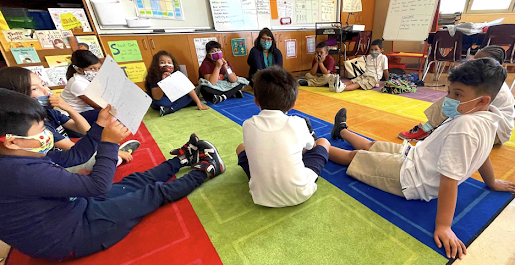
An afterschool program class of 20 students was experiencing ongoing challenges related to bullying behavior and conflict between students. The RJ Coordinator organized a circle about anger and healthy ways of managing and expressing it. Students passed around a talking piece and shared why they were personally having a hard time and why they thought the group was struggling. Consistently, this go-round revealed underlying issues such as hurt feelings or conflict from earlier in the school day, fatigue, or students missing their parents, among other challenges. 

Source: High Speed Training

After this, students shared how they tend to express and respond to different emotions and what the outcomes tend to be for various kinds of expression. Next, the RJ Coordinator said “Now we know what is happening. What do we need for ourselves – from another person, from the instructor, or in general –  to be able to move forward in a positive way?” Students shared things like “When I get mad, I need a break and some alone time”, “I need my friends to say something nice to me”, and “I need some one-on-one time with a grownup”. 

The last part of the circle involved everyone making a commitment to what they would do to help the group move forward in a more healthy way. Students made commitments such as “I will ask for space when I need it”, “I will try to be more understanding when someone says or does something I don’t like”, and “I will share my appreciation when others are stepping up in positive ways”. The RJ Coordinator has since regularly checked in with this group and each student, reminding them of their commitments and creating spaces for them to share progress and challenges.

Source: High Speed Training

A 5th grade teacher reached out to one of our RJ Coordinator’s about a student that she suspected was being bullied during the school day. Our RJ Coordinator was able to build a strong relationship of trust with this student through daily check-ins. The student confided in her that he was having a hard time interacting with his peers and making friends, and that he felt isolated and alone. The student’s dread about school began to wane once he had a caring adult he felt comfortable turning to on a daily basis for support and a sense of safety. Through ongoing coaching from the RJ Coordinator, he began to improve his social and communication skills and started making friends. 

Source: Oakland Leaf

One of our afterschool program soccer teams lost their first two games and students began lashing out, blaming each other for the loss. The negative interactions and hostility began to impact the overall morale of the class. The RJ Coordinator designed and facilitated an RJ circle specifically about teamwork and community. Students talked about what teamwork looks like, sounds like, and feels like. They discussed how they can simultaneously be supportive and hold each other accountable, on and off the field. Students also talked about what can be learned from “losing” in competitive sports and how to deal with hard feelings in healthy ways. They left the circle with renewed bonds and new tools to identify and cope with feelings of disappointment and frustration.

I hope these examples of Oakland Leaf’s every day application of restorative justice principles and practices provide you with a bit more insight into the power and potential of this work. 

MORE ABOUT...

Melissa Mendez Ochoa is the Executive Director of Oakland Leaf. Melissa grew up in Napa Valley and made the move to the East Bay when she decided to attend the University of California, Berkeley. Melissa earned her Masters in Business Administration from the Haas School of Business at UC Berkeley. In the of Spring of 2019, Melissa became Oakland Leaf’s Executive Director. In her free time, Melissa is in active alumna of TRENZA UC Berkeley and an avid sports fan of the Golden State Warriors, San Francisco Giants, and San Francisco Niners.

Oakland Leaf
serves more than 800 students annually through daily afterschool programming at seven high-need East Oakland elementary and middle schools, paid internship programs for high school students, and a summer camp. With an emphasis on social-emotional learning, academic support/literacy, creative expression, movement and sports, connection with nature, STEM, and social justice, we are supporting Oakland youth and families to be lifelong leaders creating positive change in their own lives, their communities, and in the world.


[Upcoming Webinars]

Promoting Financial Literacy for Youth in Afterschool Programs

This webinar will feature afterschool practitioners who have successfully integrated financial literacy in their programs. It will also feature financial literacy experts on why financial literacy is important for youth, available curriculum and materials, and how to get started offering financial literacy in your afterschool program.

To learn more and register, click here.
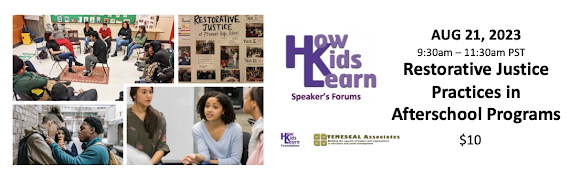
Restorative Justice Practices in Afterschool Programs

This webinar will feature afterschool practitioners who have successfully integrated restorative justice practices into their programs. It will also feature restorative justice experts on why it is important for youth, available curriculum and materials, and how to get started using restorative justice practices in your afterschool program.

To learn more and register, click here.


Tuesday, December 8, 2020

Youth Voice and Self- Expression in Afterschool: Sharing Circles

By Sam Piha

Source: www.acacamps.org
Providing opportunities for youth to reflect on and express their thoughts and feelings are a critical strategy for any afterschool program. These opportunities are essential to promoting youth voice, healthy youth development, social emotional skills and resiliency, especially those who have experienced trauma. Strategies and activities include sharing circles, poetry and spoken word, journaling, videography, art and the theater arts.

We interviewed Johanna Masis (Program Director, Oakland Leaf) on the importance of using sharing circles to promote youth voice and self- expression in afterschool programs. Below are some of her responses.

Q: Why is it important to provide youth with opportunities to reflect on and/or express themselves and their feelings?
Johanna Masis
Program Director, Oakland Leaf
A: There is a misconception that the majority of youth have an adult in their life that sits down with them and gives them uninterrupted, dedicated time to converse about what is going on in their daily lives. Families are stretched thin...even more so with the stress of the current COVID-19 era. Youth's feelings can be minimized given the increased stressors of current life. Having a platform for 20-30 minutes* to reflect on or express themselves is self-care. It's free. It's crucial. It creates connections.
*Regarding the 20-30 minutes: As an organization, we were unable to find hard data about the ideal dosage and duration for a circle. This 20 minute increment is what we do at all of our programs daily solely based on being able to give each youth participant an opportunity to speak/share once the prompt has been provided.

Q: Do you think that sharing circles are a good way to provide these opportunities? Why?
A: Out-of-school time (OST) venues allow for these opportunities to happen; it's embedded in our everyday practice. Youth learn to wait their turn to speak. They learn to empathize with their peers. Many of them end up sharing similar experiences that cut across race, religion, gender, etc. Dedicated time to engage in reflection also creates opportunities to connect their learning from the day and builds critical thinking.

Q: Do staff need special training? 
A: Staff needs training first with regards to managing their own bias and assumptions about youth and their circumstances. So often, adults default to how "THEY" grew up. Talking about your feelings may not have been culturally appropriate or even a concept. Secondly, staff needs to know how to hold space and sit in discomfort. We don't always have the answers and that is okay. However, it's important to seek out what continued support may look like on a case by case basis. At the forefront of these pieces of training is the reminder that staff are mandated reporters. There is a legal obligation to report any harm a young person is experiencing.

Source: Oakland Leaf

Q: Can you provide one example of a sharing circle you conducted that resulted in a meaningful opportunity for self- expression? What age were the kids?
A: I supported a 2nd-grade afterschool instructor with a circle after we observed a carjacking across the street from the soccer field on which our youth were playing. Because some of the youth heard the screaming from the victim and saw the weapons the carjackers had, the instructor quickly brought them indoors and circled up while I was on the phone with the police. We let them express what they saw, let them ask questions, asked what questions they had, and reassured them that we would ensure there was a follow up with their families.

Q: Can you recommend any good resources/ websites for afterschool programs that want to learn more?
A: I pulled some resources we used to create our Oakland Leaf Restorative Justice curriculum:

  • Riestenberg, N. (2012). Circle in the Square: Building Community and Repairing Harm in School. St Paul, MN: Living Justice Press.
  • Charney, R. (2002). Teaching Children to Care: Classroom Management for Ethical and Academic Growth, K-8. (Revised ed.). Turner Falls, MA: Northwest Foundation for Children.
  • Wadhwa, A. (2016). Restorative Justice in Urban Schools: Disrupting the School-to-Prison Pipeline. New York, NY: Routledge
  • [Online Resource] Center for Non-Violent Communication (n.d.). 

______________________
Johanna C. Masis is currently the Program Director at Oakland Leaf. She started her career as a high school teacher and later joined AmeriCorps. She taught abroad in Japan and has, since then, dedicated herself to promoting creative ways for youth to learn in different capacities. She has directed youth programs in San Francisco’s Chinatown, Bladium in Alameda and Denver, as well as language programs in Alameda and San Francisco. Johanna first joined Oakland Leaf in 2013 as the Site Manager for International Community School Afterschool Program. For the Fall 2014, she assumed a new role as the Site Manager for Oakland Leaf’s afterschool programs at both the International Community School and Think College Now campus. In December 2015, Johanna Masis become Oakland Leaf’s Program Director. As part of the Oakland Leaf community, you can expect to see her energy, compassion, responsibility, work ethic and natural leadership skills in full swing.

Wednesday, May 23, 2018

Sharing Circles: Cyphers

By Guest Blogger, Johanna Masis, Program Director at Oakland Leaf

Johanna Masis
At Oakland Leaf, all of our programs incorporate the practice of Cyphers. We believe in the power of people's stories and life experiences regardless of how many years they have been alive.  There is a collective wisdom that exists and needs to be honored. When we practice Cyphers, or community circles, the benefits are immense. I have seen the culture of a 100 person program change for the better in less than a month by creating the space and putting in the work to Cypher. The benefits of this practice include increased familiarity with people's stories, empathy building, idea sharing, harm repair, healing for the individual who is hurting, and compassion building. The additional value add for our Newcomer youth is that they get to practice their English in a low-risk environment. 

Cyphers are used as a space to do intentional community building in the form of having a discussion on any topic.  The Cypher is meant to serve as an emotionally safe place for each participant to say their piece without interruption or judgment. Youth have very few venues where they can speak their truth without interruption, let alone without judgment. Make sure that if chairs are used, then everyone must have a chair. If you are sitting on the floor, then everyone sits on the floor. Everyone should be able to see each other. Sitting in the circle diminishes hierarchy and overall power dynamics. Everyone is equal. 

There has been mention of some intangible components of the Cypher such as the discussion, the shared values, and emotionally safe space. However, there are tangible components, too. They include: a centerpiece where youth may focus their attention; a talking piece that can be brought by the facilitator or made by the group; and something from nature (a plant, glass/bowl of water) to remind us that we are connected to the earth. I have seen youth bring a toy or a picture of their families to the circle as an offering to the group during the Cypher.

Cyphers are encouraged to happen at least once a week and many of our programs calendar them in so that youth know when they will occur. The values of the collective are held throughout the Cypher. I would encourage you to have youth share a value they bring to the first few Cyphers.  People do not have to speak but are expected to hold the talking piece for 5-10 seconds before passing the talking piece.  If there are people absent on the day of a Cypher, then a place is still held for them in the circle.


Photo Credit: Oakland Leaf

For those considering to integrate the practice they should:

  1. Model and practice with the adults and/or youth that will facilitate. Do not assume adults are natural keepers of this space. Practice with each other in staff meetings to increase comfort levels.

  2. Be honest about your role as facilitator. Based on the reason for the Cypher, if the facilitator has been harmed or has done the harm then they should not facilitate. 

  3. Use Cyphers for different reasons not just to repair harm. You don’t want to “anchor” Cyphers as these intense conversations that make people cry.

  4. Allow time for each person to share at least twice during a Cypher. If the purpose is to plan, then you may be able to have multiple Cyphers to accomplish the task. However, if repair is needed then allow a realistic amount of time for that type of Cypher.

  5. Be prepared for the vibe to get deep. Youth will share extremely personal experiences. Be prepared to sit in that discomfort. Hold everyone accountable to the values if they veer from them because of that discomfort. Remember: it may not be intentional to break from values. Defense mechanisms manifest differently for people.

  6. As the facilitator, have discussion prompts and reflection questions prepared. Sometimes a Cypher can take its natural course and as a facilitator you do not want to lose the capacity to close up the circle. 

The more often you practice having a Cypher, the easier it gets. Youth will come to expect it and for many of our youth in Oakland this is the only part of their day or week where they can speak freely. Honor each other’s voice and experiences. 
--------------

Johanna Masis majored in Religious Studies at UC Santa Barbara and did her graduate work at Holy Names University in Teaching English as a Second Language (TESL). She started her career as a high school teacher and later joined AmeriCorps. She taught abroad in Japan and has, since then, dedicated herself to promoting creative ways for youth to learn in different capacities. Johanna first joined Oakland Leaf in 2013 and is currently the Program Director. She completed the CalSAC LDI 360/365 fellowship in March 2016, and she has since been an advocate for the powerful, learning experiences and network opportunities the fellowship provided. 

Wednesday, May 9, 2018

The Power of Sharing Circles

By Sam Piha

We know that bringing together young people and offering them the opportunity to have their individual voices heard in the larger community is an important practice. We are referring to “talking or sharing circles” - bringing youth together in a circle and asking each individual to speak while the rest of the group practices active listening.

In youth programs, these circle meetings are often called “sharing circles” or “community circles”. In the classroom, these are often called “morning meetings” (see video below). In our next blog post, Johanna Masis from Oakland Leaf will describe their circle practice called “Cyphers”.


There are many benefits of sharing circles that include:

1.  Promoting social and emotional learning (self awareness, social awareness, group belonging, etc.) 

2. Promoting a positive climate and learning environment.

3. Promoting emotional safety and youth voice (see California Quality Standards for Expanded Learning Programs). 

4. Providing youth with the opportunity to express themselves and practice active listening. 


Photo Credit: ResponsiveClassroom.org

TIPS FOR BEGINNING YOUR OWN “SHARING CIRCLE”: 

1. Offer the circle leaders facilitation training to ensure that they are prepared to support their young participants and know how to handle difficult responses. These might be responses that are very sensitive, provoke difficult feelings of the other youth, or raise legal or ethical issues for the facilitator.

2. Decide the schedule and frequency of your circle time. Some programs do this everyday to open the group or once a week.

3. Establish group agreements that pertain to “circle time”. These group agreements can be created by the youth. The question is “what do you need to feel safe and supported when you are sharing?”

4. Discuss what is known as “active listening”. This is very important to promote a sense of safety and support for the group. 


Photo Credit: Teaching Restorative
Practices with Classroom Circles
5. Select a “talking object”. This is an object that each speaker holds when they are sharing, and they pass to the next person, which signifies a new person is sharing. These objects are often things from nature like a beautiful feather or a piece of driftwood. Some programs have several objects in a basket and one youth is asked to choose the talking object for that day. 

6. It is often recommended that the circle facilitator uses questions or prompts that young people can respond to. This can be very helpful for young people who are not accustomed or comfortable with sharing with others. Some programs have a jar of prompt questions which can be drawn by a young person for that day’s prompt. 

RESOURCES 


A Book Drive for Children's Books Makes for a Fabulous Service- Learning Project

Source: The Children's Book Project  By Sam Piha   In our previous paper entitled, Reading Buddies: Promoting Literacy and Community Eng...