Wednesday, August 13, 2014

Dropout Prevention? Try Leadership Development

By Sam Piha


Sam Piha
Jason Towne is an educational writer who toured the country to research his book, Conversations with America's Best Teachers. Below, we asked Mr. Towne about his high school dropout prevention approach which features leadership development as the primary strategy. 

Q: In considering a new approach to dropout prevention, you paired at-risk youth with leadership development. What did you use to identify youth as “high risk” for dropping out? 
Jason Towne
A: I was brought in as a consultant by the principal of an urban high school to help figure out a way to reach his "at-risk" students. In this situation the at-risk students were labeled that way based entirely on absenteeism. Any students that had over a certain amount of absences, for whatever reason, were included. Of course this means that most of their grades were also quite low, but neither grades nor test scores were the basis for the "at-risk" label.

Q: Most people do not equate at-risk youth with leadership potential. What made you put these two together? 
A: Everyone has leadership potential, but some of us have just had more opportunities to practice it than others. In fact, the worst-behaved students are often some of the best natural leaders I've ever met, they just haven't been shown how to redirect that ability in positive ways. Even the most quiet students can, and often want to, become leaders, but they need someone to show them how and literally put them in a situation to practice it. You'd be surprised at what these kids can do.

Q: How do you define leadership? And how did you explain the term ‘leaders’ to the group of at-risk youth who you brought together? 
A: Dr. Warren Bennis put it best when he said, "leadership is the capacity to translate vision into reality." It sounds so simple when put like that, but the complexities behind those four words, "capacity", "translate", "vision", and "reality" really reflect what leadership is all about. When I talk to anyone about leadership, first I convince them that they can become leaders. The idea that leaders are born, not made, is nonsense. Anyone can become a leader if three things happen: 1) They need to be intrinsically motivated to do something, even if extrinsic rewards are available, 2) They need to be taught the basics of leadership, including the tools of influence and persuasion, and 3) They need to be given the opportunity to Practice, Fail, Learn, and Adjust. Then they start that process over again and again. It's no different than mastering any other skill.


Q: In your commentary in Education Week, you described a radical turnaround in the young people’s attitude. What did you see and how do you account for the change? 
A: I will answer the last part of your previous question and this question together. When I explain what leadership is to middle and high school students, I am a bit controversial. When I speak to at-risk, inner-city youth (which I was one), I don't talk to them about going to college or joining the workforce like I'm supposed to, I talk to them about the one thing they care most about-- getting out of poverty. This means I talk to them about making money and becoming successful through entrepreneurship and leadership. Of course the skills they need for that will also prepare them for college and the workforce, but focusing on those is not the way to hook most of them. If you want to motivate them, you have to understand the psychology of poverty. If you're in it you only want one thing-- to get out of it. So that's how I initially frame the leadership conversation and it gets them very intrigued.

Q: Would you recommend this approach to other schools? If yes, what would they need to do in order to prepare themselves to be successful? 
A: I do recommend this approach to other schools, but in order for it to work they must be willing to think differently about these kids. First, administrators and teachers must honestly believe these kids can succeed, in spite of all educational and socioeconomic obstacles, in spite of past performance, and in spite of apparent disinterest. This is not easy to do. It's much easier to simply proclaim that some kids "just don't get it" and can't be reached. Of course that's nonsense. It's not the kids that don't get it, it's the educators that are failing to reach them that don't get it. 

Second, the facilitators of a program like this must be willing to change the way they attempt to reach these students. You must be able to reach them before you can teach them and the only way to do that is to get them properly motivated. 

Finally, it's imperative that administrators keep the program going after the initial meeting. These students are used to being rejected and are easily discouraged. If you invite them to be a part of something special, like a leadership team, and then end it abruptly, the entire thing will backfire. The students will feel even more neglected and discouraged than before. So once you start it you must be willing and able to keep it going.
 
Photo Credit: www.pbs.org


Q: The Learning in Afterschool & Summer (LIAS) learning principles promote the ideas that learning activities need to be active, collaborative, meaningful, support mastery, and expand the horizons of participants. Can you comment from your many interviews with great teachers? 
A: In my book I was amazed to find out just how many things great educators have in common, and the principles you mention are what many base their techniques on. I constantly heard terms like "hands-on learning", "collaborative learning", and "student-based input." What none of them did was, unfortunately what many teachers still do today-- focus almost exclusively on lecturing and textbook learning. It once again all comes down to student motivation. What LIAS is doing is motivating students by making the learning fun, engaging, and relevant-- the exact recipe of success used by the most effective educators in the world.

Q: Do any of these learning principles factor into the success of your dropout prevention approach?
A: All of them do. There are a lot of reasons kids drop out of school, but not wanting to be there at all is chief among them. What if you took the 100 students most at-risk for dropping out and gave them a potion that suddenly made them absolutely love school? What if that potion showed them how they could get out of poverty and become successful? What if that potion convinced them that they could change the world and then showed them how to start? Well that potion exists and it's a mixture of all of the principles you're talking about. Is it magic? No, but get them to drink it and the results will be magical.

________________________
Jason W. Towne is an education writer, speaker, consultant, and author of the critically acclaimed book, Conversations with America's Best Teachers. A former high school dropout himself, Towne's focus is on student motivation through programs and opportunities in the areas of youth leadership and youth entrepreneurship. Towne holds a Bachelor's degree from the University of Southern California and is currently pursuing his M.Ed at the Harvard Graduate School of Education. Follow on Twitter @jwtowne .

Tuesday, August 5, 2014

Framework for Promoting Learning in Afterschool Programs (Part 2)


By Sam Piha

Sam Piha
Several years ago, Bill Penuel (formerly at SRI International) and I developed a Framework for Promoting Learning in Afterschool Programs. This framework, like the LIAS project, focused on learning so as to capture both the interest of afterschool leaders and education leaders. This framework focused on learning that contributes to school success. When I dug it up recently to review, I was pleasantly surprised how well it held up, given all the new research on learning and the brain, character skills, grit, tenacity, and social emotional skills that influence learning. The citations are not so recent but the ideas and concepts are still relevant. You can view a series of Power Point slides that align the framework here. 
Bill Penuel,
 University of Colorado
at Boulder

Because we know that the practices of the organizations that oversee the programming influence the quality of the program, we list the organizational practices that must be in play to promote learning in afterschool.  

Organizational Practices
Access to high quality resources for organizing curriculum
  • Programs need access to high quality educational materials that are engaging to youth and that youth perceive as authentic, rather than as “school-like.” 
  • Programs can increase this access by actively seeking such curricula through professional networks, the Internet, and by co-creating curricula with youth and staff.
Staff preparation and ongoing professional development targeted to academic assistance
  • Staff may need special preparation to lead homework assistance centers, tutor youth, or orchestrate enrichment activities.  They need to be prepared to answer students’ questions and to help students develop strategies to regulate their own learning.
  • Organizations can build staff capacity by hiring staff with teaching credentials or experience and by equipping existing staff with knowledge and skills from research about effective instructional practices.

Policies and strategies that promote consistency and persistence in participation
  • Policies to promote consistency and persistence in youth participation are necessary, because regular attendance is a pre-condition for effectiveness.
  • Organizations can establish norms for participation among youth, procedures for follow-up when youth are absent, and strive to provide a variety of programming options to youth to motivate attendance.


Wednesday, July 30, 2014

Framework for Promoting Learning in Afterschool Programs (Part 1)

By Sam Piha


Sam Piha
Several years ago, Bill Penuel (formerly at SRI International) and I developed a Framework for Promoting Learning in Afterschool Programs. This framework, like the LIAS project, focused on learning so as to capture both the interest of afterschool leaders and education leaders. This framework focused on learning that contributes to school success. When I dug it up recently to review, I was pleasantly surprised how well it held up, given all the new research on learning and the brain, character skills, grit, tenacity, and social emotional skills that influence learning. The citations are not so recent but the ideas and concepts are still relevant. You can view a series of Power Point slides that align the framework here. 

The framework looked at learning that affected outcomes measured by schools (grades, test scores, attendance, and behavior), the inputs that afterschool learning can contribute are listed below as Afterschool Learning Outcomes and Afterschool Practices to Promote Afterschool Learning. I believe these are still relevant to afterschool quality practice. 


Afterschool Learning Outcomes


Mastery Motivation and Persistence in Intellectual Tasks
Bill Penuel,
University of Colorado
at Boulder

Importance and Links to External Indicators: Students who adopt mastery goals for learning approach learning tasks as potentially challenging and as requiring effort to complete. Students who are more concerned with performance-avoidance, that is, preventing others from seeing them fail, tend to give up more easily on difficult tasks, especially if they are low-achieving (Ames & Archer, 1988). Students with mastery goals tend to persist more in the face of difficulty on challenging intellectual tasks (Ames & Archer, 1988).

Role of Afterschool Programs: Afterschool programs have been successful in promoting mastery goals and in providing youth with opportunities to persist on authentic, challenging tasks (McLaughlin, Irby, & Langman, 1994). 

Self-Regulation

Importance and Links to External Indicators: Self-regulation is the process by which students plan for, organize, and monitor their own learning.  Higher levels of self-regulation are associated with higher achievement levels in school (Butler & Winne, 1995).

Role of Afterschool Programs: Afterschool programs can improve student self-regulation, particularly students’ skills in planning and organizing activities and in reflecting on significant experiences associated with participation (Nichols & Steffy, 1999; Youniss & Yates, 1997).  


Collaborative Skills
Importance and Links to External Indicators: Collaborative skills are increasingly important for both schools and the workplace. Cooperative and collaborative learning experiences are positively associated with student achievement (Slavin, 1990; Johnson, Johnson, & Stanne, 2000).


Role of Afterschool Programs: Afterschool programs can improve students’ social skills and can also reduce anti-social behaviors (Catalano et al., 1999; Mahoney et al., 2003; Weisman et al., in press). 


Bonding and Commitment to School
Importance and Links to External Indicators: Bonding to school has been cited as an important protective factor in supporting youth development (Cheney et al., 1997). Students vary in their level of identification with school and with doing well in school, a factor that has been used to explain the failure of some groups to do well in school (Ogbu, 1987). 

Role of Afterschool Programs: Afterschool programs can help students feel more connected to school (Catalano et al., 1999; Roth & Brooks-Gunn, 1999).


Afterschool Practices to Promote Afterschool Learning

Positive culture of learning
  • Encouraging inquiry as an attitude and approach to difficult situations
  • Providing a program environment where mastery goals are rewarded
  • Discouraging comparisons among participants with respect to school performance  
Meaningful learning activities
  • Relying on authentic intellectual activities to engage youth
  • Organizing activities that connect to youth’s interests and life experiences
  • Opportunities for collaboration in contexts where a diversity of expertise is needed for success  
Effective adult assistance
  • Attunement to youths’ needs and interests
  • Solving problems with youth rather than for them
  • Providing feedback focused on how to improve
Support for self-regulation
  • Help with planning for studying, organizing for intellectual tasks, and monitoring progress toward goals
  • Providing youth with experiences of regulating their own learning process in a safe environment
  • Opportunities to reflect on and revise ideas
Positive connections to school
  • Tasks align with and complement schools’ focus on students’ individual academic needs
  • Adult staff articulate the importance and value of school learning
  • Adult staff help youth build bridges among the cultural worlds of school, home, and community
Support for parent engagement in youth’s learning
  • Staff communicate regularly with parents about students’ learning progress and needs
  • Staff encourage parents to talk to teachers about their child’s learning
  • Staff serve as advocates for parents in the school


Wednesday, July 23, 2014

Programs Hungry for Recognition; Youth Ready to Weigh In

By Sam Piha

Sam Piha
Kim Boyer, Executive Director
Central Valley
Afterschool Foundation
Over the last few months, I've been honored to work with a dedicated group of afterschool advocates in Fresno, CA. This group included Kim Boyer (Central Valley Afterschool Foundation), Lori Carr (Fresno County Office of Education), Adam Valencia and Diane Wilcock (Tulare County Office of Education), Johannes Troost (California Department of Education - After School Division), Mike Snell (California Teaching Fellows Foundation), and Corey Newhouse (Public Profit). This group came together to donate their time to launch a program to acknowledge older youth afterschool programs that were well aligned with the  Learning in Afterschool & Summer (LIAS) learning principles with the awards coming in the form of digital badges.
Lori Carr, Fresno County
Office of Education

Now that the project is nearly complete, we asked them what stood out in conducting this effort. There were three themes: 1) programs are more than willing to put in some extra work if it will result in their being recognized for the good work they do;  2) young people are more than willing to take their time to observe and give feedback on the practices of afterschool programs; and 3) young people have plenty to say about what they consider as quality programs. 

Sharon Arce (Afterschool Program Site Coordinator)
 and Margo Perkins (Principal), Coalinga High


Brad Lupien, Co-President
ARC
Thanks to Brad Lupien and ARC for providing a one-day leadership retreat for those youth who observed and scored afterschool programs on their alignment to the LIAS learning principles. This may have been the first time in California that older youth have been involved in assessing the quality of older youth programs alongside local afterschool leaders. 

Monday, July 14, 2014

Afterschool Program Participation and the Achievement Gap

By Sam Piha


Sam Piha
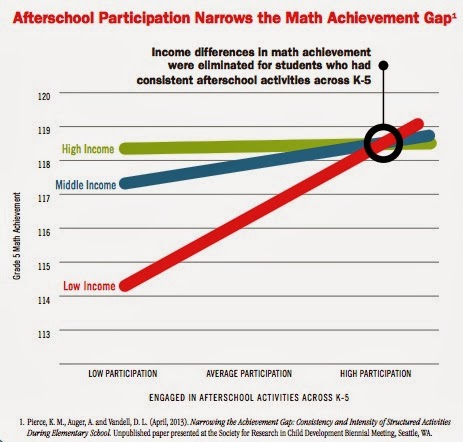
In October of last year, University of California at Irvine researcher, Deborah Vandell, released an important study on the positive effects of afterschool programs.  Her study revealed that "more consistent time spent in afterschool activities during the elementary school years is linked to narrowing the gap in math achievement, reduced school absences and improved behavioral outcomes for students."(1) 

More specifically, the math achievement gap was measured
Deborah Vandell
at grade 5. The more consistent the afterschool attendance, the narrower the gap between high-income and low-income students. Conversely, the greater the inconsistency of attendance, the wider the achievement gap. But also, those children that spent more time in afterschool programs showed:


- Better work habits
- Improved academic performance
- Gains in self-efficacy
- Improved GPA
- Increased attendance, fewer school absences

This is important information to share with program and in-school stakeholders. Click here for a colorful summary of the research.


________________________
(1) www.statewideafterschoolnetworks.net/achievement-gap-real

Friday, June 27, 2014

Central Valley Afterschool Programs Earn Digital Awards for Quality

By Sam Piha


Sam Piha
The LIAS project/Temescal Associates joined with Public Profit in forming a Fresno Work Group to develop a digital badge project with local OST leaders. They included Fresno County Office of Education, the Central Valley Afterschool Foundation, California Teaching Fellows Foundation, and Johannes Troost from the After School Division at CDE. In this pilot project, we decided to invite a group of middle school and high school afterschool programs to apply for program badges signifying exemplar practice in one or more of the LIAS learning principles.

Six programs applied after attending an orientation to the LIAS learning principles and a workshop which provided an overview of the digital badging project. After completing the application, which included a listing of the learning goals and evidence of learning for each of their clubs, they hosted a site observation by a committee that included at least one youth from their program. Youth who participated as observers received special leadership training from ARC and the Fresno County Office of Education. Awards were based on points earned from a review of their applications and program observations. Congratulations to the programs below which were deemed exemplar in one or more LIAS learning principles. 


  • Roosevelt High School Afterschool Program - earned the Active, Collaborative, Meaningful, and Supports Mastery digital badges
  • Tioga Middle School Afterschool Program - earned the Active, Meaningful, and Expands Horizons digital badges
  • Merced High School C.L.A.W.S. Program - earned the Collaborative and Supports Mastery digital badges
  • Madera High School Coyote V.O.I.C.E. After School Program - earned the Active, Collaborative, and Supports Mastery digital badges
  • Coalinga High School After School Program - earned the Active, Meaningful, and Supports Mastery digital badges
  • Martin Luther King Middle School After School Program - earned the Active and Supports Mastery digital badges

Tuesday, June 17, 2014

Digital Badges - Taking Learning Seriously

By Sam Piha


Sam Piha
The use and awarding of digital badges in afterschool and summer youth programs is a burgeoning trend that is rapidly moving across the country. This is important to the afterschool and summer program movement for the following reasons:
  • The development of digital badges requires that program leaders think through and explicitly state what learning will go on related to specific badges. This includes the required attendance, the skills and knowledge that will be acquired, and how this will be demonstrated in order to earn a badge. This specificity raises the bar for learning accountability. Also, with digital badges, this information of the learning that took place or  “meta information” is easily communicated to others. 
     
  • The awarding of digital badges defines the learning that goes on in programs, which is vital if afterschool and summer programs are to be recognized as important places of learning. These badges are important, visible evidence that afterschool and summer programs take learning seriously. 
  • The adult program staff members often acquire important knowledge and skills through professional development and years of experience. Youth acquire valuable skills and knowledge through their participation in specific afterschool and summer activities. Both deserve an artifact that documents their learning and—importantly—can be shared with peers, future employers, and those allowing admittance to higher education. 
To advance the use of digital badges, the LIAS project formed a partnership with Public Profit. We enlisted the participation of provider organizations in piloting digital badge systems. Organizations included CalSAC, California Teaching Fellows Foundation, Fresno County Office of Education, the Central Valley Afterschool Foundation, and the Youth Institute (Long Beach and replication sites). Badges will be awarded acknowledging exemplar programs, program staff that have completed certain trainings, and afterschool program youth who have completed “courses” and acquired new knowledge and skills.

We believe that digital badges, when used properly, offer great benefits to program providers and adult/youth recipients. We just finished a digital badge project to recognize older youth programs that demonstrate the LIAS principles. We will announce the digital badge earners in an upcoming blog post. 

Friday, May 23, 2014

Saving the Arts in Afterschool - Thank Goodness

By Sam Piha

Sam Piha
Youth arts programming continues to be in the news. Just when we hear about new research of how arts programming supports academic progress and the development of  important life skills, we hear about programs that are being cut out of schools because of budget woes and the over emphasis on literacy and math.

Photo Credit: vimeo.com


I had the pleasure recently of watching a high school presentation of Spring Awakening at Berkeley High School. This is the play that was a big success recently on Broadway and gave Lea Michele, star  of Glee, her start. Last week, I attended the annual dance performance by students from the San Francisco School of the Arts. The experience was the same - I was bowled over by the young people's intense commitment to mastery and commitment to the goal they shared with their group. Talk about developing a sense of purpose - a sense of mastery and agency - it was quite amazing. So enough of having to defend having arts programming, particularly performing arts, in our afterschool programs. 

Bob Cabeza
Bob Cabeza, Vice President of Community Development at the YMCA of Greater Long Beach, passionately agrees:  "When you're doing a play, you're learning critical thinking skills, you're learning sequential thinking  skills, you're learning group work, and literacy - reading, memorizing that reading - but because it is project-based learning, the enthusiasm and also the focus on learning goes up tremendously."

Want more: Oakland Technical High School's drama program was recently featured on KQED's California Report. It has risen from the ashes to be acknowledged as one of the best in the country and it has had a big effect on students. Take a listen.

"Before I lived here, when I didn't have theater, my GPA was below a 1. Then I just got into reading, working, and learning because that's what you have to do to be in theater - you have to learn a lot about everything to be in the play. So I just kind of got into doing work because it really built a lot of that integrity and now I'm like a 3.5 GPA, which is really weird for me because that's never happened before." - Jacob Moore, Senior at Oakland Technical High School  

Dennis Creedon
Photo Credit: thenotebook.org
Want more: Watch this video of Philadelphia Assistant Superintendent of Schools explain why arts programming is essential to teaching kids how to reach their full potential. 


Want more: Read about the rationale for cuts in arts programming and why the arts are essential. 

Want more: I do! Let's celebrate the arts in afterschool and shout out all the good reasons why we have saved them.

Monday, May 19, 2014

In STEM, Content is Not Enough

By Sam Piha


The post below is a reprint of my Op-Ed that was published in Youth Today on May 5, 2014. 

In STEM, Content is Not Enough

There has been an explosion of interest in providing young people with learning opportunities in science, technology, engineering and math (STEM). Many have argued correctly that afterschool and summer programs are perfectly situated to respond to this interest.  After all, the out-of-school (OST) environment provides the teacher and learner with a flexibility not found in school – the freedom to choose interesting topics, the ability to extend the learning activities across time (days or even weeks), the advantage of working in smaller groups, and use of the larger community and their surroundings as a classroom. However, the rush to offer STEM-related activities has not necessarily resulted in quality programming.

Many OST managers figured that STEM activities meant a focus on content, without an eye on what makes for a good learning experience. But successful STEM activities are more than content. They are designed to ignite young people’s imagination and involve them in ways that excite them as learners. Those responsible for providing STEM activities need to provide staff training using a framework for learning and engagement. 

Research on learning and engagement suggest several principles to guide the design and implementation of activities. To begin, learning activities must be active. They must be collaborative and meaningful to the participant. They should support mastery and they should expand the horizons of participants. These principles have become influential in how the state of California now defines quality OST learning programs.

According to Carol Tang, former Director of the Coalition for Science After School, these principles are relevant when applied to STEM.  She says, “A lot of young people are turned off because they had bad experiences learning about science.  If you look at these learning principles, I think it’s a way to really look at science education, and take a step back and say it is really about doing science.  If you think about what scientists do, they are active and hands on, they make things and break things, they talk to their peers, they learn from their mistakes, and they get better with time. If we don’t get kids excited about science then they can learn as many facts and figures that their brains can hold, but that’s not really going to help us.” (You could also view an interview with Carol Tang by clicking here.)

SRI International recently published the first part of a 5-year National Science Foundation funded research project, the Afterschool Science Networks study. In this important report, SRI presented case studies of science activities in California afterschool programs and identified “staff capacity” as one of several limitations. Many of the issues in staff capacity involved the failure to engage and can be addressed through staff development on how to engage young people as learners. Part of this is allowing young people to learn in a hands-on fashion and facilitating questions instead of giving answers.

Dr. Ann House,
SRI International
According to Dr. Ann House, leader of the SRI study, “We believe that the learning principles developed by the Learning in Afterschool & Summer project are very well aligned with inquiry science activities. For example, conducting investigations, collecting data, and designing solutions make learning activities active, meaningful, and support mastery. Engaging in scientific reasoning and argument deepens the meaningfulness of activities and often involves collaboration. Finally, investigating science phenomena and designing solutions broadens youth’s horizons. Their horizons can also be broadened as they learn more about STEM-related careers and how STEM skills and knowledge can help them become more informed citizens.” (To view our interview with Dr. Ann House, click here.)


The growing number of afterschool programs focused on STEM is an exciting development. But if children are to develop a growing interest in STEM topics, we need to think about how children learn when we design the activities and prepare adult staff to facilitate them. This can be accomplished through training and materials that offer a framework for learning and engagement.

Friday, May 9, 2014

Tom Little: A Champion for Progressive Education and Youth Development

By Sam Piha


Sam Piha
Those of us who are committed to progressive education principles and their use in classroom and out-of-school learning programs lost a great friend last week with the passing of Tom Little.

Tom was one of three founding teachers of Park Day School in 1976, a progressive K-6 school in Oakland, CA. I had the pleasure of teaching at Park Day School for five years, two of those years as a co-teacher with Tom. Nearly everything I know about youth and youth development came from this experience. 
Tom Little - Photo by Benjamin Smith


Tom went on to become the Director of Park Day in 1986. Under his leadership, Park Day expanded to include a middle school and managed to buy the property that is now their beautiful campus.

I also had the opportunity to experience Tom's leadership as a parent at Park Day. Tom was masterful at creating a sense of community and ensuring that all children engaged in what we now call social emotional learning (SEL). We used to think of Park Day School as our church in passing along the values of citizenship and social justice. 

Tom was a relentless defender of youth development and progressive education. While at CNYD, I led several tours of afterschool practitioners through Park Day classrooms to allow practitioners to see youth development in action within a classroom setting. 
Park Day School
Photo Credit: Progressive Education Network

In partnership with Temescal Associates and the Learning in Afterschool & Summer project, Tom hosted a public showing of Brooklyn Castle, participated in an LIAS video, speaking in support of the LIAS learning principles, and provided access to the Park Day campus for the taping of several other interviews with afterschool leaders. He was committed to equity in education and freed up teachers and youth to provide support to local public schools. 

Last year, Tom used his sabbatical to visit progressive schools across the country. He wrote a book about this experience, which will be published in the near future. Tom's legacy will live on for a long time, through the demonstration by the practices at Park Day School. He was a good friend and inspiration to a large number of East Bay families, youth, and educators. He will be sorely missed. 


___________________________
In 2001, Tom Little was awarded a Klingenstein Visiting Heads Fellowship. From 1997-2003, he served as the Private School Representative on the Mayor's Oakland Education Cabinet. He served on the Board of Directors for the Oakland Academic Stars, an organization providing college scholarships for public school students in Oakland. He also served on the Board of Wingspan, a national organization sponsoring public and private school partnerships. He served on the Board of the Progressive Education Network, a national organization of educators working to advance progressive educational practices throughout the United States. Tom consulted on educational matters with public and private schools in the Bay Area and in Ireland. 

Friday, May 2, 2014

Childhood Trauma: Impediments to Learning

By Sam Piha

Sam Piha
The Learning in Afterschool & Summer project is dedicated to ensuring that afterschool and summer youth programs are strong places of learning. To this end, we are promoting five important principles of learning that should be evident in all youth programs. 

However, it is also important that practitioners understand not only what promotes learning but the environmental factors that impede learning. These factors are related to complex trauma - children who have experienced physical or sexual abuse, abandonment, domestic and neighborhood violence, and/or having a parent or close family member incarcerated. 

"In the brains of traumatized youth, neural pathways associated with fear and survival responses are strongly developed, leaving some children in a state of hyperarousal that causes them to overreact to incidents other children would find nonthreatening, the research shows. Consumed by fear, they find it difficult to achieve a state of calmness that would allow them to process verbal instructions and learn, according to the Child Welfare Information Gateway of the U.S. Department of Health and Human Services.

Dr. Nadine Burke Harris
And many children are experiencing chronic stress, according to data. In 2012,
California child welfare agencies received 487,000 reports of child abuse and neglect. Nationally, an estimated 1 in 4 children has witnessed a violent act and 1 in 10 has seen one family member assault another, according to the federal National Survey of Children’s Exposure to Violence, sponsored by the Office of Juvenile Justice Prevention and Delinquency Prevention and the Centers for Disease Control." (1)

According to Dr. Nadine Burke Harris, Pediatrician at the Bayview Child Health Center in San Francisco, children who had four or more categories of adverse childhood experiences, “their odds of having learning or behavior problems in school were 32 times as high as kids who had no adverse childhood experiences”. (2)

We will explore some of these learning impediments in upcoming blog posts by citing important literature and featuring interviews with field experts. 
______________________
(1) School Promoting 'Trauma-Informed' Teaching to Reach Troubled Students; Adams, Jane Meredith; December 2, 2013; http://edsource.org/today/2013/schools-focus-on-trauma-informed-to-reach-troubled-students#.Up-6QmRDvJ4

(2) The Adverse Childhood Experiences Study — the largest, most important public health study you never heard of — began in an obesity clinic; Stevens, Jane Ellen; October 3, 2013; http://acestoohigh.com/2012/10/03/the-adverse-childhood-experiences-study-the-largest-most-important-public-health-study-you-never-heard-of-began-in-an-obesity-clinic/

How the Meta Settlement Can Benefit Afterschool Programs

Source: www.pexels.com This blog by Dan Gilbert has been reposted from Afterschool Alliance’s Afterschool Snack Blog. Meta's new settlem...