Tuesday, February 26, 2013

Remembering the Broad Shoulders of Richard Murphy


By Sam Piha

Sam Piha
The field of youth development lost an important leader and friend recently when Richard Murphy passed away at 68. 

When I served as the first director of the San Francisco Beacon Initiative, Richard Murphy was an important mentor to me. As many people on the west coast may not know, Richard was a pioneer in New York City opening public schools in the afternoons and evenings to serve as neighborhood community centers for youth. He called these centers Beacons. 

Richard Murphy

One of the many lessons I learned from Richard was "when windows of opportunity to serve large numbers of youth open, don't think you have to have it all figured out. Jump through the window and you'll figure out how to land on the way down." This was very reassuring as the San Francisco Beacon Initiative represented an "open window", which many of us jumped through. I was reminded of this advice again with the launching of California's afterschool initiative that was funded by Prop. 49. 

The youth development and the afterschool movement owes a great debt to the creativity and courage of Richard Murphy. His passing is an important reminder that we all stand on the shoulders of leaders who came before. For a full obituary, click here. To read a fine remembrance by Karen Pittman (Forum for Youth Investment) and access other articles about Richard, click here


Wednesday, February 20, 2013

5 Ways to Give a Talk that Matters and Wows


By Guest Blogger, Lynn Johnson 


Lynn Johnson
I recently gave a “TED-like” talk at the How Kids Learn II Conference in San Francisco entitled "Igniting a Compassion Revolution". My 18 minute talk was about igniting a compassion revolution by putting girls center stage. Judging from the responses I got afterwards, I did a good job. I heard stuff like: “Stunning!” “A real highlight!” “You were so f#@ckin’ amazing!!”  More formal testimonials and video to come.  

I learned a lot.  I want to make sure I capture that learning so that I can do even better next time.  Hopefully, this learning can help you too.

1. Start Strong.  End Strong.  A good talk is a call to action; an opportunity to connect with future members of your tribe.  So, you gotta connect with them right at the very beginning.  Pull out all the stops.  But I don’t just mean with fancy technological bells and whistles.  Those are cool but it’s more important to connect with the audience heart-to-heart.  Same thing with the end.  Leave them wanting more of what you got.

2. Focus on your Why.  In my talk, I wasn’t just sharing the whats of my Go Girls! program, I was sharing the why.  When Simon Sinek taught me to “Start with Why,” I took it to heart.  Don’t just share what you do, share the underlying beliefs that inspire you to do it in the first place.  That is what will inspire your audience.

3. Tell the Truth.  I discovered yesterday that it is okay to make the audience a little uncomfortable.  I decided to start my talk by performing an original poem (see point 1).  In it, I allowed myself to get vulnerable as I shared feelings and experiences from my own girlhood.  Doing this made my audience trust me, even though I was saying things that weren’t so easy to hear.  And you don’t have to scream and be aggressive with the truth.  The truth is powerful enough by itself.  As long as you authentic, you can always make a connection.


4. Never Apologize.  Allison and I teach girls all time how important it is not to apologize for each and every mistake.  We women do this all the time.”Oh, I’m sorry, I don’t know how to use this.” or “Oh, I’m sorry, I didn’t get enough time to practice.”  Or whatever.  Don’t do this.  Ever.  If a mistake you make hurts someone physically, emotionally or spiritually, then, apologize.  Otherwise, just let it be a mistake.  Let “oops” replace “sorry.”

5. Look Good. Just like you spend time crafting and rehearsing your talk, working on your timing, prepping your slides/cue cards, etc, you should also spend some time to work on how you will look while giving the talk itself. I know some of you won’t want to hear this but, believe it, this point is very important. But make sure you look like yourself. Don’t dress to look like some character of what you think you should look like.  Take my experience.  In my ongoing quest to become the bad ass power lesbian, Bette Porter, I had it in my mind to buy a suit.  That felt like what I should wear to speak in front of important people.  So,  I shopped everywhere. In stores.  Online.  Nothing looked right.  Then, I found a dress on the coolest website ever.  I bought it and it looked incredible on me.  The color, the fit, the style perfectly matched my body (which is nothing like Bette Porter’s) and my personality.  And I looked great.  So, I felt great.  And that always helps.  So, please, do yourself a favor and look good.
___________________________

Lynn Johnson is the Co-Founder & CEO of Glitter & Razz Productions. She knew that she wanted to be an actor when she was just 5 years old and has spent her whole life centered around the learning, teaching, and creation of theater.

After graduating from Northwestern University, she founded TurnStyle Teen Theatre, a multicultural teen ensemble. The company used the process of creating original productions to explore themes central to the lives of its members. Later, in Chapel Hill, NC she designed and directed a number of community-based educational programs that focused on literature, oral history, community building, and personal narrative.

Lynn transferred her direct youth service experience to work as a trainer and organizational development consultant at the Community Network for Youth Development (CNYD). Lynn is also a founding member of OutLook Theater Project (with Rebecca Shultz), a community-based professional theater company that explores social issues from a queer perspective.

Wednesday, February 13, 2013

Expanding Minds and Opportunities: Leveraging the Power of Afterschool and Summer


By Sam Piha

I was honored to be a contributor to an important new book that was just released entitled Expanding Minds and Opportunities: Leveraging the Power of Afterschool and Summer Learning for Student Success

This compendium was edited by Terry K. Peterson, Ph.D. and includes a number of studies, reports, and commentaries by "more than 180 thought leaders including community leaders, elected officials, educators, researchers, advocates, and other prominent authors. This landmark collection of nearly 70 articles is being met with great acclaim, as it presents bold and persuasive evidence and best practices from the field that quality expanded learning opportunities:


Terry K. Peterson, Ph.D.
• promote student success and college and career readiness,
• build youth assets such as character, resilience and wellness,
• foster partnerships that maximize resources and build community ties, and
• engage families in their children’s learning in meaningful ways". (You can view an email that describes this new release and share it with friends.)

Every article in the book is available for free download by clicking here and the entire book is available on hard copy through Amazon.com. Check it out! 


During my years at CNYD, I managed a team project to create a guide to introduce California's burgeoning afterschool movement to CNYD's youth development framework. That publication entitled Youth Development Guide: Engaging Young People in After-School Programming is now available as a free download. It is an excellent guide that has withstood the test of time.  

Wednesday, February 6, 2013

Paul Tough, How Children Succeed and Non-cognitive Skills

By Sam Piha

Reporter, Paul Tough, recently authored a book entitled How Children Succeed.  It has stimulated conversation among educators and afterschool and summer providers. This book can be ordered by clicking here, and Paul can be heard on a recent This American Life radio broadcast by clicking here
Paul Tough, Author, How Children Succeed

Mr. Tough was unable to attend our recent How Kids Learn II conference but offered the responses below, many of which are drawn from his own website

Q: What made you want to write How Children Succeed?

A: In 2008, I published my first book, Whatever It Takes, about Geoffrey Canada and the Harlem Children’s Zone. I spent five years reporting that book, but when I finished it, I realized I still had a lot of questions about what really happens in childhood. How Children Succeed is an attempt to answer those questions, which for many of us are big and mysterious and central in our lives: Why do certain children succeed while other children fail? 

Q: Where did you go to find the answers?

A: My reporting for this book took me all over the country, from a pediatric clinic in a low-income San Francisco neighborhood to a chess tournament in central Ohio to a wealthy private school in New York City. And what I found as I reported was that there is a new and groundbreaking conversation going on, out of the public eye, about childhood and success and failure. It is very different than the traditional education debate. There are economists working on this, neuroscientists, psychologists, medical doctors. They are often working independently from one another. They don’t always coordinate their efforts. But they’re beginning to find some common ground, and together they’re reaching some interesting and important conclusions.

Q: What’s new?

A: Until recently, most economists and psychologists believed that the most important factor in a child’s success was his or her IQ. This notion is behind our national obsession with test scores. From preschool-admission tests to the SAT and the ACT – even when we tell ourselves as individuals that these tests don’t matter, as a culture we put great faith in them. All because we believe, on some level, that they measure what matters.

But the scientists whose work I followed for How Children Succeed have identified a very different set of skills that they believe are crucial to success. They include qualities like persistence, curiosity, conscientiousness, optimism, and self-control. Economists call these non-cognitive skills. Psychologists call them personality traits. Neuroscientists sometimes use the term executive functions. The rest of us often sum them up with the word character.

Q: Who are the big thinkers behind these ideas?
Economist, James Heckman

A: The central scholar in this movement is James Heckman, a Nobel prize–winning economist at the University of Chicago. He’s the one who did some of the first work identifying and quantifying these non-cognitive skills. And in recent years he has been working to pull together thinkers from lots of different disciplines — psychologists and economists and neuroscientists and geneticists — to get them to share ideas and find connections between their theories.

The book includes plenty of others doing important research, from Angela Duckworth, a psychologist at the University of Pennsylvania who studies self-control and grit; to Michael Meaney, a neuroscientist in Montreal who found a remarkable connection between a mother rat’s licking-and-grooming habits and the future success of her offspring; to Suniya Luthar, a psychology professor at Columbia University who has written about the unique stresses faced by kids who grow up in affluence.

Q: How do these ideas play out in the lives of actual kids?

A: There’s a lot of science in How Children Succeed, but much of the book is taken up with stories of young people trying to improve their lives, and the teachers and counselors and doctors trying to help them, often using unorthodox methods.

Sometimes these kids are achieving great things: Take James Black Jr., a student who just graduated from Intermediate School 318 in Brooklyn. He grew up in a low-income neighborhood, he has siblings who’ve spent time in prison, and he doesn’t do great on traditional tests of cognitive ability. But he might be the best thirteen-year-old chess player in the country. I followed him for a year, trying to figure out why he’s so successful.
James Black, Jr. was featured in a recent documentary
entitled Brooklyn Castle

When I started my reporting, I thought what everyone thinks: that chess is the ultimate intellectual activity, a skill inextricable from IQ. But to my surprise, I found that many chess scholars now believe that chess success has more to do with non-cognitive skills than with pure IQ. James’s chess teacher at IS 318 is a woman named Elizabeth Spiegel. She’s a great teacher, and I think what makes her so good is that she’s able to help her students develop their non-cognitive skills to high levels — in James’s case, to very high levels.

__________________________________
A contributing writer to the New York Times Magazine, Paul Tough is also the author of Whatever It Takes: Geoffrey Canada's Quest to Change Harlem and America, which focuses on the steps necessary to improve the lives and education of underserved children. Through the case study of the Harlem Children's Zone, Tough describes the inspiring struggle to establish a way to combat poverty that could be replicated nationwide. Tough has also contributed to This American Life and The New Yorker, where he has honed his focus upon education, poverty, parenting, and politics.

Wednesday, January 30, 2013

Resources for Afterschool and Summer Programs


By Sam Piha

Sam Piha
There is a growing consensus that the learning principles as stated by the Learning in Afterschool & Summer project are critical features of effective learning environments. As a result, there are a growing number of resources that help practitioners go from theory to practice in designing activities that align with these learning principles. Occasionally we will attempt to identify these resources as they become available, knowing that we can't possibly keep up with every resource that is released. 

Recently, Edutopia offered a set of resources focused on learning that is collaborative. While many of these resources have been developed by an elite college prep high school in the East Bay, we believe there's much that could be mined that would help afterschool practitioners as well. These resources can be found here

Samantha Tran of Children Now and a member of our LIAS Work Group, recommended a publication entitled Work-Based Learning in Linked Learning: Definitions, Outcomes, and Quality Criteria, which defines work-based learning as a continuum of work-based learning experiences that stretches from kindergarten into adulthood. Stated most simply, the stages of work-based learning can be described as: Learning ABOUT work; Learning THROUGH work; Learning FOR work. This approach aligns well with learning that is active, meaningful, supports mastery, and expands horizons. 


Samantha also recommended Guide to Work-Based Learning: A Continuum of Activities and Experience. This resource was developed by the National Academy Foundation (NAF). They write, "After extensive discussions with business and post-secondary leaders, partner organizations and digesting the still growing policy and research literature on this topic, NAF has settled on a definition of college and career readiness to guide its efforts to help students pursue their career and life goals.  Utilizing this definition, NAF has aligned its work-based learning activities and outcomes with our curriculum and recommended programs of study to ensure students are prepared to demonstrate the skills and attributes necessary to be college and career ready." This publication would be most useful to those serving older youth, grades 9 - 12. 

Another important and useful resource is a webinar sponsored by ASCD entitled Ask Dr Judy: The Essential Neuroscience of Learning. Copies of the PowerPoint slides are available here and here as handouts.

And check out this radio podcast of This American Life program entitled Back to School. It offers conversations with Paul Tough, James Heckman, and others on issues that effect and promote or deter learning.  

Wednesday, January 23, 2013

The Power of Gratitude


By Guest Blogger, Allison Kenny, Co-Founder of Glitter & Razz Productions 

Allison Kenny
According to the Greater Good Science Center out of UC Berkeley, it’s a scientific fact that practicing gratitude makes us happier, healthier people. 

For the Go Girls! at Glenview Elementary, I frame it like this: “Gratitude is like a superpower. When you are feeling negative or angry or lost or sad or scared, try remembering the things in life that make you feel happy- the things that you are thankful for. These thankful or grateful feelings can lift you up and help you feel better. Gratitude makes us happy.”

Then we got to work making our very own Gratitude Journals. Simple. Tiny books. Girls love to fill them with sketches, lists, poems, watercolor, stickers- whatever they can get their hands on. And the focus is gratitude, or as I tell the littlest girls if they look confused, “parts of life that make you feel happy.” I asked the girls to choose a special place where they could keep these journals and come work in them when they need to use their power of gratitude. One 4th grader decided to tape hers to the back of her frog’s cage. Whatever works! Go forth and be grateful.

Check out a few tips from parenting expert and Go Girls! mom, Christine Carter on practicing gratitude at home with your kids.
___________________________
Allison Kenny is the co-founder/owner of Glitter & Razz and serves as the Chief Officer of People & Programs.  She has spent a good part of her life leading and participating in creative and community-based activities focused on personal transformation. Growing up in Phoenix, AZ as the dramatic and extroverted one in a house with 3 other sisters, she built her values through active engagement in softball teams, theater productions, show choir, and youth ministry programs. She was a natural leader from a young age who was particularly influenced by her role in WomanStory, a Phoenix-based organization that supports the spiritual and emotional development of women and girls in intergenerational, arts-based camps and retreats. To this day, she has a personal mission to create healing spaces for women.


Wednesday, January 16, 2013

All About Character


Long ago, I had the pleasure of co-teaching with Tom Little for 2 years. Most recently, Tom and Park Day School co-hosted a screening of Brooklyn Castle, a feature film that details the grit of a national championship chess team from a public middle school in Brooklyn. This chess team was also featured in a new book by Paul Tough, which Tom comments on below. We will interview Paul Tough in an upcoming post. - Sam Piha

By Guest Blogger, Tom Little, Head of School at Park Day School

Tom Little
Much is being made these days about character. Especially those virtues of character related to grit, perseverance and all manner of a person’s capacity to persist and endure. Educators across the country are making waves in schools and school districts on the heels of the release of How Children Succeed: Grit, Curiosity, and the Hidden Power of Character by Paul Tough. Tough is a writer for the N.Y. Times who wrote an article last year presaging the publication of his book. Pulling together findings from various fields, Tough makes the case that there are traits beyond cognitive ability, namely perseverance, resiliency and optimism, necessary for academic success. 

Even before his book was released, I could see the tides rising. Last year I wrote an article for Park Central asking to what extent the development of character was the province of a school, using as examples Tough’s description of schools in New York which have embarked on efforts to make character development essential to their mission.

Angela Duckworth, a professor at the University of Pennsylvania is featured prominently in Tough’s book (see her 2009 TEDtalk on the subject of Grit here). Duckworth’s research focuses on hundreds of subjects who had achieved measurable success, and revealed that the most successful individuals have in common character traits such as perseverance, grit, and diligence. More than intelligence or talent, in study after study these attributes demonstrated that the “grittier” a person is, the more he or she is likely to succeed. Both Tough and Duckworth make the distinction between two categories of character: moral character and performance character. Moral character embodies ethical values like fairness, generosity, compassion and integrity, while performance character refers to values such as effort, diligence, and grit.
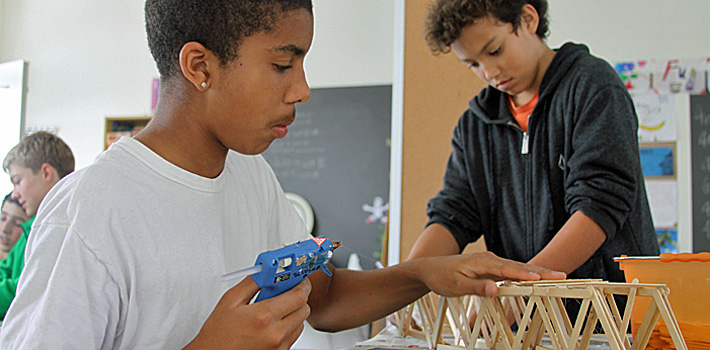
So, what is grit? In her tool measuring this attribute in children and adults, Duckworth looks at a person’s reaction to very difficult or challenging tasks; how does one respond to failure? Does one have the capacity to stick with projects that require perseverance and hard work? Grit is a measurement of how one endures and pushes through obstacles in pursuit of a goal or passion.

It’s no surprise if you are asking (as I have been), “so, how can we teach grit?” Are there teacher parenting or educational strategies that seem to foster these virtues in our children?

In his book, Tough illustrates that the most important factors in a child’s early life are close, loving, nurturing, and attached relationships with a parent (or guardian). Ironically, the need to pull back becomes vital as the children grow. Resisting the temptation to intervene, we need to allow children to stumble and fall, experience failure, have lots of frustrations and disappointments, then to dust off and carry on, learning something about themselves in the process.

Progressive educators have resonated strongly with Tough’s premise and the recent research in the measurement of student success. We understand the need to partner with parents in the challenging task of child rearing. Weighing on us is the tension between wanting to pave the way for children and allowing them to experience disappointment and failure. As parents, we can feel it viscerally – the pain of failure – we want to fix it or make it better. This tendency is quintessential to parenting. Teachers also face this struggle.

In part, the teaching of character arises situation by situation. I spoke recently with a parent whose daughter had “hit a wall” while trying to learn a new skill.  Though she wanted to quit, he pushed her to stick with it and she finally succeeded in learning the process. It was difficult for him to watch her angst and resistance. Similarly, I recently observed a teacher who insisted that two students who were involved in a conflict sit as long as necessary for them to resolve their issue. I saw the students’ transition from a fevered pitch of anger and venom to a reasonable place of calm and measured discussion and problem solving. In these situations, had it not been for the parent and the teacher, the players would have walked away from an important learning opportunity.

I recommend that folks read Paul Tough’s book. It has spawned countless blogs and commentary such as this. The book validates our mission of holding children’s social and emotional development, and brings into relief the importance of encouraging the development of their character. These virtues are important to their success as students, but equally to their success at life.
_____________________________
Tom Little was a founding teacher at Park Day School in 1976, and taught for ten years before becoming the Director in 1986. He earned his Masters Degree in Educational Leadership at Teachers College, Columbia, at the Klingenstein Leadership Academy. In 2001, Tom was awarded a Klingenstein Visiting Heads Fellowship. From 1997-2003, he served as the Private School Representative on the Mayor's Oakland Education Cabinet. He currently serves on the Board of Directors for the Oakland Academic Stars, an organization providing college scholarships for public school students in Oakland. Tom is also on the Board of Wingspan, a national organization sponsoring public and private school partnerships. He serves on the Board of the Progressive Education Network, a national organization of educators working to advance progressive educational practices throughout the United States. Tom has consulted on educational matters with public and private schools in the Bay Area and in Ireland. He and his wife, Elizabeth, have two grown children, both of whom are Park Day School graduates, Courtney ('93) and Matthew ('00). 

Wednesday, January 9, 2013

Empowering Youth Voice, Live From the Bridge Conference 2012


By Sam Piha

Many of us know the importance of building youth-adult partnerships and involving youth as leaders in our programs, but we also know that this view is not widely held and little is written about how exactly to do this. Clearly, many of our discussions are absent of youth voice in helping us guide this work. 

Eric Gurna
Eric Gurna of Development Without Limits moderated an impressive panel of youth who talked about building youth and adult partnerships at the elementary, middle, and high school levels. This session was conducted at the recent School's Out Bridge conference in Seattle, WA. Development Without Limits provides an audio tape of this session in their series entitled Please Speak Freely. We were very inspired by what we heard and urge adult and youth leaders within afterschool programs to give this a listen. The session is entitled Empowering Youth Voice, Live From the Bridge Conference 2012. Click here to listen or download the presentation. The podcast is also available on iTunes


____________________________________
Eric Gurna is the founder and Executive Director of Development Without Limits. He sets the overall vision for the organization's work, develops and guides new projects, and represents Development Without Limits in the national education and youth development arena. 

Eric designs and facilitates staff development, curriculum, and other resources for community organizations and schools on topics including youth development, experiential learning, literacy, leadership, communication, and organizational development. In addition, he designs and directs youth programs, including Project Unity, an internship program during which teenagers create and perform plays based on their own experiences and ideas.


Wednesday, January 2, 2013

Lessons Learned: An Interview with Robert Granger, President of the W.T. Grant Foundation


By Sam Piha

Over the last ten years, the William T. Grant Foundation has been a leading friend of the afterschool movement - leading in terms of investing nearly $21 million into advocacy and research investigating the most vexing problems facing the afterschool movement. Their investments help to answer the questions, "what are the positive impacts that afterschool programs can have on youth outcomes, what are the qualities that successful afterschool programs share, what are the tools we can use to assess quality, and how can we move the needle on quality through program improvement"? These investments were guided by Robert Granger, President of the WT Grant Foundation. (Mr. Granger will be a speaker at the upcoming How Kids Learn II conference on January 9th.)


Robert Granger
Mr. Granger recently published a paper reflecting on the past decade. This essay entitled "Our Work on the Quality of After-School Programs: 2003-2011" provides an important history of the afterschool movement over the last decade and details the effort to define value and quality. In a recent "Letter from the President", Mr. Granger cites three lessons that the Foundation learned over this time. These lessons include: 

  • Harnessing intermediaries, relationships, and networks is key to connecting research and practice. 
  • Practitioner-friendly, evidence-based measures of program practices are powerful tools for improving practice. 
  • Focus on staff practice. 

We urge readers to read both the essay and the letter, authored by Mr. Granger. The essay can be downloaded from the letter
Below we offer a brief interview with him.


Q: Your first lesson you cite in your “Letter from the President”, you talk about the importance of collaboration between practitioners and researchers. Can you explain what you mean by this and give an example, if you have one?


A: The conventional model of researchers producing findings and then disseminating them to practitioners creates a weak connection between research and practice. Too often the information is not relevant or accessible. One potential fix is to make the relationship between researchers and practitioners much more of a two-way street where each affects the other. An approach with a lot of potential is to have practitioners identify a persistent problem and then work in an ongoing way with researchers to develop and test solutions. In the after-school field, Charles Smith and colleagues at the David P. Weikart Center for Youth Program Quality are doing this in several locations—Providence , Palm Beach County, and Cleveland  are three examples. Here is a link to the Cleveland work. In K–12 education, there are several examples of such partnerships. My colleague Vivian Tseng is leading a learning community of nine  of them, and she has written about that work.

Q: In your third lesson, you state that examining the quality of youth interactions is important for program improvement. The Learning in Afterschool & Summer project is training high school youth to help assess local after-school programs and their alignment to key learning principles (see #4). Do you think that youth are equipped to assess program quality if they are given the right tools and training?

A: This is an interesting idea. I bet the young people would learn a lot about the staff-youth interactions that lead to good results, and I like the emphasis on youth voice. It would also push the tool developers and trainers to be very clear in order to help the youth produce reliable results. That’s got to help make the tools better for adult use, too.

In a large study of K–12 teaching, the Bill & Melinda Gates Foundation compared information about the quality of classrooms—which came from student surveys about their experiences in the classrooms—to adult observations of videotapes of the same classrooms. The judgments of the young people and the adult observers were highly correlated—young people, especially middle-school age and up, can report on quality. One caution: I do not think any of this works well if the stakes are too high for the program (e.g., it might get defunded based upon the assessments). Rather, the information is best used by practitioners for program improvement.

Q: In the research you funded, conducted by Joseph Durlak and Roger Weissberg, the value of well-implemented programs that promote social-emotional learning is well-documented. The development of non-cognitive skills is also stressed by author Paul Tough and economist James Heckman. Can you speak as to how well after-school programs are positioned to promote the competencies and whether they should focus their attention on them?

A: Durlak and Weissberg reviewed the results from evaluations of after-school programs focused on social and emotional development and discovered that the programs  that produced positive effects in those areas also produced positive effects on measures of school achievement and engagement. Too often those areas are thought of as an “either/or”. Given their flexibility, after-school programs are in a great position to deliver experiences that can improve “21st century” skills, including persistence, personal responsibility, and good communication. This is why the LIAS principles and similar statements ring so true to after-school staff. But potential is not enough. In the Durlak and Weissberg review, about two-thirds of the programs produced no better results than other activities available in the community. As you noted, the good news came from the one-third of programs that were well-designed and well-implemented. So, our challenge is to make programs better.

It’s worth mentioning that the Forum for Youth Investment produced a very good compendium of practical measures of these important, 21st century “soft skills.” Researchers and practitioners should review that publication and use some of the measures in their work.

Q: The Learning in Afterschool & Summer project is promoting five learning principles that should, in part, define quality after-school programs. This project stresses that learning should be active, collaborative, and meaningful, while supporting mastery over time and expanding the horizons of participants. Which of these do you think is most important?

A: I resist the urge to pull apart the five principles because I do not think it’s necessary for policy or practice. Learning can be all these things at the same time. I know, however, that it is useful to focus. “Meaningful” strikes me as an umbrella under which the others could fit, so it stands out as the most important. For example, “active” learning alone is not important if it is not meaningful, but active learning helps to make learning more meaningful.   

Q: Recently, five states approved initiatives to increase learning time in school by 300 or more hours. If this trend grows, do you have any advice to ensure that these efforts are effective and how should after-school program leaders be involved?

A: I do not think it is possible to ever ensure that changes like this are effective. I would begin in any community by getting a consensus on what problems this change is meant to solve. If it is that students are not achieving or attaining at the desired levels, more time alone is not likely to make a big difference, although it may help some students. The extra time creates the opportunity to reconsider the entire school day. And yes, after-school leaders and others with good ideas should be involved.

Q: What do you see as the risks and opportunities facing the after-school movement in the decade ahead?

A: All discretionary programs for young people are going to be under increased pressure as my generation retires and the general population ages. Therefore, one risk is not enough funding to provide services. At the same time, more single parents and the increased emphasis on work means the need for safe activities for kids will remain. The challenge is to make those activities as engaging, supportive, and meaningful as possible.

Q: Word has it that you are planning to retire soon. Is this true? If so, when are you planning to step down, and what are your plans in the future?

A: We announced that I will retire at the end of August 2013, and the Board is actively engaged in a search for my successor. It has been a privilege to work at the William T. Grant Foundation. My wife and I plan to live on Cape Cod in Orleans, Massachusetts. I will continue some ongoing work with a couple of foundations,  focused on making research and evaluation more relevant to practice. I also plan to donate time to youth organizations on the Cape. I recently spoke with Bob Haggerty, who was president of the Foundation from 1980 to 1992. Bob advised me not to over-commit and suggested I think about a few more after-lunch naps. I have always thought that Bob Haggerty is a very wise man. 

_______________________
Robert Granger has been president of the William T. Grant Foundation since 2003. Before joining the Foundation in 2000 as senior vice president of program, Dr. Granger served as senior vice president of the MDRC and executive vice president at Bank Street College of Education. Dr. Granger also recently chaired the National Board for Education Sciences. This presidentially appointed advisory panel of the Institute of Education Sciences in the U.S. Department of Education oversees federal activities regarding educational research. In addition, Dr. Granger serves on the editorial board for several professional journals. He received his Ed.D. from the University of Massachusetts.


Monday, December 17, 2012

Enough is Enough. It's Time to Act.

By Sam Piha

The tragic shootings in Connecticut touched everyone and resulted in a feeling that "enough is enough". If you feel similarly, here are some things you can do that were suggested by a friend of mine:

1) Call Dianne Feinstein’s office and tell her that we support her plan to introduce a bill on the first day of Congress to ban assault weapons (415-393-0707).

2) Call
/write Pres. Obama and tell him that prayers are not enough and that it’s time for him to make gun control a priority (202-456-1111).

3) Call the NRA and ask them how much is enough (1-800-672-3888). Ask why you can buy a gun at a gun show without a background check. Ask them why common citizens need assault weapons designed for warfare. 

4) Pass this on to the people in your network. 


Wednesday, December 12, 2012

STEM: Teaching Process Over Outcome


By Guest Blogger, Cathie Mostovoy of Mostovoy Strategies

Cathie Mostovoy

The thousands of people who gathered recently as the Space Shuttle Endeavor journeyed through the streets of Los Angeles to its resting place at the California Science Center offer clear evidence of the degree to which we as a society, consciously or unconsciously, derive our national identity from a tradition of innovation and technological progress.  After a decade of educational policy preoccupied with attaining targeted achievement levels in reading, writing and math, there isn’t a lot of mystery behind the current resurgence of interest in STEM (Science, Technology, Engineering, and Math) programs. STEM is the hot topic in education at the moment, yet getting quality programs off the ground is presenting quite a challenge. What’s the problem?  

“How LIAS Can Strengthen the STEM Movement” (LIAS blog, October 3, 2012) provides a good overview of issues involved and provides points for more in-depth discussion. While a central point of Sam Piha’s Q&A with Carol Tang, Director of the Coalition for Science After School, is that afterschool programs, particularly those that incorporate the LIAS principles, can support STEM education, Tang also explains that well-intentioned programming efforts fall short when “educational materials selected are not matched well with the program's mission, strengths, staff skills or audience.” This reminder that there are multiple factors that can create barriers to success is incredibly important. From the list Tang provides, I believe staff skills may be one of the most critical.


As Ms. Tang notes early in the conversation “we have to be honest and admit that students in school are not receiving science instruction anymore given other priorities.” It is critically important to recognize this isn’t just a problem today. The demise of in-school science programs dates back to 2001 when reauthorization of the Elementary and Secondary Education Act tied standardized test scores to federal school funding. (Ironically, the act called for schools to employ scientifically-based teaching methods and scientifically-based standardized testing, yet at the same time effectively pushed science programs out of many schools.) This is significant because afterschool program leaders, the staff members who have the most direct contact with program participants, are often college students or recent graduates. These are young people whose elementary, middle and high school years also coincide with this era of missing science programs. Their college educations prepared them to enter a teaching world that emphasizes outcomes over process. And, they came of age in a society that values instant gratification. Teaching in manner that aligns with LIAS principles simply doesn’t align with their own experiences.

During my years running an agency that provides afterschool programs, we interviewed and hired many bright and passionate young people, but it was difficult to find staff members who were comfortable being inventive and experimental. The majority felt most at-home with sequential learning; they liked lesson plans that moved from A to B to C with some specific expected outcome related to each step. And, I was often struck by how hard it could be to get them to think a situation through critically and suggest corrective actions; things were either working or they were not. These things just did not come naturally to them. That is a challenge we need to address, because if teachers aren’t comfortable exploring their students won’t be either.

So, when I think about how LIAS can strengthen the STEM movement, I think that one important way is for LIAS principles to be incorporated into professional development programs. There are many intelligent, dedicated, service-oriented young people in the afterschool ranks, we just need to provide them with the right technical assistance. The success of STEM and how quickly that success can be achieved may hinge on understanding this. 

__________________________
Cathie Mostovoy is a proven executive leader with more than 25 years’ experience administering youth development and educational programs.  Her expertise is in organizational growth, strategic partnerships, and program and leadership development. As the past Chief Executive Officer for Woodcraft Rangers, Inc., a non-profit organization in Los Angeles she utilized her growth strategy plan and natural assessment skills to grow the organization from under $1 million dollars to over $11 million and increased services to over 17,000 young people. Much of her success as a leader in her work is due to her ability to leverage funding, build strong relationships and maximize youth and community involvement.


Currently she is the Vice-President and Past President for the California School Age Consortium, member of the leadership team for the California Afterschool Network and Chair for the Older Youth Committee. Her past history of service includes serving as State Ambassador for the National After School Alliance, Ambassador for the National VERB, Chair of the Los Angeles Partnership for After School Enrichment and is member of numerous other initiatives and committees for children, families and the community. 

A Book Drive for Children's Books Makes for a Fabulous Service- Learning Project

Source: The Children's Book Project  By Sam Piha   In our previous paper entitled, Reading Buddies: Promoting Literacy and Community Eng...