Showing posts with label Nikki Yamashiro. Show all posts

Tuesday, September 20, 2022

New Survey Shows that Afterschool Programs are Still in High Demand

Source: NHP Foundation

By Guest Blogger, Nikki Yamashiro (Previously published by The Afterschool Alliance)

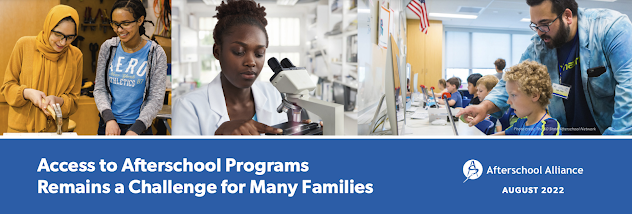
Back-to-school season is in full swing and intermixed with the uplifting news stories on students’ return to the classroom are stories of the challenges taking place after the school day ends, from families waitlisted for afterschool programs to program providers struggling to find staff to fill open positions. A new brief, based on responses from nearly 1,500 parents or guardians of school-age children, conducted May 12-June 28, 2022, provides insights into both the issues families face when looking for afterschool programming, as well as the motivations behind wanting to enroll their child in a program. Four key takeaways from “Access to Afterschool Programs Remains a Challenge for Many Families,” include:

  1. Unmet demand for afterschool programs remains high during the pandemic. There are 24.7 million children who are not in an afterschool program, but would be enrolled if a program were available to them. Now, for every child in an afterschool program, there are four more who are waiting for an available program.
  2. Cost is the top barrier to afterschool program participation. More than half of parents without a child in an afterschool program (57 percent) report that programs being too expensive was an important factor in their decision not to enroll their child.  Other barriers include lack of a safe way for their child to get to and from programs (52 percent), inconvenient program locations (51 percent), and programs’ hours of operation not meeting parent needs (49 percent).
  3. For kids who are able to access afterschool programs during the pandemic, programs are keeping kids safe, connected, and engaged in learning. Fully 95 percent of parents are satisfied with their child’s afterschool program and 90 percent rate the quality of their afterschool program as excellent or very good. Most parents report that their program is helping their child with everything from building social skills (91 percent) to providing homework help (79 percent) and from providing time for physical activity (87 percent) to connecting their child with caring adults (79 percent).
  4. Parents agree that afterschool programs are providing critical supports to children and families during the pandemic. Strong majorities of parents agree on the positive role of afterschool programs, including keeping kids safe and out of trouble (82 percent), helping young people build positive relationships with caring adults and mentors (78 percent), providing working parents peace of mind that their children are safe and supervised (85 percent), and helping working parents keep their jobs (83 percent). Eighty-three percent of parents agree that all young people deserve access to quality afterschool and summer programs.


As a recent EdWeek Research Center report finds that nearly half (49 percent) of program providers surveyed in May and June 2022 said that they currently had a waitlist of students, similar to Afterschool Alliance’s Afterschool in the Time of COVID-19 spring 2022 survey, it’s clear that additional public and private investments at the local, state, and federal levels are needed to ensure that all young people have access to quality, affordable afterschool programming. Thanks to COVID relief funding, there are programs who have benefited from the additional support and have been able to meet the needs of their children and families, with one spring 2022 program provider respondent writing, “We would not have been able to stay in business or provide the same quality of care and programming without financial assistance. Or, we would have had to greatly increase the cost of our programming at a time our families were least able to afford it.” However, with only 1 in 5 program providers reporting receiving COVID relief funds, there is still more to be done. Read the full brief to learn more about the current afterschool program landscape. 


MORE ABOUT...
Nikki Yamashiro
Nikki Yamashiro
joined the Afterschool Alliance in June 2012. In her current role, Nikki coordinates, manages, and advances the Afterschool Alliance’s research efforts, including developing the organization's research goals and agenda and effectively communicating findings on afterschool and summer programs to policy makers, afterschool providers, advocates, and the public. Current major research initiatives that are a part of Nikki's portfolio include America After 3PM, a longitudinal study of how children in America spend their hours after school, and Afterschool in the Time of COVID-19, a multi-wave tracking survey documenting the pandemic's impact on the afterschool field.

Tuesday, August 4, 2020

Afterschool Provider Survey Results: Afterschool in the Time of COVID-19

By Guest Blogger Nikki Yamashiro, Afterschool Alliance

Source: Afterschool Alliance
Since the first statewide stay-at-home orders were issued in mid-March, individuals across the United States have found their lives and livelihoods upended by the coronavirus. As states enact safety measures and transition between phases of reopening to combat the virus, families are struggling with school closures, job losses, food insecurity, and more. Afterschool programs are joining local efforts to address the urgent needs of children and families while facing an uncertain future themselves.

Throughout the crisis, many afterschool providers have been innovating to stay connected with students and keep them safe, healthy and engaged in learning, even while struggling to keep their own doors open. Many programs face budget shortfalls and will need additional staff and professional development, as well as more space and resources to provide consistent care for children and families as school schedules shift. In the first in a series of surveys, in partnership with Edge Research, we take the pulse of the afterschool field and it is clear that although afterschool programs remain a vital partner to help young people emerge from this crisis strong, resilient, and hopeful, they are in need of dire support. The future of afterschool programs is in jeopardy.

Source: Afterschool in the Time of COVID-19

In our first survey we learned that afterschool programs are severely affected by the hardships created by the pandemic. As programs work to continue to provide services in their communities, they face their own struggles, from funding to staffing, with a majority unsure if the worst is over or yet to come (55%). Read the full report of survey responses at the following link: http://afterschoolalliance.org/documents/Afterschool-COVID-19-Wave-1-Fact-Sheet.pdf

There is also an interactive dashboard with the survey results to see the differences in response by region: http://afterschoolalliance.org/covid/Afterschool-COVID-19-dashboard.cfm

Source: Afterschool in the Time of COVID-19
Help us keep up the story of how COVID-19 is affecting afterschool and summer programs by completing a follow-up survey that focuses on what programs have been able to offer this summer and plans for fall. The survey should take no more than 10-15 minutes of your time and your responses will be anonymous. To thank you for your time, 50 respondents to the survey will be randomly selected to win a $50 cash prize. You can start the survey at: https://3to6.co/survey


Nikki Yamashiro is Vice President of Research at Afterschool Alliance. She joined the Afterschool Alliance in June 2012, and works to coordinate and implement annual research activities, design surveys on pressing issues in the afterschool field and analyze research findings, communicating the need for and great successes of afterschool programs to policy makers, afterschool providers, advocates, and the public. Prior to joining the Afterschool Alliance, Nikki served in a variety of research capacities, including as Policy Advisor at Third Way, where she handled a wide range of domestic policy issues such as juvenile justice, and as legislative assistant to former Rep. Hilda L. Solis, where she handled education and youth issues.

Monday, October 10, 2016

Afterschool and Communities of Concentrated Poverty

By Sam Piha

Sam Piha
Afterschool youth programs have been serving low-income youth since the late 1800s. This is well documented in Robert Halpern’s book, Making Play Work. The History of Afterschool in America will also be the subject of a documentary video that we are working on currently. 

The Afterschool Alliance recently published a new report, America After 3PM Special Report: Afterschool in Communities of Concentrated Poverty. According to Nikki Yamashiro, Director of Research at the Afterschool Alliance, “Where you live has direct and indirect impacts on the fundamental resources and opportunities you count on, and which many people may take for granted. Your location affects the quality of schools available to you, your access to healthy and affordable food, and your overall wellbeing and future economic success.This is why the Afterschool Alliance believed it was critical to examine the role that afterschool programs are playing (or not playing) in communities of concentrated poverty.” 

Making Play Work by Robert Halpern and
History of Afterschool Project by The How Kids Learn Foundation

Key findings from the report include:
  • The demand for afterschool and summer learning programs in communities of concentrated poverty is high. Both participation in and the demand for afterschool and summer learning programs is higher in communities of concentrated poverty compared to the national average. 
  • Parents living in communities of concentrated poverty rely on afterschool programs. Parents living in communities of concentrated poverty looked to afterschool programs as a source of support for their family, more so than parents living outside of these communities. 
For more infographics from the Afterschool Alliance, click here.

  • Afterschool programs provide integral supports for children living in communities of concentrated poverty. An overwhelming majority of parents living in communities of concentrated poverty report that their child’s afterschool program provides opportunities for physical activity (87 percent); homework assistance (81 percent); STEM learning opportunities (78 percent); opportunities for reading or writing (76 percent); and beverages, snacks or meals (75 percent).
  • Key barriers exist regarding access to afterschool programs in communities of concentrated poverty. Accessibility and affordability are two major obstacles affecting the ability of parents living in communities of concentrated poverty to enroll their child in an afterschool program. 

Jodi Grant, Executive Director at the Afterschool Alliance, will share some of the findings at our upcoming How Kids Learn VI conference (San Francisco) in December.  


Visit the America After 3PM page where you can read the full report or executive summary.  

How the Meta Settlement Can Benefit Afterschool Programs

Source: www.pexels.com This blog by Dan Gilbert has been reposted from Afterschool Alliance’s Afterschool Snack Blog. Meta's new settlem...