By Sam Piha and Stacey Daraio
The last year has been one of incredible violence and hate
speech. Much of this has been graphically reported in the media and has greatly
effected young people. There have been a series of mass killings in Charlotte,
Orlando, San Bernardino, Paris and elsewhere. There have been a number of
shootings by the police of unarmed civilians captured on video.
This year’s presidential campaign has been filled with hate speech directed at people of color, people of faith, and on. Not to mention threats of deportation of Latino families. Over the last year, we have seen a rise in hate crimes as well as a dramatic spike after the election. One young person asked on the news if “hate is now state-sponsored?” After students chanted, "build a wall" at a school sporting event, Archer City (Texas) school Superintendent C.D. Knobloch apologized, stating heated emotions after the election probably were a factor.
 |
| Photo Credit: Commondreams.org |
This is especially difficult for adult youth workers who
young people turn to to understand what is happening and how they should
respond. A number of students in Des Moines, Iowa; Omaha, Neb., Portland, Ore.,
Los Angeles and Oakland, Calif., and other cities have walked out of school to
protest possible federal policies that promote fear and hate.
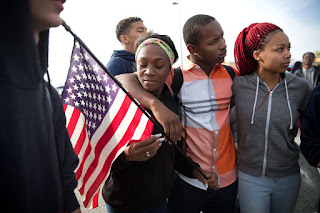 |
| Photo Credit: Omaha.com |
First, we want to acknowledge the difficulties and concerns
that youth workers have in light of the above. Secondly, we want to offer a few
tips for leaders and staff of youth programs.
1) READ WHAT OTHERS HAVE SAID: Much has been written by
educational and afterschool leaders about all of this. We recommend that youth
workers read what others have written. Here is a link to a statement by the National AfterSchool Association (NAA): It's Not About Politics. It's About Community. We also recommend articles from UC Berkeley's Greater Good Science Center.
2) ADULT SELF-CARE: These events have been very stressful
for adult youth workers who often support low-income and youth of color. For
many, the quest for social justice is what motivated their engagement. Before
talking with young people, it is important that the leaders of youth programs
provide a safe place for workers to discuss their own feelings. Secondly, it is
important that there is an organizational discussion of what adults should say
and how they should address the need for young people to express their
thoughts, concerns, and fears, and what they can do if they experience hate
speech or actions. Finally, adult youth workers may need access to resources
that speak to how to have difficult conversations with groups of youth. For a listing of some resources, see a previous post here.
3) TALKING WITH YOUNG PEOPLE: It is especially useful for
programs to have an ongoing place and process where youth can express their
thoughts or concerns. This negates the need to convene conversation groups only
when there is an event. It is important that adult staff have some training in
facilitating conversation groups. It is also important that:
- Youth are assured that they will be physically and
emotionally safe within their program, and that they are valued and loved;
- Youth feel safe sharing their thoughts, including those
with differing views;
- Youth understand who they can go to if they experience
hate speech or actions;
- Youth have opportunities to positively respond to their
fears or concerns. This may involve activities that improve the climate of
their school and/or community.
4) A PLAN FOR SUPPORTING UNDOCUMENTED YOUTH: Undocumented
youth and their families are experiencing their vulnerability in new ways.
Educate yourself first on actions you can take before broaching the subject
with youth. Websites like: National Immigration Justice Center and My (Un) Documented Life are
great resources.
5) COMMIT TO STOPPING INJUSTICE WHERE YOU SEE IT: We must
all, especially white allies, recommit ourselves to stepping in, speaking up,
educating our youth and other adults about the injury injustice causes.
6) BE KIND AND CONNECT: Know that everyone is experiencing
the news in their own way. Reach out to youth and other adults.
Make time to check in and ask how people are really doing. Respect what they
say and just LISTEN.
These negative events described above are not going away.
Thus, it is important that afterschool and community-based youth programs have
strategies that are thought through and long-term. This is critically important
if youth programs are experienced as safe places.