Showing posts with label Erika Martinez. Show all posts

Monday, March 28, 2022

California Teaching Fellows: Afterschool as a Teaching Practicum (Part 2)

Source: www.ctff.us

By Sam Piha

We interviewed Malia Villarreal (Public & Strategic Development Manager) and Mike Snell (CEO) at California Teaching Fellows Foundation (CTFF) which views afterschool programs as a valuable experience for future teachers. Below is part 2 of this interview. You can view part 1 here.

You can view our paper on this topic here. We also conducted a webinar, which you can view here.

Q: What are the responses of teaching fellow participants to the afterschool experience and what results have you seen?    

A: Reflecting on her experience as a student-teacher during the pandemic, Erika made connections on how her experience and training in the afterschool program enabled her to rise to the occasion. Erika expressed that the culture of afterschool taught her some very important lessons, “afterschool never happens how it is supposed to, but I was taught no matter what, it (the after-school program) needs to work out for the students.” She learned early on that she must always have a plan A, B, C, and D. Her experience as a tutor first, and later as a site coordinator taught her to think on the spot and basic classroom management skills; which she admitted didn’t come naturally to her in the beginning. It took a lot of coaching and patience to master those skills. Looking back on her journey in afterschool, Erika revealed she never would have gone through with pursuing a teaching career if she didn’t have the opportunity to practice and receive consistent feedback. 

Trainings during the Teaching Fellow Academies really stuck with me, and I had the opportunity to directly apply it. There were Ah-ha moments when I went back to my school site and would witness how what I was taught was all true.”                  – Erika Martinez


Erika stated the cycle of training, hands-on practice, and feedback were the keys to her success. Needless to say, Erika credits much of her current success to her time spent working in expanded learning programs. 

Source: www.ctff.us

Q: Is this program particularly important now as a result of the COVID pandemic?

A: COVID-19 continues to teach us many new lessons while reinforcing much of what we already knew as educators and humans. Now more than ever, students need social and emotional support from our expanded learning and school staff, and our working parents need a safe and supportive environment for their children during the critical out-of-school time hours. 

COVID-19 has exacerbated the teacher shortage crisis and we’re seeing record college dropout rates which is a recipe for a student equity disaster (Carver-Thomas et al, 2021). Our role as a community benefit organization is to elevate the voices of our two critical stakeholders: K-12 students and our college students (Teaching Fellows). We know our community needs and deserves highly qualified and diverse teachers, especially in our historically underserved communities. Our experience working with diverse first-gen college students for the last 20 years has taught us that despite their navigational capital, managing the process of graduating college and entering a credential program is complex. 

The pandemic has made college even less accessible to students. When we ask Teaching Fellows why they’re dropping out of college and teacher credential programs, they say “I can’t afford college anymore.” Being mostly first-gen college students, our Teaching Fellows need to be able to work and support their families while they attend college. They say their largest barriers are test and tuition costs, inconsistent class schedules that don’t allow them to work, credential programs/college classes being (geographically) too far from where they live, and an overwhelming feeling that they do not belong. 

Expanded Learning programs and models like the CTFF have tremendous opportunities to challenge traditional teacher education models, to work to align systems that serve youth and communities and share our knowledge and experiences to further this important work and foster a sense of belonging.

MORE ABOUT... 

Malia Villarreal, Public & Strategic Development Manager, California Teaching Fellows Foundation has worked in the expanded learning field for six years at the CTFF where she has worked on a plethora of projects and strategic initiatives. She has graduated over 100 college interns in an innovative pipeline that yields talent and champions of the out-of-school time field in the Central Valley, and has built relationships with local, state, and federal elected officials, multisector stakeholders, and community influencers to promote afterschool programs and the California Teaching Fellows model in the San Joaquin Valley and beyond.

Mike Snell, CEO, California Teaching Fellows Foundation is the Chief Executive Officer of CTFF. The mission of CTFF is to inspire next-generation leaders with a passion for teaching and learning while impacting the lives of youth. Mike’s personal mission is to link talent to opportunity in the kindergarten through the college pipeline. Mike invests a significant portion of his off-work hours serving and supporting organizations aligned with his personal and professional goals and making a significant impact in California’s Central Valley. Mike serves and has served on various committees at the California Department of Education Expanded                                     Learning Division.

Erika Martinez, Teaching Credential Candidate and Former Teaching Fellow, is a first year, first-grade teacher at Williams Elementary. She is currently working on her Master’s in Social-Emotional Learning. She recently graduated from the Fresno Unified Teacher Residency Program through National University, where she obtained her Multiple Subject Teaching Credentials. Prior to that, she attended Fresno Pacific University, where she completed her Bachelor’s in Liberal Studies. She has two years of experience teaching Drama through Fresno Unified School District (FUSD), and six years of experience working in afterschool programs through California Teaching Fellows Foundation (CTFF) where she gained nearly 3,000 hours of hands-on experience and more than 120 hours of professional and personal development. 

Monday, March 14, 2022

California Teaching Fellows: Afterschool as a Teaching Practicum (Part 1)

Source: www.ctff.us

By Sam Piha

We interviewed Malia Villarreal (Public & Strategic Development Manager) and Mike Snell (CEO) at California Teaching Fellows Foundation (CTFF) which views afterschool programs as a valuable experience for future teachers. Below are their responses.


You can view our paper on Afterschool as a Teacher Pathway here. We also conducted a webinar on this topic, which you can view here.


Q: Can you describe how the California Teaching Fellows Foundation (CTFF) works?
A: CTFF at Fresno State University (FSU) links college students with opportunities for paid placements working in afterschool, summer, and regular school day programs in public schools, charter schools, and community centers. These college students gain experience working with school site leaders, students, and families so they know the climate and culture of the school well before becoming a teacher. They’re diverse and have built relationships so they’re well prepared and reflect the community they serve. We also provide ongoing monthly paid professional development via our Teaching Fellow Academies; where tutors gain access to incredible out-of-school time professionals as well as K-12 and Higher Education leaders who help professionally develop them. 

The Teaching Fellow Academies have intentionally provided additional content and training around social and emotional learning supports, trauma-informed practices, and social and cultural pedagogy. In addition to the Teaching Fellows Academies, CTFF offers the DREAM Initiative which provides personal development to Teaching Fellows. Examples of DREAM services are one on one life coaching, CBEST prep workshops, group meet-ups, home buying workshops, financial literacy, a care fund, and so many other great benefits that help Teaching Fellows reach their full potential.

Q: Can you give an example of how CTFF works from the perspective of a teaching fellow?
Erika Martinez
A:
The story of Erika Martinez is a powerful illustration of the Teaching Fellows program and our quest to strengthen and diversify the pipeline of future teachers in the Central Valley. Erika is currently in the Fresno Unified Teacher Residency Program and will be a credentialed teacher with a Master’s in Social and Emotional Learning upon graduation from the school district’s program. Erika will soon join the ranks of hundreds of teachers in the Central Valley who gained early field experience working in afterschool programs through the CTFF. We are proud to call Erika a Teaching Fellows Alumni.

Erika started as a Teaching Fellow tutor working in an afterschool program in 2014. After over two years as a tutor managing a classroom of 20 students, then Erika was promoted to a Site Coordinator where she served for two more years. As a Site Coordinator, Erika managed the school’s afterschool program and a team of 12 tutors and one ASL. Her school site regularly served 220 students a day. In 2020, Erika earned a bachelor's degree in Liberal Studies. While Erika’s story is amazing, she is not unlike many amazing Teaching Fellows who take advantage of CTFF’s model. 

Q: Can you explain how the experience of afterschool workers are relevant to becoming a teacher. What advantages do these experiences offer? 
A: As Erika leaves the CTFF, she takes with her nearly 3,000 hours of hands-on classroom experience, more than 120 hours of professional and personal development via the Teaching Fellows Academies (paid professional development), and a deep understanding of school systems and the communities they serve. Erika represents the demographics we see throughout the Teaching Fellows program: diverse, educated, first-generation, bi-lingual college students, and highly motivated to make a difference in her community. As she graduates from her Teacher Residency program, Erika will be day 1 ready to teach. Erika, like so many Teaching Fellows, has tremendous capital; she is culturally competent, linguistically diverse, aspires for a better future, and is acutely aware of what it takes to work with school-age youth, families, and educational professionals. Erika’s experiences’ like so many others who work in afterschool programs, perfectly prepare her to take advantage of career path opportunities in education and position them well to navigate it. 

Erika Martinez practicing "youth voice and leadership" by signing up her students to attend the Afterschool and Summer Challenge at the state capitol to talk to Legislators and the Governor's Office about the importance of afterschool.  
(Pictured left to right back row: Sanger High School student, Malia Villarreal, Senator Melissa Hurtado, Mike Snell, Erika Martinez, front row: West Fresno Elementary School students)


While teachers have the California Standards for the Teaching Profession (CSTP), fortunately, afterschool (also referred to as expanded learning professionals) have the Learning In Afterschool & Summer’s Principles (LIAS) and California Quality Standards for Expanded Learning Programs. The LIAS and quality standards are the framework we provided to Teaching Fellows who are serving as educators and leaders for students. There are natural similarities between the standards in afterschool and the standards of the teaching profession. While more research needs to be done to connect the afterschool quality standards to the teaching profession standards, it is clear that the pre-service experiences in afterschool programs help leaders like Erika in their pursuits of becoming a teacher. 

END OF PART 1


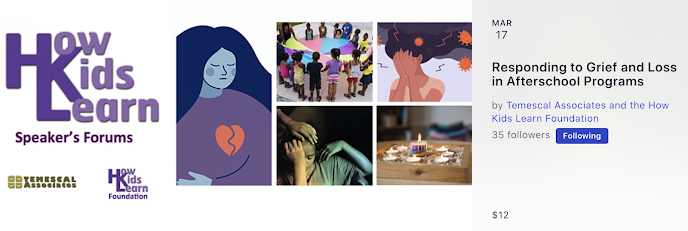
Temescal Associates and The How Kids Learn Foundation will be conducting a webinar featuring a presentation by Brittany Collins and a panel of experts on Responding to Grief and Loss in Afterschool Programs, Thursday, March 17, 2022 from 10:00am - 12:00pm (PST). To learn more and register, click HERE.


Summer Learning Meets The LIAS Principles

Source: Learning in Afterschool & Summer From the LIAS Archives By Guest Blogger, Katie Brackenridge, Glen Price Group A child’s need fo...