Showing posts with label deborah vandell. Show all posts

Tuesday, June 1, 2021

Dr. Deborah Lowe Vandell and the Longitudinal 26- Year Afterschool Study

​Ongoing research on out-of-school time programs is essential to help shape our practice and ensure ongoing support from policy makers. Dr. Deborah Lowe Vandell, founding Dean Emerita of Education at the University of California Irvine, has been a leading researcher on expanded learning programs since 1985. Dr. Vandell appeared in our video on the Learning in Afterschool & Summer Learning Principles and our documentary on the History of Afterschool in America. She also shared her thoughts in a plenary presentation and workshop at the How Kids Learn VIII conference and has been interviewed for past LIAS Blogs. 

In a recent article from the Mott Foundation she was interviewed about the release of a 26- year study on the impacts of early childhood and afterschool programs. “As one of the principal investigators with the National Institute of Child Health and Human Development (NICHD) Study of Early Child Care and Youth Development, she has conducted an intensive study of the development of 1,300 people from birth to 26 years. This work is viewed by many social scientists as one of the most comprehensive studies of the short- and long-term effects of early care and afterschool education to date.”  

Below we quote some excerpts from the interview with Dr. Vandell published by the Mott Foundation. You can read the full Mott interview here.

Q: What has research on afterschool programs revealed since you first started working in this field? 

Deborah Lowe Vandell
Photo: Steve Zylius
 
A: Many researchers in both the United States and other countries are now studying afterschool programs and activities in childhood and adolescence. The good news is that our science has now substantially increased what we know about these important developmental contexts, and we are now much better situated to meet the needs of children and adolescents by providing accessible, affordable, high-quality afterschool learning opportunities. 

We’ve also identified many of the key ingredients needed for out-of-school time to have positive effects. This work has shown that consistent and sustained participation in high-quality afterschool programs is linked to positive academic and social outcomes for both children and adolescents. However, findings are less clear (and sometimes even negative) when participation is sporadic or activities are lower in quality, so we have to pay close attention to program quality and to participation over time. 

Q: Tell us about your latest study. What were the biggest questions? 

A: My latest study is one that circles back to that first afterschool study. This latest study looked at children’s early care and education and their organized afterschool activities in elementary school and asked how these two sets of experiences (early care and afterschool care) are related to children’s academic and social functioning in high school. 

In this study, my coauthors and I followed almost 1,000 children over time and asked if both early care and education (ECE) and afterschool organized activities during elementary school are related to how students are doing in high school — both academically and socially. We focused on ninth graders because the high school transition is challenging for many adolescents, and we wanted to know if children’s early care and afterschool activities in elementary school could help adolescents to meet these challenges. 

Q: What did you and your coauthors find?

A: We found that both early child care and out-of-school time during elementary school predicted higher academic achievement at age 15. 

Children who received higher quality ECE and who had sustained participation in afterschool organized activities demonstrated higher academic achievement in high school. These effects on academic achievement were additive — with the effects associated with afterschool programs building on or adding to the early care effects. Importantly, the effects associated with early care and afterschool care also were exactly the same size, indicating that both are good investments. 

In this paper, we also found that early care and out-of-school time were related to different aspects of behavioral development. Higher quality ECE predicted fewer behavioral problems in adolescence, whereas afterschool organized activities were linked to greater social confidence. 

We found that consistent participation in afterschool was important for building children’s social competence — including feeling more confident about meeting new people and interacting with peers and adults — which bodes well for students’ future success in school and in the workplace. These benefits were not associated with ECE experiences, suggesting that afterschool programs serve a unique role in this respect. 

Q: What makes this body of work unique and its findings important? 

A: There are several factors that make the study noteworthy, I think. The first is the effort to examine early care and education and out-of-school time in relation to later development. For the most part, these two important developmental contexts have been studied separately. 

Second, the study finds effects of these earlier experiences on longer term outcomes in adolescence. These effects, evident in the 15-year-olds, suggest that the benefits of early care and elementary school activities do not fade away, but persist over time. Now we are asking if the effects continue to be evident in adulthood. 

Third, the sample in this study was economically, geographically and ethnically diverse, suggesting that these findings on the benefits of afterschool programming have wide generalizability for children in the United States. 

This work is consistent with and extends prior research by showing that sustained participation in high- quality afterschool programs in elementary school is linked to positive academic and social outcomes in high school and that those effects persist. 

Q: What does the study imply for post-COVID-19 recovery? 

Source: www.njsacc.org
A: Researchers and educators are deeply concerned about the effects of COVID on children’s learning and development — and the impact of school closures, disruptions and trauma brought on by the pandemic. 

In one set of studies released by NWEA, a nonprofit research organization, researchers documented a significant widening of academic achievement gaps by income and race last spring, which was further exacerbated by school closings and disruptions this fall. Other researchers are reporting increases in students’ social-emotional problems as a result of the trauma and disruptions brought on by COVID. 

The work by NWEA and others is highlighting that children growing up in under-resourced families and communities are going to be in particular need of high-quality afterschool and summer programs. However, because of the financial disruptions being experienced by many low-income and working families — and because of the budget shortfalls facing many communities — children who most need high-quality afterschool programs will likely have less access to these programs and services. To address these serious issues, a coordinated response is going to be needed — one that brings together the resources of early childhood programs, afterschool programs and schools. 


Source: www.whitehouse.gov


President Biden's COVID Relief Bill contains billions of dollars for afterschool and summer learning programs. To learn more:

Monday, October 29, 2018

An Interview with Researcher Deborah Lowe Vandell

By Sam Piha

Sam Piha
Deborah Lowe Vandell has been a leading researcher on expanded learning programs since 1985. Dr. Vandell agreed to respond to our interview questions regarding her research on the field of afterschool. Below are some of her responses. 

Dr. Vandell appeared in our video on the Learning in Afterschool & Summer learning principles and our documentary on the History of Afterschool in America. She will also be sharing her thoughts in a plenary presentation, and a workshop alongside fellow researcher, Milbrey McLaughlin at the upcoming How Kids Learn VIII conference on December 6th, 2018 in Oakland, CA.

Q: You have been studying and researching afterschool programs for
Deborah Lowe Vandell
many years. Can you cite/list what you think are the most important lessons?


A: For me, the most important lesson is that the quality of children’s daily experiences at programs is critically important. Research, my own and the research of others, has demonstrated repeatedly the central role of caring, supportive relationships with adult staff for children’s well-being as well as their academic and social competencies over time. 

Lesson 1 is that the quality of staff-child relationships is front and center. Research also has shown that these supportive staff-child relationships typically occur in the context of activities that are engaging to young people and that build on the interests of the young people, a second important lesson. A third lesson, I think, is that we need to be doing more to support adult staff in their work. Staff training is critical as is planning time. Developing and retaining staff who have caring, supportive, and respectful relationships with young people is central as is staff who can provide rich opportunities for learning and engagement. Staff turnover is a big problem.  

Q: Civic engagement and youth activism is an increasing part of afterschool youth programs. Can you comment on this trend as a part of positive youth development?

A: I just returned from a meeting that convened 250 researchers and practitioners who focused on this very issue. A recurrent theme across many presentations (by both researchers and practitioners) was the ways in which afterschool programs can foster civic engagement and youth activism. The connections between positive youth development, social-emotional learning (SEL), and character development were another recurrent theme. It is exciting for me to see connections being made across areas that are too often in separate silos.  

Source: Jenniferbodford.com
Q: Over the years, there has been much discussion on the indicators we should use to assess the effectiveness of afterschool programs. What are your thoughts on this? 

A: This is a BIG question. A critical first step is we have to specify effectiveness with respect to what end - effectiveness with respect to:

  • Particular youth outcomes in the short-term or youth outcomes in the long-term;
  • Access to high quality programs; 
  • Sustained participation or to daily attendance numbers; or
  • The quality of children’s daily experiences at the program? 
It’s only when we clarify the particular aspects of effectiveness that we are interested in can we start to identify indicators that can be used to assess effectiveness.  

Q: Can you share what you are or will be studying in regards to afterschool?

A: I am in the midst of three afterschool projects right now: 

I have been studying effects of afterschool programs and organized activities (their quality, duration, type) on adolescent outcomes at age 15 and the end of high school. My colleagues and I have now extended that work to ask if after school activities are linked to adult outcomes at age 26, including educational attainment, employment, civic engagement, physical and mental health, as well as positive social relationships. Results at age 15 and end-of-high-school are pointing to links between sustained participation and positive academic and social outcomes. Analyses of the age 26 data on 815 participants are underway. 

My second project is a series of research syntheses. This project is a collaboration with Professor Sandra Simpkins at UC Irvine and a wonderful team of graduate students. One of the papers that we are working on examines conceptualizations of program quality and links between different aspects of program quality and youth outcomes. A second paper focuses on the challenges and opportunities of programs that serve Latino and African-American children and youth. In preparing the data base for these syntheses, we scanned more than 2000 papers and are focusing our analyses on 200 papers published since 2007. 

The third project, is also in collaboration with Professor Simpkins. In this study, we are conducting secondary data analyses of two large data sets, the National Institute of Child Health and Youth Development (NICHD), Study of Early Child Care and Youth Development (SECCYD), and the Study of Promising Afterschool Programs with a focus on character development during childhood and adolescence. In this work, we are examining individual aspects of character such as persistence and work habits as well as inter-personal aspects of character such as prosocial behaviors and helping others.  

Q: Any thoughts on what the future of afterschool will hold, either in regards to policy or practice? 

A: I am of two minds about the future of afterschool. The good news is that there is now widespread recognition of the role that afterschool programs (and out-of-school time more broadly) play in children’s development and well-being. Many parents, educators, researchers, and policy makers now endorse investments in afterschool as necessary and important. This is very different than when I did my first study of afterschool programs in 1985! 

The bad news is that there are still serious inequities in children’s access to high quality afterschool activities. Children from low-income families have less access than their more affluent classmates, and this lack of access is undermining their life opportunities. Relatedly, I worry that the funding for programs that serve low-income children remain precarious. 

---------------------
Deborah Lowe Vandell, Ph.D., is the Founding Dean of the School of Education at the University of California, Irvine, where she is a Professor of Education and of Psychology and Social Behavior. The author of more than one hundred fifty articles and three books, Dr. Vandell studies the effects of afterschool and summer programs on children's academic, social, and behavioral development.

Wednesday, February 3, 2016

Looking Back: Some of Our Favorite Interviews

By Sam Piha


Sam Piha
The Learning in Afterschool & Summer project posted our first blog post on October 6, 2010. Since then, we had attracted 142,000 views. The purpose of the blog is to interview thought leaders in the field of afterschool and summer, alert readers to important developments, and provide commentary and an exchange between readers. 

Some of our colleagues have expressed a concern that because so many afterschool workers are young, underpaid, and have a short tenure, they “can’t handle” so much information. We are mindful of this concern, but are convinced that many of the youth worker professionals have made this work a vocation and deserve to have access to leading thinkers and researchers. 

Below (in no particular order) are some of our favorite interviews that we have published on our blog. We urge readers to click on these to go back and view these interviews. (There are many other great blog posts that are not included in this list.)


Monday, July 14, 2014

Afterschool Program Participation and the Achievement Gap

By Sam Piha


Sam Piha
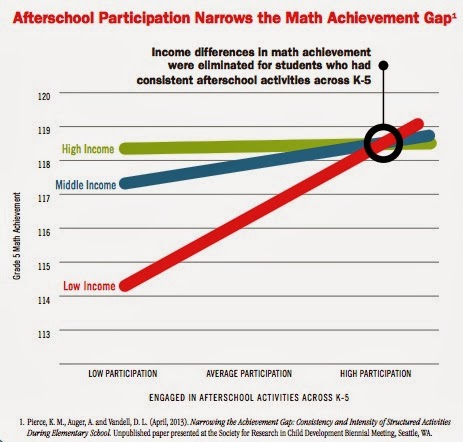
In October of last year, University of California at Irvine researcher, Deborah Vandell, released an important study on the positive effects of afterschool programs.  Her study revealed that "more consistent time spent in afterschool activities during the elementary school years is linked to narrowing the gap in math achievement, reduced school absences and improved behavioral outcomes for students."(1) 

More specifically, the math achievement gap was measured
Deborah Vandell
at grade 5. The more consistent the afterschool attendance, the narrower the gap between high-income and low-income students. Conversely, the greater the inconsistency of attendance, the wider the achievement gap. But also, those children that spent more time in afterschool programs showed:


- Better work habits
- Improved academic performance
- Gains in self-efficacy
- Improved GPA
- Increased attendance, fewer school absences

This is important information to share with program and in-school stakeholders. Click here for a colorful summary of the research.


________________________
(1) www.statewideafterschoolnetworks.net/achievement-gap-real

Wednesday, May 22, 2013

A Conversation with UCI Professor and OST Researcher, Deborah Vandell


By Sam Piha


Sam Piha

In late 2012 and early 2013, we conducted a number of videotaped interviews with educational and out-of-school experts on the Learning in Afterschool & Summer learning principles. These taped sessions included interviews with Deborah Vandell, State Superintendent Tom Torlakson, neurologist Judy Willis, youth development specialist Karen Pittman, Professor Pedro Noguera, two Bay Area school principals, CDE After School Division Director Michael Funk, and others. These videos will be excellent training tools and will be made available very shortly. The videos were shot by youth videographers and produced by Temescal Associates.

Below is a portion of an interview with UCI Professor and OST researcher, Deborah Vandell. To view two short videotapes of our conversation, click here.


Q: The LIAS learning principles were not intended to apply to strictly afterschool settings. In your experience as an educator and researcher, how are these principles, when taken together, relevant to young people’s learning? 
A: I think that the learning principles in after school and summer really get at the core of learning for students - starting in early childhood, going through to university. So if we think about those core principles, the first is active. We know that young people learn by being active. Many years ago, Piaget started talking about the key to learning being children’s activity. It’s in the context of activity that children and young people develop new skills.  

A second principle is the principle of collaboration. And this is also very important. The most influential of the psychologists would be Vygotsky, who talked to us about collaboration, and that children really learn through what we call the zone of proximal development. What young people can do alone is not as advanced as what they can do with others in a group.  So in a group where they’re collaborating, we're able to actually move them into that zone to develop their skills further.  

A third principle, really important within the learning and after school framework, is that learning needs to be meaningful, it needs to be embedded in activities that are important for young people. When I think about the importance of it being meaningful, what really comes to mind is the work of Reed Larson, who did some really important work looking at development of initiative and engagement. What he found is that when young people are in school, what they often are doing is putting forth a lot of effort, but they’re not really motivated - its not something they really care about. What happens in afterschool activities, when they’re really working, when they’re active, they’re choosing those activities and they are also focused on them, it’s the best combination for learning that is meaningful.  

The fourth principle is that programs and activities should be working towards mastery.  Now the striving towards mastery is not an activity that you can do in one day, in half a day, its really an activity that you’re building over time.  When you’re building for a concert, you're practicing, you're developing those skills. When you are getting out to put together a newspaper, when you’re planning a play, which is a complex activity, it gives young people a chance to put those skills together. Notice many of them are also working with others in a group, often with a culminating event. Jacqueline Echols, in a very important book on the role of positive youth settings for development, as part of the National Academy of Science report back in 2002, talked about this learning to support mastery as a key element to support positive youth development.  

And then the fifth principle is that of expanding horizons. Our young people live in a global society. Our young people are living in a society in which science is becoming increasingly important, mathematics and those activities have to really happen in context.  Part of what students can do in afterschool and in summer, in really fine programs, is that we can expand the horizons, beyond where they are in this moment in time.

(This is only an excerpt of our complete interview. To view a complete videotaped interview, click here.)
_______________________

Deborah Vandell is a Professor of Education and Psychology and Dean of the School of Education at the University of California, Irvine, discusses the relevance of the Learning in Afterschool and Summer Principles. Ms. Vandell has longstanding interests in three areas: (1) early child care and education - its effects on children's social, cognitive, and behavioral development and strategies for improving the quality of early care and education, (2) after school programs and activities - their impact on children and youth and strategies for improving the quality of after-school programs, and (3) children's relationships with peers, parents, siblings, teachers, and mentors as developmental and educational contexts.

How the Meta Settlement Can Benefit Afterschool Programs

Source: www.pexels.com This blog by Dan Gilbert has been reposted from Afterschool Alliance’s Afterschool Snack Blog. Meta's new settlem...