Friday, March 28, 2014

The Top 5 Women in STEM Making a Difference – Coding Edition


By Guest Blogger, Samantha Walters

Samantha Walters
In 2012, to celebrate International Women’s Day, I decided to span the internet and find the Top 5 Most Influential Women in the Data Center Industry. After hours upon hours of research I finally found the top 5 women who would make my list. However, through all that research, what I really discovered was actually a complete lack of women being represented in tech companies! Sure, there were women on almost every executive team but they held the position of Marketing, Human Resources, or Legal Counsel and not the positions which would enable them to make innovative products or technological decisions that would influence their company and the world.

This concerned and perplexed me – if women made up half of the world, why were there so few in science, technology, engineering, and mathematics (STEM) related companies?

Turns out, women truly are underrepresented – only 25% of IT jobs are held by women. Then again, this statistic should not surprise us. The young women of today are not always encouraged to consider a career in STEM; only 10% of all girls say their parents encouraged them to think about an engineering career (Harris Interactive for the American Society for Quality, 2009). Thankfully people are starting to take notice. In February 2013, President Barack Obama stated, “we’ve got half the population that is way underrepresented in [STEM] fields and that means that we’ve got a whole bunch of talent… that is not being encouraged…” (White House Correspondence, June 2013).

Fueled by the words of President Obama and the real women in STEM, leading thought leaders have come up with a solution: jump-start girl’s interest in STEM subjects, boost the percentage of women scientist and engineers, and give great prominence to strong role models. This is “… not just the right thing to do, but the smart thing to do,” (White House Correspondence, June 2013).

We, as a nation, must continue to encourage our young girls to get involved in STEM related fields and support them in any way possible. The women spotlighted below are doing just this. These women have taken the issue of underrepresentation of women in STEM fields head on by creating programs and nonprofits that encourage and give young women the opportunity to learn and discover their own STEM-related passions. This article is to celebrate their accomplishments and that of other women working within the field who are inspiring young women around the world.

Reshma Saujani (@reshmasaujani), Founder and Chief Executive Officer of Girls Who Code (@GirlsWhoCode)

Reshma Saujani
 Before founding and becoming CEO of Girls Who Code, whose mission is to inspire, educate, and equip girls with the computing skills to pursue 21st century opportunities, Saujani was the former Deputy Public Advocate of New York City. In this position, Saujani was responsible for bringing together public and private sectors to encourage entrepreneurship and civil engagement across NYC. In 2010, Saujani became the first South Asian women to run for Congress but by 2012, when she founded Girls Who Code, she shifted her focus to closing the gender gap in STEM education. In just one year, Girls Who Code expanded into 8 programs in 5 cities nationwide.


For her commitment in making it ok for girls to “fail fast, fail hard, and fail often,” we salute you!

Vanessa Hurst (@DBNess), Co-Founder of Girl Develop It (@girldevelopit)

Vanessa Hurst
Hurst is a self-proclaimed “advocate of coding for humanity.” Over the last 4 years Hurst has been founding and developing non-profit organizations and programs that use technology to make the world a better place. As a computer programmer, lifetime girl scout, and social entrepreneur, Hurst has made a difference in the world as co-founder of Girl Develop It, a judgment-free learning opportunity focused on results and supporting women teaching and learning from one another, founder and CEO of CodeMontage, which empowers coders to improve their impact on the word, and founder and organizer of Developers for Good, a NYC-based network of technologist who meet monthly to share social impact opportunities, guide nonprofits, and make the world a better place.

For her commitment to encouraging young women to get involved in coding and for adult-coders to make a difference in the world, we salute you!

Samantha John (@SamJ0hn) and Jocelyn Leavitt (@JocelynLeavitt), Co-Founders of Hopscotch (@hopscotch)
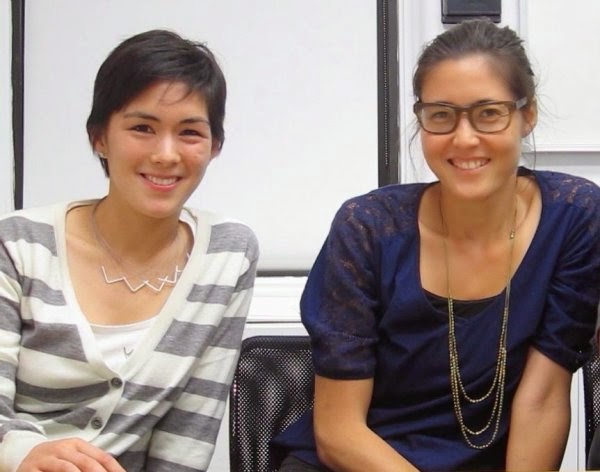
Samantha John and Jocelyn Leavitt
For John and Leavitt, creating Hopscotch, an iPad app designed to teach kids how to code, just made sense. The first of its kind, this free app teaches kids the fundamental components of programming languages.  Although both John and Leavitt work within the tech industry, they did not even consider programming as a career until after college. This late exposure to the programming world fueled their drive to create a project-based learning tool that will help inspire and encourage young women to get involved with programming earlier rather than later in life. So far, their concept is work. Hopscotch was the winner of the 2013 “Parent’s Choice Gold Aware for Mobile Apps” by the Parent’s Choice Foundation and the 2014 KAPi Award for “Best Educational Technology.”

For their commitment in teaching the youth, at an early age, to solve problems through coding, we salute you!

Kimberly Bryant (@6Gems), Founder and Executive Director of Black Girls Code (@BlackGirlsCode)

Bryant is the founder of Black Girls Code, an organization dedicated to
Kimberly Bryant
empowering girls of color to become innovators in STEM fields, leaders in their community, and builders of their own future through computer science and technology. Since her college days, Bryant has first-handedly experienced the dearth of African-American women in the STEM fields. Feeling that the problem is not a lack of interest but rather a lack of exposure and access, Bryant created Black Girls Code to create a big impact in the smallest demographic represented in the STEM-related fields. In 2013, Bryant was honored at the White House as a “Champion of Change for Tech Inclusion” for her work in encouraging the next generation of innovators.

For her commitment in expanding the minds of young women, regardless of background, we salute you!

Heather Payne (@heatherpayne), Founder of Ladies Learning Code (@llcodedotcom) 

Heather Payne
In 2011 Payne founded Ladies Learning Code, a Canadian not-for-profit organization that runs workshops for women (and men) who want to learn computer programming and other technical skills. Since then, Ladies Learning Code has grown into over a dozen cities and continues to educate youth in a social and collaborative way. Beyond her work with Ladies Learning Code, Payne spent a year working on a project for Mozilla Foundation where she was responsible for building a community of people and organizations in Toronto who care about raising youth as creators of technology and the web. Payne is also the CEO of HackerYou, one of only a dozen programming boot camps in North America founded by a woman, and she operates a 7000-square foot digital literacy education facility in downtown Toronto called The Lab. She was also recently named one of Canada’s “Top 100 Most Powerful Women.”  To sum it up, Payne is one of the forces behind the Women in STEM movement in Canada. 

For her commitment in fueling the next generation of tech entrepreneurs we salute you!

______________________________
Samantha Walters is the Vice President of Online Strategies at Colocation America. While getting her B.A. in Sociology from the University of Arizona, Samantha started working as a Social Media Consultant for a nonprofit organization. This experience led her to pursue a Master’s degree in Social Entrepreneurship and Change from Pepperdine University.

Today, she is involved in branding a LA-based tech company, Colocation America, into new markets and forming new strategic partnerships by conducting and analyzing internal and external evaluations. She also spearheaded her company’s Corporate Social Responsibility by developing a strategic plan resulting in numerous partnerships between Colocation America and Los Angeles based nonprofits. These partnerships have led to innovative STEM programming for young adults in the greater Los Angeles area.

Recently she was welcomed onto a nonprofit board for an afterschool program in LA, Big Up Kidz. There she helps with fundraising efforts and evaluations.


When she is not in the office or aiding Big Up Kidz, she can be found on the basketball court teaching young girls how to play. When basketball is out of season, Samantha is spanning the globe helping nonprofit organizations make an impact in the online world.


Friday, March 21, 2014

Quality Standards Work Group – Phase II Stakeholder Input


By Guest Bloggers, Diego Arancibia, ASAPconnect and Katie Brackenridge, Partnership for Children & Youth, Co-Chairs, CAN Quality Committee

Dear expanded learning time stakeholder –

Diego Arancibia
The California AfterSchool Network (CAN) is excited to announce the launch of the Quality Standards Work Group – Phase II, which is providing further context and description of the 12 California quality standards. 

We would love your input about these descriptions as the Work Group begins its first draft.  Please visit this page on the CAN website by April 2nd to give your ideas and suggestions.  There will be additional opportunities to provide input to the first drafts between April 9 and May 2, 2014.

As background, phase I of the Work Group developed 12
Katie Brackenridge
quality standards for expanded learning time programs that were adopted by the California Department of Education (CDE) After School Division (ASD) in January, 2014.  The group recommended that a second phase of the work be initiated to further describe for the field what the standards look like in action.   As a result, the Quality Standards Work Group II was created.  This group is charged with making recommendations of examples of standards in practice or indicators for CDE/ASD’s expanded learning quality standards, and a matrix of existing quality assessment tools that could be used to measure progress toward quality standards.

For more information about Phase II, please visit this page on the CAN website where you will find more detail about this work, a timeline for your input and a list of Work Group members.

Thank you for partnering on this exciting work. 

Monday, March 17, 2014

Employability: Beyond Grades

By Sam Piha

Diego Arancibia
Our colleague, Diego Arancibia, from ASAPconnect recommended this article below, saying, "I thought of the LIAS learning principles when I read this…".

By THOMAS L. FRIEDMAN
February 22, 2014

Thomas Friedman
[Photo Credit: NY Times]
MOUNTAIN VIEW, Calif. — LAST June, in an interview with Adam Bryant of The Times, Laszlo Bock, the senior vice president of people operations for Google — i.e., the guy in charge of hiring for one of the world’s most successful companies — noted that Google had determined that “G.P.A.’s are worthless as a criteria for hiring, and test scores are worthless. ... We found that they don’t predict anything.” He also noted that the “proportion of people without any college education at Google has increased over time” — now as high as 14 percent on some teams. At a time when many people are asking, “How’s my kid gonna get a job?” I thought it would be useful to visit Google and hear how Bock would answer.

Laszlo Bock
[Photo Credit: Jim Wilson, NY Times]
Don’t get him wrong, Bock begins, “Good grades certainly don’t hurt.” Many jobs at Google require math, computing and coding skills, so if your good grades truly reflect skills in those areas that you can apply, it would be an advantage. But Google has its eyes on much more.

“There are five hiring attributes we have across the company,” explained Bock. “If it’s a technical role, we assess your coding ability, and half the roles in the company are technical roles. For every job, though, the No. 1 thing we look for is general cognitive ability, and it’s not I.Q. It’s learning ability. It’s the ability to process on the fly. It’s the ability to pull together disparate bits of information. We assess that using structured behavioral interviews that we validate to make sure they’re predictive.”

The second, he added, “is leadership — in particular emergent leadership as opposed to traditional leadership. Traditional leadership is, were you president of the chess club? Were you vice president of sales? How quickly did you get there? We don’t care. What we care about is, when faced with a problem and you’re a member of a team, do you, at the appropriate time, step in and lead. And just as critically, do you step back and stop leading, do you let someone else? Because what’s critical to be an effective leader in this environment is you have to be willing to relinquish power.”

What else? Humility and ownership. “It’s feeling the sense of responsibility, the sense of ownership, to step in,” he said, to try to solve any problem — and the humility to step back and embrace the better ideas of others. “Your end goal,” explained Bock, “is what can we do together to problem-solve. I’ve contributed my piece, and then I step back.”

And it is not just humility in creating space for others to contribute, says Bock, it’s “intellectual humility. Without humility, you are unable to learn.” It is why research shows that many graduates from hotshot business schools plateau. “Successful bright people rarely experience failure, and so they don’t learn how to learn from that failure,” said Bock.

“They, instead, commit the fundamental attribution error, which is if something good happens, it’s because I’m a genius. If something bad happens, it’s because someone’s an idiot or I didn’t get the resources or the market moved. ... What we’ve seen is that the people who are the most successful here, who we want to hire, will have a fierce position. They’ll argue like hell. They’ll be zealots about their point of view. But then you say, ‘here’s a new fact,’ and they’ll go, ‘Oh, well, that changes things; you’re right.’ ” You need a big ego and small ego in the same person at the same time.

The least important attribute they look for is “expertise.” Said Bock: “If you take somebody who has high cognitive ability, is innately curious, willing to learn and has emergent leadership skills, and you hire them as an H.R. person or finance person, and they have no content knowledge, and you compare them with someone who’s been doing just one thing and is a world expert, the expert will go: ‘I’ve seen this 100 times before; here’s what you do.’ ” Most of the time the nonexpert will come up with the same answer, added Bock, “because most of the time it’s not that hard.” Sure, once in a while they will mess it up, he said, but once in a while they’ll also come up with an answer that is totally new. And there is huge value in that.

To sum up Bock’s approach to hiring: Talent can come in so many different forms and be built in so many nontraditional ways today, hiring officers have to be alive to every one — besides brand-name colleges. Because “when you look at people who don’t go to school and make their way in the world, those are exceptional human beings. And we should do everything we can to find those people.” Too many colleges, he added, “don’t deliver on what they promise. You generate a ton of debt, you don’t learn the most useful things for your life. It’s [just] an extended adolescence.”


Google attracts so much talent it can afford to look beyond traditional metrics, like G.P.A. For most young people, though, going to college and doing well is still the best way to master the tools needed for many careers. But Bock is saying something important to them, too: Beware. Your degree is not a proxy for your ability to do any job. The world only cares about — and pays off on — what you can do with what you know (and it doesn’t care how you learned it). And in an age when innovation is increasingly a group endeavor, it also cares about a lot of soft skills — leadership, humility, collaboration, adaptability and loving to learn and re-learn. This will be true no matter where you go to work.

Monday, March 10, 2014

Increased Physical Activity for Children Aged 12-15

By Sam Piha


Sam Piha
Increases in childhood obesity has raised a good deal of concern and calls for solutions that are based in the home, school, and out-of-school/summer programs. Solutions include both better nutrition and increased physical activity.

A new study by the Centers for Disease Control and Prevention found that only 25% of youth between 12-15 years of age report meeting the 2008 national goal of 60 minutes of physical activity everyday. Adults at home need to encourage and provide additional opportunities for exercise. Schools need to do the same and reverse the trend of eliminating recess and physical education. 

Afterschool and summer programs can also help. However, because afterschool
Photo Credit: arc-experience
programs for this age group are not run like a single club where everyone does the same activities, afterschool programs can help by:


  • Ensuring they are offering healthy snacks;
  • Communicating the importance of exercise, including inviting influential role models to speak; 
  • Offering a greater diversity of program choices that involve physical activity such as hip-hop dance, aerobic exercise classes, yoga, ropes course activities, backpacking, biking and hiking clubs, team sports, etc.; and
  • Offer a greater diversity of programs that include culinary arts and healthy cooking, as well as nutrition and healthy eating.
Photo Credit: NHP Foundation

Below are some additional resources:


Photo Credit: arc-experience

Monday, March 3, 2014

Effective Strategies to Teach Collaborative Learning Skills

By Sam Piha

Sam Piha
The Learning in Afterschool & Summer learning principles have been widely embraced by educators, youth workers, and researchers alike. Learning that is collaborative is not only an essential 21st Century learning skill, it is an employability skill. But how do you actually teach this skill? We ask Allison Kenny, long-time youth worker and Co-Founder of Glitter & Razz Productions and Director of Go Girls! Camp. Her responses are below.

Q: Why do you think young people learning to work and learn collaboratively is important? 
Allison Kenny
A: For one thing, it's simply more fun. Even for kids who initially struggle with collaboration skills, the process of building them decreases loneliness and isolation. Kids who are having more fun and feeling a sense of belonging learn better and more importantly, are happier people. I think this is the most important antidote to violence in schools- addressing loneliness. 

Young people also deserve a chance to learn the job readiness skills that prepare them for life in our fast-paced, flexibly thinking world. Every job in every field requires you to be part of an effective team. Humans were built to work together. We just often forget how.

Q: We know that to do this requires that young people learn certain collaborative skills. What skills do you think are foundational to good collaborative learning?
A: Saying yes- it's a crucial skill in theater improvisation and in life. It means going along with, changing and adapting someone else's idea without shutting it down. "Saying yes" also gives permission to put your own idea out into the world without judgement.

Give & Take- another life skill the theater offers. It means tracking who is center stage and when to step up vs. step back.

Boundaries- Often when young people struggle with collaboration, they are feeling annoyed, invisible or overwhelmed in their work with others. Remembering their power to say what they do and do not want helps. Teaching young people to set and respect one another's boundaries is crucial for successful collaboration.  

Q: How are these skills taught to a group of young people who will be expected to work collaboratively? Can you cite some specific strategies?
A: At Go Girls! Camp, we use theater and expressive art to teach collaboration. Our girls experience how good it feels to say yes to one another's ideas in theater games. "Yes, Let's" is a perfect example. One girl takes center stage with an idea and says, "Hey Go Girls! let's...." and fills in the blank with something all the other girls can DO with her. Imagine she says, "Let's swim with sharks!" All the girls in the group respond with, "Yes, let's!" and pretend to swim with sharks. We play round after round and debrief at the end. "What does this game teach us about working together? How will that help us in real life?"

We teach give & take through our play-making process. Each young person creates a part for the play overall. They get to see how their character matters to the story overall and how to share the spotlight. 

The best way we've found to teach boundary setting is through the Kidpower curriculum by Irene van der Zande. She has amazing books and free articles on the Kidpower website. It's all based in role play and features real life scenarios for kids, teens and adults. 


Q: In designing activities that require effective collaboration, what are essential elements or expectations that the leader must introduce?
A: The leader must be sure each participant in the group has a role. Young people want to be clear on which part they get to be in charge of. There must be an expectation that everyone in the group participate in some way, using roles to address a variety of learning styles. They should be clear how and when to ask for help. They should be given an opportunity to reflect on their experience- both in how it was to work together and how successful they were at the given task.

Q: If young people were working together and learning together through collaboration, what would it look like?
A: The room would feel safe and charged. Young people would be finding and using their own materials, working in close proximity to those in their group, celebrating and cheering one another on, solving problems and addressing conflicts, asking for help only when they truly need it. Everyone would be included. No one left behind.

Q: Do you have any additional comments?
A: Celebrating and appreciating one another is essential for collaboration. Young people can learn how to give and receive compliments, how to bolster themselves up and build self esteem, how to look for the good in one another. This creates a sense of belonging and a way to work with the inner or outer critics that tell kids they have nothing to contribute. 


At Go Girls! Camp, we end every day with a celebration circle, where girls write or draw on the things they loved and learned that day. Other times they celebrate themselves, each other or their teachers. We also teach how to give and receive feedback, so kids can deepen their skills, grow and achieve even more.
______________________
Allison Kenny is an actor, writer, teaching artist, co-founder of Glitter & Razz Productions and Director of Go Girls! Camp. Since 2002, Allison has worked in the Bay Area as a theater teaching artist with kids ages 2-18. For 5 years, she studied Floortime Play Therapy with Dr. Ilene Lee and worked as an inclusion facilitator with kids on the Autism Spectrum. Allison served as a Youth Development Trainer and specialist with the YMCA of San Francisco and The Children, Youth and Families Minister at First Congregational Church of Oakland and an ECE Trainer to Preschool Teachers across Alameda County. In 2012, she became a Certified Instructor with Kidpower, Teenpower, Fullpower International and leads safety workshops for kids and families all over the Bay Area.

As a girl advocate, Allison believes women and girls are the world’s greatest natural resource. “We bring creativity, compassion, nurture, resilience, reliability and love to any challenge and situation. When we forget that, the whole world suffers.” Allison’s work is to create art, experiences, and books for girls and women to remember who we are and why we have value. In 2013, Allison published “Starring Celia,” a chapter book about a 4th grade girl who goes from being bullied to being a “Go Girl!”

Monday, February 24, 2014

How Out-of-School Programs Can Effect Academic Outcomes

By Sam Piha

Sam Piha
While educators wring their hands about low test scores and educational reformers struggle to show improved academic outcomes, another study has recently been released that shows how out-of-school programs that do not focus on remediation, can lead to improved school outcomes. 

Effects of an Out-of-School Program on Urban High School Youth’s Grades,” which was just published in the Journal of Community Psychology, examined the effect of the YMCA High School Youth Institute (YI) on grades, test scores and school attendance using a randomly selected matched comparison group. YI youth had significantly higher English-Language and Math test scores and somewhat fewer absences than the comparison group. Active YI participants had significantly higher academic GPAs and math test scores as well as somewhat higher total GPA. The findings suggest that high quality, comprehensive out-of-school programs can positively influence the academic performance of low-income youth. 

Below, we ask Bob Cabeza a number of questions about this study (Bob is the Vice President of Community Development, YMCA of Greater Long Beach and Founder of the Youth Institute).  

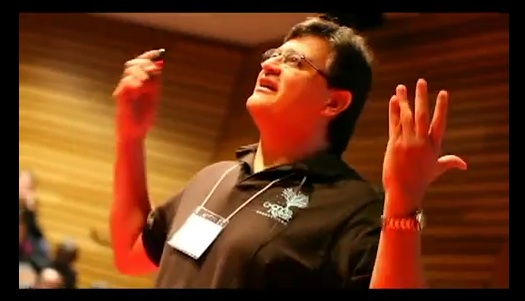
Bob Cabeza, How Kids Learn Conference
Q: Can you briefly describe what you think are the most important findings of this study? 
A: The most important findings in the study are the increases in GPA and grades as compared with the control group. Also, the real eye-opener was that the greater duration of the youth's involvement with the program, the more positive their grades and GPA became. Clearly showing that not just academic interventions, but learning engagement coupled with social supports in an out-of-school program makes a difference in a youth's in-school academic outcomes.

Q: What are you most excited about? 
A:  I am most excited about the fact that we knew that we were making a positive difference in young peoples' academic success and future, anecdotally and qualitatively, but now we really have some indisputable, quantifiable evidence to that fact. I am also excited that this article supports greatly what all of us in the high school afterschool field believe and are doing.

Q: You have spent much of your career defending youth development over pure remediation in afterschool as a way to promote school and life success. What in your program design and implementation would you point to that resulted in these findings? 
Photo Credit: Youth Institute, Long Beach
A: When youth are bonded to a pro-social adult who supports them academically and hold high expectations of them, they want to do well intuitively. And when those relationships are strong and long-term, young people feel cared for. They open themselves to academic and social interventions, as well as positive messages that they need. As a result, they try harder and do better academically. I also think that when young people are engaged in learning activities that they see as relevant to their lives and futures, they gain other skills that are transferable in academic environments - things like 21st Century skills. We are talking about abstract thinking, sequential thinking, problem solving, group work, and critical thinking. We see them use their love of learning, which all young people have, and they sometimes challenge the academic environment if it lacks relevance.

Q: The Learning in Afterschool & Summer (LIAS) project has stressed the importance of learning – we believe that learning IS development. How do you view and how do you use the LIAS principles in your program? 
A: Our whole programmatic philosophy is based on the LIAS principles. We design all of our curriculum and teaching approaches to these principles. For instance, we budget unique field trips to cities and national parks and do unique activities and bonding in these spaces to help young people become exposed to different environments. These experiences develop independent living skills, appreciation of their natural world, life sciences, cultural experiences, and different artistic as well as architectural environments. This experience directly relates to learning that expands horizons and connects a real world experience to an abstract exercise in school such as reading about the natural environment or studying about a city or culture. 

Photo Credit: Youth Institute, Long Beach

All of our creative digital arts assignments are project-based and require problem solving, exploration, group work, and an end product and celebration. Moving through a multi-dimensional activity where it's both research-based and active-based supports multiple learning principles. These approaches support learning that is collaborative, active, meaningful, supports mastery, and expand horizons.

Q: How important are the LIAS principles to achieving the kind of findings that your study showed?
A: We need to get young people excited about learning. We need to get them engaged in the learning process and we need to activate their innate developmental curiosity, passion, and intellect. That is what the LIAS principles do when approached correctly. When youth have a positive learning experience, it provides for the development of new skills and a greater sense of agency, which effects their performance in the academic environment.  

Monday, February 17, 2014

We Knew That...

By Sam Piha

Sam Piha
The covers of two national magazines serve as a good reminder for those of us who work with young people in afterschool and summer programs. The results of a recent poll also reinforces the Learning in Afterschool & Summer learning principles. 

1. The cover of the most recent TIME magazine features a story on the "Mindful Revolution". It states, "Educators are turning to mindfulness with increasing frequency--perhaps a good thing, considering how digital technology is splitting kids' attention spans too."

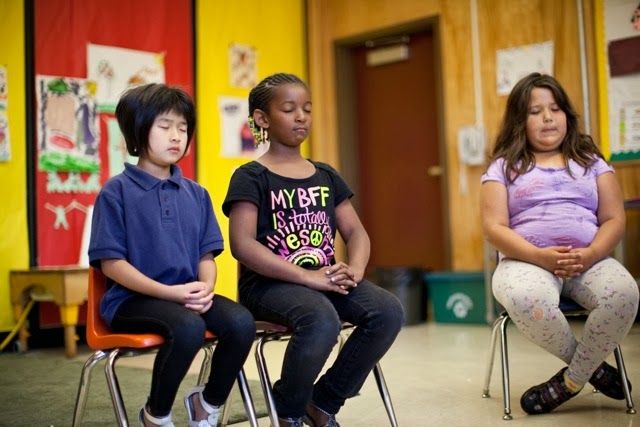
We have been promoting the value of Mindfulness in Afterschool, both as a wellness strategy for adult workers as well as a program for young people. We now have a 16-week curriculum and training that we offer to afterschool programs (now with matching funds from a local foundation). We hope to spread the practice of engaging young people in mindfulness exercises throughout the field of afterschool and summer programming. Below are a few quotes from afterschool practitioners (in Delano and Oakland, CA) who received our Mindfulness in Afterschool training:

- "Mindfulness has helped me in my life as a de-stressor when I’m overwhelmed." 

- "When I’m having a bad day, I realize that there may just be a bad situation or two but that actually there were more good situations than bad ones. It’s helping me focus on the good ones, which is making me happier and less sad."

- "We’ve starting doing mindfulness with the kids for 20 minutes. Doing a body scan and having them focus on their breath. The parents sit down and watch them and they are surprised because they’ve never seen the kids so quiet. It’s working really well."

Photo Credit: Mindful Impact

- "Before P.E., the instructor does mindful breathing. She also relayed that the Kindergarten school-day teacher had started to implement mindfulness when she saw the impact of it on her students. Co-incidentally, this same teacher stopped us in the hallway mid-program to let us know that the school-day teachers were talking about the positive effects of mindfulness on their 1st and 2nd graders who were having a particularly difficult year. When I inquired further to ask what specifically they were seeing as different, this teacher said that the youth were less volatile and less confrontational."

- "Mindfulness is effective in changing student behavior in a short amount of time. Students tell us that they enjoy it and will continue to use it in the future."  

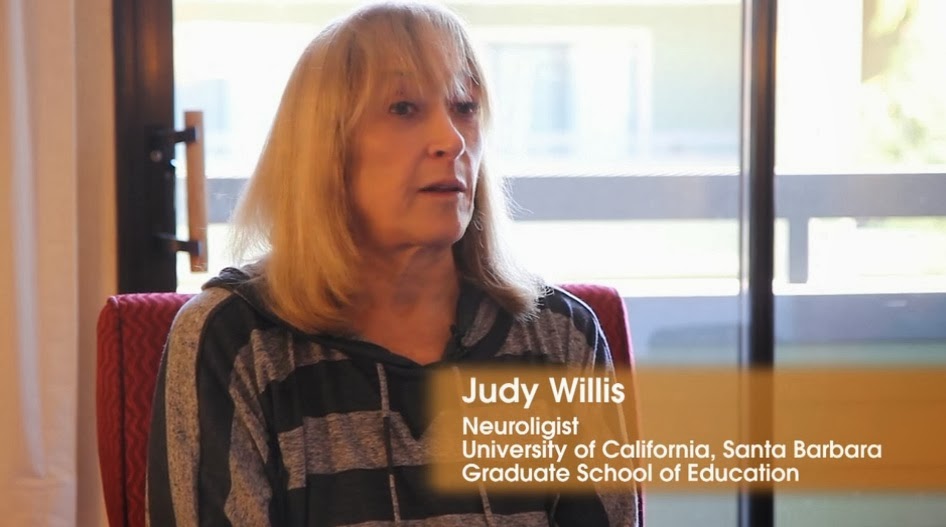
2. The latest cover of National Geographic serves as a reminder that our growing understanding of the brain and how we learn can shape our practices in youth programs. With the help of Youth Radio (Oakland, CA), we conducted two brief interviews with neurologist and classroom teacher, Judy Willis, on how we can use new learnings in brain research in our youth programs. You can view the two videos on our website by clicking here

- “As the neuroimaging evidence has shown, the more a student is engaged in a learning activity, especially one with multiple sensory modalities, the more parts of his/her brain are actively stimulated. When this occurs in a positive emotional setting, without stress and anxiety, the result is greater long-term, relational, and retrievable learning.”

- Judy Willis, M.D., M.Ed. , Board-Certified Neurologist, 
           Graduate School of Education, University of California, Santa Barbara


3. "A new survey finds that getting physically involved in learning something trumps reading about it. The results paint a picture of a very different kind of learning than what is typically found in most classrooms. The survey conducted for Everest College by Harris Interactive asked 1,000 adults what methods of learning worked best for them. Here's how the responses break down:" (Article written by Catherine Gewertz, Education Week)


Monday, February 10, 2014

More Resources on the Role of "Grit" in Learning

By Sam Piha


Sam Piha
Over the past year, we have dedicated several blog posts and portions of our last two How Kids Learn conferences to explore the importance of "grit" and persistence in young people's learning. According to research, grit is a strong indicator of GPA and graduation rates. And as we have noted in our exploration of grit, it is something that can be cultivated and taught. Part of this is developing in young people a "growth mindset", which Stanford Professor, Carol Dweck, claims is highly correlated with success. Below are some valuable resources that will help our readers continue their learning about grit and how to teach it. 


Carol Dweck, Author, Mindset: The New Psychology of Success 

True Grit: The Best Measure of Success and How to Teach It: A blog post from Edutopia, January 9, 2014. This post lists several other resources about "grit".

TED Video: Angela Lee Duckworth: The key to success? Grit: In this TED Talk, Ms. Duckworth discusses her experience regarding the role of grit in learning.  

Angela Lee Duckworth - TED Talk


Grit Scale: This survey, developed by Angela Duckworth and Chris Peterson, attempts to measure a person's "grit" and ability to persevere when challenged.

Resilience and Grit - Resource Roundup: This listing was assembled and published by Edutopia. It is a "curated collection of blogs, articles, interviews, and videos with information for parents and educators about the associated concepts of resilience and grit."


Monday, February 3, 2014

The New Quality Standards for Expanded Learning

By Sam Piha

Sam Piha
I was honored to join a group of afterschool leaders to develop a set of quality standards for expanded learning on behalf of the CDE After School Division. This group was selected through a competitive application process and met several times over the past year to complete its recommendations. After the quality standards were reviewed by stakeholders across the state, they were submitted to the After School Division in June 2013. 

CDE approved the recommendations for the 12 Quality Standards for Expanded Learning and have released them in a full report. 


The Learning in Afterschool & Summer learning principles (below in bold) are fully reflected in the following standards: 

- Active and engaged learning 
Program design and activities reflect active, meaningful and engaging learning methods that promote collaboration and expand student horizons.

- Skill building 
The program maintains high expectations for all students, intentionally links program goals and curricula with 21st-century skills and provides activities to help students achieve mastery.

There are 12 standards in all. You can view a full copy of the report here. A second quality committee is being formed to consider the terms that require further definition, the need for a self-reflection tool, and other tools to help field leaders make good use of the California Quality Standards for Expanded Learning. 


Monday, January 27, 2014

Digital Learning Day Challenge: #Make4DLDay

By Guest Blogger Jennifer Rinehart, Vice President, Research & Policy at the Afterschool Alliance

Jennifer Rinehart
On Feb. 5, thousands of educators will take part in the third annual Digital Learning Day, a nationwide celebration of common sense, effective applications of digital learning that support educators, improve learning and provide opportunities for students to achieve at their highest potential.  As part of this celebration, we’re excited to announce the #Make4DLDay challenge and want you to join the fun!

Thanks to digital media and technology, our
education system is undergoing a major shift in how, where and what students are learning.  The organizations collaborating in this challenge—the Afterschool AllianceEdutopia, and the National Writing Project (via its Educator Innovator Initiative and Digital Is platform)—share a common belief that this shift should reflect connected learning principles, including interest-driven, production-centered learning opportunities for youth, in school and out.  These principles allow youth to collaborate with peers and mentors in person and via the Web as they become producers of digital artifacts and not just consumers.


 To that end, we’re inviting you to join us in accepting the #Make4DLDay challenge—a set of digital storytelling activities that allow youth and adults to be makers for Digital Learning Day.  

So, what exactly are we making?  From remixing important historical events to educating peers about issues in their communities, we’re encouraging young people everywhere to create and share digital stories that reflect what interests them.

The #Make4DLDay challenge allows you to “level up” and participate in a number of ways, based on your familiarity with digital tools and access to technology.  All you have to do is choose your level, pick your topic and share your work on Twitter, Instagram, Facebook, Google+ or other social media platforms using the hashtag #Make4DLDay.

Check out the Digital Learning Day website for more details about the #make4DLDay challenge or browse the resources below to help familiarize you with the power of storytelling as a digital learning strategy. We can't wait to see what you come up with!

____________________________________
Jen Rinehart joined the Afterschool Alliance in September 2002 and established the Afterschool Alliance's WashingtonD.C. office.  Jen takes a primary role in the Afterschool Alliance's coalition building, policy and research efforts, and serves as a spokesperson for the organization.  Recent projects include America After 3 PM: A Household Survey on Afterschool in America and Kids Deserve Better, a campaign to get voters and candidates thinking and talking about children's issues, particularly afterschool. Jen also served as Interim Executive Director of the Afterschool Alliance from December 2004 through June 2005.  

A Book Drive for Children's Books Makes for a Fabulous Service- Learning Project

Source: The Children's Book Project  By Sam Piha   In our previous paper entitled, Reading Buddies: Promoting Literacy and Community Eng...