Monday, July 31, 2023

Defending LGBTQ+ Youth: Voices Beyond the Bubble Part 2

Source: www.pexels.com

By Sam Piha

When it comes to LGBTQ+ issues, those of us in California live in somewhat of a progressive bubble. To learn more about how leaders are responding to the recent political attacks on LGBTQ+ youth, we interviewed leaders residing outside of California to hear their views. We continue our interviews with these leaders below.

How can we support LGBTQ+ youth amid these attacks?

“Converse with the community! Educate those who are not aware of the harmful laws that are being placed and help them understand that this will not stop with us; this goes beyond our community. Reassure the youth that you will do your part and actively engage to do better for their community.” – Rex Barnes, Florida 

“Be a visible advocate and accomplice. Demonstrate you’re a supportive person by introducing yourself with your pronouns, incorporating LGBTQ+ themes and figures into your programming, and allowing space for them to process their feelings. Know and share local resources and supports and find ways for them to connect to others who share their identities.” – Nat Duran, Illinois   

What can we do to promote pro-LGBTQ+ policy and/or youth program practice?

 “Contact local organizations in your region or state that combat current legislators who are trying to silence our voices and ask them how you can get involved- whether by donating, spreading awareness, or even participating in marches.” – Rex Barnes, Florida

“Assess programmatic policies and procedures for gender inclusive language and practices - including dress codes, and gender segregated spaces. Learn how to make as many options available to all participants and let them choose their own adventure. Create regular mechanisms to get feedback from youth to ensure they feel affirmed as they move throughout your program. Connect with local LGBTQ+ advocacy organizations to stay informed about local policy changes (including school boards, local government, etc.) and advocacy asks.” – Nat Duran, Illinois   

“Programs can support LGBTQ+ youth by affirming them and creating inclusive spaces in which youth feel safe. Programs can provide spaces that affirm youths’ identities, using preferred pronouns and names, providing materials that represent identities of youth, addressing issues of discrimination openly and immediately when they happen. Inclusive materials can range from providing a variety of identities on a registration form to including members of the LGBTQ+ community in curriculum. Programs can further support LGBTQ+ youth by having explicit messages in program spaces that affirm that all young people are welcome and respected and creating spaces and opportunities for supportive and educational discussions led by experts that involve youth, staff, program leaders, and families. Programs should be educating their staff about appropriate ways to support LGBTQ+ youth from learning the vocabulary, acknowledging mistakes through training and conversation. Finally, be that caring adult and listen. LGBTQ+ youth, like their peers, want to feel heard and listened to without judgment can be what they need to feel supported.” – Patricia McGuiness, Massachusetts

“Everyone can take a step, large or small, to fight for LGBTQ+ rights and affirming policies in their community. In the K-12 school setting, educators, school support staff, and afterschool program leaders play a vital role in both directly supporting LGBTQ+ youth and advocating for better policies. 

LGBTQ+ youth need to feel seen, heard, and loved for who they are – just like any other young person. We know that having just one affirming adult in an LGBTQ+ young person’s life is correlated with a 40% lower likelihood of reporting a suicide attempt in the past year. When LGBTQ+ young people don’t feel safe or supported at home, their only access to forming positive relationships with adults who uplift and affirm their identities is often at school or in an afterschool program. People working in the afterschool space can access resources from GLSEN and local providers of Safe Zone/Safe Space trainings to learn more about being a strong advocate for LGBTQ+ youth.

K-12 school staff and afterschool program leaders also play an important role in setting the tone for LGBTQ+ inclusion at a local level. Folks who work on the ground and in the classroom with young people can directly address anti-LGBTQ+ bullying, proactively introduce positive representations of queer and transgender people in programming, and provide LGBTQ+ young people with access to resources and direct services to improve their health outcomes and help them to feel included. People who work with LGBTQ+ youth can also monitor their local school board meetings and advocate for best practice policies like introducing school Gender Support Plans, updating school dress codes, and making sure transgender students have access to restrooms and locker rooms matching their gender identity. There are lots of other ways that individuals can take action to stop these harmful bills. The Trevor Project has a great list of opportunities to get involved here.” – Brennan Lewis, North Carolina 

Who is responsible for these attacks?  

“Culturally conservative community members on the far right have been organizing for decades now against bodily autonomy. Queer and trans youth leadership programs (such as Gender Justice Leadership Programs) and GSA networks across the country are leading efforts to protect, uplift, and support LGBTQ+ young people.” – Nat Duran, Illinois    

“Many of the attacks on the LGBTQ+ community are a coordinated effort by far-right national political organizations like the Alliance Defending Freedom and Moms for Liberty. The Southern Poverty Law Center tracks these organizations as anti-LGBTQ hate groups.

National LGBTQ+ organizations like the GSA Network and GLSEN offer invaluable resources for afterschool leaders and educators to better support LGBTQ+ students and take action against harmful policy at the state and local level.” – Brennan Lewis, North Carolina

MORE ABOUT…

Rex Barnes (he/they) is the Youth & Family Services Coordinator at Compass LGBTQ+ Community Center in Lake Worth Beach, Florida. Compass is one of the largest gay and lesbian community centers in Florida and the Southeast United States and one of the largest and most respected of its kind in the nation. More than 25,000 people utilize its 14,000 square foot facility, and more than 17,000 referrals are fielded by more than 12,000 volunteer hours graciously contributed by hundreds of community-centered individuals each year.

Nat Duran (they/them) is a compassion-led and dedicated educator focused on community building and social justice across various realms of youth work. Nat has been a champion for putting youth voice to action throughout their career within school, housing, and advocacy settings; most recently they served as the Youth Engagement Manager for the Illinois Safe Schools Alliance providing statewide leadership for the safer schools movement. In addition to their role at Constellation Collective, Nat teaches within the Youth Development Masters program at University of Illinois at Chicago.

Patricia McGuiness-Carmichael MSW (she/her) is a Research Associate at the National Institute on Out-of-School Time (NIOST). Patricia has an extensive background in youth development and family engagement practice, research, and evaluation. She has worked in school and community based out-of-school time (OST) programs, creating and facilitating Social Emotional Learning (SEL) curricula, and coaching OST programs to integrate SEL into their everyday practices. Patricia participated as a National After School Matters Fellow contributing to research in the OST field. She has a background in evaluation of education initiatives, such as Reading First in South Carolina, treatment programs with Children’s Hospital Boston, and OST programs in and around Boston. As a Licensed Certified Social Worker (LCSW), Patricia began her career in the mental health and juvenile justice field before focusing on roles in prevention. 

Brennan Lewis (they/them) is Equality North Carolina's Education Policy Associate. They manage Equality NC's programs serving youth, students, and families, including the statewide Rural Youth Empowerment Fellowship. Previously, they served as the Regional Manager for the U.S. & Canada at Peace First, a global nonprofit that coaches and funds young people to create social action projects. Through work with Peace First, Equality NC, and as the founder of the Raleigh-based LGBTQ youth group QueerNC. Brennan is dedicated to mobilizing young people to lead change both in North Carolina and globally. They envision helping to build a North Carolina that elevates the voices, work, and lives of LGBTQ youth.

To see additional tools to ensure a sense of safety for all youth, see our Youth Development Guide 2.0 here. Also, we’ve developed a series of LIAS Blogs and a new briefing paper on supporting LGBTQ youth. Feel free to share these resources with your network.

Monday, July 24, 2023

Defending LGBTQ+ Youth: Voices Beyond the Bubble Part 1

Source: www.pexels.com

By Sam Piha

Recent attacks, in political rhetoric and state house legislation, are targeting LGBTQ+ young people. When it comes to LBGTQ+ issues, those of us in California live in somewhat of a progressive bubble. To learn more, we interviewed leaders residing outside of California to hear their views on the current political attacks.

Why are the political attacks on LGBTQ+ youth happening now? 

“Attacks on LGBTQ+ youth are nothing new, but the sheer number of bills introduced this year that are designed to remove rights and protections for LGBTQ+ people is staggering. As of May 1st, 2023, the ACLU is tracking 469 anti-LGBTQ+ bills introduced in the country since January, a record which more than doubles the number of bills introduced in all of 2022. The Equality Federation puts the total number at over 500. The good news is that advocates, much like our team at Equality NC, worked together to defeat nearly 90% of the harmful bills considered in 2022. 

These bills are based on mis/dis/malinformation and mischaracterization of transgender and LGBTQ+ people. Many of the bills introduced include bill text which is based on false information about fairness, societal dangers, and fear-based tactics to attack the most marginalized of our community. As we've seen the number of anti-LGBTQ+ bills increase since 2018, we've seen steady trends in attempts to strip rights away from LGBTQ+ youth and adults, such as prohibiting access to gender-affirming care for transgender youth and young adults, banning transgender students from playing on sports teams, forcing school educators and state employees to “out” LGBTQ youth, and limiting topics in school curriculum relating to race, equity, gender, LGBTQ+ topics, and systemic inequities and oppression.” – Brennan Lewis, North Carolina

What impact do you think the current political attacks are having on the LGBTQ+ youth community and the programs that serve them? 

“The impact happening now is that our trans youth who have been under gender-affirming care have been dropped from their doctors. We are hearing that a lot of doctors are worried about losing their licenses even though it's legal for youth who have been grandfathered in. This loss of treatment has been devastating four our youth and families.” – Rex Barnes, Florida

“Young people are scared. And angry. Especially trans, nonbinary, and gender expansive youth who have to witness nearly daily attacks on their rights to affirming medical care, and participation in athletic programs. More broadly, LGBTQ+ youth are actively being told they are not welcome in their home and school communities as their full and authentic selves - this is gravely impacting their mental and emotional health.” – Nat Duran, Illinois

 “Youth in the LGBTQ+ community are likely feeling unsafe and uncertain about the people in the community around them, unsure about how people are going to treat them. Even if they have safe spaces and trusted people they go to, others in those settings could create uncertain environments where youth don’t feel safe and supported. This vulnerability can lead youth to disengage from programs that are there to support them. Living daily with the stress and anxiety of knowing that other people in and around your own community are legislating against you or forming policy that is intended to limit your ability to live your life securely and equally just because of who you are, can be devastating and a continuous source of depression and pain. Young people and the programs that support them can feel targeted and experience unresolvable anger and hopelessness.

Additionally, LGBTQ+ youth are dealing with a heightened prevalence of mental health concerns, further exacerbated by the pandemic, and compounded now by an uptick in targeted attacks toward their community. According to the Trevor Project (2022), 73% of LGBTQ youth reported experiencing symptoms of anxiety, 58% experienced symptoms of depression, and 45% considered suicide in the past year. These experiences can make it both more difficult for youth to participate successfully in programming, as well as for staff to meet their needs as their experiences may be more than the program is equipped to address. Programs may face challenges in areas where policies and legislation discriminating against LGBTQ+ communities threaten to impact funding and even what can be taught or discussed within programming.” – Patricia McGuiness, Massachusetts

“LGBTQ+ youth across the country are significantly impacted by the introduction of anti-LGBTQ legislation. According to the results of a national survey of LGBTQ youth ages 13 to 24, released on May 1st by the Trevor Project, almost two thirds of respondents reported that "hearing about potential state or local laws banning people from discussing LGBTQ people at school (also known as 'Don't Say Gay') made their mental health a lot worse." Mental health impacts on transgender youth are exacerbated by high numbers of bills specifically targeting gender-affirming care, participation of transgender youth athletes in school sports teams, and protections for LGBTQ youth in K-12 schools.

For organizations and educators serving LGBTQ young people, it can be difficult to navigate the rapidly changing policy landscape. In states like Florida, where the state Board of Education approved a ban on classroom instruction about sexual orientation and gender identity in all grades, some LGBTQ teachers and allies have moved out of state or left the profession entirely amidst confusion and backlash caused by the policy. 21% of the LGBTQ population in the U.S. lives in a state that censors discussions of LGBTQ people or issues in schools (known as “Don’t Say Gay” policies), and more states are considering similar bills this legislative session.” – Brennan Lewis, North Carolina

(Note: A complete list of bios can be found at the end of part 2.) 

To see additional tools to ensure a sense of safety for all youth, see our Youth Development Guide 2.0 here. Also, we’ve developed a series of LIAS Blogs and a new briefing paper on supporting LGBTQ youth. Feel free to share these resources with your network.

Monday, July 17, 2023

How Educators, School Administrators and Families Can Thwart an Anti-Equity Agenda

Source: www.pexels.com

By Sam Piha 

Katy Swalwell & Noreen Naseem Rodríguez authored an article, How To Thwart An Anti-Equity Agenda: Advice For Teachers, Administrators, And Families published in Education Weekly (April 18, 2023) subtitled Ignoring Right-Wing Smear Campaigns Won’t Make Them Go Away.

The authors warn, “Coordinated, well-funded campaigns by conservative lawmakers across the United States are fast-tracking a radical agenda to shut down diversity, equity, and inclusion initiatives in schools. Book bans, rules for restroom and pronoun use, regulations against rainbow flags, restrictions on curriculum addressing race and gender, and other efforts fly in the face of facts, logic, democratic norms, and basic humanity.” 

“Many youth are already strategically advocating equity and justice, organizing and building coalitions while too many adults stay silent.” - Katy Swalwell & Noreen Naseem Rodríguez, How to Thwart an Anti-Equity Agenda: Advice for Teachers, Administrators, and Families

They offer advice for teachers, school administrators, and families and community members on they how they can respond to anti-equity actions. Some of their recommendations are cited below. (You can view the entire article and full set of recommendations here.)

Source: www.pexels.com

For educators 

  • Connect with people who show up to support efforts that center marginalized students and communities, including members of local organizations and online networks.
  • Engage students in primary-source inquiry, allowing them to draw their own conclusions to compelling questions. Couple this inquiry with lessons about critical media literacy and the civics of technology so their claims utilize credible evidence.
  • Review district policies and state legislation carefully so you can avoid the chilling effect of ill-informed or bogus interpretations of new rules and keep school leadership in the loop about your students’ engagement and success. This provides evidence if they need to defend you and gives them time to prepare for pushback. Build trust by communicating with families about your appreciation for their child, what you’re doing, and why—not just when controversies arise.


For school administrators 

  • Develop a detailed plan for how to support and protect staff and students if they get targeted by community members, media, or lawmakers on the anti-equity bandwagon.
  • Educate staff about the political climate so they can be more proactive about the support students and colleagues in targeted groups need.
  • Celebrate and allocate resources for staff and youth defending educational equity.

“Even the best, bravest educators in the world can only do so much if no one has their backs. Every single one of us has a role to play in helping make the work of educators less fraught and dangerous.”- Katy Swalwell & Noreen Naseem Rodríguez, How to Thwart an Anti-Equity Agenda: Advice for Teachers, Administrators, and Families


Source: www.pexels.com

For families and community members 

  • Ask young people what they need from you to feel safe and supported.
  • Support local and national organizations defending teachers and librarians’ efforts to make schools more inclusive and just.
  • Donate or request books at libraries from banned lists.”

“Whatever we do, we cannot choose to ignore this moment or shrink from scrutiny. That will not make these problems go away. It simply offloads them onto the shoulders of youth. And of any of the options before us right now, that is the least conscionable.” - Katy Swalwell & Noreen Naseem Rodríguez, How to Thwart an Anti-Equity Agenda: Advice for Teachers, Administrators, and Families


MORE ABOUT THE AUTHORS

Katy Swalwell is a former classroom teacher and professor who leads professional development, creates curriculum, and coaches leaders in schools and districts across the United States. She is a co-author of the forthcoming Fix Injustice Not Kids and Other Principles for Transformative Equity Leadership (ASCD, 2023) with Paul Gorski and co- editor of Anti-Oppressive Education in ‘Elite’ Schools: Promising Practices and Cautionary Tales from the Field (Teachers College Press, 2021) with Daniel Spikes. 

Noreen Naseem Rodríguez is an assistant professor of Teacher Learning, Research, and Practice in the School of Education at the University of Colorado Boulder and was a bilingual elementary teacher in Texas for nine years. Together, Katy and Noreen, are the authors of Social Studies for a Better World: An Anti- Oppressive Approach for Elementary Educators (Norton, 2022)


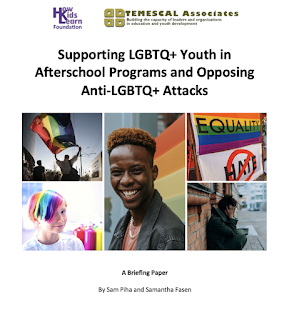
In an effort to speak out against recent political attacks on LGBTQ+ youth, Temescal Associates and The How Kids Learn Foundation have posted several LIAS blogs and authored a briefing paper entitled, Supporting LGBTQ+ Youth in Afterschool Programs and Opposing Anti-LGBTQ+ Attacks. Feel free to share these resources with your network. 

Monday, July 10, 2023

The Importance of Routines and Rituals in Afterschool Programs

Source: www.pexels.com

By Guest Blogger: Rebecca Fabiano, MSED, Executive Director of FAB Youth Philly
 
I saw this tweet several years ago and it’s stayed with me: “Structure provides predictability. Predictability enables preparation. Preparation raises confidence. Confidence is energy.” It made me think about the ways afterschool and out-of-school time (OST) programs use rituals and routines to achieve similar results for the children and youth we serve. They even often benefit our adult staff.
 
Routines are the day-to-day habits that help create and maintain structure and predictability, thus, leading to better preparation. This could be standing at the door and saying hello to everyone as they enter your space.
 
Or adhering to a specific schedule, daily chores, etc. Routines create a sense of predictability, which is very important to children and youth of all ages. 
 
“Predictability, or being able to know what to expect, is an important ingredient for healthy development. Predictable routines and consistent relationships provide a foundation of trust and security for children. When children know what to expect and who they can rely on, they have the confidence to explore the world around them and develop new skills.” - Future Learn, Predictability and Development

Predictability can help children who need consistency every day to stay on task, and routines can help reduce off-task behaviors, especially during transitions, which is when children tend to be most off track (think in between classes in the hallways, transitioning from independent stations to group work). Predictability provides those who need a sense of control something they can count on. Routines also become the ‘boss’ and they can diminish arguments about what is and isn’t fair, and what is and isn’t going to happen, or how it is or isn’t going to happen. This is important both for younger children who care about right and wrong from the perspective of concrete thinking to older teens who are trying to understand the nuances of right and wrong.

“Predictability is a stabilizing force for teens, but it’s been disrupted by the pandemic.” - Teen Mental Health: A Vulnerable Stage of Life

Here are a few more examples of routines you may expect to see in an OST program:
  • Procedures are in place for getting materials, sharpening pencils, discarding paper, etc.
  • Group leaders use signals and/or cues (clapping, music, chimes, quotes, etc.) to gain students’ attention.
  • Expectations for productive group work are established and clearly communicated orally and/or in writing.  
Adults benefit from routines too (and naps!), and the predictability of them can help them to better prepare. Having a deadline to submit lesson plans, a weekly learning community meeting with peers, scheduled prep time, are all examples of routines that provide structure for adults. Think about how more confident you often feel when you are prepared. Children and youth also feel more confident when they are prepared. OST programs by nature are designed to help children and youth to build confidence and that happens most when we implement intentional strategies like rituals and routines.

Different from a routine (the day-to-day things that create predictability), a ritual is something that has special meaning. For example, on the first day of the program, roll out a ‘red carpet’ and have people dance into the building or classroom. Decorate a classroom or library door to celebrate historical figures during Black History Month. When distributing certificates of completion, give them out in alphabetical order by participant to participant, starting with the person with the last name starting with an “A” and them giving the certificate to the person with the last name starting with a “B”; and have that person give to the person with a last name starting with “C” and so on. Rituals can also be energizing because they evoke a different energy from the day-to-day routines. Think campfires at the end of a long week of summer camp, or an end of semester talent showcase by the senior class.
 
If you’re looking to re-energize your OST program, or to inspire more confidence, or looking to add a little more structure to your program, take some time to assess what rituals and routines you have in place. Ask your staff if they have any favorite rituals from when they were in school, or summer camp or as an OST participant themselves. Try them out! Assess whether your current routines are effectively creating structure and predictability, or if they just create bureaucracy. If people aren’t feeling prepared or energized by them, maybe it’s time to find new routines for your OST program.
 
[Note: Pictures and quotes added by Temescal Associates.] 

MORE ABOUT…

For nearly 25 years, Rebecca Fabiano has worked in various capacities across nonprofit and youth-serving organizations, served on boards and helped to build solid youth programs that engage, encourage, and create spaces for positive development. As a program leader, she has successfully raised funds and managed program budgets; hired and supervised staff; developed and sustained strong community partnerships and designed award-winning programming.
 
Fab Youth Philly (FYP) has a unique, holistic model for youth development. Their three-pronged approach to youth development is aimed at creating relevant, engaging, and empowering learning opportunities at the individual, professional, and community level. First, they provide innovative, award-winning summer and afterschool programs for teens with a focus on workforce development programming. Second, they connect with youth development professionals working with or on behalf of youth through their Center for Youth Development Professionals (CYDP), which offers competency-based professional development and networking opportunities. Third, they consult with other youth-serving organizations to provide a range of consulting services, ranging from curriculum development to retreats and small conferences.

To see additional tools to ensure a sense of safety for all youth, see our Youth Development Guide 2.0 here. Also, a new briefing paper on supporting LGBTQ youth. Feel free to share this resource with your network.


Monday, July 3, 2023

You Can't "De-Gay" Our GSA

There have been many attacks on LGBTQ+ youth in political rhetoric and state house legislation recently. This blog was written by Joshua Kilburn when he was a student at South Garland High School in Garland, Texas. It was originally published by the Texas ACLU

YOU CAN'T "DE-GAY" OUR GSA By Joshua Kilburn 

Joshua Kilburn
My school, South Garland High School in Garland, Texas, is really large and diverse. It’s also right outside of Dallas, so it’s not like the fact that gay people exist is something new here. But I do still sometimes hear the word “faggot” thrown around in the hallway. Sometimes it can be a scary place to be gay.

That’s why I decided to start a Gay-Straight Alliance. GSAs can provide a safe space for LGBT students and their friends to be who they are without having to hear that kind of thing. They make schools a safer place for everyone, and thankfully, they’re in thousands of schools all over the country and have been around since the 1990s.

With over 2,000 students here, it’s not surprising that we have more than 50 different student clubs and organizations. There are cultural groups like Sabor Latino and religious clubs like Fellowship of Christian Athletes. And, there are all sorts of clubs that are just about things people are interested in like: Table-Top Gaming Club, Fashion Club, Chess Club, and Comedy Improv Troupe. With so many clubs at our school, my friends and I didn’t think getting approval for a GSA would be a problem at all.

We lined up four faculty sponsors who were willing to help us out and came up with a plan to call our club the PRIDE (Promoting Relationships in Diversity Education) GSA. We planned a bunch of activities like a Rainbow Day in the spring when we’d all wear rainbow t-shirts and have a little pride party after school with snacks and music. One of the first things we wanted to do this semester was Ally Week. Created by the Network (GLSEN), it’s a time to talk about how we can all be better allies to LGBT students while helping to fight bullying and harassment.

There was some confusion while we were trying to make plans for the year, and for a while there we thought the school wasn’t going to let us call it a Gay-Straight Alliance, so the name would have to be just PRIDE. We also were told it shouldn’t be about LGBT stuff, but more of a general diversity club, doing stuff about Latino American culture and Black History Month even though there are already clubs that celebrate those things. And we were under the impression that we couldn’t have Rainbow Day or Ally Week.

I went to the GLSEN website looking for help, and that’s when I found a link to the ACLU’s resources for LGBT students. I learned that federal law says that if a public school allows any noncurricular clubs like Table-Top Gaming Club or Fellowship of Christian Athletes, then it can’t say no when students want to start other noncurricular clubs like a GSA. The school also can’t act like it’s allowing a GSA and then just de-gay everything about our club – including the name. And best of all, I found out how to contact the ACLU for help.

So that’s why the ACLU LGBT Project and the ACLU of Texas worked with my school district last week to make sure they understood we have the legal right to form a club with GSA in the name and talk about LGBTQ issues. And, it was a big relief when the school told us that we could do all of the things we’d hoped for, including hosting Ally Week and Rainbow Day. More importantly, I learned that we had a right to equality, and I wasn’t alone.

All we want is to make South Garland High School a safer school, not just for LGBT students but for everyone. We’re glad our school has decided to become an ally, too, and help us make that happen, especially to take the “scary” away from being gay at South Garland High.

Learn more about LGBTQ news and other civil liberties issues: Sign up for breaking news alerts, follow the Texas ACLU on Twitter, and like them on Facebook

In an effort to speak out against recent political attacks on LGBTQ+ youth, Temescal Associates and The How Kids Learn Foundation have posted several LIAS blogs and authored a briefing paper entitled, Supporting LGBTQ+ Youth in Afterschool Programs and Opposing Anti-LGBTQ+ Attacks. Feel free to share these resources with your network. 


Monday, June 26, 2023

What is Experiential Intelligence?

Soren Kaplan

By Sam Piha

Many people, young and old, ask themselves, “Am I smart?, Am I intelligent?” Traditionally this was measured by an IQ test or for many young people, their grades received in school. The notion of intelligence changed in the 80’s and 90’s, with the idea of “multiple intelligences.” In his new book, Soren Kaplan promotes the idea of “Experiential Intelligence,” or XQ.  

“Rather than book smarts or empathetic abilities, experiential intelligence is a measure of how your life experiences have shaped the way you think, what you know and how you use that knowledge.” - Natasha Piñon, A more useful way to measure intelligence, XQ is ‘the new EQ,’ says USC researcher

While Kaplan's idea of experiential intelligence has been adopted by leading business thinkers, we thought that the idea of experiential intelligence was important for youth workers to understand. This is because everyone, regardless of race, gender or social economic status has life experiences that can add to experiential intelligence. We interviewed Dr. Kaplan to learn more about this idea. Below are his responses.

“When you more fully understand the impact of your past on how you think, feel, and act, you increase self-awareness. And by exploring your most challenging experiences with greater intention, you can discover hidden strengths that you can use to empower your future.”- Soren Kaplan, Your Childhood Traumas Can Empower Your Future Success 

Q: People often say they are "smart." What is the difference between "smart" and "intelligence"? 

A: Sometimes we use the word smart to describe someone’s ability to function effectively in the world. Think about the term “street smarts” for example. This term suggests someone might not have a high score on an IQ test or have received the highest test scores in school, or even a degree, but rather the person is adept at navigating the world because of their experiences. Intelligence, on the other hand, is typically tied to more formal definitions related to the intellect and IQ tests.

Q: Can you define experiential intelligence?

A: Experiential Intelligence, or XQ for short, is "the combination of mindsets, abilities, and know-how gained from your experiences." Just as memorizing facts doesn't give you a high IQ, Experiential Intelligence isn't merely what you've learned over time. It's how you view opportunities, perceive challenges, and tackle goals.

Your XQ consists of:

  • Mindsets: attitudes and beliefs about yourself, other people, and the world
  • Abilities: competencies that help you integrate knowledge, skills and experiences to respond to situations in the most effective way possible
  • Know-how: your knowledge and skills

As a complement to IQ and EQ, Experiential Intelligence expands our understanding of what's needed for success in today's increasingly uncertain, ever-changing business environment. XQ is like the third leg of a stool that's been propping us up all along but that we haven't been able to see because it's been hidden beneath our seats.

Here are a couple of articles that were written about my book that define this a bit deeper:

Q: Can experiential intelligence come from negative experiences?

A: Research from Richard Tedeschi on Post-Traumatic Growth reveals how “negative experiences can spur positive change, including the recognition of personal strengths, the exploration of new possibilities, improved relationships, a greater appreciation for life, and spiritual growth.” People who have endured natural disasters, bereavement, job loss, economic stress, and serious illnesses often gain insight into themselves and the world in ways that transform their lives. The opportunity is to understand how your past led to tangible strengths, not despite your traumatic experiences, but because of them.

Q: It occurs to me that "experiential intelligence" is very democratic and can be possessed regardless of socio-economic status. Your thoughts? 

A: It absolutely is. Everyone has street smarts because we all have experiences. And our experiences give us strengths and assets. So, it’s as democratic as can be.

Q: How can someone discover his/her hidden strengths that have come from past experiences?

A: There are two strategies for viewing your past:

  • Gain insight into how the negative impacts of certain experiences may still linger with you today so you can overcome them
  • Uncover hidden strengths that certain experiences delivered to you that can be leveraged in new, creative ways.

Q: Similar to "growth mindset," it seems the notion of experiential intelligence is very useful in working with youth as it credits their experience regardless of socio-economic status. Your thoughts?

A: Again, I completely agree. When working with youth in schools, in the home as parents, as educators, etc., we have the opportunity to:

  1. Recognize the strengths that exist because of all experiences.
  2. Help youth see their experiences holistically, as things that might have been difficult that might need to be addressed due to certain struggles but at the same time instilling unique strengths. Allowing youth to understand themselves better and see their strengths not despite their experiences but because of them.
  3. Create experiences that build intelligence – dialoguing with others they might not normally experience (elderly, from other schools, ages, etc.), travel to unusual places in nature or cities, new types of games and experiential learning activities, etc.

There are several video interviews/ podcasts with Soren Kaplan that are available to watch online at no cost. Below is one video that is worthy of your attention: 

Inside Personal Growth, Podcast 993: Experiential Intelligence with Soren Kaplan

MORE ABOUT...

Soren Kaplan is the bestselling and award winning author of Leapfrogging, The Invisible Advantage and his newest release, Experiential Intelligence: Harness the Power of Experience for Personal and Business Breakthroughs. He is also an Affiliated Practitioner at the Center for Effective Organizations at USC’s Marshall School of Business, a writer for FastCompany and Inc. Magazine, a globally recognized keynote speaker, and the Founder of InnovationPoint and upBOARD. He has been recognized by the Thinkers50 as one of the world’s top thought leaders in business strategy and innovation.

He has been quoted, published, and interviewed by Harvard Business Review, Fast Company, Forbes, CNBC, National Public Radio, the American Management Association, USA Today, Strategy & Leadership, and The International Handbook on Innovation, among many others.  

Monday, June 19, 2023

Political Attacks on LGBTQ+ Youth: The Role of the Afterschool Community and Funders

Source: Temescal Associates
By Sam Piha

As LGBTQ+ youth are being politically attacked across the country, many are asking how should the afterschool community and funders respond? Below we weigh in on this question.

THE ROLE OF THE AFTERSCHOOL COMMUNITY
The answer to the question of how the afterschool community should respond to the current anti-LGBTQ+ youth actions is complex. First and foremost, afterschool programs should focus on creating a safe and supportive environment for all youth, including LGBTQ+ youth and ensuring that all of their participants feel seen and supported. 

Afterschool programs can: 

Build Awareness
  • Stay informed by following news about LGBTQ issues in your state and around the country. Sign up for newsletters or alerts from organizations like The Trevor Project or the ACLU and follow their social media accounts to stay up-to-date on the latest developments.
  • Educate others in their networks and community.

Improve Program Practice
  • Hire knowledgeable and diverse staff, especially from the LGBTQ+ community.
  • Ensure that staff are fully informed and know the risk factors for LGBTQ+ youth.
  • Really listen to young people.
  • Build positive relationships among adults and youth.
  • Provide opportunities for all youth to express themselves.
  • Promote positive peer interaction, respect and support.
  • Provide opportunities for youth to make their voices heard in policy discussions.
  • Provide opportunities for youth to form Genders & Sexualities Alliance  or Gay/Straight Alliance (GSA) clubs.
  • Know how and when to communicate and collaborate with the school and parents regarding the importance of supporting the safety and acceptance of all youth, including LGBTQ+ youth. 
  • Introduce efforts to prevent meanness and promote kindness.
  • Provide professional development opportunities to build knowledge and skills of afterschool staff. 

Source: Hart Van Denburg/ CPR News
Directly Oppose Anti-LGBTQ+ Legislation and Attacks
Afterschool programs and leaders are not equipped to end the political attacks on LGBTQ+ youth alone. However, they and their allies can still act. If history is any teacher, systemic oppression begins with targeting the most vulnerable. 
“Whatever we do, we cannot choose to ignore this moment or shrink from scrutiny. That will not make these problems go away. It simply offloads them onto the shoulders of youth. And of any of the options before us right now, that is the least conscionable.” Katy Swalwell & Noreen Naseem Rodriguez, How to Thwart an Anti-Equity Agenda: Advice for Teachers, Administrators, and Families


The afterschool community can advocate in support of LGBTQ+ youth by:
  • Speaking out against anti-LGBTQ+ attacks.
  • Finding a state or local organization that’s working to fight back against anti-LGBTQ+ bills. 
  • Reaching out to their legislators and share your views.
  • Watching or following related hearings and legislative sessions.


“It’s clear that lawmakers should be taking an intersectional approach to public policy, not working overtime to target the most marginalized young people, particularly those who are transgender or nonbinary, for partisan political points. We all must play a role in promoting LGBTQ acceptance and creating a more supportive world for all young people.” – Josh Weaver, The Trevor Project 


A Caution for Afterschool Networks and Providers
It is important that each organization determine how best to respond to the anti-LGBTQ+ youth legislation and political rhetoric, in consideration of the local climate regarding LGBTQ+ issues.

A national afterschool leader we interviewed shared, “If leaders were to speak out in opposition to the legislators in power about actions, they may be adding fuel to the “culture wars”- whether it be at the local, state or national level. They may run the risk of losing funding for the children they serve and getting into a fight where we can’t win without hurting kids we care so much about. Instead, we can showcase by actions how to treat people and children with love- not hate - and not engaging on terms that will inflame tensions and hurt our ability to serve kids.”

“Educators committed to inclusive, equitable, information-rich schooling are asking: How can we avoid becoming targets for right-wing smear campaigns? What might get us in trouble with a zealous school board? What if we get fired—or even prosecuted? Should we quit rather than comply with a policy that hurts youth?”– Katy Swalwell & Noreen Naseem Rodriguez, How to Thwart an Anti-Equity Agenda: Advice for Teachers, Administrators, and Families


THE ROLE OF AFTERSCHOOL AND YOUTH DEVELOPMENT FUNDERS
Many funders are not clear as to how they can get involved. A consultant and advisor to foundations we interviewed shared “After many foundations jumped to creating statements against the George Floyd murder and other atrocities, board of directors started requesting policies regarding when it is appropriate for an organization to take a stand and when it’s not (e.g., should we make a statement for EVERYTHING?).”

However, afterschool and youth development funders can respond to this wave of anti-LGBTQ legislation and attacks in several ways. In A New Wave of Anti-LGBTQ Bills – What Can Funders Do?, author Andrew Wallace offers suggestions on how funders can respond. Below we present excerpts from this article. 

Source: Temescal Associates
“Foundations and corporations can respond to this wave of anti-LGBTQ legislation in a number of ways – and many are already doing so. Here are a few of the ways that funders are standing up for LGBTQ rights in the face of a new wave of backlash:

1. Make a public statement. As anti-LGBTQ+ bills have surfaced around the country, so has rhetoric that scapegoats LGBTQ people, especially transgender people. It can be powerful for a respected foundation to simply make a public statement that your foundation believes in full dignity and equality for LGBTQ people…”

 
La June Montgomery
“The W.K. Kellogg Foundation (WKKF) stands with businesses, organizations and individuals seeking to protect the human rights of the LGBT communities in North Carolina, as well as other states where similar laws are being considered. We are heartened by the broad coalition of public sector, non-profit, business and civic leaders who are speaking out against this injustice. WKKF is proud to join their ranks.”
 
- La June Montgomery, CEO of WKKF

2. Advocate for partners to take a stand too. Foundations can have influence even when based outside of states where anti-LGBTQ laws are being considered. For example, The California Endowment sent letters to Georgia-based corporations where the Endowment held investments, asking them to take a stand against the state’s anti-LGBTQ legislation. In addition to that kind of shareholder advocacy, foundations and funder networks also hold conferences and events around the country. Many funders and networks are considering moving meetings to states that have more LGBTQ-affirming laws. Even if moving your event doesn’t make sense, you can use it as an opportunity to foster dialogue and raise awareness of the real harm caused by anti-LGBTQ laws.”


In an effort to speak out against recent political attacks on LGBTQ+ youth, Temescal Associates and The How Kids Learn Foundation have posted several LIAS blogs and authored a briefing paper entitled, Supporting LGBTQ+ Youth in Afterschool Programs and Opposing Anti-LGBTQ+ Attacks. Feel free to share these resources with your network. 

Monday, June 12, 2023

In Case You Missed It

By Sam Piha
 
We’ve been very busy during the first half of 2023 addressing many of the cutting edge issues faced by the afterschool field. We have written many LIAS blogs (23), published several briefing papers (3), and sponsored several training webinars (7). Below we share several of our most popular resources and some of our favorites from 2023. 
 

BLOGS


BRIEFING PAPERS


RECORDED WEBINAR TRAININGS
 
For a comprehensive catalogue of our afterschool resources, click here
 
MORE ABOUT...

Temescal Associates and the How Kids Learn Foundation (a 501(c)3) are dedicated to building the capacity of leaders and organizations in education and youth development who are serious about improving the lives of young people. Our clients include leaders of youth serving institutions and organizations, school and youth program practitioners, public and private funders, intermediary organizations, and policy makers. Our work ranges from building large scale youth and community initiatives to providing services to young people on a day-to-day basis.


A Book Drive for Children's Books Makes for a Fabulous Service- Learning Project

Source: The Children's Book Project  By Sam Piha   In our previous paper entitled, Reading Buddies: Promoting Literacy and Community Eng...