Showing posts with label anti-lgbtq bills. Show all posts

Monday, July 3, 2023

You Can't "De-Gay" Our GSA

There have been many attacks on LGBTQ+ youth in political rhetoric and state house legislation recently. This blog was written by Joshua Kilburn when he was a student at South Garland High School in Garland, Texas. It was originally published by the Texas ACLU

YOU CAN'T "DE-GAY" OUR GSA By Joshua Kilburn 

Joshua Kilburn
My school, South Garland High School in Garland, Texas, is really large and diverse. It’s also right outside of Dallas, so it’s not like the fact that gay people exist is something new here. But I do still sometimes hear the word “faggot” thrown around in the hallway. Sometimes it can be a scary place to be gay.

That’s why I decided to start a Gay-Straight Alliance. GSAs can provide a safe space for LGBT students and their friends to be who they are without having to hear that kind of thing. They make schools a safer place for everyone, and thankfully, they’re in thousands of schools all over the country and have been around since the 1990s.

With over 2,000 students here, it’s not surprising that we have more than 50 different student clubs and organizations. There are cultural groups like Sabor Latino and religious clubs like Fellowship of Christian Athletes. And, there are all sorts of clubs that are just about things people are interested in like: Table-Top Gaming Club, Fashion Club, Chess Club, and Comedy Improv Troupe. With so many clubs at our school, my friends and I didn’t think getting approval for a GSA would be a problem at all.

We lined up four faculty sponsors who were willing to help us out and came up with a plan to call our club the PRIDE (Promoting Relationships in Diversity Education) GSA. We planned a bunch of activities like a Rainbow Day in the spring when we’d all wear rainbow t-shirts and have a little pride party after school with snacks and music. One of the first things we wanted to do this semester was Ally Week. Created by the Network (GLSEN), it’s a time to talk about how we can all be better allies to LGBT students while helping to fight bullying and harassment.

There was some confusion while we were trying to make plans for the year, and for a while there we thought the school wasn’t going to let us call it a Gay-Straight Alliance, so the name would have to be just PRIDE. We also were told it shouldn’t be about LGBT stuff, but more of a general diversity club, doing stuff about Latino American culture and Black History Month even though there are already clubs that celebrate those things. And we were under the impression that we couldn’t have Rainbow Day or Ally Week.

I went to the GLSEN website looking for help, and that’s when I found a link to the ACLU’s resources for LGBT students. I learned that federal law says that if a public school allows any noncurricular clubs like Table-Top Gaming Club or Fellowship of Christian Athletes, then it can’t say no when students want to start other noncurricular clubs like a GSA. The school also can’t act like it’s allowing a GSA and then just de-gay everything about our club – including the name. And best of all, I found out how to contact the ACLU for help.

So that’s why the ACLU LGBT Project and the ACLU of Texas worked with my school district last week to make sure they understood we have the legal right to form a club with GSA in the name and talk about LGBTQ issues. And, it was a big relief when the school told us that we could do all of the things we’d hoped for, including hosting Ally Week and Rainbow Day. More importantly, I learned that we had a right to equality, and I wasn’t alone.

All we want is to make South Garland High School a safer school, not just for LGBT students but for everyone. We’re glad our school has decided to become an ally, too, and help us make that happen, especially to take the “scary” away from being gay at South Garland High.

Learn more about LGBTQ news and other civil liberties issues: Sign up for breaking news alerts, follow the Texas ACLU on Twitter, and like them on Facebook

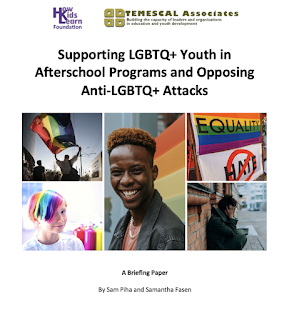
In an effort to speak out against recent political attacks on LGBTQ+ youth, Temescal Associates and The How Kids Learn Foundation have posted several LIAS blogs and authored a briefing paper entitled, Supporting LGBTQ+ Youth in Afterschool Programs and Opposing Anti-LGBTQ+ Attacks. Feel free to share these resources with your network. 

Monday, June 19, 2023

Political Attacks on LGBTQ+ Youth: The Role of the Afterschool Community and Funders

Source: Temescal Associates
By Sam Piha

As LGBTQ+ youth are being politically attacked across the country, many are asking how should the afterschool community and funders respond? Below we weigh in on this question.

THE ROLE OF THE AFTERSCHOOL COMMUNITY
The answer to the question of how the afterschool community should respond to the current anti-LGBTQ+ youth actions is complex. First and foremost, afterschool programs should focus on creating a safe and supportive environment for all youth, including LGBTQ+ youth and ensuring that all of their participants feel seen and supported. 

Afterschool programs can: 

Build Awareness
  • Stay informed by following news about LGBTQ issues in your state and around the country. Sign up for newsletters or alerts from organizations like The Trevor Project or the ACLU and follow their social media accounts to stay up-to-date on the latest developments.
  • Educate others in their networks and community.

Improve Program Practice
  • Hire knowledgeable and diverse staff, especially from the LGBTQ+ community.
  • Ensure that staff are fully informed and know the risk factors for LGBTQ+ youth.
  • Really listen to young people.
  • Build positive relationships among adults and youth.
  • Provide opportunities for all youth to express themselves.
  • Promote positive peer interaction, respect and support.
  • Provide opportunities for youth to make their voices heard in policy discussions.
  • Provide opportunities for youth to form Genders & Sexualities Alliance  or Gay/Straight Alliance (GSA) clubs.
  • Know how and when to communicate and collaborate with the school and parents regarding the importance of supporting the safety and acceptance of all youth, including LGBTQ+ youth. 
  • Introduce efforts to prevent meanness and promote kindness.
  • Provide professional development opportunities to build knowledge and skills of afterschool staff. 

Source: Hart Van Denburg/ CPR News
Directly Oppose Anti-LGBTQ+ Legislation and Attacks
Afterschool programs and leaders are not equipped to end the political attacks on LGBTQ+ youth alone. However, they and their allies can still act. If history is any teacher, systemic oppression begins with targeting the most vulnerable. 
“Whatever we do, we cannot choose to ignore this moment or shrink from scrutiny. That will not make these problems go away. It simply offloads them onto the shoulders of youth. And of any of the options before us right now, that is the least conscionable.” Katy Swalwell & Noreen Naseem Rodriguez, How to Thwart an Anti-Equity Agenda: Advice for Teachers, Administrators, and Families


The afterschool community can advocate in support of LGBTQ+ youth by:
  • Speaking out against anti-LGBTQ+ attacks.
  • Finding a state or local organization that’s working to fight back against anti-LGBTQ+ bills. 
  • Reaching out to their legislators and share your views.
  • Watching or following related hearings and legislative sessions.


“It’s clear that lawmakers should be taking an intersectional approach to public policy, not working overtime to target the most marginalized young people, particularly those who are transgender or nonbinary, for partisan political points. We all must play a role in promoting LGBTQ acceptance and creating a more supportive world for all young people.” – Josh Weaver, The Trevor Project 


A Caution for Afterschool Networks and Providers
It is important that each organization determine how best to respond to the anti-LGBTQ+ youth legislation and political rhetoric, in consideration of the local climate regarding LGBTQ+ issues.

A national afterschool leader we interviewed shared, “If leaders were to speak out in opposition to the legislators in power about actions, they may be adding fuel to the “culture wars”- whether it be at the local, state or national level. They may run the risk of losing funding for the children they serve and getting into a fight where we can’t win without hurting kids we care so much about. Instead, we can showcase by actions how to treat people and children with love- not hate - and not engaging on terms that will inflame tensions and hurt our ability to serve kids.”

“Educators committed to inclusive, equitable, information-rich schooling are asking: How can we avoid becoming targets for right-wing smear campaigns? What might get us in trouble with a zealous school board? What if we get fired—or even prosecuted? Should we quit rather than comply with a policy that hurts youth?”– Katy Swalwell & Noreen Naseem Rodriguez, How to Thwart an Anti-Equity Agenda: Advice for Teachers, Administrators, and Families


THE ROLE OF AFTERSCHOOL AND YOUTH DEVELOPMENT FUNDERS
Many funders are not clear as to how they can get involved. A consultant and advisor to foundations we interviewed shared “After many foundations jumped to creating statements against the George Floyd murder and other atrocities, board of directors started requesting policies regarding when it is appropriate for an organization to take a stand and when it’s not (e.g., should we make a statement for EVERYTHING?).”

However, afterschool and youth development funders can respond to this wave of anti-LGBTQ legislation and attacks in several ways. In A New Wave of Anti-LGBTQ Bills – What Can Funders Do?, author Andrew Wallace offers suggestions on how funders can respond. Below we present excerpts from this article. 

Source: Temescal Associates
“Foundations and corporations can respond to this wave of anti-LGBTQ legislation in a number of ways – and many are already doing so. Here are a few of the ways that funders are standing up for LGBTQ rights in the face of a new wave of backlash:

1. Make a public statement. As anti-LGBTQ+ bills have surfaced around the country, so has rhetoric that scapegoats LGBTQ people, especially transgender people. It can be powerful for a respected foundation to simply make a public statement that your foundation believes in full dignity and equality for LGBTQ people…”

 
La June Montgomery
“The W.K. Kellogg Foundation (WKKF) stands with businesses, organizations and individuals seeking to protect the human rights of the LGBT communities in North Carolina, as well as other states where similar laws are being considered. We are heartened by the broad coalition of public sector, non-profit, business and civic leaders who are speaking out against this injustice. WKKF is proud to join their ranks.”
 
- La June Montgomery, CEO of WKKF

2. Advocate for partners to take a stand too. Foundations can have influence even when based outside of states where anti-LGBTQ laws are being considered. For example, The California Endowment sent letters to Georgia-based corporations where the Endowment held investments, asking them to take a stand against the state’s anti-LGBTQ legislation. In addition to that kind of shareholder advocacy, foundations and funder networks also hold conferences and events around the country. Many funders and networks are considering moving meetings to states that have more LGBTQ-affirming laws. Even if moving your event doesn’t make sense, you can use it as an opportunity to foster dialogue and raise awareness of the real harm caused by anti-LGBTQ laws.”


In an effort to speak out against recent political attacks on LGBTQ+ youth, Temescal Associates and The How Kids Learn Foundation have posted several LIAS blogs and authored a briefing paper entitled, Supporting LGBTQ+ Youth in Afterschool Programs and Opposing Anti-LGBTQ+ Attacks. Feel free to share these resources with your network. 

Monday, May 1, 2023

Our Resolution: Defeat Anti-LGBTQ Bills in 2023


By: Guest Blogger Ryan Bernsten, The Trevor Project
 
As we start a new year, we enter a hostile political landscape for LGBTQ young people in states across America. In 2022, 220 anti-LGBTQ bills were considered in a majority of states across the country — a record number. In 2023, this trend is set to continue, as state houses around America are considering legislation that targets LGBTQ young people, ranging from censoring LGBTQ-related curriculums and books, banning transgender student-athletes from participating in sports that match their gender identity, and criminalizing doctors and families who support youth with transgender medical care.  

Source: The Trevor Project
That’s the bad news. However, there is reason for optimism: nearly 90% of harmful bills considered in 2022 were defeated by LGBTQ advocates and allies.  

These wins don’t just happen organically. They’re a result of targeted grassroots efforts of educating legislators about the real impacts and harm these policies cause. We know that to many families, the prospect of another tough year is daunting. For those new to LGBTQ advocacy, joining in to defend our young people can seem overwhelming. Our best power and momentum lies when we stay informed and work together. So, at the Trevor Project we’re making a New Year’s resolution to support advocates in state legislatures across the country who are standing up for LGBTQ youth, especially trans and nonbinary youth. We hope you’ll join us.

Source: The Trevor Project

As an advocate for LGBTQ rights, it’s important to stay informed about these bills and to be ready to take action to fight back against them. Here are some steps you can take to make a difference:

Stay informed: Follow news about LGBTQ issues in your state and around the country. Sign up for newsletters or alerts from organizations like The Trevor Project or the ACLU, and follow their social media accounts to stay up-to-date on the latest developments.

Get involved: Find a state or local organization that’s working to fight back against these bills. Consider joining their efforts and getting involved in their campaigns. Volunteering your time, donating money, or even just sharing information on social media can make a difference. You can find local organizations here.

Reach out to your legislators: Remember that politics is local. If you live in a state where an anti-LGBTQ bill is being considered, reach out to your state legislators and let them know how you feel. You can do this through email, phone, or even by writing a postcard or letter. Make sure to explain why the bill is harmful and why you oppose it. You can even visit them at their offices to have a face-to-face conversation with their staff. You can find your state legislator here

Watch hearings and state legislative sessions: As these bills are being debated, they often go through a public hearing process. Find out where and when these bills are being discussed and show up or watch them online. Let the legislators know that there is an audience that doesn’t agree with these harmful bills. Remember that politicians want to be re-elected. Presence is pressure.

Educate others: One of the most powerful things you can do to protect LGBTQ young people is to speak to the people in your life about why these bills are so harmful. Visit our Resource Center to find guides and educational materials. Remember, you don’t have to have all the correct language to make a difference. You just have to speak from your heart and practice empathy. If you have a platform or writing skills, you can also contact local publications to write op-eds or letters to the editor about these issues. 

The Trevor Project is fighting every day for a more inclusive world for LGBTQ young people, but we can’t do it alone. We all have the power to change hearts and minds through people-to-people conversations, local and state advocacy, and the ballot box. Make a resolution this year to stay involved and ensure that we defeat as many of these harmful bills as possible.

MORE ABOUT...

Ryan Bernsten is a Senior Managing Editor at The Trevor Project, a suicide prevention and mental health organization for lesbian, gay, bisexual, transgender, queer & questioning (LGBTQ) young people.


The Trevor Project
'
s mission is to end suicide among lesbian, gay, bisexual, transgender, queer & questioning young people. Their vision is a world where all LGBTQ young people see a bright future for themselves.

A Book Drive for Children's Books Makes for a Fabulous Service- Learning Project

Source: The Children's Book Project  By Sam Piha   In our previous paper entitled, Reading Buddies: Promoting Literacy and Community Eng...