|
| Source: www.unsplash.com |
By Sam Piha
(Note: Our series of blog posts on chronic school absenteeism
are excerpts from a larger briefing paper entitled, Chronic School Absenteeism and the Role of Afterschool.)
“Once you better understand the ‘why’ then you can consider community resources and other supports that can assist the family and begin to improve school attendance. Developing a supportive relationship and maintaining regular contact will show the family this is about long-term change and that they could on rely on you as a support system. They need to see you working with them as a positive partnership. Your relationship and work with them needs to be seen as an ally.” [i]
Myths Of Chronic Absence—And How to Counteract Them
According to an article published by American Institutes for Research (AIR), “Standing in the way of truly addressing chronic absence are three harmful myths. These myths can be counteracted by using evidence-based approaches grounded in the seminal body of knowledge known as the conditions for learning. A safe, supportive and engaging environment for learning buffers against widespread chronic absence, and educators must examine these conditions to appropriately address this issue.
- Myth 1: Invoking legal consequences is an effective response to poor attendance. Counter Action: Refrain from relying on punitive policies that create additional obstacles to attendance.
- Myth 2: Attendance is simply a reflection of how much students and families value education. Counter Action: Get to know your students and their families better.
- Myth 3: Improving student attendance is beyond educators’ sphere of influence. Counter Action: Provide support when possible and counterbalance external factors by creating a supportive school environment.” [ii]
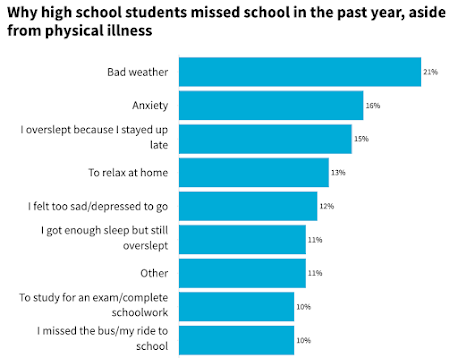
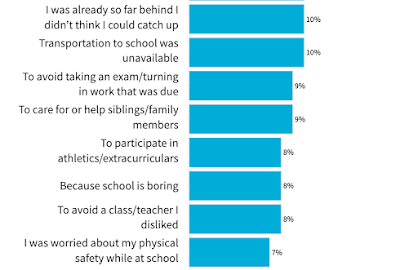
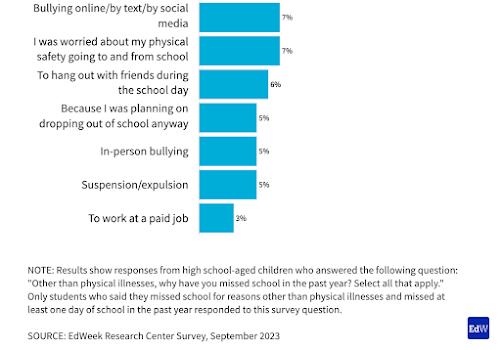
“Aside from physical illness and bad weather, anxiety is the top reason high school students missed school in the past year, according to the results of a student survey from the EdWeek Research Center. Sixteen percent of students who were absent for at least a day in the past year and missed school for reasons other than physical illness said they didn’t attend because of anxiety, and 12 percent said they felt too sad or depressed to attend.” [iii]
Causes Of Chronic Absenteeism
There are many causes for absenteeism, and they involve issues concerning the individual child, the school and/or family. “These included barriers like illness, caring for another family member, mental or emotional health issues, involvement with the child welfare or juvenile justice system, difficulties with housing or food, or no safe path or transportation to school; aversions like bullying, bad grades, or ineffective or exclusionary discipline practices; and disengagement factors like lack of engaging or culturally relevant instruction or poor school climate. Moreover, low-income students are four times more likely to be chronically absent.” [iv] (In Chronic School Absenteeism and the Role of Afterschool, see Appendix 1 for an assessment tool to help identify the causes for a young person’s absence.)

When looking at causes for absenteeism, it is important to look at the individual child. Causes include:
- School avoidance- The child may not want to leave home due to various reasons because of a change in their life, such as a new school or just moved or issues cited below.
- Academic struggles
- Disabilities
- Trauma
- Anxiety
- Safety concerns at school (This could be a result of bullying at school.)
- Social dynamics involving other youth
- Health issues (This could involve emotional health, such as depression or anxiety. Note: Childhood asthma is a leading cause of chronic disease-related school absenteeism in the U.S., associated with over 10 million missed school days annually.)
 |
| Source: www.unsplash.com |
Issues can be rooted in the family. Causes might include:
Issues can also be rooted in the school. Causes might include:
End Notes:
[i] Supporting Attendance Through After School Programming Mini-Guide
[ii] Chronic Absence: Busting Myths and Helping Educators Develop More Effective Responses
[iii] Students Are Missing School Because They’re Too Anxious to Show Up
[iv] Afterschool Focus: The Role of Attendance in Afterschool
- School safety concern
- History of negative school experiences
- New child (by birth, adoption or placement)
- Illness or death in the family
- Divorce or separation
- Problems with transportation
- Mental or emotional health issues in the household
- Children caring for others (siblings or adults)
- Housing insecurity
- Food insecurity
- Lack of school clothing
- Beliefs that schools can’t be trusted
- A preference for home schooling
- Cultural or language barriers
- Unwelcoming school climate
- Concerns about physical and emotional safety
- Lack of connectedness and belonging
- Academic challenges
- Lack of social-emotional support


[i] Supporting Attendance Through After School Programming Mini-Guide
[ii] Chronic Absence: Busting Myths and Helping Educators Develop More Effective Responses
[iii] Students Are Missing School Because They’re Too Anxious to Show Up
[iv] Afterschool Focus: The Role of Attendance in Afterschool

UPCOMING WEBINARS
To learn more and register, click on the banner below.