Showing posts with label Forum for Youth Investment. Show all posts

Monday, October 4, 2021

The Language of Inclusion and Equity

Source: www.researchgate.net

As we increase the dialogue around inclusion and equity, it is important that we examine the language and terms that we are using. Below are some terms that we often use as synonyms followed by their definitions and differences, courtesy of Karen Pittman and the Forum for Youth Investment (FYI). She later offers some of her thoughts on this. To read her full article, click here.

Equality | Equity. Equality is a good goal given where we are, but it is not at all a sufficient one. Equity is achieved when all kids have a shot at getting the essentials they need to succeed because 1) the differences in their starting points have been taken into account, and 2) the systemic or institutional barriers to their success have been addressed. People often use a baseball analogy to get at equality vs. equity. Equity is achieved when the playing field is leveled and the fences are taken down, providing young people with real opportunities to get into the game. 

Access | Quality. Access is necessary, but far from sufficient and sometimes harmful. Providing young people with opportunities to get into the game is only useful if these opportunities are appropriately structured to support youth success. Opportunities that are mismatched to youth’s capacities and motivations significantly reduce the chance that young people feel that they matter and want to put in the effort to master the game. 

Source: www.sfcenter.org
Completion | Readiness. Grades and diplomas have become necessary tickets for youth success, but they are not sufficient. 40 percent of employers report that high school graduates lack the competencies they need to succeed at entry-level jobs – such as responsibility, initiative, problem- solving, teamwork and a strong work ethic. When learning opportunities lead too heavily with content and don’t create safe and engaging contexts, youth may gain rote knowledge but miss the opportunity to name, practice and master the skillsets and mindsets that economists now confirm are more important for adult success than academic grades. 

Readiness, according to the Merriam-Webster Dictionary, is defined as 1) being willing to do something, and 2) being prepared to do something. This dual definition is important. To embrace the opportunities and survive the challenges that come their way, young people need to be willing and prepared to tackle things they cannot anticipate. This means that every opportunity to learn new content (e.g., how to bake a pie, hit a double, build an engine) is also an opportunity to use the skills and knowledge they have. Young people who “hit the wall” when trying to learn something new have not only internalized the idea that they can’t learn, they have missed the opportunity to use and improve the skills employers are looking for.
 
Source: https://i.imgur.com/aJNHjPq.png
Young people who have repeatedly hit the wall and found that no one notices, no one is surprised, or no one helps, tune out, act out or drop out. Ultimately, they lose out on opportunities they could easily have been prepared for. The cost to them, and to the country, is absurdly large. This is not just because these young people are more likely to earn less or stray into trouble more. It is because these young people are the ones best suited to change the odds in their communities. They are willing, if asked. They can be ready, if supported. History shows that they are able. 

To tackle the country’s readiness problem, we also have to address equity issues. And when the path to readiness goes through quality, young people not only build skills and competencies, they develop a sense of agency and a sense of urgency to take action to change the odds for themselves and their communities.  


Karen J. Pittman
served as the President & CEO of the Forum for Youth Investment (FYI) until February 2021 then transitioned to a senior fellow role to dedicate more of her time and energy to thought leadership. FYI is a national nonprofit, nonpartisan “action tank” that combines thought leadership on youth development, youth policy, cross-system/cross-sector partnerships and developmental youth practice with on-the-ground training, technical assistance and support. Karen is a respected sociologist and leader in youth development. Prior to co-founding the Forum in 1998, she launched adolescent pregnancy prevention initiatives at the Children’s Defense Fund, started the Center for Youth Development and Policy Research, and served as senior vice president at the International Youth Foundation. She was involved in the founding of America’s Promise and directed the President’s Crime Prevention Council during the Clinton administration.


We are hosting a webinar/ Speaker's Forum on Wednesday, October 6, 2021 from 10:00am- 12:00pm (PST) entitled, Youth Civic Engagement and Activism in Afterschool. The purpose of this webinar is to inform and encourage expanded learning programs to offer youth opportunities to be civically engaged. It is our intention to capture and share valuable and intriguing ideas and information. To learn more and register, click the banner below.


We are hosting another webinar/ Speaker’s Forum on Wednesday, October 20, 2021 from 10:00am- 12:00pm (PST) entitled, Engaging Youth as Workers in Afterschool. The purpose of this webinar is to inform and encourage afterschool programs to offer youth opportunities to serve as workers within these programs. It is our intention to capture and share valuable and intriguing ideas and information to help programs enlist youth as workers. To learn more and register, click the banner below.


Tuesday, April 27, 2021

Leveraging Summer Programs: A Downpayment on Long- Term Change

Source: www.afterschoolalliance.org

Some young people are now returning to school, in a face- to- face or hybrid model. This after a full year of isolation. This fall youth are likely returning to school full time. Summer programs will be an important gateway to returning to school and healing from a year of isolation. 

Below we offer excerpts from an article authored by Karen Pittman with the Forum for Youth Investment on the importance of summer programs in 2021. Please note: this is just an excerpt from her article posted from Medium.com. You can read the entire article here.

Almost a full year into the COVID-19 pandemic, we once again find ourselves at a critical juncture. As we head into the spring, schedules are still uncertain. But there is growing confidence schools will reopen in the fall. 

With this anticipation of reopening, there is broad commitment to build back better. There is increased recognition of the role that community partners and families can play and that the impact of the last year on teens and young adults will have lasting ramifications. COVID and the racial reckonings have exposed inefficiencies and inequities. This means we are now face to face with a tangible opportunity to challenge and support school districts and community partners in creating equitable learning and development ecosystems that unleash the potential of all learners, recognize the power of all committed adults, and optimize all learning settings and approaches. 

If we are truly intent on not going back to normal, we must recognize the interdependence of systems and center on young people and their families. To do so, school and community leaders must work collaboratively to reflect and take stock to identify innovations and understand roadblocks, look at the ways school, family, and community leaders worked or did not work together, and hear the lessons learned from students, families, and front-line staff. 

Source: www.medium.com
While we saw pockets of exceptional supports for young people and innovation, for the most part young people went without opportunities to connect in meaningful relationships, without opportunities for engaging learning experiences, and without summer jobs to earn money critical to their future goals. 

Summer 2021 shouldn’t look like 2020. The young people across the nation deserve more. It also shouldn’t look like summers of years past. Summer has traditionally been a time when schools stepped back, families stepped in and community organizations stepped up. This division of labor made sense because the stakes are not only lower in summer (no requirements, no grades, no tests) and the success metrics are different (keep academic skills sharp while having fun, mastering new skills, taking on family responsibilities, having different experiences). If we are intent to Build Forward Together our roles in and focus on summer will have to shift. 

This summer can begin to preview “the new normal” and to make a down payment toward the equitable learning ecosystems we hope to create. Where instead of some stepping back and others stepping in, we see communities working collaboratively. We are confident there are many communities that see value in finding some way to use Summer 2021 to document, design, test, or even scale up some ways to BUILD FORWARD TOGETHER to make a down payment on the idea that by the summer of 2022, every student should have equitable opportunities for learning and development because every young person and their family has the support needed to create learning pathways across the ecosystem that are attractive, accessible, affordable, appropriate, affirming, and assessable. 

The Readiness Projects are challenging local school, government and community leaders to: 
  1. Use summer as a low-stakes testing ground to document, test, and scale different ways to leverage school, family, and community assets in support of accelerated learning and development that can help us build forward together post-COVID. 
  2. Prioritize children and youth most challenged by the pandemic who are also the least likely to have resources for summer programs. 
  3. Place focused attention on teens, especially those whose success trajectories are threatened. 
  4. Ask how you will know how many young people had great summers and why, so you can bring that data into the school year and have a baseline for improvement in 2022. 
After a full year of learning isolation, young people are just now returning to school, in a face- to- face or hybrid model. This Fall youth are likely returning to school full time. 

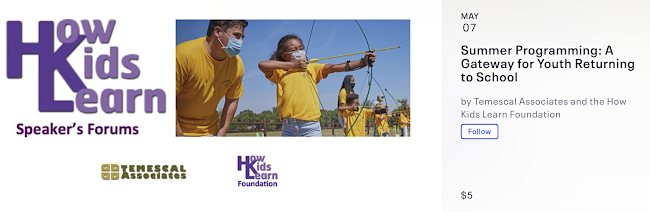
Summer youth programs will be an important gateway to returning to school and healing from a year of isolation. But how should we be thinking about our gateway summer youth programs? What do youth need from their summer program experiences? How will this year's summer programming differ from past years?

On Friday, May 7, 2021, we are sponsoring a Speaker's Forum/ webinar discussion on this topic. It will be facilitated by Ayala Goldstein (Director of Programs, California School- Age Consortium). She will be joined by Aaron Dworkin (CEO of National Summer Learning Association), Autrilla Gillis (Director of Expanded Learning, ISANA Academies) and other summer program experts and practitioners who will be sharing their thoughts and responding to your questions. To register and learn more, click here.


Karen J. Pittman
served as the President & CEO of the Forum for Youth Investment (FYI) until February 2021 then transitioned to a senior fellow role to dedicate more of her time and energy to thought leadership. FYI is a national nonprofit, nonpartisan “action tank” that combines thought leadership on youth development, youth policy, cross-system/cross-sector partnerships and developmental youth practice with on-the-ground training, technical assistance and support. Karen is a respected sociologist and leader in youth development. Prior to co-founding the Forum in 1998, she launched adolescent pregnancy prevention initiatives at the Children’s Defense Fund, started the Center for Youth Development and Policy Research, and served as senior vice president at the International Youth Foundation. She was involved in the founding of America’s Promise and directed the President’s Crime Prevention Council during the Clinton administration. 

Wednesday, June 27, 2018

Family Separation and Childhood Trauma

By Sam Piha

In expanded learning programs, we are seeking to learn the effects of childhood trauma and design programs that integrate trauma informed practice. Thus, we were horrified by the Trump Administration’s practice of “zero tolerance” which inflicts trauma on children and youth. 

Below, we post a statement by our colleagues at the Forum for Youth Investment on this topic. We have also published several LIAS blog posts on the issue of immigration and young people.  
---------

The Forum for Youth Investment stands with our partners and peer organizations in expressing deep concerns over the Trump administration's immigration policy and its impact on children and families.

On June 20, President Trump issued an Executive Order to reverse his administration's policy of separating children from their parents. The "zero tolerance" policy that separated more than 2,300 children from their parents was inhumane and unjustifiable, but the approach that is likely to replace it is only a small improvement and falls far short of what we should demand of our nation.

In particular, the policy to allow indeterminate detention of entire families is morally indefensible.  It is also counter to everything that science tells us about child and youth development, health and well-being and the impact of trauma on young brains. As many physicians' associations have noted, these children are experiencing trauma that will likely follow them for the rest of their lives.


Photo Credit: SparkAction
Therefore, we implore the Trump administration to move swiftly to end this inhumane practice and to focus on reunifying separated children with their families as quickly as possible. We also strongly advocate for the President to work with bipartisan congressional leaders to craft just and responsible long-term immigration solutions that have at their center the health and well-being of children, young people and their families.

Please visit SparkAction's Immigration Resources page for more resources and actions to take.

Friday, February 17, 2012

Measuring Soft Skills in OST Programs: An Interview with Nicole Yohalem, Part 2

By Sam Piha


The Learning in Afterschool project is promoting five learning principles that are well rooted in education and youth development research. Teachers and youth workers alike know that these principles are important to engaging young people in learning. Although these principles are vital to developing important skills, sometimes referred to as 21st century skills, many refer to them as “soft”. Further, the lack of accessible tools that measure these skills has been a problem for the OST field. 

Recently the Forum for Youth Investment published From Soft Skills to Hard Data: Measuring Youth Program Outcomes, which offers a survey of measurement instruments that measure many of these skills. They include:

Nicole Yohalem

  •      Communication
  •      Relationships & Collaboration
  •      Critical Thinking & Decision-making
  •      Initiative & Self-direction


Below, we interview Nicole Yohalem (Forum for Youth Investment) one of the co-authors of this report.


Q: What criteria did you use in selecting instruments?

A: We considered several factors. First we looked for measures where a majority of the contents mapped directly onto one of our four areas of interest. We looked for measures that were appropriate for use in a range of settings, including OST programs, and focused on tools that can be used with upper elementary through high school age youth, since a lot of useful work has already been done by CASEL to review measures for use with younger children. We also prioritized measures that are accessible to practitioners and relatively easy to use. Because we are committed to ensuring practitioners have access to tools that yield reliable (consistent) and valid information, we also looked for instruments that at a minimum, had been investigated for scale reliability, factor structure and sensitivity to OST program impact. 

Q: How might the guide be helpful for OST programs?

A: In selecting measures there are some important things for program leaders to consider. First and foremost, outcome measures should reflect the goals and activities of the program. Programs should measure outcomes that they value and that they are actively trying to influence. Second, it is important to select measures that will yield reliable and valid information. Finally, there are all the practical issues to consider – cost, ease of administration and accessibility. 

The guide includes information about all of these considerations. For each instrument we summarize the origins and focus on the tool, include sample items, and discuss user and technical considerations. Where possible we also include information about length, cost, format, supplemental tools, and training. Our technical reviews focus on the extent to which reliability and validity have been established. 

Q: Finally, do you see this new resource helping to address any important risks or opportunities facing the OST/afterschool movement at this time? 

A: Unfortunately we haven’t done a good job of coming to consensus on what to call important skills like critical thinking and decision-making, relationships and collaboration, communication and initiative and self-direction. I hear these referred to as social-emotional skills, soft skills, 21st century skills, new basic skills, higher-order thinking, non-academic outcomes…the list goes on. 

If we could get more consistent about naming these and measuring them, programs will be more likely to identify them as target outcomes and demonstrate their ability to move the dial on these skills. At the policy level, we have historically under-invested in programs that are good at developing these skills. With the education and business sectors increasingly recognizing their value to school and workplace success, we have a unique window of opportunity to demonstrate the important role that afterschool programs play in supporting learning and development. 


________________________________________________________________
Nicole Yohalem
Director of Special Projects, The Forum for Youth Investment
Nicole oversees Forum projects on out-of-school time, postsecondary success and bridging research, policy and practice; speaks on behalf of the Forum at national conferences and events; and serves as an advisor to several foundations, organizations and initiatives connected to the Forum. She has authored numerous reports, articles and commentaries, and oversees several regular Forum publications, such as the Ready by 21, Credentialed by 26 issue brief series.

Friday, February 10, 2012

Measuring Soft Skills in OST Programs: An Interview with Nicole Yohalem, Part 1

By Sam Piha


The Learning in Afterschool project is promoting five learning principles that are well rooted in education and youth development research. Teachers and youth workers alike know that these principles are important to engaging young people in learning. Although these principles are vital to developing important skills, sometimes referred to as 21st century skills, many refer to them as “soft”. Further, the lack of accessible tools that measure these skills has been a problem for the OST field. 

Recently the Forum for Youth Investment published From Soft Skills to Hard Data: Measuring Youth Program Outcomes, which offers a survey of measurement instruments that measure many of these skills. They include:

Nicole Yohalem

  •      Communication
  •      Relationships & Collaboration
  •      Critical Thinking & Decision-making
  •      Initiative & Self-direction


Below, we interview Nicole Yohalem (Forum for Youth Investment) one of the co-authors of this report.

Q: Of the many important skills, why did you focus on the four skill areas presented in your paper?

A: We didn’t want to create a new framework because there is so much good 
existing work out there.  So in identifying these four areas to focus on, we reviewed commonly used and cited frameworks from the Collaboration for Academic, Social and Emotional Learning (CASEL); the Partnership for 21st Century Skills; and the U.S. Department of Labor. We identified the common constructs across those frameworks, focusing specifically on skill-oriented outcomes and those that are amenable to intervention by afterschool programs. We also focused on skills that are cross-cutting, which means we left some things out that relate to specific content knowledge (e.g., technology, global awareness). That’s how we came to communication, relationships & collaboration, critical thinking & decision-making and initiative & self-direction. We aren’t suggesting this is a comprehensive list of important skills, or that these are the only skills afterschool programs should focus on. We may tackle additional areas in an updated report next year.

Q: Why are these “soft skills” deemed important?

A: There is growing evidence and recognition that these skills and dispositions are critical – to academic success, workplace success, and to overall wellbeing.  Teachers, students, parents and Fortune 500 companies all think these kinds of skills are critical. In a 2006 national survey of employers, collaboration, work ethic and communication were among the most important skills necessary to succeed in the workplace. On the academic side, focusing on social skills is linked with developing a positive connection to school, improved behavior, and increased achievement.

Q: What do you see as the role of OST programs to build these skills? In other words, why are OST programs well positioned to build these skills?

A: We feel these kinds of outcome areas could really be a strategic niche – in economic terms – a “comparative advantage” for many youth programs. Afterschool programs operate with limited resources yet have significant flexibility compared to schools. These are skills that youth programs are good at building and supporting, and they matter for learning and development.

Q: Why did you think it was important to identify instruments to measure these skills?

A: We know that high quality afterschool programs can help young people develop these and other skills, but to live up to this potential, activities need to align with outcomes and programs need tools that are accessible and that do a good job of measuring them. When you are tracking things like attendance, grades or standardized test scores, which many afterschool programs do, data are typically obtained from school records, which means program leaders and evaluators rarely face decisions about what instrument to use.

To be continued in Part 2

________________________________________________________________
Nicole Yohalem
Director of Special Projects, The Forum for Youth Investment
Nicole oversees Forum projects on out-of-school time, postsecondary success and bridging research, policy and practice; speaks on behalf of the Forum at national conferences and events; and serves as an advisor to several foundations, organizations and initiatives connected to the Forum. She has authored numerous reports, articles and commentaries, and oversees several regular Forum publications, such as the Ready by 21, Credentialed by 26 issue brief series.

How the Meta Settlement Can Benefit Afterschool Programs

Source: www.pexels.com This blog by Dan Gilbert has been reposted from Afterschool Alliance’s Afterschool Snack Blog. Meta's new settlem...