Monday, September 27, 2021

Four Things You Can Do Right Now to Promote Meaningful Participation in Afterschool

By Sam Piha

Research tells us that if we hope to make a difference in young people’s learning, we need to provide opportunities for learning that is meaningful. This is especially important as youth return to afterschool programs after a year of isolation.  

If young people are engaged in meaningful participation, they are empowered to be self-directed, make responsible choices about how to use their time, and participate as group members in making decisions that influence the larger program and what they learn about. 

Four more things you can do right now to promote meaningful participation:

1. Leadership: Learning is more meaningful when young people have opportunities to act as leaders in the learning activities. This includes eliciting the prior knowledge that youth already have and building in opportunities for youth to act as leaders in other ways – passing out materials, leading activities, etc. 

2. Youth as helpers: Young people can be trained to effectively assist peers during homework time and during other activities. Try to give every child or young person an opportunity to help another, so that some aren’t always in the helper position and others always in the position of being helped. Newcomers to the program can be assigned buddies to show them around the room, explain ground rules, and help them learn the routine. You can also teach a skill to a small group, and then “deputize” them to teach others. Older youth are also excellent helpers for younger children, and the helper role often brings out the best in them. Duties can include serving as “reading buddies,” homework helpers, escorts, or making informational presentations to the younger groups. Providing service to the larger community is also an excellent way for young people to apply their planning and leadership skills, while experiencing how their efforts impact others. (For ideas about engaging youth as helpers within high school afterschool and summer programs, see Engaging Youth as Workers Within High School Afterschool Programs: A Briefing Paper and other resources.  


3. Use portfolios to help participants reflect on their progress and accomplishments: If your participants have consistent enrollment over time or if participants engage in long-term projects where they increase their skills on- going, consider how you might collect their work over time. You can create a portfolio or personal file with your young participants to serve as an on-going record of their work. After several months or at the end of a project sit down with them to review their record of accomplishments. What do they think about it? What does their portfolio reflect back to them? What kinds of records can be stored? For younger children, it might be a portfolio of self portraits that were done monthly, or simply their own file they use over time to store things they have done that they are proud of. For older youth who might be developing a set of skills over time, say in the arts or technology, communicate your project learning goals and ask them to develop personal learning goals, if appropriate. Assist them in assessing which goals they have met over time.

4. Plan a project that will benefit the community: Clean up or plant trees or flowers at a local park, speak out at a public forum on a youth or community issue, visit elders at the senior center, serve snacks at a neighborhood fair, design and paint a mural… the possibilities are endless! Try to match projects to the interests of the young people, and look for existing programs that can help you prepare young people for a meaningful experience. 

Below is a good program example of meaningful participation:
Summer Bridge Program; Valley High School (Grades 9 – 12); Santa Ana School District; Santa Ana, CA; Operated by THINK Together 
This Summer Bridge program targets incoming high school freshmen and operates 5 hours a day for 4 weeks. Participants choose their first activity in their high school enrichment class. A goal of the program is to give freshman information and skills that prepare them to manage their first year in high school. These participants are particularly engaged when they learn that the High School Life Lessons component is designed and led by high school age Youth Leaders. 

Youth Leaders are trained prior to the start of the Summer Bridge program. They learn how their participation in the program will impact incoming freshmen along with trainings on class management, lesson planning and relationship building. In the summer, they are responsible for choosing the information and lesson plans they believe will best prepare their incoming freshmen for high school life. They also choose the themes and field trips for the program, with their students’ best interest in mind. Other Youth Leaders choose to serve as student teachers, teacher’s aides, tardy sweepers, and lesson planners. They also serve as mentors to the incoming freshmen. 

To learn more see our Youth Development Guide 2.0. This 165- page guide is available as a free download or can be ordered as a spiral bound, hard copy.


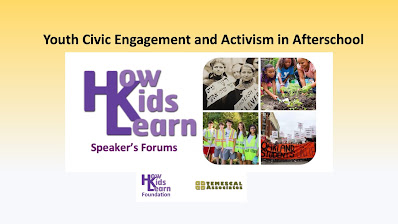
We are hosting a webinar/ Speaker's Forum on Wednesday, October 6, 2021 from 10:00am- 12:00pm (PST) entitled, Youth Civic Engagement and Activism in Afterschool. The purpose of this webinar is to inform and encourage expanded learning programs to offer youth opportunities to be civically engaged. It is our intention to capture and share valuable and intriguing ideas and information.


Discussion Topics:
  • Importance Of Youth Civic Engagement / Activism for Youth Development
  • Benefits To Youth and the Program
  • Challenges
  • Legal/Regulatory Issues
  • Tips For Program Leaders
  • How Best To Prepare Staff/Youth
  • What Would Help Afterschool Leaders Going Forward? (Guidance, Models, Policies, etc.)

To learn more and register for this Speaker's Forum, click here.

Monday, September 20, 2021

Civic Engagement and Activism in Afterschool Programs (Part 3): Why Youth Participate


By Sam Piha

We are continuing to post a series of blogs to inform and encourage expanded learning programs to start today infusing civic engagement and activism in their afterschool program. NOTE: There are many program resources on the topic, some of which are detailed in our paper, Youth Civic Engagement and Activism in Expanded Learning Programs. You can view part 1 of this series here and part 2 here. We also held a webinar on this topic which can be viewed here.

Below, we explore why youth participate in civic engagement and activism activities.

Urban youth collectively respond to community and school problems through youth organizing, spoken word, volunteering, and participation in civic affairs. Organizations in urban communities can provide youth with opportunities to and develop critical civic praxis through engagement with ideas, social networks, and experiences that build individual collective capacity to struggle for social justice. This view of youth acknowledges structural constraints in their communities, but also views young people as active participants in changing debilitative neighborhood conditions.”– Shawn Ginwright and Julio Cammarota 

There have been many studies examining the reasons why youth participate in civic engagement and activism activities. Below we offer some highlights from selected studies focusing on why youth participate.

From Reasons Youth Engage in Activism Programs: Social Justice or Sanctuary?

“Participants attend youth activism programs for social justice work, but also for sanctuary and peer/adult relationships. Youth defined sanctuary as a protected space but also a place that celebrates aspects of identity. Sanctuary and social justice work were intertwined as reasons for attending. Both sanctuary and social justice motivations should be considered in designing youth activism programs.” 

From Researchers Study What Motivates Rural LGBTQ Youths to Take Part in Activism 

“Helping others and reducing discrimination for future generations were the top concerns. Many respondents indicated the issues they care about affected their friends, so they fought on their behalf as well. Others said they had lived or are still living through various forms of discrimination or harassment, and they want to ensure future generations of LGBTQ individuals do not face the same problems. Generativity, or working across generations, was a key issue. Some respondents indicated they had an older mentor who helped guide them through difficult times. Others did not and wanted to ensure they could act in that role for younger individuals.”

It's great that we have marriage equality, but there are many other forms of oppression still happening. I think these young people weren't just worried about what was happening to them but issues that affected others as well.”– Mike Krings 


From What Teens Gain When They Contribute to Their Social Groups 

“Adolescents, it turns out, are remarkably well adapted to contribute to others. Adolescence is a time of massive restructuring in the brain, creating a faster, more efficient system. Neuroimaging studies show that the neural networks that change most significantly during adolescence are the same networks activated by contributing to others.  For example, the “social brain”—the intricate network of areas in the brain that activate in social interactions—matures rapidly during the adolescent years. This development increases young people’s ability to understand the feelings and perspectives of other people. Adolescents’ advancing cognitive maturity allows them to consider the complex dynamics of other people’s competing perspectives and needs to determine whom and how to help. 

Another area changing during these years is the “reward system,” which increases the positive feelings teens get from new and exciting experiences. This is the brain area most commonly implicated in adolescent risk taking, which strikes fear in the hearts of many parents. But evidence suggests that the same brain changes involved in adolescent rebelliousness and risk taking also drive kind and helpful behaviors, such as contributing.”

From Youth Civic Engagement and Activism in Expanded Learning Programs 

YOUTH ACTIVISTS ON WHAT ACTIVITIES AND ISSUES THEY THINK YOUTH ARE MOST INTERESTED IN:

“Most recently, I think youth have been invested in gun violence, given the many incidents that have rocked our nation. Following Parkland, many young people created groups and organizations that are still doing meaningful work in their communities. Some other areas of interest for youth, I think are: criminal justice reform, sexual assault and harassment, and education (especially in places where schools are underfunded and under resourced).” - Ivan Garcia, Youth Activist (We interviewed Ivan in 2019. Read the full interview here).


“Right now, a lot of youth have been interested in learning more about issues on police brutality, racial injustice, environmental injustice, broken healthcare systems, along with other systemic issues, food insecurity, and more. Activities that can tie into these issues can be a workshop for Know Your Rights, learning about systems and how it leads to the Prison Industrial Complex, and more. Other activities can also include ways youth can develop leadership skills and individual skills they want to have or improve, anything that can support their growth and self-power.” - Ann Guiam, Youth Activist 


We are hosting a webinar/ Speaker's Forum on Wednesday, October 6, 2021 from 10:00am- 12:00pm (PST) entitled, Youth Civic Engagement and Activism in Afterschool. The purpose of this webinar is to inform and encourage expanded learning programs to offer youth opportunities to be civically engaged. It is our intention to capture and share valuable and intriguing ideas and information.


Discussion Topics:
  • Importance Of Youth Civic Engagement / Activism for Youth Development
  • Benefits To Youth and the Program
  • Challenges
  • Legal/Regulatory Issues
  • Tips For Program Leaders
  • How Best To Prepare Staff/Youth
  • What Would Help Afterschool Leaders Going Forward? (Guidance, Models, Policies, etc.)

To learn more and register for this Speaker's Forum, click here.

Monday, September 13, 2021

Youth Voice and Self-Expression in Afterschool: Art Projects

By Sam Piha

Source: www.icavictoria.org

Providing opportunities for youth to reflect on and express their thoughts and feelings are a critical strategy for any afterschool program. This is especially important as youth return to afterschool programs after a year of isolation.  

These opportunities are essential to promoting youth voice, healthy youth development, social emotional skills and resiliency, especially those who have experienced trauma. Strategies and activities include sharing circles, poetry and spoken word, journaling, videography, art and the theater arts.

Practicing art is a transformative experience that not only gives each student the ability to objectively look within but also critically look at the world. Through various media, art teachers are able to teach the core values of  perseverance, community and belonging, respect, and critical thinking on a daily basis." - Bryan Stanton, Alamo Heights High School, "Building Character Through the Arts"

We interviewed Martha Peña (Coordinator, Expanded Learning Programs Community Schools & Student Services, Oakland Unified School District) on the importance of using art projects to promote youth voice and self- expression. Below are some of her responses.

Martha Peña, OUSD
Q: Why is it important to provide youth with opportunities to reflect on and express themselves and their feelings?
A: It's essential to give students the opportunity to express themselves and their feelings in a safe and supportive environment. It's through these experiences that help a child grow and develop. This is why afterschool programs are so important to youth. Afterschool programs provide a safe and supportive space for students to experience new things, reflect on their experiences, and express themselves without the stress of grades, testing, and judgment. Afterschool staff are supportive caring adults that reflect the community and therefore are able to connect with youth.

Q: Do you think that art projects are a good way to provide these opportunities? Why?
A: Art projects provide youth opportunities to express themselves in ways that inspire and spark their creativity. They also help youth process and interpret their feelings and the world around them. It's through these projects that students are able to reflect on their own personal experiences through a variety of mediums from digital storytelling, music, painting, or dance.

Source: www.mommypoppins.com

Q: Do staff need special training?
A: Providing professional opportunities to staff is crucial to ensure the success of the program. Instructors not only need to know how to teach the content but how to connect with youth and encourage them to take risks and feel comfortable in their own skin.

Q: Can you provide one example of an art project that you did that provided youth with good opportunities for self- expression? What age were the kids?
A: In one of the afterschool programs, the site leader supported students as they created a video about their community. Youth share their experiences and how they use Yoga and SEL to help them manage their feelings and stresses. Students were able to reflect on their own experiences and provide advice and support to other students experiencing the same things.

Q: For programs that plan to continue working with their youth through distance learning, can art projects be done virtually? If so, can you give an example?
A: Yes, afterschool art programs can be done virtually and successfully if you have a strong plan. Many afterschool providers distributed materials to students during the Grab & Go meal distribution sites. Each bag contained several art supplies and instructions on when and how to sign on to their virtual classroom. At the end of the lesson, students and instructors held a virtual showcase, where students and their families could log on and see their artwork. This gave grandparents and families the opportunity to be a part of the experience. 


Martha Peña is a coordinator for afterschool programs for Oakland Unified School District. In her role she manages grant requirements and applications for all ASES and 21st CCLC grants, builds systems that ensure equity and sustainability across all afterschool programs, manages city-wide partnerships, and supports the implementation of Social Emotional Learning in all afterschool programs.

Monday, September 6, 2021

Civic Engagement and Activism in Afterschool Programs (Part 2): Important Terms and Definitions

Source: www.mesacc.edu

By Sam Piha

According to the Afterschool Alliance, “The afterschool field is an essential partner in ensuring that all children have the ability to participate in immersive, relevant, and hands-on civic engagement opportunities.” Not only are civic engagement strategies participatory strategies, they contribute to the positive development of youth and the health of our democracy. 

We are continuing to post a series of blogs to inform and encourage expanded learning programs to start today infusing civic engagement and activism in their afterschool program. NOTE: There are many program resources on the topic, some of which are detailed in our paper, Youth Civic Engagement and Activism in Expanded Learning Programs. You can view part 1 of this series here. We also held a webinar on this topic which can be viewed here.

In part 2 we offer definitions to a number of terms that are commonly used in relation to youth civic engagement and activism. 

Activism - “Youth activism is used to describe youths which are engaged in community organizing for social change. Young people engaged as activism planners and leaders in the environmental movement, social justice organizations, as well as anti-racism and anti-homophobia campaigns.”1

Adultism - “Adultism is the assumption that young people are inferior to adults simply because of their young age. Adults often act on this assumption by limiting our access to decision-making, information, resources, human rights, and opportunities to voice our thoughts.”2


We've all heard adults tell kids, you have no reason to be stressed. You don't pay bills. You don't go to work. That's what I like to call toxic adulting. Although we might not pay bills or go to work, we go to school, and we deal with other issues. Just because we're younger does not mean our issues should be minor compared to adults.”3            -  Jakeelah Blacknell, grade 8


Agency - “Youth agency is the desire and ability of young people to make decisions and drive change—in their own lives, in their communities, and in their larger spheres of influence. Agency allows young people to become the architects of their own future.”4

Here’s what young people need to unlock their agency: 5 

Source: https://iyfglobal.org/youth-agency

Authentic Learning - “Authentic learning is an instructional approach that places students at the heart of real-life experiences. Armed with a challenge to address, a task to be handled, or content to explore, students develop academic and problem-solving skills in a context that is relevant to the learner.”6

Civic Engagement - Civic engagement encompasses a wide range of actions and behaviors that improve communities and help solve problems. “Civic engagement means working to make a difference in the civic life of our communities and developing the combination of knowledge, skills, values and motivation to make that difference. It means promoting the quality of life in a community, through both political and non-political processes.”7

Community Service - “Community service is work done by a person or group of people that benefits others. It is often done near the area where you live, so your own community reaps the benefits of your work. You do not get paid to perform community service, though sometimes food and small gifts, like a t-shirt, are given to volunteers. Community service can help any group of people in need: children, senior citizens, people with disabilities, English language learners, and more. It can also help animals, such as those at a shelter, and it can be used to improve places, such as a local park, historic building, or scenic area as well. Community service is often organized through a local group, such as a place of worship, school, or non-profit organization. You can also start your own community service projects.”8 

Equity - Equity is often confused with equality. “Equality means each individual or group of people is given the same resources or opportunities. Equity recognizes that each person has different circumstances and allocates the exact resources and opportunities needed to reach an equal outcome.”9   


Healing Centered Engagement - “A key component of Healing Centered Engagement, is taking loving action, by collectively responding to political decisions and practices that can exacerbate trauma. By taking action, (e.g. school walkouts, organizing peace march, or promoting access to healthy foods) it builds a sense of power and control over their lives. Research has demonstrated that building this sense of power and control among traumatized groups is perhaps one of the most significant features in restoring holistic well-being.”10

Meaningful Contribution - “When we talk about contributing, it’s not just about being kind or volunteering here and there (although both are important). It refers to “contributions of consequence”—actions that have substantial benefits to others that help to reach a shared goal. This type of contributing involves not simply taking a single action but playing an important role within a group—whether it’s a family, school, or community.”11  

Sanctuary - “Youth descriptions of sanctuary often went a step beyond what is commonly referred to as psychological safety, which is defined as feeling comfortable enough to take interpersonal risks; that is, a state in which people feel confident to express their views or make mistakes. A protected space may be considered psychologically safe, and this may be an important component of sanctuary. However, an affirming space does not simply lack physical or psychological danger. Rather, youth were often quick to note that aspects of their identity are celebrated (not just tolerated) in these spaces.”12

Service Learning - According to Vanderbilt University, service learning is defined as: “A form of experiential education where learning occurs through a cycle of action and reflection as students seek to achieve real objectives for the community and deeper understanding and skills for themselves.”13  

Social Capital - “The central premise of social capital is that social networks have value. Social capital refers to the collective value of all “social networks” [who people know] and the inclinations that arise from these networks to do things for each other [“norms of reciprocity”]. The term social capital emphasizes not just warm and cuddly feelings, but a wide variety of quite specific benefits that flow from the trust, reciprocity, information, and cooperation associated with social networks. Social capital creates value for the people who are connected and – at least sometimes – for bystanders as well.”14  

Social Justice - Social justice promotes fairness and equity across many aspects of society. “Social justice is the view that everyone deserves equal economic, political and social rights and opportunities.”15 

FOOTNOTES:

1 Educationchoices.com, Youth Activism, https://www.educationchoices.com/Learning-terms/Youth-activism.htm

2 Youth on Board, What is Adultism?, https://www.youthonboard.org/adultism

3 NPR, How Indiana Teens Find Resilience During COVID Pandemic, https://www.npr.org/2021/06/12/1005833489/how-indiana-teens-find-resilience-during-covid-pandemic

4 International Youth Foundation, What is Youth Agency?, https://iyfglobal.org/youth-agency

5 Ibid

6 Lexia, Creating Authentic Learning Experiences in the Literacy Classroom, https://www.lexialearning.com/blog/creating-authentic-learning-experiences-literacy-classroom

7 Youth.gov, Civic Engagement, https://youth.gov/youth-topics/civic-engagement-and-volunteering

8 Christine Sarikas, Definition: What is Community Service?, https://blog.prepscholar.com/what-is-community-service

9 Milken Institute School of Public Health, Equity vs. Equality: What’s the Difference?, https://onlinepublichealth.gwu.edu/resources/equity-vs-equality/

10 Shawn Ginwright, The Future of Healing: Shifting from Trauma Informed Care to Healing Centered Engagement, https://ginwright.medium.com/the-future-of-healing-shifting-from-trauma-informed-care-to-healing-centered-engagement-634f557ce69c

11 Meghan Lynch Forder, What Teens Gain When They Contribute to Their Social Groups, https://greatergood.berkeley.edu/article/item/what_teens_gain_when_they_contribute_to_their_social_groups

12 Thomas Akiva, Roderick L. Carey, Amanda Brown Cross, Lori Delale-O'Connor, Melanie R. Brown, Reasons Youth Engage In Activism Programs: Social Justice Or Sanctuary?, http://remakelearning.org/wp-content/uploads/2019/09/2017AkivaCareyCrossDelaleBrown.pdf

13 Heather Wolpert-Gawron, What the Heck Is Service Learning?, https://www.edutopia.org/blog/what-heck-service-learning-heather-wolpert-gawron

14 Robert D. Putnam, Bowling Alone, http://robertdputnam.com/bowling-alone/social-capital-primer/

15 The San Diego Foundation, What is Social Justice?, https://www.sdfoundation.org/news-events/sdf-news/what-is-social-justice/

Monday, August 30, 2021

Civic Engagement and Activism in Afterschool Programs: Forms and Strategies

Source: www.npr.org


By Sam Piha

We will be posting a series of blogs to inform and encourage expanded learning programs to start infusing civic engagement and activism in their afterschool program. NOTE: There are many program resources on the topic, some of which are detailed in our paper, Youth Civic Engagement and Activism in Expanded Learning Programs. You can read other blogs in this series here. We also held a webinar on this topic which can be viewed here.


C
ivic engagement and activism come in many forms. There are a number of ways to help youth build their activism skills. In this blog we detail a number of these forms and strategies. Consider how the following could be included in your expanded learning program setting. 


When their contributions are recognized, young people come to understand their place and value in the world.”
- Meghan Lynch Forder 


Promoting Voting and Census Participation - "Voting and elections happen everywhere and provide valuable opportunities for young people to use their voices and have a tangible impact—and because it can serve as an entry point to other kinds of participation. But young people have political lives beyond the ballot box that meaningfully influence everything from consumer decisions to media and culture. Some youth (especially, for example, young people of color and/or LGBT youth) may see and experience their daily lives as "political" in ways that shape their views and their engagement in civic life."1 

Philanthropy - "Raising money is a concrete way for students to contribute to community or national efforts to address injustice. From organizing a bake sale around a local issue to fundraising on a larger scale for a national concern like racial disparities in the criminal justice system, raising money helps students feel like they are part of something bigger and backs the cause. Fundraisers can include selling items, auctions, entertainment, sponsoring events and more."2 

Advocacy - "This helps kids build writing skills, understand local, state, and national government, and allow them to voice their opinions about issues that affect them."3 Advocacy activities can also take many forms.  


Educate others - "As students learn about an issue they care about, their natural instinct is to share their new knowledge and insight with others. Encourage this by providing live and online opportunities for them to teach others, including their classmates, younger students and adults in their lives. This can include school assemblies, community forums, teach-ins, peer-to-peer programs and social media forums. Include opportunities to share the information in interesting ways (written, art, theatre, etc.) and they should also give other students the chance to explore their own thoughts and feelings about the topics."4 

Create a public awareness campaign that includes social media - "Creating signs and posters using art and photography can be very effective as can videos and live speeches; these are all useful skills that young people can learn. In recent years, the use of social media to raise public awareness has been largely driven by young people and is a useful vehicle for raising issues and effecting change. The use of blogs, social media sites like Instagram, Twitter and Snapchat, videos, memes and online petitions are just a few examples of how words travel fast online and can incite quick and effective action."5 

Advocate for legislation - "The primary advocates for the DREAM Act have been young people known as the DREAMers, who have a personal investment in the issue. With your students, provide opportunities for them to learn about the history and impact of legislative change like the Civil Rights Act of 1964. Help them analyze proposed legislation in relation to their goals and assess the extent to which it will have an impact."6 

Do a survey about the issue and share the results - "Understanding what people think and why is helpful in bringing about social change. Students can learn more about public opinions on issues by participating in surveys themselves and also reading about them. They can also create their own surveys. Using paper surveys or online surveys, students can gain insight into how other students in their school or the larger community feel about an issue. This is useful in organizing others and addressing their concerns and needs; at the same time it builds math, critical thinking and interpersonal skills."7 

Write a letter to a company - "Students can reach out to companies or organizations that they feel have done something unfair or biased. This is something do-able that can make a difference. In crafting a well-written letter with evidence and a clear statement of what needs to change, students learn useful skills in persuasion and at the same time, it has a made a difference."8 

Get the press involved - "Help students understand that bringing publicity to their issue amplifies the message, gets more people concerned and potentially has a greater impact. They can write a press release, do an interview, write an op-ed in their local paper or invite a reporter to see what they are doing and write something about it."9 

Volunteer/ Community Service - "Youth can engage in community service on issues they care about. Serving the people who are directly impacted gives young people firsthand knowledge of the situation, deepens their understanding and builds empathy."10 


Protesting - "Marching in the streets enables students to express themselves and publicly convey what's happening while meeting and connecting with other people who feel passionate about the same issues. Demonstrations and protests can be uplifting and empowering and can help students feel like they are part of a larger movement. In preparing to attend a protest, have students consider what their goals are in attending the event and think through what message they want to convey. They can create posters, prepare songs or chants and practice symbolism that conveys their thoughts and feelings. They should consider whether they want to do individually or organize a group of students from their school to go together, make transportation arrangements and ensure that safety concerns are addressed."11 

FOOTNOTES 
2-11 Ibid

Friday, August 20, 2021

Afterschool as a Teacher Pathway

By Sam Piha

Source: A Natural Fit: Supporting After-School Staff of Color in Teacher Pipelines

Our national teacher shortage predated COVID-19, however there is growing evidence that suggests that the shortage of educators will grow in coming years as due to the pandemic. According to Linda Darling-Hammond “The COVID-19 pandemic has further strained an already faltering pipeline of qualified teachers. Resuming in-person instruction and meeting the needs of students will require a stable, high-qualified teacher workforce. It’s more important than ever that states and districts invest in proven solutions that address ongoing teacher shortages.” 

You can view our paper on this topic here. We also conducted a webinar, which you can view here.


We also know that families of color were disproportionately affected by COVID-19. This will only exacerbate the shortage of teachers of color. Why is this important? Research findings from Teachers of Color: In High Demand and Short Supply tell us, “Teachers of color boost the academic performance of students of color, including improved reading and math test scores, improved graduation rates, and increases in aspirations to attend college; students of color and white students report having positive perceptions of their teachers of color, including feeling cared for and academically challenged, and greater diversity of teachers may mitigate feelings of isolation, frustration, and fatigue that can contribute to individual teachers of color leaving the profession when they feel they are alone.”

Afterschool/ out of school time (OST) programs can be part of the solution. There are many reasons to think about OST as a teacher pathway. The first is that the knowledge and skills that OST workers gain is very similar to those required of teachers. On a personal note, my experience as an afterschool worker led me to serve as a classroom teacher for 10 years. 

Another reason is that many OST workers are people of color and bring a unique understanding of the community that their young people reside in. 

After-school/OST workers, particularly those with longer tenure in those settings, bring essential skills in building relationships with students and families, fostering positive classroom communities, and managing instruction. As teachers of color, they also bring an understanding of the varied strengths and needs of students of color and find a great deal of meaning and commitment in working with students of color. Yet these essential skills are not sufficiently recognized and viewed as assets in the teacher preparation experience.
” - A Natural Fit: Supporting After-School Staff of Color in Teacher Pipelines 

Resources to learn more:
Source: A Natural Fit: Supporting After-School Staff of Color in Teacher Pipelines


Implementing Grow Your Own programs at the district level that recruit teacher candidates from nontraditional populations (e.g., high school students, paraprofessionals, and after-school program staff." - Diversifying the Teaching Profession: How to Recruit and Retain Teachers of Color


To learn about grow your own programs we interviewed Priscilla Parchia (Program Manager, Expanded Learning) and Soo Hyun Han-Harris (Coordinator, Retention and Employee Development) about Oakland Unified School District's (OUSD) After School to Teacher Pipeline program. 

Q: Can you describe what the Afterschool to Teacher Pipeline is about?
A: OUSD’s After School To Teacher Pipeline is a program designed to support out-of-school-time professionals to make progress towards a California Teaching Credential. We do this through intentional test prep support, peer support through a cohort model, guidance navigating the licensure process, professional development for resumes, interviewing, and professional conduct support as well as a small stipend to support with testing and application fees. Our goal is to help create and nurture a support system that they can continue to use throughout their career in OUSD. The program is also part of a larger umbrella of Grow Our Own initiatives designed to attract and retain teachers in OUSD. Participants commit to teaching in Oakland for 2 years for the support they receive. 

Q: Can you explain how the experience of afterschool workers are relevant to becoming a teacher. What advantages do these experiences offer? 
A: After-school staff are uniquely suited to teaching, particularly here in Oakland. Youth development practices are relationship-centered and focused on the whole child which is directly related to culturally competent teaching practices. Furthermore, many after-school staff have an already established interest in working with youth and often through their experience discover a desire to expand their career trajectory in education. 

Their work in afterschool gives them a unique and important perspective and experience of students and families that they can bring to bear in their teaching practice. In many ways the creative space within after-school programs allows staff to connect with students in ways that classroom teachers often can't. 
In addition, many after-school instructors and program coordinators are not only local to Oakland but to the 10 - 15 block radius of the school. This gives them an unprecedented perspective of a student's experience. 

We are also very drawn to the diversity of after-school program staff as it more closely reflects the demographics of our student populations. We know from experience and from research that being taught by somebody who shares your cultural background can have a tremendous impact on student outcomes. 

Q: What are the responses of OST workers to the program and what results have you seen?    
A: Participant responses have been overwhelmingly positive. The California teacher licensure process can be complicated and the demystification and resource sharing can go a long way in lighting the path for someone who is intent on becoming a classroom teacher. Many are placed at schools they are familiar with and are swiftly thrust into leadership roles because of their experience with classroom culture and engagement. 


Priscilla Parchia
is the Program Manager, Expanded Learning with OUSD. For the past 13 years, she has worked in the Bay Area with OUSD as a youth developer, teaching artist, teacher, and curriculum specialist. Priscilla stands for equity, empowerment, and peace for herself and all others and hopes to uplift the innovative and transformative work that is done in the out-of-school time field while cultivating space for this work to inform daytime school efforts to grow thriving, productive youth leaders with authentic agency.


Soo Hyun Han-Harris
is the Coordinator for Retention and Employee Development with OUSD. She has been an educator with OUSD since 2002. She discovered a passion for supporting the development of teachers while teaching and as the Coordinator of Retention and Employee Development, she supports the development of teacher pathways in OUSD and current and aspiring teachers to become credentialed. 

Tuesday, August 17, 2021

"Misnakes" Are OK

Source: "Learning From Mistakes: Helping Kids See the Good 
Side of Getting Things Wrong"

By Sam Piha

When I was a classroom teacher, I always had a large sign that read, “Misnakes are OK.” Early in the year my students would eventually ask if I misspelled the word “mistakes”. I would reply that I misspelled the word intentionally to emphasize that mistakes are ok. 

Most people, particularly older youth, are often ashamed or embarrassed if they make a mistake publicly. It’s no wonder that many are afraid to engage to avoid the shame and judgement that comes with mistakes.

Embracing our mistakes is an important part of a growth mindset. GoZen, an online social emotional learning resource, writes, “Carol Dweck rocked the world of education with her research into something she called a Growth Mindset: the belief that a person’s basic abilities can be improved by hard work and determination. A growth mindset is central to a love of learning, perseverance and resiliency. Adopting a growth mindset also allows adults and kids to reframe mistakes into learning opportunities, making them less frightening and less debilitating.” (see LIAS Blog on Growth Mindsets).

I say to myself that I never lose, that I only learn. Because when you lose, you have to make a mistake to lose that game. So you learn from that mistake, and so you learn [overall]. So losing is the way of winning for yourself."- Tanitoluwa Adewumi, America’s 10- year- old Chess Master

And, we are more than our mistakes. Afterschool programs are particularly good at helping youth see themselves as more than their mistakes or school grades.

I particularly struggled with math. But after-school activities redefined the school for me. It wasn’t just the place where I failed my first test. It was where I learned how to sew. And I wasn’t just a person with a bad grade. I was a dancer.”- Meril, 17- year- old student

How do afterschool workers view their own mistakes? How do young people in your program think about mistakes? How are program staff trained to address the times when youth may make a mistake? I asked these questions to several afterschool leaders and share their responses below.

Carol Tang,
ED Children's Creativity Museum,
former Director, Coalition for
Science After School
Carol Tang -“If you take a step back and look at science, it's not about facts and figures or rote memorization. If you think about what scientists do- they are active, hands on, they make things and break things, they talk to their peers, learn from their mistakes and get better through time.”


Autrilla Gillis,
Director of Expanded Learning,
ISANA Academies
Autrilla Gillis -“I think that mistakes identify areas of opportunity for both young people and staff. Often times both staff and young people view mistakes as failures, while in reality mistakes are opportunities to try again with targeted supports or a focused action plan to improve the results.

From the district level, mistakes identify areas of future professional development for my staff and I. We veer away from vilifying staff members and instead investigate what led to the mistake, using our findings to determine whether an individual, school site, or district wide training should occur to ensure that the mistake is avoided in the future. 

Addressing mistakes is one of the most common conversations our staff encounters. Whether the mistakes involve academic feats, student responses to personality clashes, or poor decision making. As adults, we’ve taken the stance that young people must be empowered to work through their mistakes so that they acquire that skill, one that they’ll use for the rest of their lives. 

For our youngest scholars it begins with one-on-one conferences that utilize visuals and worksheets to help students identify the root causes of their decision making that led to the mistake, next we set goals to avoid making the same mistake when the situation is encountered again. As our scholars progress through grade levels we increase the reflective aspect of the process by incorporating journaling and peer support. It is rewarding to see scholars encounter mistakes and work their way through the same process using “self-talk” to get themselves through.” 


Rebecca Fabiano
President & Founder,
FAB Youth Philly

Rebecca Fabiano - “'Mistakes are Ok!; Take accountability for, and learn from your mistakes!'

That is the first line of our guiding principles, which we recite in a call and response fashion when we come together as a group. One person chanting the first part, the rest of us responding the second part. We actually changed it this fall to this current statement from 'Mistakes are Ok!; It’s Ok to ask a lot of questions' because we wanted to focus more on accountability and learning. 

The original statement was part of a job description for college interns; we wanted them to really see their time with us as a learning experience and that we didn’t expect them to know everything right away or to even ‘get’ everything the first time, which is why we encourage asking questions. Several interns noted that very sentence was why they wanted to work at Fab Youth Philly (FYP).

We also ask about mistakes during interviews as we see mistakes as teachable moments. As a learning organization, we are constantly making mistakes in part because we are also risk-takers, we are somewhat nontraditional in some of our work and so there are bound to be mistakes made. We also primarily work with teens for whom it is their first job being employed by us so we want them to develop a ‘muscle’ around mistake making, but also seeing mistakes as an opportunity.

The way staff addresses mistakes varies from staff, to staff, and sometimes has to do with confidence and experience. But all of us TRY to approach it as a teachable moment. The more experienced staff tend to see right away the opportunity for learning, and working with the teen to address the issue, as opposed to blaming or shaming. Sometimes as adults, we need coaching too, around suggestions for how to support teens when they make a mistake.”  

LEARN MORE

Mistakes are a natural part of learning, but students cannot develop into critical thinkers if they regularly freeze out of the fear of making a mistake.”- Colin Seale, Thinking Like a Lawyer 

About Childhood Trauma

Source: Champions By Sam Piha Many of the children we serve in afterschool programs have experienced individual or collective trauma. Accord...